
Living room floors get dented by concentrated point load and scratched by trapped grit, so the right furniture pad and a stable finish stop the damage early.
Match the pad to the floor, spread every leg over at least 1 square inch, and keep caster wheels at 1.5 inch or larger. You should use those three rules on hardwood, vinyl, and laminate.
Quick Answer: What Protects a Living Room Floor From Furniture Damage
Three decisions do most of the work: the pad material, the contact area under each leg, and the hardness of the finish you bought. Everything else, including rugs and sliders, is secondary to those three.
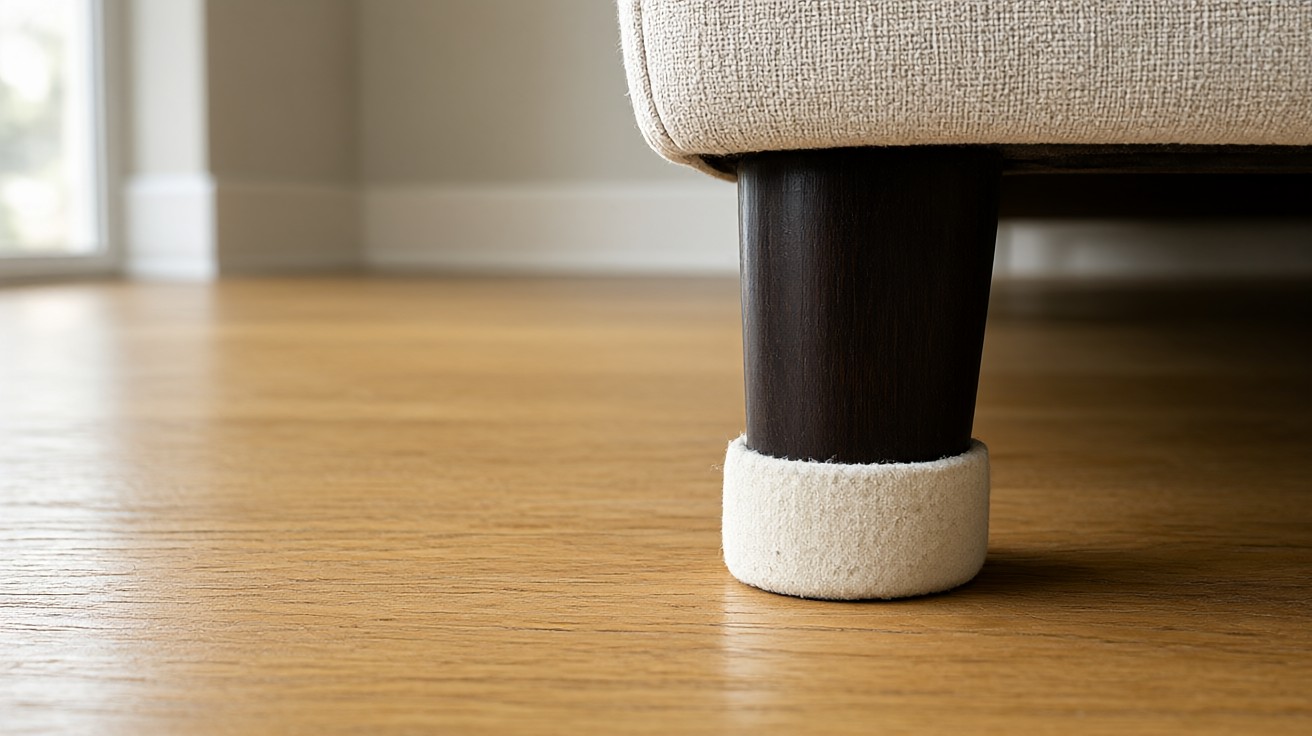
On hardwood, a 0.25 inch felt pad under a 2 inch contact diameter keeps the load under 15 psi and leaves no plasticizer behind. On vinyl and laminate, a hard polyurethane pad works better because soft felt grinds grit into the wear layer.
When the two materials conflict, the floor wins. A pad that protects a sofa leg but marks the floor is a failed pad, and a finish that cannot survive a 120 lbs sectional is a finish the room cannot hold.
Point load is the weight pressing through a single small area, and it is the reason a heavy sofa leaves a dent that no amount of cleaning will touch. Prevention is arithmetic here, not luck.
How Point Load Turns a Sofa Leg Into a Dent
A 30 lb leg on a 1 square inch foot print creates 30 psi, while the same leg on a 3 square inch footprint creates 10 psi and never marks the finish. The load did not change, only the area it passed through.
Wood and resilient flooring both yield under sustained point load. Oak at 1,360 pounds per square inch of Janka hardness still dents, because the wood fibres compress instead of springing back once the load stays put.
Imagine a 120 lbs sectional on oak with plastic feet. Each leg lands on a 0.5 inch disc, so the pressure lands near 150 psi, well past what a 20 mil urethane finish layer can carry without taking a permanent indentation.
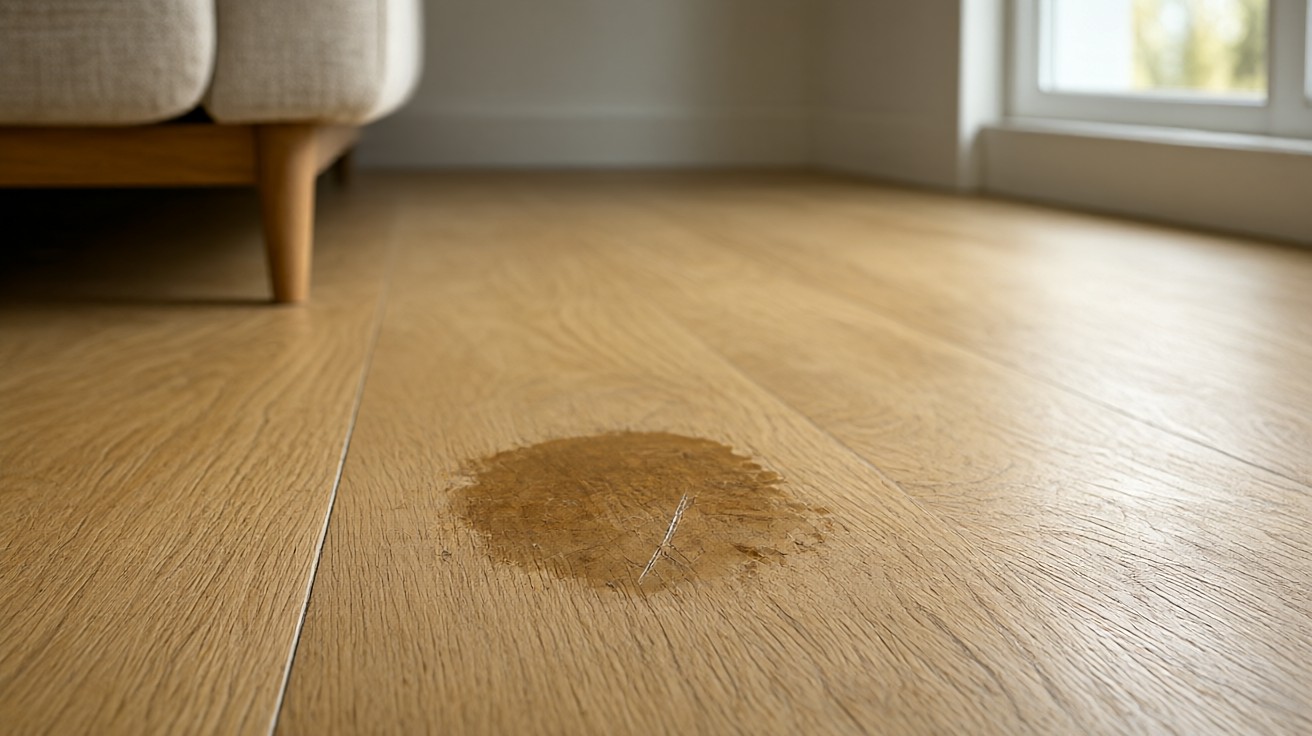
That indentation is not a finish defect. It is compression set in the wood itself, which is why sanding alone will not remove it and why the fix is a wider pad rather than a stronger topcoat.
The rule is simple. Anything that stays on the floor for more than a few hours needs a contact area of at least 1 square inch, and anything over 100 lbs needs more than that.
Why Rubber Feet and Plastic Pads Stain Wood
Rubber and some hard plastics carry plasticizer, a softener added to keep the material flexible. When such a pad sits on a wood floor for months, plasticizer migration pushes that softener into the finish and leaves a dark halo.
The stain is chemical rather than dirty, so it does not lift with a neutral cleaner. It sits inside the finish layer itself, which is why black plastic feet on light oak can leave a mark that outlasts the furniture that made it.
Colour is the clue. A black pad that leaves a dark ring on white oak was almost certainly the source, and the same pad on walnut hides the problem instead of solving it.
Lift furniture. Never slide it.
Replace any pad that has been down for 6 months or that feels tacky under a thumb, because a compressed pad concentrates the load instead of spreading it.
Pad Materials Compared by Floor Type
There is no universal best pad. Felt wins on wood because it compresses gently and holds grit, hard plastic wins on resilient floors because it does not compress, and a caster sleeve only works when the wheel is large enough to roll rather than grind.
| Pad material | Thickness | Best floor type | Avoid on | Key detail |
|---|---|---|---|---|
| Felt | 0.25 inch (6 mm) | Solid and engineered hardwood | Vinyl with a soft wear layer | Sheds no plasticizer, traps grit |
| Hard polyurethane | 0.06 inch (1.5 mm) | Porcelain and ceramic tile | Prefinished hardwood | Does not compress or mark |
| Plastic PVC glide | 0.09 inch (2.3 mm) | Budget furniture only | Any finish, light oak especially | Can leach plasticizer into the finish |
| Rubber caster sleeve | 0.12 inch (3 mm) | Carpet and low pile rugs | Hardwood and tile | Black rubber stains light woods |
| Felt and rubber combo | 0.25 inch (6 mm) | Engineered hardwood | Glossy lacquer finishes | Felt face down, rubber core up |
| Silicone soft glide | 0.04 inch (1 mm) | Glass and polished stone | Concrete with a sealer | Grips without abrasion |
Metric and imperial pad sizes are not interchangeable in practice. A 6 mm felt pad behaves like a 0.25 inch pad, but a 4 mm pad compresses roughly a third more under a 30 lb leg and pushes the contact area past the point load limit.
Choose the softer material when the floor is what is at risk and the furniture is well made. Choose the harder material when the floor is vinyl or laminate and the furniture has cheap legs or glued plastic glides.
If you are still comparing floors rather than pads, the best flooring for living rooms guide covers which finishes tolerate furniture movement best, and it is worth reading before you buy protection for a floor you have not installed yet.
Casters and Rolling Furniture Are the Worst Offenders
A caster concentrates an entire chair into one wheel. A 250 lbs office chair on four casters puts 62 lbs through each wheel, and a 12 mm wheel turns that into pressure several times higher than a flat furniture leg.
Wheel diameter is the variable that matters. A 1.5 inch wheel rolls, so the load travels across the finish instead of parking on it, while a 0.75 inch wheel digs in, grinds grit, and leaves a dull track every time the chair moves.
If you cannot replace the caster, replace the contact patch instead. A felt sleeve fitted over a hard wheel converts a rolling point into a broad face and costs far less than a new chair.
ANSI A326.3 classifies interior dry walking surfaces at a dynamic coefficient of friction of 0.42 or higher, and a floor in that range still lets a chair roll freely. Below it, furniture tends to skid, which is exactly the movement that drags grit into a scratch.
Castors that roll under a desk and back 20 times a day will scratch any floor within a year, because each pass drags grit sideways across the finish. Lift the chair instead of pushing it, or fit a guard mat under the work zone.
Scratches Come From Grit, Not From the Furniture Itself
Most scratches are not made by the object sitting on the floor. They are made by the grit trapped under it, dragged sideways by a foot or a chair wheel and cutting across the finish in a random arc.
Because the grit does the cutting, the same furniture is harmless on a clean floor and damaging on a dusty one, which is why vacuuming matters as much as padding here.
A felt pad is half scratch prevention and half scratch insurance. It captures grit before the grit reaches the finish, and it keeps that grit off the surface when the furniture moves.
Vacuum with a hardwood rated nozzle rather than a beater bar, and do it before you move anything back into place. Grit that sits for a week becomes an abrasive that a felt pad then grinds into the finish for months.
Pet claws and castors are different problems. When a dog works the rug and the floor together, the fix is a floor that tolerates claws rather than another pad, and the best living room flooring for dogs comparison covers that decision in detail.
The Finish Layer Decides How Much Damage You See
A 20 mil urethane finish layer on hardwood is a protective film, not an armour plate. It resists abrasion far better than bare wood and far worse than a 6 mil porcelain tile, so the same furniture does very different things on each surface.
Aluminum oxide, added to some vinyl and laminate wear layers at 5 to 10 microns, is harder than urethane and handles point load better. UV fade is a separate issue, because roughly 500 hours of strong direct sun weakens the top layer, and a faded finish is a brittle finish.
Softwood and open grain finishes scratch visibly because the grain itself is a series of soft valleys. A satin or matte finish hides what a gloss finish magnifies, since gloss reflects light off a scratch instead of into it.
Moisture matters as well. NWFA technical guidelines set interior relative humidity at 30% to 50% with wood moisture content at 6% to 9%, and outside that range the finish loses some of its flexibility.
Once humidity climbs past 55% and the wood takes on more than 8% moisture content, the same 30 lb leg that would have compressed and recovered overnight now leaves a permanent mark. Climate control is part of furniture protection.
What the Standards Say About Indentation and Cushion
Two test methods explain why flooring specifications keep numbers for furniture loads rather than adjectives. ASTM F1700 loads a resilient floor with a 140 lb weight on a 0.178 inch flat foot for 10 minutes, then measures how much indentation remains after 1 hour of recovery.
Under that method, a compliant resilient floor shows no more than 8% average residual indentation and no more than 10% at any single reading. A floor that fails that limit will show permanent furniture marks, and no pad rating will fix a floor that fails it.
Carpet has its own cushion rule. CRI 105 caps residential carpet cushion thickness at 7/16 inch, because a thicker pad under a heavy sofa compresses past the point where it supports the leg, which pushes the load down onto the carpet backing and the subfloor.
Because all three standards measure sustained load rather than short touches, the useful reading of all three is the same. They describe what a floor survives under sustained load, which is exactly what furniture delivers every hour of every day.
Decision Rules by Furniture Weight and Floor Type
Protection is a lookup rather than a guess. Match the furniture weight to a contact area, then match the floor type to a pad material, and the decision takes under a minute at the store.
| Furniture weight | Minimum contact area | Pad specification | Why it matters |
|---|---|---|---|
| Under 50 lbs | 1 square inch | 0.25 inch felt or hard glide | Any hard floor tolerates this |
| 50 to 150 lbs | 3 square inches | 0.5 inch felt or a pad rated over 100 lbs | Keeps pressure under 15 psi |
| Over 150 lbs | 6 square inches | Load spreading plate or a 2 inch leg base | Avoids compression set in the wood |
| Rolling casters | 1.5 inch wheel diameter | Felt sleeve or replacement wheel | Rolling beats grinding every time |
On tile, use a hard pad under any leg that stays more than a day, because felt traps moisture against grout lines. On carpet, use a rubber or felt sleeve, and check the pad every 6 months for compression set.
The answer to the recurring question of felt or rubber is that felt belongs on wood and hard plastic belongs on resilient floors. Only when the floor has a factory aluminum oxide layer of 10 microns or more does the choice stop mattering much.
Unless the furniture stays in one spot permanently, do not rely on a rug alone. A rug moves, and the furniture on it moves too, which puts the same point load back onto the floor the moment the rug is pulled.
Rugs and Area Pads Under Furniture
A rug under a sofa protects the floor from grit and spreads a little of the load, but it is a supplement rather than a substitute for pads, because the load still travels through the rug into the floor beneath.
Because a rug compresses the load downward rather than outward, use a rug with a low pile and a firm backer under heavy seating, and keep it large enough to hold all four legs of a piece. A 9 by 12 foot rug under a sectional keeps the legs off the bare floor at the edges where wear happens.
Layout planning matters as much as the rug itself. If the room is still being arranged, the living room flooring ideas and layouts page covers how to place seating so furniture does not sit in the walking line where grit gets tracked in and dragged.
Do not put a rubber backed rug on a wood floor unless the backer is vapor permeable. A trapped rubber layer holds moisture against the finish and can cause the finish to cloud or bond unevenly.
When Furniture Damage Has Already Happened
Prevention stops new damage, but existing dents need a different set of tools. A shallow indentation in a wood floor can often be worked out with heat and pressure, while a deep one means replacing boards.
Before reaching for a repair kit, identify the damage type, because the cause determines the fix. The table below separates the patterns you will actually meet in a living room.
| Damage type | Cause | Prevention |
|---|---|---|
| Crescent shaped dent | Point load from a narrow leg or a 12 mm caster | Widen the contact area to 1 square inch or more |
| Dark halo under a leg | Plasticizer migration from a rubber or PVC pad | Replace with felt and lift rather than slide |
| Random arcs near a rug edge | Grit dragged under furniture | Vacuum with a hardwood head and use felt pads |
| Flat dull track | Small casters rolling over the finish | Fitted sleeves or 1.5 inch replacement wheels |
| Faded band near a window | UV fade weakening the finish layer | Sheer curtains, rotate rugs and furniture |
| White haze at a seam | Moisture trapped under a rubber backed rug | Use a vapor permeable rug backer |
Cleaning the surface is a separate matter from fixing the dent, and a cleaner at a pH between 7 and 8 keeps the finish film intact while a stronger alkaline stripper can dull it.
Repair has its own reference on this site, and the guide to repairing dents in wood floors owns the sanding, steaming, and touch up sequence, including how to tell a compression dent from a finish scratch before you touch a sander.
Repair early.
A dent left in place collects grit, and grit in a dent is how a 30 lb leg turns into a 100 lb problem over a single year.
A Ten Minute Living Room Protection Checklist
A low flashlight reveals dents and marks that overhead light hides, so walk the room with one held low. Every leg, every wheel, and every place where furniture sits within 4 inches of a wall is worth 30 seconds of attention.
Check each pad for compression, tackiness, and a visible outline in the finish. Replace anything older than 6 months, anything that has flattened, and anything that leaves a mark when you lift the leg and look underneath.
Then measure.
If any leg has less than 1 inch of contact, replace that pad today. If any caster is under 1.5 inch, order a replacement sleeve before the next gathering pushes that chair across the floor.
Finally, put a rule on the calendar. Pads and caster sleeves are consumables rather than permanent fittings, and a 6 month check costs less than re-sanding 40 square feet of floor.
Last updated: November 2026