
A hollow living room floor is almost always an air gap under the planks or a loose subfloor panel, and the fix depends on which one your floor actually has.
The answer in most homes is to start with a tap test, work out whether the sound is an empty cavity or a moving panel, and repair the underlayment, the fasteners, or the flatness, not the finish.
A laminate plank that clicks over one joist bay needs a different repair from a hardwood plank that groans across the whole room, even though both sound alike from the doorway.
Quick Answer: What Is Actually Making Your Living Room Floor Sound Hollow
Three causes account for nearly every hollow-sounding or squeaky living room floor.
The first is an air gap. If the underlayment was cut short, taped badly, or left to buckle overnight, the assembly has a cavity under it and every step lands on a drum.
The second is a moving panel: a subfloor lifting off its joist, a fastener that has backed out, or a floating floor whose expansion gap has closed.
The third is flatness, where the assembly rides over a high spot or a low spot and the material above flexes.
That is the whole decision tree, and it takes five minutes with a coin.
Start with the sound itself.
A dull, low thud that repeats exactly where you tap is a cavity. A sharp tick under load only is a fastener. A groan that follows your footsteps across a long run is a deflecting joist.
What Is The Fastest Way To Tell A Cavity From A Moving Panel?
Kneel down and tap hard along a straight line with a coin or the side of a screwdriver, marking every spot that sounds hollow or dull. Then press down on that spot with your weight.
If pressing silences the sound, the panel underneath is moving and the fix is fastening or flatness, not the covering. If the sound does not change and the board does not flex, you have an air gap, and you are looking at the underlayment layer.
Hollow Sound, Squeak, Or Click: What Each One Is Telling You
Each sound comes from a different mechanical event, so the words you use to describe it narrow the diagnosis.
A hollow sound is resonance. The panel vibrates like the skin of a drum, and the pitch tells you how big the cavity is. A large void gives a low, ringy tone, while a small one under a dense plank gives a short, flat thud.
A squeak is friction. Two surfaces rub or slide against each other under load, and the noise is a short, high-frequency complaint rather than a tone. Squeaks appear at panel edges and joist lines, where two components are in contact.
A click is the same friction event with a harder surface. Click-lock laminate and vinyl floors click when the tongue and groove joint flexes, and that flexing is often a flatness problem below rather than a defect in the plank.
Picture a 4 by 8 living room section that clicks only over the joist bay and goes quiet the moment you step off that bay onto the seam. That separates a flatness problem from an air gap, because an air gap follows the underlayment seams, not the framing.
| What you hear | Most likely cause | Confirm it this way | What the fix is |
|---|---|---|---|
| Dull thud, repeats where you tap | Air gap under the floor | Sound unchanged when you press down | Re-tape seams, relay the floor |
| Sharp tick, only under load | Fastener backing out of a joist | Panel movement seen from below | Drive a screw or shim with a wood block |
| Low groan that follows your walk | Joist deflection or a weak bearing | Over 1/4 inch of movement at mid-span | Add a sister joist or blocking |
| Click on every step, all over | Click-lock lip stress from a subfloor dip | Flex over 1/8 inch between fasteners | Lift, correct flatness, relay |
| Grinding or rattling, seasonal | Seasonal shrinkage and expansion | Noise tracks humidity, not location | Stabilise humidity, re-fasten, add a gap |
| Dull thud on one plank only | Debonded area under the covering | Tap test isolates a small area | Re-bond, replace, or inject adhesive |
The Four Causes Behind Most Living Room Floor Noise
Air gaps, loose panels, seasonal movement, and deflection cover most complaints about noisy living room floors.
An air gap forms when the underlayment seams are cut short, when tape fails to cover the joint, or when a sheet is folded back on itself during installation. Any of those leaves the assembly floating over nothing at that line.
A loose panel forms when the fastening pattern into the joists was incomplete or when seasonal shrinkage has pulled the fasteners loose. The panel then moves a fraction of a millimeter per step, and the sound is a tick, not a tone.
Seasonal shrinkage and deflection are the two people rarely look for, because they stay invisible until you know where to stand.
Shrinkage works in winter, when the air is dry. Deflection works every day, at the middle of the joist span.
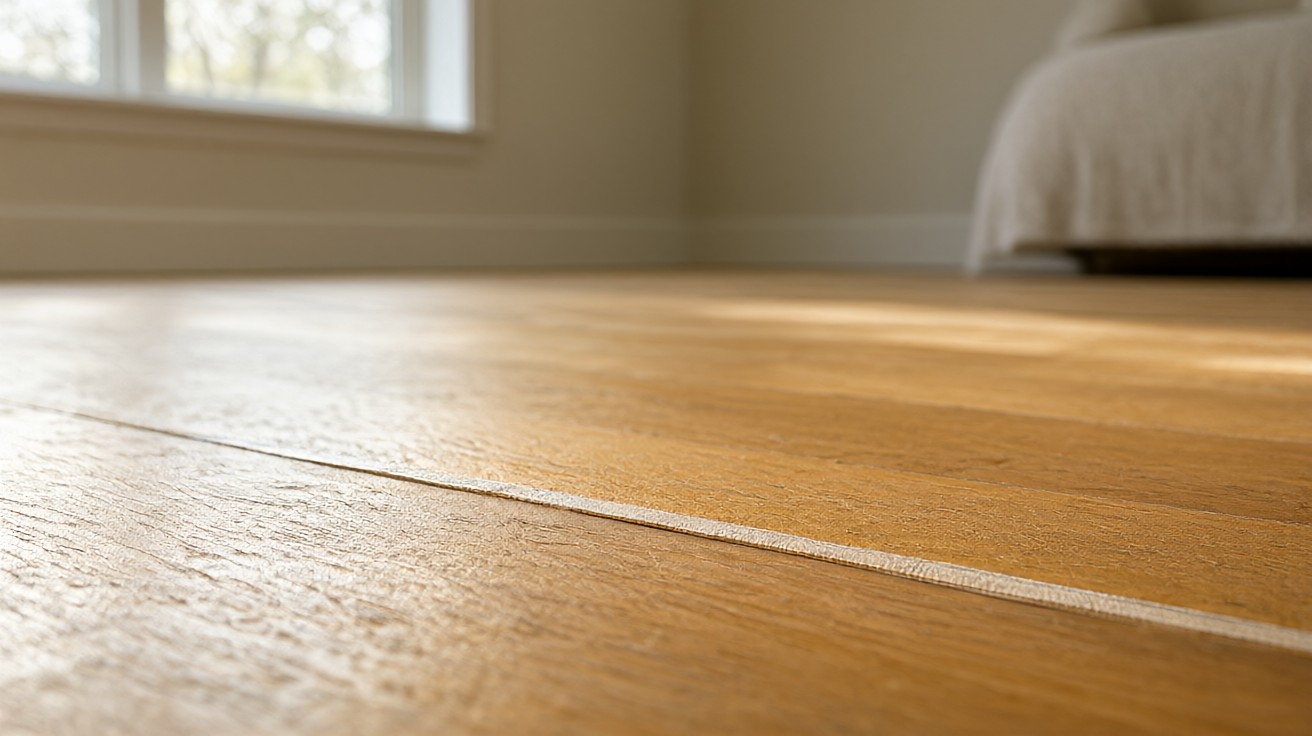
Underlayment, Foam Pad, And The Air Gap Under Your Floor
An air gap is the easiest defect in this category to find and the easiest one to misdiagnose, because it sounds exactly like a loose subfloor.
Underlayment is the sacrificial layer between the finish and the subfloor. It absorbs the small movement a wood subfloor produces, and when it is installed with gaps, missing tape, or overlapping seams that were cut instead of butted, it stops working.
Look for three failures. Seams that run short and end in midair. Tape peeled off the joint or never pressed down. And pad compression, where the pad has lost its resilience and the finish bears directly on the subfloor.
Pad compression is the failure that gets blamed on the finish. A 2 mm foam pad under hardwood in a high-traffic living room can be crushed to half its thickness in a few years, and the sound that follows reads as a subfloor issue.
Replace the pad rather than the finish here. If the underlayment is a 6 mil polyethylene sheet, it is not doing acoustic or cushioning work anyway, and the hollow sound comes from the joint that was never taped.
Do You Replace The Floor Or Just The Layer Under It?
Replace the layer, not the floor, whenever the covering is flat and undamaged. A hollow spot under a sound plank is a workmanship problem in the underlayment, and pulling up good boards to chase a taped seam costs more than the noise did.
Replace the covering only when it flexes on its own, the boards are visibly cupped, or the joints are crushed. Those are material failures, and no underlayment work brings them back.
Subfloor Flatness, Joist Deflection, And The L/360 Rule
An assembly that is not flat rocks on the high spots, and one that spans a flexing joist bends over the room, so both create noise that reads as a material defect.
Subfloor flatness has a hard threshold. The National Wood Flooring Association calls for a subfloor flat to within 3/16 inch over a 10 foot span, and resilient flooring practice calls for 1/8 inch over 6 feet. Outside those numbers the finish must flex to reach the subfloor, and flexing produces the drum effect.
Joist deflection has its own number. Residential joists should deflect no more than L/360 of their span under live load, so a 12 foot joist can move 1/4 inch in total and still be acceptable. A joist that moves twice that, or one with a cracked bearing, produces a groan that tracks your footsteps.
The American Plywood Association (APA) span tables are the other half of the check. They set 3/4 inch rated plywood over joists at 16 inches on center for a residential floor carrying 40 pounds per square foot of live load. A 1/2 inch subfloor over joists at 24 inches on center is a deflection problem whatever the finish.
Tile has its own rule. ANSI A108.02 sets subfloor flatness at 1/8 inch over 10 feet with a lippage limit of 1/32 inch for tiles 12 inches and larger. A slab that passes for resilient flooring can fail for large-format tile.
A simple test isolates the cause. Have one person walk a straight line while a second kneels at mid-joist-bay and watches the subfloor from below. Visible movement means a fastening or joist problem. No movement, with a hollow sound on top, means a cavity.
Seasonal Shrinkage, Relative Humidity, And The Noise That Only Appears In Winter
Seasonal shrinkage loosens connections that were tight in August, which is why a floor can be silent for a year and then start talking every January.
Wood and plywood respond to the relative humidity of the room. NWFA guidance targets 6 to 9 percent moisture content for hardwood, with a maximum spread of 2 percent between flooring and subfloor. Keep interior relative humidity between 30 and 50 percent and movement stays in the joint design.
Below 30 percent relative humidity, the wood shrinks and the fasteners holding the panel to the joist lose their grip. Above 60 percent, the panels swell and a floating floor can buckle or its expansion gap can close.
The pattern tells you which one you have. Noise in winter that vanishes in summer is shrinkage loosening fasteners. Noise in summer that disappears is expansion closing the expansion gap.
Concrete behaves differently. A slab read with an in-situ probe at 75 percent relative humidity or higher needs a moisture membrane, and above 95 percent it needs drainage work, not a better membrane.
Over a slab, the hollow sound and the seasonal noise often share one cause.
Click-Lock Lip Stress, Floating Floor Movement, And Glue-Down Bond Failure
How the finish is attached decides which failure you can have, because a click-lock floor only fails in ways a glue-down floor cannot.
Click-lock lip stress is the mechanism in floating laminate and vinyl installations. The board locks into its neighbour by an angled tongue and groove, and the joint carries the load. If the subfloor dips more than 1/8 inch between fasteners, the joint works harder than designed, and that is the click.
A floating floor moves as a unit, and it needs an expansion gap of at least 1/4 inch at every wall and obstacle. When that gap closes the floor has nowhere to go, so it lifts and buckles, and the noise becomes a rumble.
A glue-down floor has no expansion gap requirement because it is bonded, and its failure mode is a loss of bond instead. A hollow area under a glue-down plank means the adhesive did not transfer there, and the plank spans a void it was never designed for.
So the repair path differs by assembly. You can lift a floating floor, correct the flatness, and relay it. You cannot correct flatness under a glue-down floor without removing it, which is why flatness is checked first.
IIC, Decibels, And Whether Your Neighbors Can Hear You
Impact sound travels through the structure, so the number describing it is not a surface property and does not care what the finish is.
The Impact Insulation Class rating comes from ASTM E492, which measures how much impact sound passes through a floor assembly, and it is reported on the same scale as the Sound Transmission Class from ASTM E413. For a home interior, IIC 45 is the practical floor, IIC 50 is comfortable, IIC 60 or above means real isolation.
A hollow or squeaky floor is a structural problem before it is an acoustic one. A floating floor with an open expansion gap and unsealed underlayment loses measurable impact performance, because the cavity turns footstep energy into structure-borne vibration.
The scale is logarithmic, so the numbers are less intuitive than they look.
A 3 dB change is roughly a doubling of sound energy, and a 10 dB difference is generally heard as about twice as loud. That is why a 10 point gain in IIC is substantial and why chasing a 2 point change is wasted effort.
If the noise is between you and the room itself, acoustics are the wrong frame. If it is between you and the downstairs neighbour, the room acoustics guide covers the soft-surface side, and the assembly work here covers isolation.
Diagnosis By Material: Hardwood, Laminate, Vinyl, Tile, And Carpet
The same four causes sound different in different materials, so the material narrows the diagnosis before you lift a plank.
| Material | How the noise sounds | Most common cause | First thing to check |
|---|---|---|---|
| Solid or engineered hardwood | Low creak along the joist lines | Subfloor movement against the joist | Fastener pattern into the joists |
| Laminate | Sharp, loud click on every step | Click-lock lip stress from a subfloor dip | Flatness with a 6 foot straightedge |
| Luxury vinyl or resilient sheet | Little noise of its own, hollow thud | Air gap or debonded underlayment | Underlayment seams and tape |
| Tile over mortar or thinset | Dull thud, or a sharp click if bonded | Incomplete coverage under the tile | Tap test and hollow area count |
| Carpet over pad | Quiet unless the pad has crushed | Pad compression | Pad thickness on the traffic line |
| Slab under a floating floor | Rumble plus an echo of the room | Closed expansion gap or missing membrane | Gap width and slab moisture |
Solid and engineered hardwood transmit low-frequency creak best, because a stiff board over a loose panel rings rather than thuds. Laminate is high-density fibreboard and gives a shorter, harder click, often the loudest in the category.
Resilient floors such as luxury vinyl transmit almost nothing on their own, so any noise comes from the underlayment or subfloor below. Carpet over pad is quiet, but a hollow sound usually means pad compression, since the pad carries the load.
Concrete slabs change the diagnostic frame. A slab is flat by definition, so a hollow sound over concrete means a debonded tile or an unfilled void, not a flatness problem.
Decision Rules: What To Fix, What To Shim, And What To Replace
A decision rule beats a guess, because it tells you what the tap test means and what to do next.
The first rule is about area. If more than 3 of every 10 random tap points sound hollow across a contiguous region larger than 4 feet by 4 feet, treat that region as suspect and open it up. Isolated hollow points under 2 feet square are usually a seam and a length of tape.
The second rule is about deflection. If you can push the floor down more than 1/4 inch at mid-span with your body weight, the framing is the cause and no underlayment will fix it. If the deflection is under 1/8 inch and the tap sounds hollow, you have an air gap.
The third rule is about the threshold for action. When more than 4 in 10 tap points in a room sound hollow and the sound carries into the adjoining room, the repair is worth doing now. Below that, monitor through one more heating season.
The fourth rule is about cost of fix versus fix of cause. If you find an air gap under a floating floor, correct the flatness and relay it rather than replacing the covering. If the cause is a loose fastener or a shimmed joist, the repair takes under 30 minutes and the covering stays.
The fifth rule is about when to call a professional: when the noise appears in more than one room on the same joist line, when the floor slopes, or when a joist shows a crack or a soft bearing.
How Do You Know Whether The Job Is A Weekend Or A Contractor?
Call a contractor when the noise is structural at the framing level, when the assembly sits over a concrete slab, when the covering is glued down over a large area, or when the joists are unreachable.
A weekend is enough when the problem is a taped seam, a loose fastener, or an assembly that needs lifting and relaying over a corrected subfloor.
When the finish is solid hardwood and the noise is a loose board or a subfloor rubbing on the joist, the repair procedure lives in the how to fix squeaky hardwood floors guide, which covers fastening and shimming in detail.
And if you are choosing a floor rather than repairing one, the best flooring for living rooms guide covers how each material behaves under foot, the living room flooring acoustics guide covers the sound side, and the living room flooring over concrete guide covers the slab base.
Last updated: November 2026