Terrazzo is not one specific material. It is a poured composite of stone chips set in cement or epoxy, then ground smooth to expose the aggregate beneath.
That construction explains everything else about terrazzo. The aggregate is exposed, so the floor is essentially a cross-section of stone laid into a binder. The binder is either cement-based or epoxy-based, and the two behave differently.
The grind is what creates the smooth finish, and the size of the chips and the grind together decide whether the floor reads as a fine mosaic or a large chip pattern. Once a buyer can name those three things, the spec sheet and the pricing are legible.
This guide covers terrazzo as a material, separate from the comparison to other materials. For that, the terrazzo versus concrete page is the reference, and the tile flooring guide sits above both.
What Terrazzo Is, At the Material Level
Terrazzo is a flooring system, not a tile, although tile-sized terrazzo products exist. The original terrazzo is poured in place: a cement or epoxy binder is mixed with chips of marble, granite, glass, or other aggregate, poured onto a prepared subfloor in a layer typically 0.5 to 1 inch thick, then ground and polished after it cures.
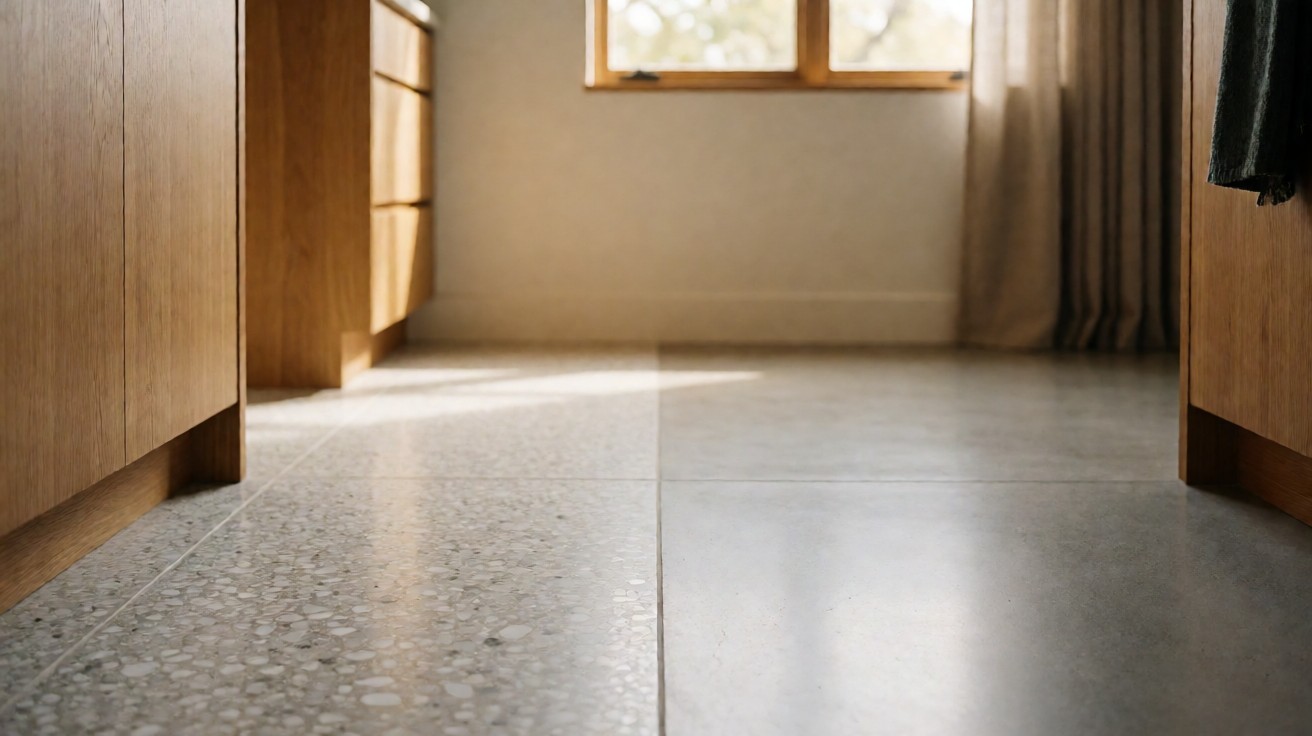
The grinding is what exposes the aggregate, and the depth of the grind determines how dramatic the pattern is. A terrazzo floor with a coarse grind shows large chips and uneven colour, more like a stone mosaic. A terrazzo floor with a fine grind shows small chips in a uniform field, which reads as a coloured surface with subtle texture.
Beyond the original poured form, modern terrazzo is also sold as precast tiles, which are smaller formats of the same material made off-site and installed like a tile.
The precast form has thinner chips and a more uniform look, and it is what is sold in residential flooring shops as “terrazzo tile.” The trade versus poured terrazzo is the absence of the seamless appearance, since precast tiles have joints.
Cement-Bound Terrazzo
The traditional terrazzo uses a Portland cement binder. The cement holds the aggregate but it is porous and softer than the chips it holds, so the surface needs sealing and the lifetime behaviour is closer to a high-end concrete than to a marble or granite.
Cement-bound terrazzo is the version that has been installed for a century and the version still found in older public buildings. It is a thick slab, often reinforced, and it can last indefinitely with resealing.
The limitations are that the cement binder does react to acids and stains, the colour range is more limited than the epoxy version, and the floor is heavy and slow to install.
For residential use, cement-bound terrazzo is occasionally poured in a custom new build or a major renovation, and is much rarer as a retrofit. The cost of the pour, the grinding equipment, and the installer skill is high enough that a residential floor is unusual.
Epoxy-Bound Terrazzo
Epoxy-bound terrazzo uses an epoxy resin as the binder instead of cement. The epoxy is non-porous, which eliminates most of the staining and sealing concerns of the cement version, and the colour palette is much wider because epoxy accepts pigments cleanly.
This is the dominant form of new commercial terrazzo. The advantages over cement are real: no sealing, faster install, lighter weight per square foot, and a much broader colour range.
The disadvantage is that epoxy does not tolerate UV exposure the way cement does, so an outdoor terrazzo patio is almost always cement-bound, and a south-facing window in a poured terrazzo floor will yellow over many years.
For residential use, an epoxy terrazzo installed by a specialty contractor is a real option for a kitchen or a hallway, although the cost makes it more common in luxury construction than in mid-range renovations.
Aggregate and the Visual Choice
The aggregate is the look of the terrazzo, and three things about the aggregate matter.
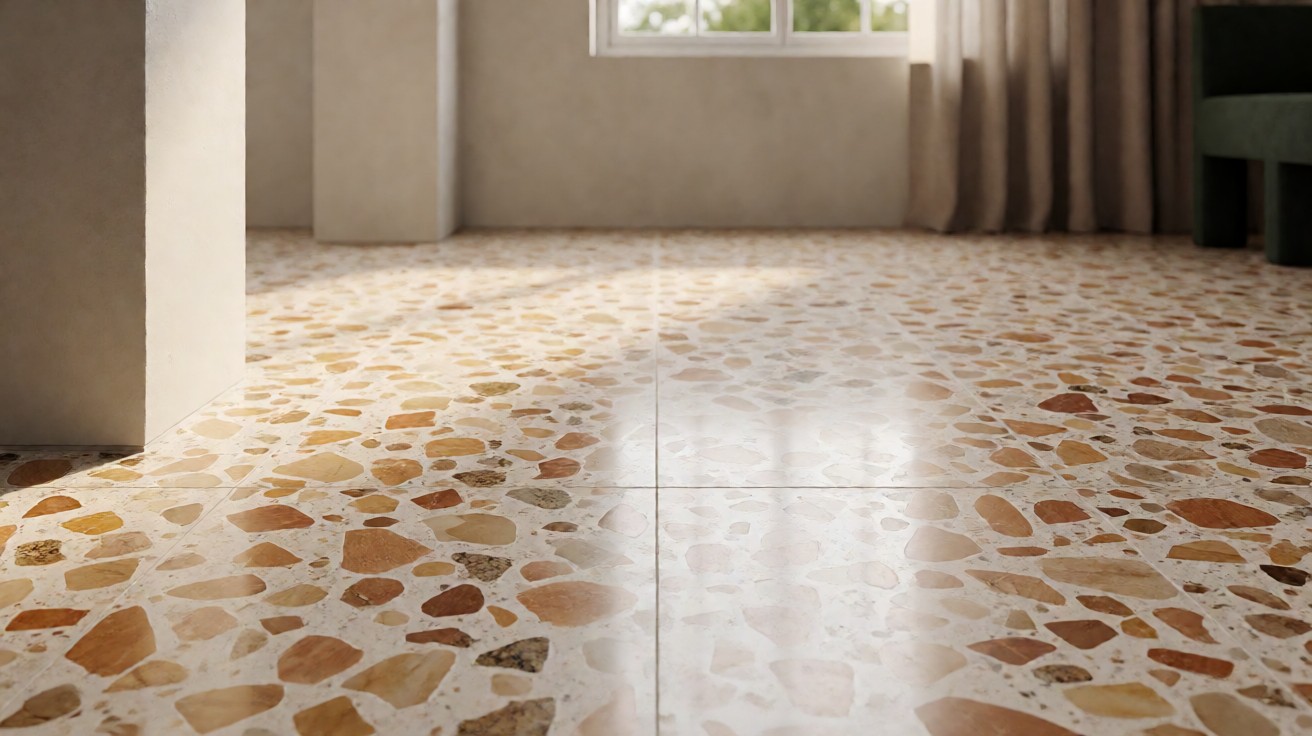
The material of the chips decides the colour palette and the durability. Marble chips are traditional and read warm, with cream, beige, and grey tones. Granite chips read cooler and darker, with speckled patterns. Glass chips add reflective flecks and a wider colour range. Mother-of-pearl, mirror, and metal chips are decorative additions often used in luxury installations.
The size of the chips dictates the texture of the finished floor. Chips under 5 millimetres read as a fine field with subtle variation. Chips 10 to 20 millimetres read as a more obvious mosaic. Chips above 25 millimetres read as a stone pattern and are sometimes called “Venetian” terrazzo. None of these is structurally different from the others; it is purely visual.
The colour of the binder, usually grey or white for cement or a pigmented version of the epoxy, decides the field colour around the chips. White binder with white marble chips reads as a soft cream, while white binder with dark granite chips reads as a contemporary grey.
The Grind and the Finish
After the pour cures, the surface is ground to expose the aggregate, and the depth of the grind controls how much of the chip shows.
A honed terrazzo has a matte finish and shows the chips as muted shapes. It is the most common finish and the most forgiving in a working room because it does not show scratches or dust.
A polished terrazzo has a high gloss and shows the chips as crisp, reflective shapes. It is the most striking finish and the most demanding in a living room or a kitchen because it shows every scuff.
The grind and the finish are independent. Honed terrazzo can have a deep grind that shows large chips, or a fine grind that shows small chips. The combination of grind and finish defines the look, and the choice is mostly aesthetic.
Seams, Joints, and Where Poured Terrazzo Is Practical
The great advantage of poured terrazzo is that it has no joints across the field. The pour is continuous, the grind is continuous, and the result looks like one surface from wall to wall. The exceptions are where the floor meets other materials, where dividers in the pour are needed, and where penetrations like drains interrupt the surface.
This is why terrazzo is most practical for large open rooms, commercial lobbies, and kitchen floors where the seam-free appearance is worth the install cost. For a residential bathroom, the floor area is small enough that the difference between poured and precast tile is mostly visual.
For a residential retrofit, precast terrazzo tile is the practical alternative. It loses the seam-free field but gains the ability to install over an existing subfloor without the cost and disruption of a wet pour.
Durability in a Real House
Terrazzo is among the longest-lived floors in residential construction, and a poured terrazzo floor is genuinely a one-time install for the life of a house.
The aggregate is real stone, so the visible surface ages the way stone ages: slowly, with a patina on the binder and a stable surface on the chips.
The cement-bound version needs resealing every 5 to 10 years, similar to a concrete floor. The epoxy version does not need sealing. Neither version needs a wax coat for protection, although a polish can be applied for gloss or scuff resistance.
The real durability question is what happens when the floor is damaged. A poured terrazzo floor can be re-ground and re-polished to look new, which is a major advantage over most other floors.
A precast terrazzo tile can have individual tiles replaced if they chip or stain. The repair is not invisible on either, but both are recoverable, and both last much longer than a tile or a vinyl floor.
The Trade-Offs at a Glance
| Decision | Cement-bound terrazzo | Epoxy-bound terrazzo | Precast terrazzo tile |
|---|---|---|---|
| Sealing needed | Every 5 to 10 years | None | Every 3 to 5 years |
| Colour range | Narrow (cement-coloured) | Wide (pigmented epoxy) | Wide |
| Stain resistance | Moderate (porous binder) | High | Moderate to high |
| Installation complexity | High (poured) | High (poured) | Low (tile) |
| Residential suitability | Custom build only | Luxury renovation | Common renovation |
| Seam-free field | Yes | Yes | No (joints) |
| Outdoor use | Yes | No (UV-yellowing) | Rare |
The Three Trade-Offs at a Glance
Three decisions drive the terrazzo choice and the price. Together they tell you whether the floor is right for the room.
The first is the binder. Cement is the traditional and forgiving choice, with a sealing schedule and a colour palette limited to cement tones. Epoxy is the modern and decorative choice, with a wider palette and no sealing. UV exposure is the only meaningful limitation of epoxy, which makes it wrong for outdoor use.
The second is the aggregate. Marble chips are the historical default and read warm. Granite chips read cooler and darker. Glass and mother-of-pearl add reflective flecks. The chip size and grind together decide whether the floor reads as a fine field, a coarse mosaic, or a chunky “Venetian” pattern.
The third is the format. Poured terrazzo is the only way to get a seamless field, and it is expensive. Precast terrazzo tile is the only practical option for most residential retrofits, and it reads the same way visually once installed, just with visible joints between sheets.
| Choice | Low end | High end | Read as |
|---|---|---|---|
| Binder | Portland cement | Pigmented epoxy | Stone surface in a field |
| Chip material | Marble or granite | Mother-of-pearl, mirror, glass | Coloured speckle or fleck |
| Chip size | 3 to 6 mm | 20 to 30 mm | Fine texture or coarse mosaic |
| Format | Precast tiles | Poured in place | Tiled surface or seamless field |
| Finish | Honed (matte) | Polished (high gloss) | Quiet or dramatic |
What Terrazzo Costs
The honest number is that terrazzo is among the most expensive residential floors when poured. The pour, the grinding equipment, and the skilled labour are costly, and a residential floor may need a journeyman terrazzo mechanic rather than a tile installer.
A precast terrazzo tile is much cheaper than a poured floor, and it sits in the high end of the tile price range rather than the specialty composite range. A poured terrazzo kitchen in a renovation can be priced like a high-end concrete or stone floor, and it lasts long enough that the lifetime cost evens out.
Is terrazzo cheaper than tile?
No. Poured terrazzo is among the most expensive residential floors installed today. The precast terrazzo tile costs more than most porcelain tiles but is competitive with high-end marble or stone, and a poured terrazzo kitchen is typically priced well above any tile option. The lifetime cost can even out over decades, but the upfront cost is real.
Where should terrazzo not be installed?
Avoid outdoor locations for epoxy-bound terrazzo because UV exposure yellows the resin. Avoid kitchens with heavy grease exposure for cement-bound terrazzo without a sealing plan. Avoid rooms where the floor cannot be poured and ground in place without disturbing other finishes, which makes a poured floor impractical for many retrofits. In all these cases the precast tile is the workable alternative.
Can terrazzo be repaired?
Yes. Poured terrazzo can be re-ground and re-polished to look new, which is one of its key advantages over other floors. Precast terrazzo tiles can have individual tiles replaced. Neither repair is invisible, but both are recoverable from a stain, a deep scratch, or a chip that would have destroyed a tile floor.
How This Fits With the Rest of the Choice
This page covers terrazzo as a material. It does not cover the comparison to concrete or to other flooring systems, the installer trade, or the cleaning routine.
For the comparison to concrete, the terrazzo versus concrete page is the reference. For the umbrella tile material, the tile flooring guide sits above both. For the natural stone that often appears as the aggregate, the marble, granite, slate, travertine, and limestone page covers the aggregates one by one.