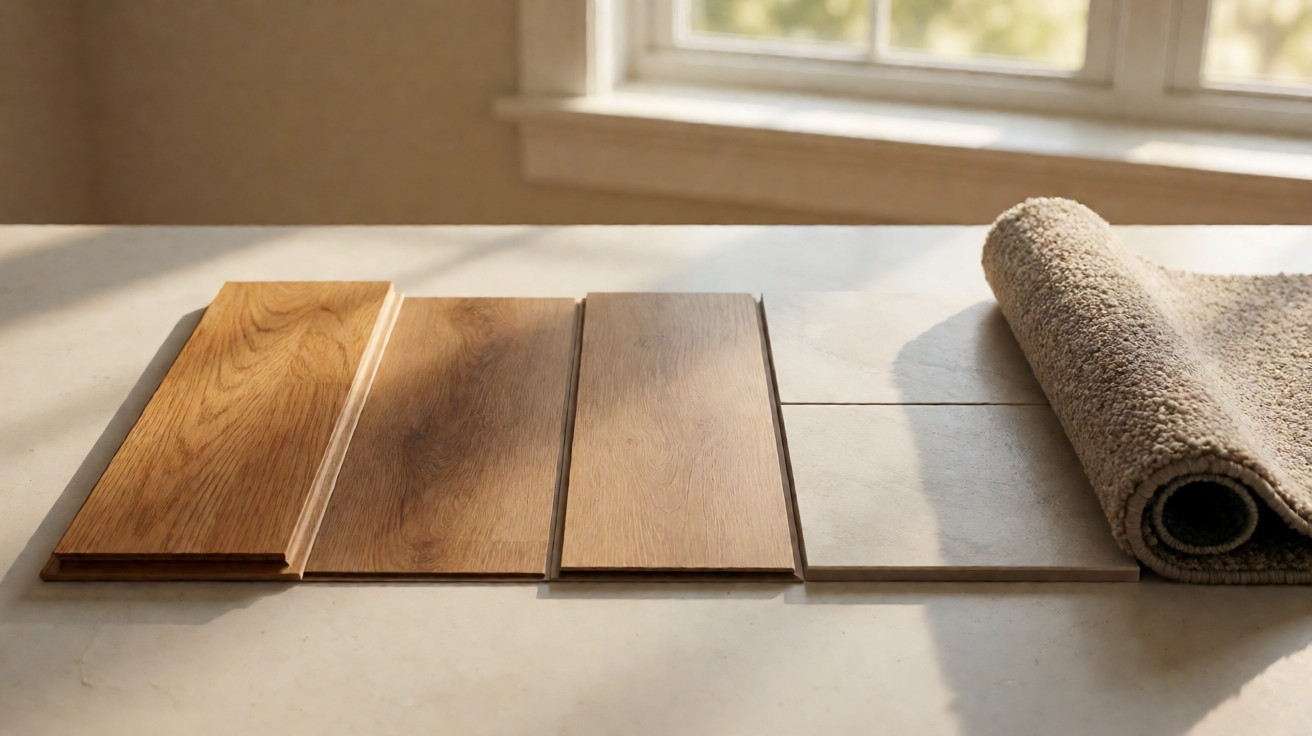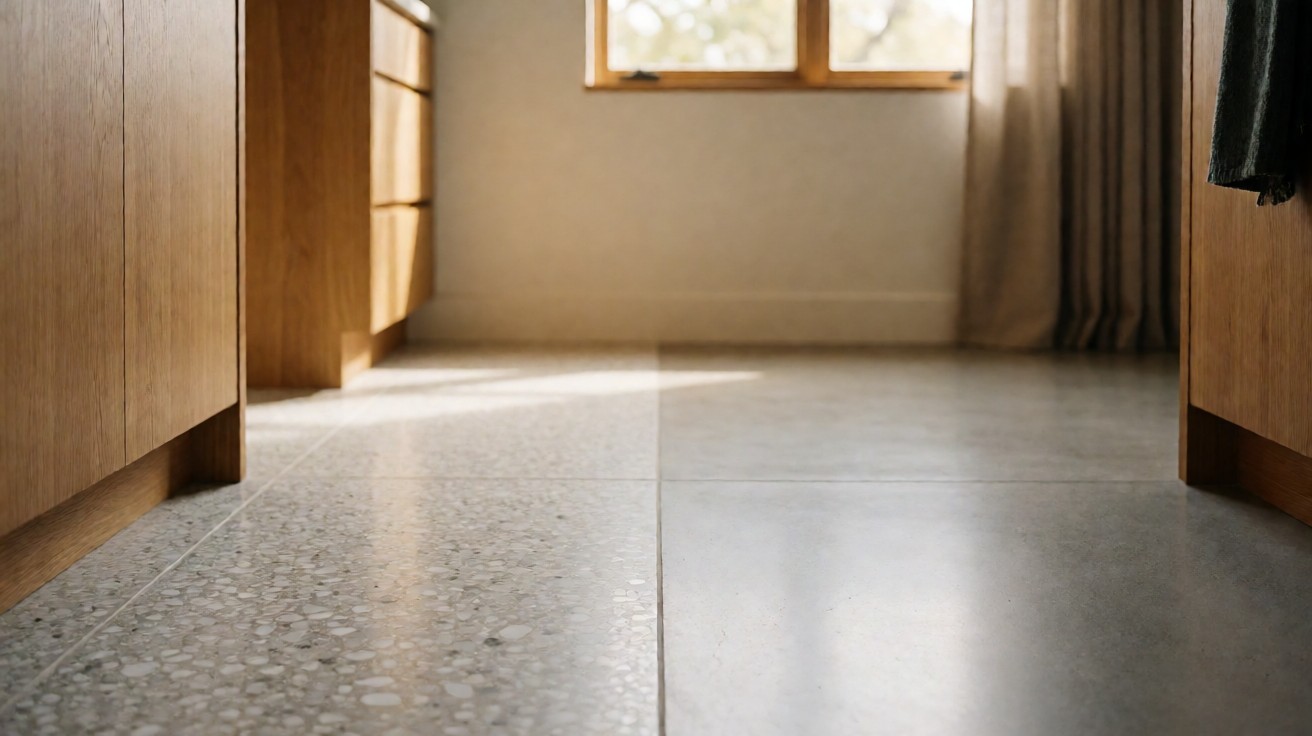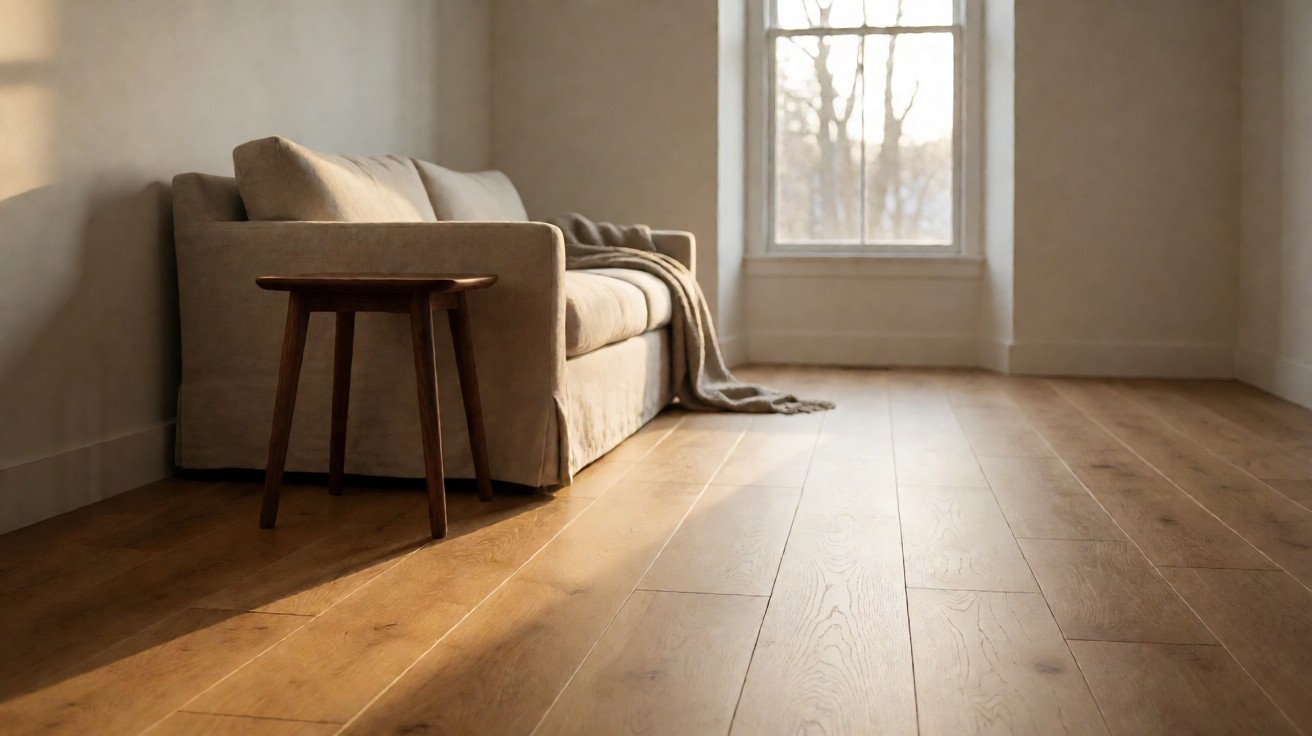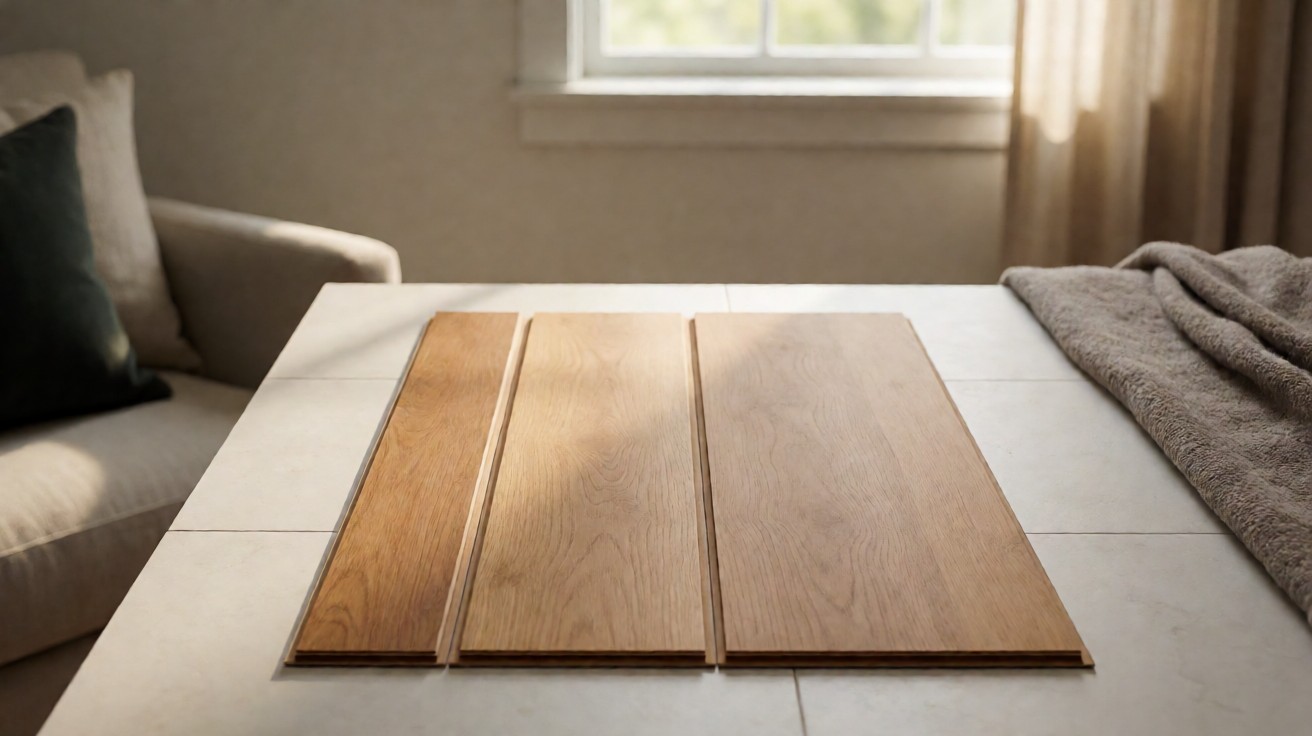

Laminate is unusual among flooring types because the visual variety comes from the engineering, rather than from the material in each individual laminate plank.
A solid hardwood floor varies with the wood species and the cut, because the material is what carries the look. A laminate floor varies with the embossing roller that pressed the surface, the printer that laid the pattern, and the milling that shaped the edge, because the look is built in.
That is why laminate can plausibly imitate so many things, and it is also why choices that look similar on paper behave differently in a room.
Three decisions drive the result: the plank width and length, the surface texture, and the edge profile. This guide covers each one, then shows how they interact in a real room.
The material itself is covered in the wear-layer explainer, and the wider-or-narrower decision logic (which is a room-size question, not a material one) is in the wide versus narrow plank page.
Plank Widths and Why the Difference Matters
Laminate planks come in three width ranges, and each one changes the way a room reads once the floor is down.
Narrow strip, around 3 inches wide, is the historical default. It reads busy and detailed, and it works in small rooms because the visual frequency matches the scale. Standard plank, around 5 inches wide, is the workhorse.
It is the most common product on shelves and suits most rooms. Wide plank, 7 to 9 inches or more, reads quieter and more current, and it suits larger rooms where the proportion is balanced.
This is aesthetic rather than structural. A wide plank is the same thickness and HDF core as a narrow plank, and the installation does not change. The only practical difference is that wide planks show subfloor unevenness more clearly because the flat surface has nothing to disguise it, and on a floor that is not flat, narrow planks forgive more.
Plank Lengths
Plank length matters less than width, but it shapes the way the floor reads once installed.
Short fixed-length planks install with a uniform joint pattern and read somewhat tile-like, which makes them a clean fit for a tile-look laminate. Standard planks run from 4 to about 5 feet.
Long boards, in the 6 to 7 foot range and increasingly common, read quieter and more like a wide-plank solid floor. Random-length packs combine several board lengths in one carton, which disrupts the joint pattern and looks more natural.
The trade with longer boards is mainly layout flexibility. A 5-foot plank works in a narrow hallway; a 7-foot plank can land badly in a short room and force an awkward rip cut at the end of a row. The pattern in the box matters as much as the spec.
Surface Textures Available on Laminate
Laminate surfaces range from completely smooth to deeply embossed, and the texture interacts with light more than most buyers expect.
Smooth is the simplest finish and the most forgiving. A smooth laminate reads flatter and slightly more synthetic than the other options, but it is also the easiest to keep clean because there are no crevices to collect dust.
Embossed in register, or EIR, is the texture that follows the printed pattern. The roller that embosses the surface presses the grain in the same place the printed grain runs, so the finished plank reflects light the way real wood does. It is the upgrade that most matters on a wood-look laminate.
Hand-scraped and distressed textures are deeper embossings that simulate saw marks, knots, and the uneven surface of solid wood. They are usually paired with a matte finish to read naturally. A hand-scraped laminate will look wrong in a glossy finish and right in a matte one, and the texture choice and the finish choice should be made together.
Edge Profiles and the Painted Bevel
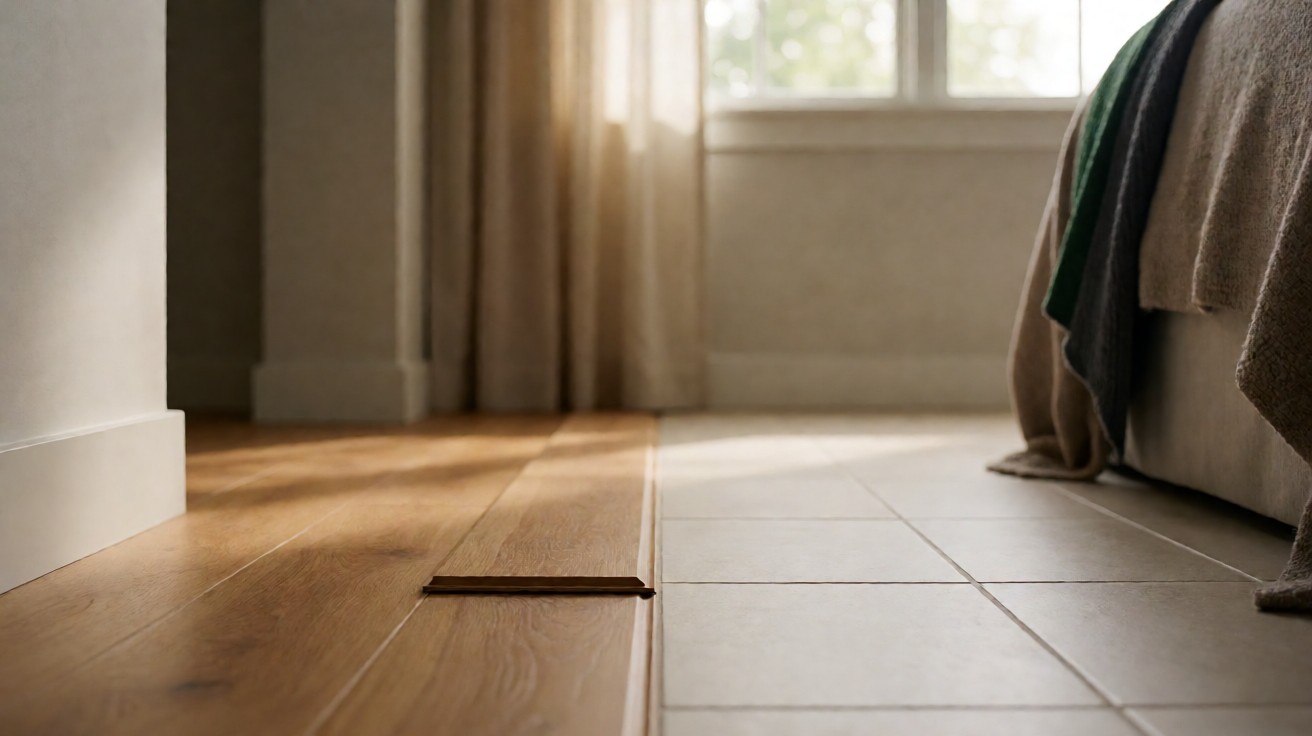
The edge profile is the shape of the side of each plank, where two planks meet.
A square edge has no bevel and the joint between two planks is a hairline crack. The floor reads as one continuous surface, more like tile than wood, and the grout line between planks disappears.
A micro-bevel is a faint chamfer that catches a bit of light and shows the joint without making it dominant. A full bevel is a noticeable V between planks that imitates the join of a solid wood floor and is the most “wood-like” of the options.
The painted bevel is a separate idea: the V groove of a beveled edge is printed with a darker line, simulating the shadow and the slight dye absorption at the edge of a real plank.
It is a small detail that lifts a plank from looking like a tile imitation to looking like real wood, and it is one of the better values in a mid-range laminate.
How Size, Texture and Edge Interact
The three choices are not made in isolation, and the combinations that look wrong are easy to spot.
A wide plank with a square edge and a smooth surface reads as a continuous surface that you cannot trust as wood because the joints are missing. A wide plank with a full painted bevel and EIR texture reads convincingly as wide-plank wood. A narrow strip with a hand-scraped texture is unusual because the texture fights the plank width.
The pattern that dominates mid-range and high-end product is wide plank, EIR texture, and a micro-bevel or full painted bevel. The pattern at the lower end is standard plank, smooth or lightly embossed, and a square edge. Either end of that spectrum works; the choices in the middle have to be compatible with each other to look right.
Choosing by Room Size and Light
Two room qualities shape the choice, and both are about visual scale.
A small room wants a smaller plank. A wide plank in a small bathroom reads as a few floor-sized boards and makes the room feel like a single surface, not a room. The same width in a living room reads as the right proportion. The wide versus narrow plank page walks through that decision in more depth.
Bright light makes every surface detail visible, including bad embossing and obvious pattern repeats. A room with a lot of natural light is where the EIR texture and the random-length pack earn their cost, because the floor is on show all the time.
A room with lower light forgives cheaper surfaces and shows fewer pattern repeats, which is one reason a budget laminate is a sensible choice in a basement bedroom but a less sensible one in a sunlit living room.
The Typical Lineup at a Glance
| Choice | Budget | Mid-range | Premium |
|---|---|---|---|
| Plank width | 5 inch standard | 5 to 7 inch | 7 inch and wider |
| Length | Fixed 4 foot | Random length 4 to 5 foot | Long board 6 foot and up |
| Texture | Smooth or light emboss | EIR (embossed in register) | Hand-scraped EIR |
| Edge | Square | Micro-bevel | Full painted bevel |
| Pattern repeats | Visible | Frequent repeats | Rare repeats, multi-print run |
| Box price (per sq ft) | $1 to $2 | $2 to $4 | $4 and up |
The table is not a value judgment: a budget laminate is the right answer in a basement bedroom and a premium one is wasted in a guest closet. It is a layout of what the choices buy at each step, so the buyer can decide which trade-offs matter.
What is the most common laminate plank width?
Around 5 inches. That is the standard plank that fills most product lines and most rooms, and it is the most forgiving option for subfloors that are not perfectly flat. The narrower 3-inch strip is harder to find than it used to be, and the 7-plus inch wide plank is the upgrade choice for larger rooms and for current design.
What is the best edge profile for a wood-look laminate?
A micro-bevel or a full painted bevel. The square edge on a wood-look laminate reads more like tile than wood because the joint disappears, which is not what a wood floor does.
A beveled edge catches a bit of light at each joint and makes the plank read as a separate board, and a painted bevel adds a small dark line that imitates the natural colour absorption at the edge of a solid wood plank.
Is EIR (embossed in register) worth the upgrade?
On a wood-look laminate, yes. EIR is what makes the printed grain line up with the pressed surface, so the plank reflects light the way real wood does.
On a smooth or lightly embossed laminate, the printed grain and the surface grain do not match, which is what makes the floor read as a picture of wood rather than wood. For tile-look laminate, the embossing matters less and the surface choice is more about how the tile reads at the joints.
Gloss Level and How It Interacts with Texture
Gloss level is a separate setting from texture, and on laminate the two should be matched.
A high-gloss finish on a smooth surface is the most tile-like configuration, and it shows every footprint, scuff, and dust in a room with direct light. It is also the easiest to clean because there is no embossing for dirt to settle into. A matte finish on an embossed surface is the most wood-like configuration, and it hides wear because the surface already scatters light.
Pairing high gloss with deep embossing reads as plastic, because the printed pattern looks wet under the gloss. Pairing matte with a smooth surface reads as dull. Most residential laminate is delivered in a mid-matte with a moderate embossing, which is the trade-off that most buyers actually want without naming it.
The spec to look for is the gloss unit, typically reported as a percentage of light reflected at a fixed angle. A 5 to 10 percent gloss is matte, 10 to 25 percent is satin, and above 25 percent is high gloss. The number is not widely published on laminate, but the look is, and the look follows the formula above.
Pattern Repeats and How to Read the Catalogue
A laminate catalogue page that shows several planks in a hero shot is hiding something: the planks shown are different printed faces of the same product. Each box contains a small set of unique print runs repeated across many planks, and the higher the number of unique faces per box, the more natural the finished floor reads.
A budget laminate may have four to six unique faces, so a small room starts to repeat within a few square metres. A mid-range laminate has eight to twelve. A premium laminate with EIR texture can run to twenty or more unique faces, and the floor stops repeating at the scale of a residential room.
The catalogue line to look for is “unique planks per carton” or “unique faces.” It is not always published, but when it is, a higher number is a genuine upgrade at every price point and is the difference between a floor that reads as a printed repeat and one that reads as a random pattern.
The Typical Lineup Quick Reference
Two condensed answers worth keeping in mind when comparing options.
| If you want | Default config |
|---|---|
| A wood-look floor that reads as wood | EIR texture, painted bevel, mid matte finish |
| A tile-look floor that reads as tile | Smooth texture, square edge, low embossing |
| A pattern that does not repeat in a small room | 12 or more unique faces per carton |
| A floor that forgives uneven subfloor | Narrower planks and a thicker underlayment |
How This Fits With the Rest of the Choice
This page is the design choices inside the laminate family. It does not cover the laminate material itself, the wide-versus-narrow plank decision logic in general, or the installation method.
For the material, the wear-layer explainer is the page. For the room-size decision behind plank width, the wide versus narrow plank page covers that. And for the material comparison against vinyl or hardwood, the material comparison is the reference.