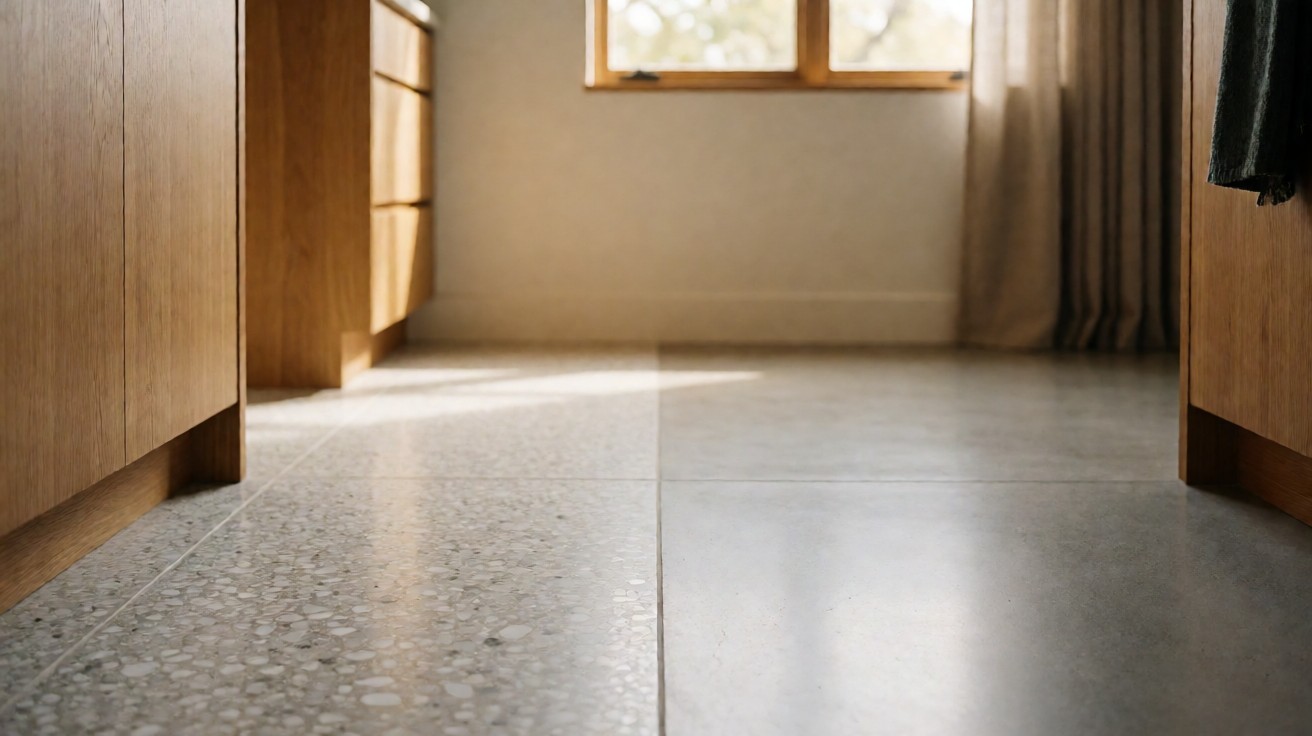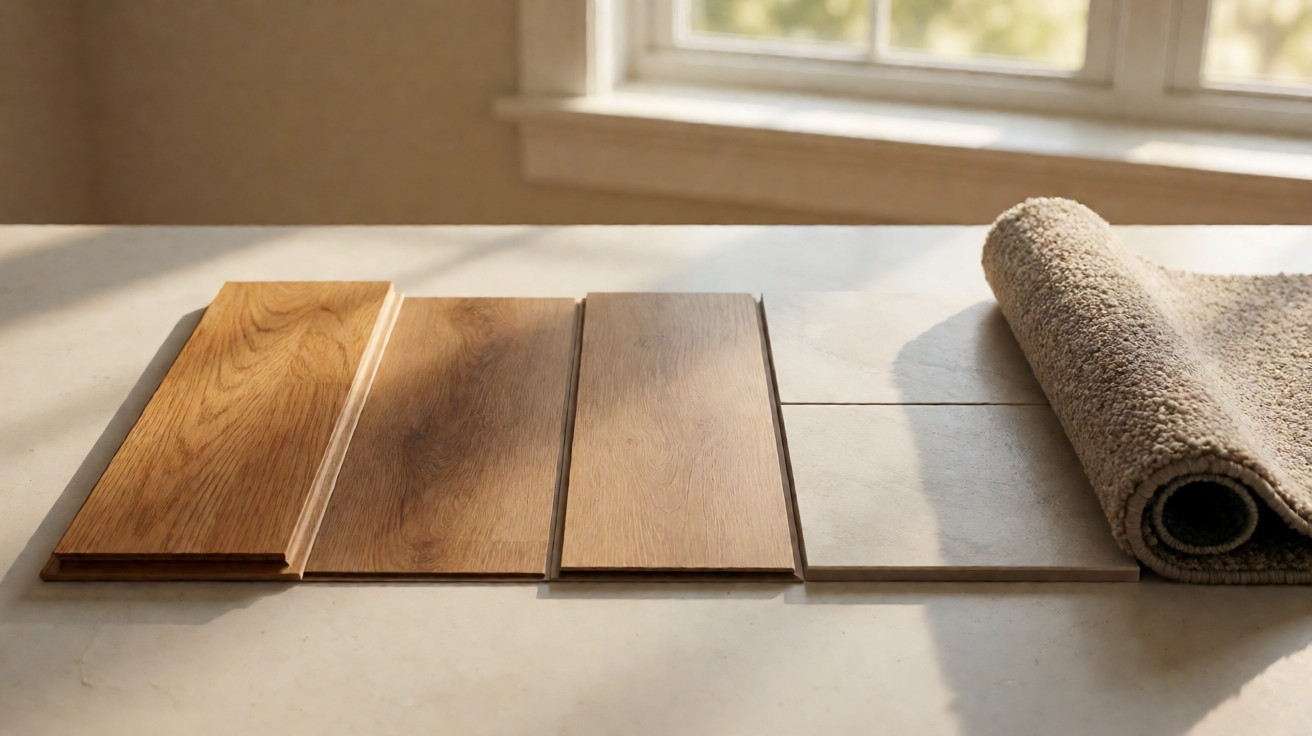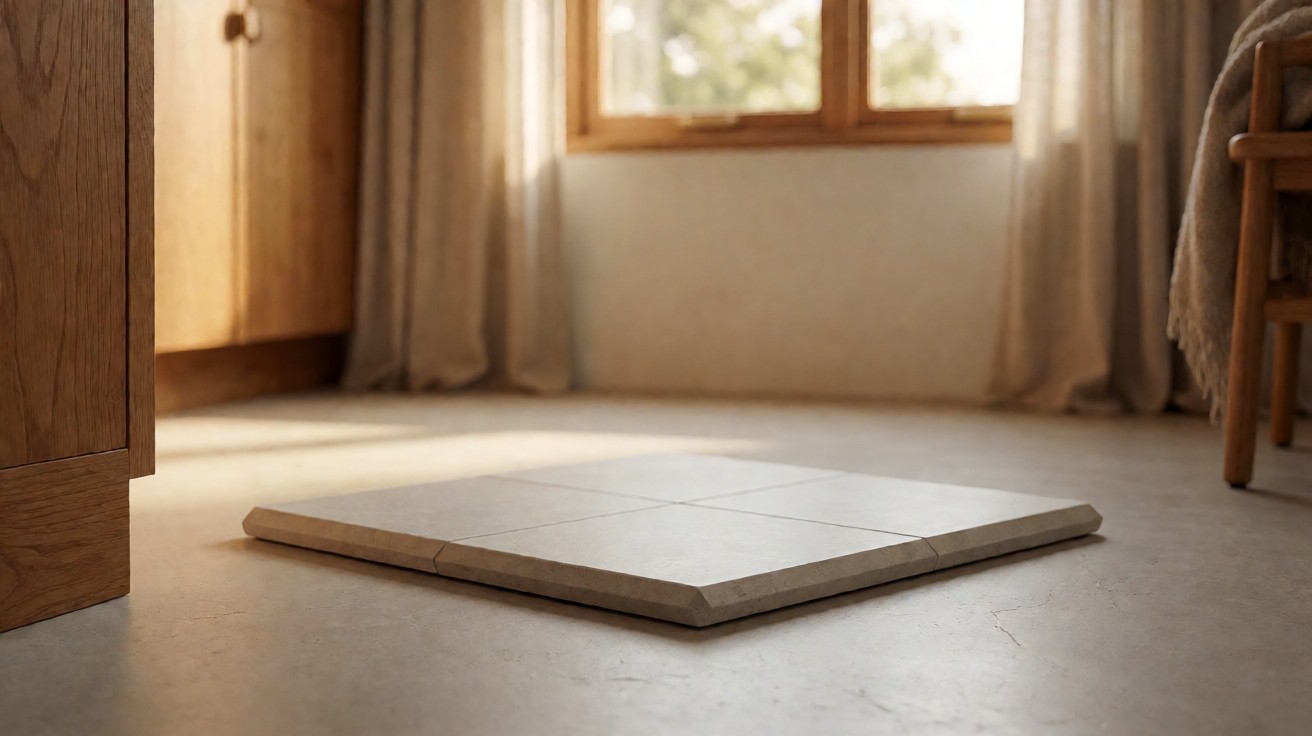

Porcelain tile is a fully vitrified ceramic fired at a higher temperature than standard ceramic, and that one fact alone is what makes the practical difference.
Vitrified means the clay body has been fired until the particles fuse into a glass-like mass with almost no pores. Water absorption under 0.5% is the formal definition, and it is what makes porcelain different from a standard ceramic tile at the material level.
Everything people notice about porcelain in a house follows from that single property: it is dense, it is hard, it does not absorb water, and it chips rather than wearing through.
This guide covers porcelain as a material, separate from the decision of porcelain versus ceramic, the installation, or the surface finish. For the decision logic, the tile flooring guide page is the reference, and for the broader tile material, the tile flooring guide is the umbrella.
What Porcelain Tile Is
Porcelain is a type of ceramic tile, but the words tile and ceramic no longer describe it accurately. The body is made from a fine mixture of refined clay, feldspar, and silica, pressed and fired at temperatures higher than ordinary ceramic. The result is a tile body that is glass-like throughout and almost impermeable to water.
The vitrification is what changes everything. A standard ceramic tile is porous enough to soak up a small amount of water over its lifetime, which is why an exterior ceramic wall tile is rarely used and a porcelain patio is.
Once a tile body is vitrified, the same tile can sit in a shower, on a kitchen floor, or on a freeze-thaw patio without absorbing enough water to swell, crack, or grow mould.
So the practical reading is simple. Porcelain is the denser and less porous sibling in the ceramic family. Its strengths relative to a standard ceramic are mechanical and chemical, and the cost difference is the manufacturing process that produces them.
Porcelain Versus Ceramic: The Material Distinction
The distinction is not the colour of the tile or the finish on the surface. The distinction is the body of the tile, and it is set at the kiln.
Standard ceramic, sometimes called non-porcelain or monoporosa in some catalogues, is fired at a lower temperature and the body remains slightly porous. It is cheaper, easier to cut with a manual tile cutter, and easier to drill. It is the right answer in dry interior locations and is the typical bathroom wall tile in residential construction.
Porcelain is fired at a higher temperature and the body becomes non-porous. It is harder to cut (typically needs a wet saw), heavier for a given size, and stronger in compression. It is the right answer anywhere water or frost is involved, and in any high-traffic area where the mechanical strength matters.
The two look identical in a showroom. The difference shows up under the surface and in the cut edge, and it is the difference between a tile that lasts a lifetime indoors and one that handles a lifetime outdoors. For the decision logic and the cost comparison, the tile flooring guide walks through which is the right answer in a given room.
PEI Rating and How It Differs from AC Rating
Porcelain tiles carry a PEI rating, and it is not the same as the AC rating on a laminate floor.
PEI stands for the Porcelain Enamel Institute, and the rating runs from 1 to 5 based on a Taber-style abrasion test against the glazed surface.
PEI 1 is the lowest, rated for very light residential traffic such as a bathroom floor in a guest room. PEI 5 is the highest, rated for heavy commercial traffic including stores and public spaces. The rating measures the glaze, not the body.
The difference from laminate AC is technical, not just categorical. AC measures how many cycles the decorative paper can survive; PEI measures how many cycles the glaze can survive. PEI is more about the visible wearing pattern of a glaze over time, AC is more about the point of wear-through.
The two scales are independent, so the buyer should not translate between them. A PEI 3 porcelain floor and an AC3 laminate floor are not equivalent products; they are both at the residential mainstream on their own scales.
Through-Body Colour Versus Glaze
One of the most important distinctions within porcelain is whether the colour runs through the body or sits on top of it.
A glazed porcelain tile has a hard, glass-like coating applied to the surface and fired in. The colour of the tile is on that glaze, and if the glaze chips, the body of the tile is visible underneath as a different colour, usually beige or grey.
Glazed porcelain is the typical choice for a wall tile, a bathroom floor with a printed pattern, and any porcelain tile that needs a sharp printed image.
A through-body porcelain tile uses a colour that runs uniformly through the entire body. A chip on the edge of a through-body tile shows the same colour as the surface, so a chip is much harder to see. Through-body is the right answer for commercial floors, outdoor pavers, and any installation where chips are likely.
The distinction shows up in the spec sheet. A through-body tile is described as full-body or colour-body porcelain. A glazed tile is described as glazed and the spec should specify the glaze hardness (PEI).
Edge Profile: Rectified Versus Pressed
The edge of a porcelain tile is set by how the tile was cut after firing, and it changes the joint between tiles.
Pressed edges are what most ceramic tiles have. The tile is pressed in a mould with slightly rounded or bevelled edges, and the joint between two tiles has a small V shape that catches grout. It reads as a tile floor with a visible grout line.
Rectified tiles are cut on a saw after firing so the edges are mathematically square and the dimensions are exact. Two rectified tiles fit together with a hairline joint, and the grout line becomes a thin line that is almost invisible at a distance.
Rectified is the choice for a tile that is meant to look like a continuous surface, like a large-format porcelain slab with a printed marble pattern.
The two behave the same in terms of water; the difference is purely aesthetic and in the level of skill required from the installer, because rectified tiles leave no room for error.
Porcelain Formats Available Today
Porcelain comes in formats that grow every year, and the format choice shapes the floor more than the colour choice.
Standard tile format is square and small: 12 inch, 16 inch, 18 inch, 24 inch. Wood-look plank is a relatively new format, 6 by 24 inches or 8 by 48 inches, that imitates a wood plank in porcelain.
Large format means anything over 24 inches in one dimension: 24 by 48, 36 by 36, even larger slabs that are book-matched across the room. Tile-look is a porcelain tile printed to imitate a smaller tile, often used as an alternative to a mosaic installation.
The format choice is constrained by what the substrate can support. A large-format tile needs a flatter subfloor because the tile is rigid and shows every wave, and it usually needs a medium-bed mortar to set properly. Smaller formats are forgiving on a less-than-perfect subfloor.
Porcelain on a Bathroom Floor
A porcelain bathroom floor is the cleanest example of what the material is for, because the conditions line up with porcelain’s strengths.
The floor is wet or near-wet constantly. The body of the tile cannot swell because porcelain does not absorb water. The grout is the weak point, so epoxy grout or sealed cement grout should be used. The tile is hard, so dropped objects chip rather than denting. The tile is heavy, which suits a floor installation but makes the floor harder to lift later.
A standard ceramic in the same location works for some years, because most bathrooms dry out between uses. The porcelain choice becomes worth the cost in a steam shower, a wet-room, or anywhere the floor stays wet for long enough that the body absorbs a meaningful amount of water.
Outdoor Porcelain
Outdoor porcelain is a different product grade even though it shares the name. The tile bodies are formulated for frost resistance, the surface is usually textured for slip resistance, and the tile thickness is calibrated to the installation (typically 2 centimetres for a pedestal install over a membrane).
This is the porcelain that sits on a balcony, a rooftop deck, or around a pool. The same porcelain tile used on a kitchen floor would not be the right product outdoors: the surface would be too smooth, the body would not be calibrated for outdoor use, and the tile would not have the right slip rating.
The PEI rating matters less for outdoor porcelain than the slip rating, which is rated on a different scale (the German R rating from R9 to R13, or the Australian P rating).
Tile Format and the Subfloor Question
The format choice is constrained by the subfloor, and this is the trade most buyers do not anticipate.
A small-format tile forgives subfloor unevenness, because each tile can flex slightly with the floor. A large-format tile is rigid, and a tile that spans a wave in the subfloor will crack along a joint under load.
The minimum subfloor flatness for a 12 inch tile is around a 3 millimetre deviation across 10 feet; for a 24 inch tile the same deviation reading is roughly 1.5 millimetres; and for a 36 inch or larger tile, subfloor flatness becomes a critical specification and usually requires a self-levelling underlayment.
The other constraint is mortar coverage. A small tile can be set with a notched trowel and a thin-set mortar. A large-format tile needs a medium-bed mortar and a trowel that lays a thicker ridge, because the tile needs full coverage without voids that can crack the tile under furniture weight.
| Format | Subfloor flatness required | Mortar method | Best use |
|---|---|---|---|
| 12 inch mosaic or small tile | 3 mm over 10 ft | Thin-set and small notch trowel | Shower floors with slope |
| 12 to 16 inch tile | 3 mm over 10 ft | Thin-set, standard notch | Residential bathroom walls and floors |
| 18 to 24 inch tile | 1.5 mm over 10 ft | Thin-set, larger notch | Residential main floor |
| 24 to 36 inch tile | 1.5 mm over 10 ft, often self-levelled | Medium-bed mortar | Open living areas, commercial |
| Large format slab | Critical flatness, substrate prep | Medium-bed or epoxy mortar | Feature walls, fireplaces, counters |
The format choice is genuinely a subfloor choice. Buyers who want a 24 inch tile on a slab that has not been levelled pay the difference at installation, often as much as the tile itself.
The Material Properties at a Glance
| Property | Porcelain | Standard ceramic |
|---|---|---|
| Water absorption | Under 0.5% | Typically 3 to 7% |
| Firing temperature | Higher | Lower |
| Body hardness | Harder, more brittle | Softer, more chip-resistant |
| Frost resistance | Suitable for outdoors | Not frost-resistant |
| Cutting | Wet saw needed | Manual cutter feasible |
| PEI rating | Yes, on the glaze | Yes, on the glaze |
| Weight per sq ft | Heavier | Lighter |
| Cost per sq ft | Higher | Lower |
The table is the material summary. Most of the practical differences follow from water absorption; the rest follow from hardness.
Is porcelain tile just ceramic tile with a glossy finish?
No. The difference is in the body of the tile, not the surface. Porcelain is fired at a higher temperature and the body becomes non-porous, which is why a porcelain tile can sit in water, freeze outdoors, or absorb stains without damage.
A standard ceramic has a porous body that absorbs water, even though the glaze on top can look identical. The two behave very differently once water is involved, regardless of the finish.
Does porcelain tile chip easily?
Porcelain is harder than standard ceramic and that is what makes it brittle. A heavy object dropped on a porcelain floor can chip the glaze or the body, and a chipped through-body porcelain shows the body colour rather than a glaze colour.
It does not wear through the way a laminate floor can, but it does chip in cases where ceramic would absorb the impact as a crack.
Can porcelain tile be installed outside?
Yes, when it is rated for outdoor use. Outdoor porcelain is a different grade from indoor porcelain: the body is formulated to survive freeze-thaw cycles, the surface is textured for slip resistance, and the thickness is often calibrated for installation on pedestals or sand.
The same tile sold as a kitchen floor will not necessarily be the right product on a patio, even if it looks the same.
How This Fits With the Rest of the Choice
This page is the material behind porcelain tile. It does not cover the porcelain-versus-ceramic decision logic, the surface finish choices, the installation, or the cleaning.
For the porcelain-versus-ceramic decision, the comparison page is the reference. For the surface finishes (glaze, polished, honed), the tile flooring guide and the finish comparison cover it. For installation, the installation page walks through the sequence. And for the broader tile material, the tile flooring guide is the umbrella.