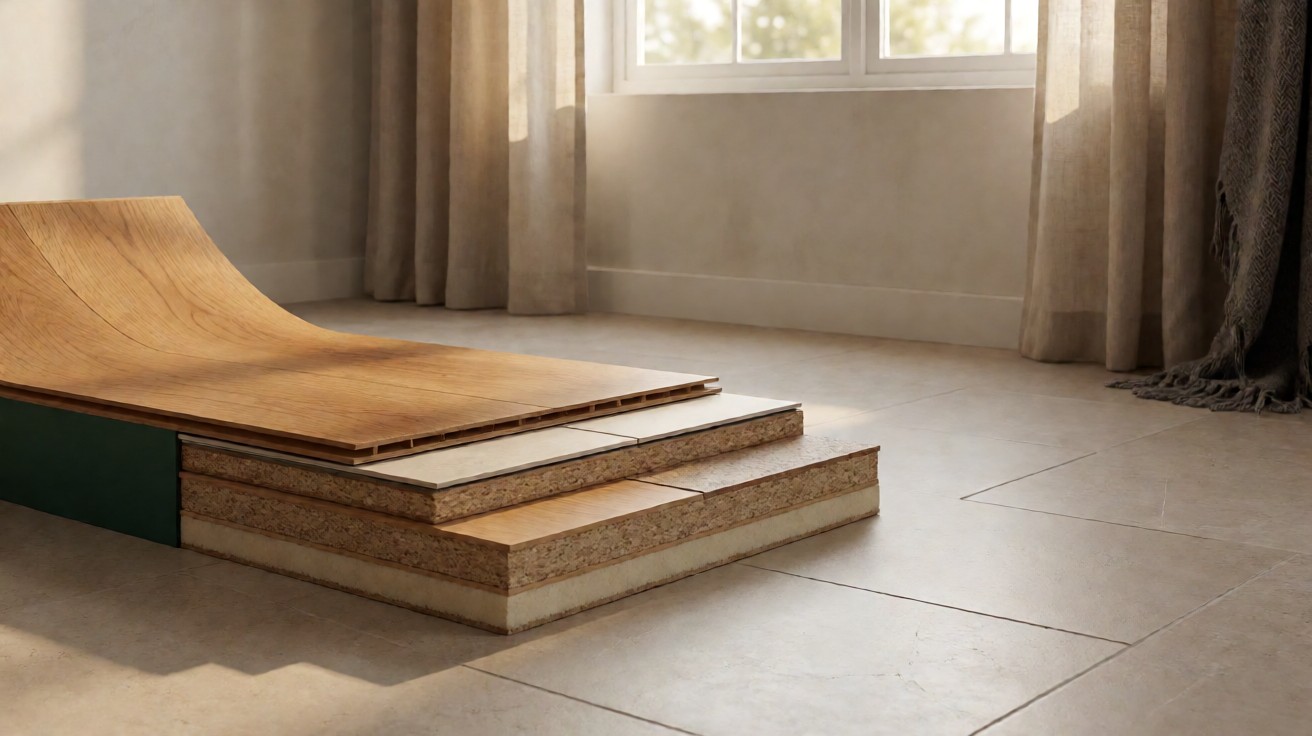

Laminate is a layered wood-product paper and plastic, and almost every behavior people complain about in a laminate floor comes from one of four layers.
Walk into a showroom and laminate looks like wood, feels like wood, and is sold like wood. Underneath the picture is a stack of materials that do not behave like wood at all. The top layer is a paper soaked in melamine resin and rolled with aluminum oxide.
Beneath it is the printed decorative paper, which is the pattern. Beneath that is the high-density fibreboard core, which is the bulk of the plank and the reason a laminate floor sounds hollow and swells when it gets wet. Underneath that is a balance paper or melamine backing that stops the plank from cupping once it is fused.
Once a buyer can name those four layers, the words “waterproof laminate” stop being a meaningful phrase, because the layer that absorbs water is also the layer that gives the floor its rigid structure.
The laminate flooring guide covers the material as a whole, and the AC rating explainer covers the wear-layer specification. This guide covers the entire four-layer stack and how it differs from solid wood or vinyl.
What a Laminate Floor Is Made Of
Reading the four layers in order is the cleanest way to understand laminate, because each layer has one job and each layer is responsible for a different floor behavior.
The wear layer takes the abrasion, so it decides how the surface holds up. The decorative paper is the look, so it is what the wear layer protects. The HDF core is the bulk of the plank, so it decides whether the floor feels solid or hollow. The backing is the balance, so it decides whether the plank stays flat.
Together those four layers describe almost everything about a laminate floor: how long it lasts, how it sounds underfoot, how it handles moisture, and how it compares to vinyl or hardwood.
The Wear Layer: Melamine and Aluminum Oxide
The wear layer is the topmost layer, and it is not what most buyers expect. It is not a finish applied on top of the board; it is a sheet of paper soaked in melamine resin and pressed onto the printed decorative paper as part of the manufacturing step. The melamine cures into a hard, clear plastic.
Most wear layers are also loaded with aluminum oxide particles. Aluminum oxide is a mineral used in industrial grinding wheels, and adding it to the melamine turns the wear layer into something genuinely resistant to scuffs and scratches.
The amount of aluminum oxide and the way it is distributed across the sheet are what separate one laminate from another at the durability level, beyond what the AC rating on its own tells you.
The wear layer sits on top of the floor and takes every step, every chair cast, every dragged toy. It is what the AC rating test measures, and it is what wears out first in normal use.
The Decorative Paper
Beneath the wear layer sits the decorative paper, and this is the layer that decides what the floor looks like. It is a high-resolution image of wood, stone, or tile, printed on a paper substrate. The pattern runs through the wear layer because the wear layer is transparent once it cures.
That is why a laminate floor can plausibly imitate oak, walnut, concrete, or marble while being a different product. The picture is on paper, and the wood is not wood. Two effects follow from this construction.
First, the pattern repeats, which is visible in cheaper products where the same grain shape reappears every few boards. Second, the wear layer protects the pattern by being clear, so the picture wears at exactly the same rate as the wear layer wears out.
The decorative paper is also the limit of what the wear layer can protect. Once the wear layer wears through, the paper shows, and the wear is irreversible because there is no wood underneath to refinish.
The HDF Core
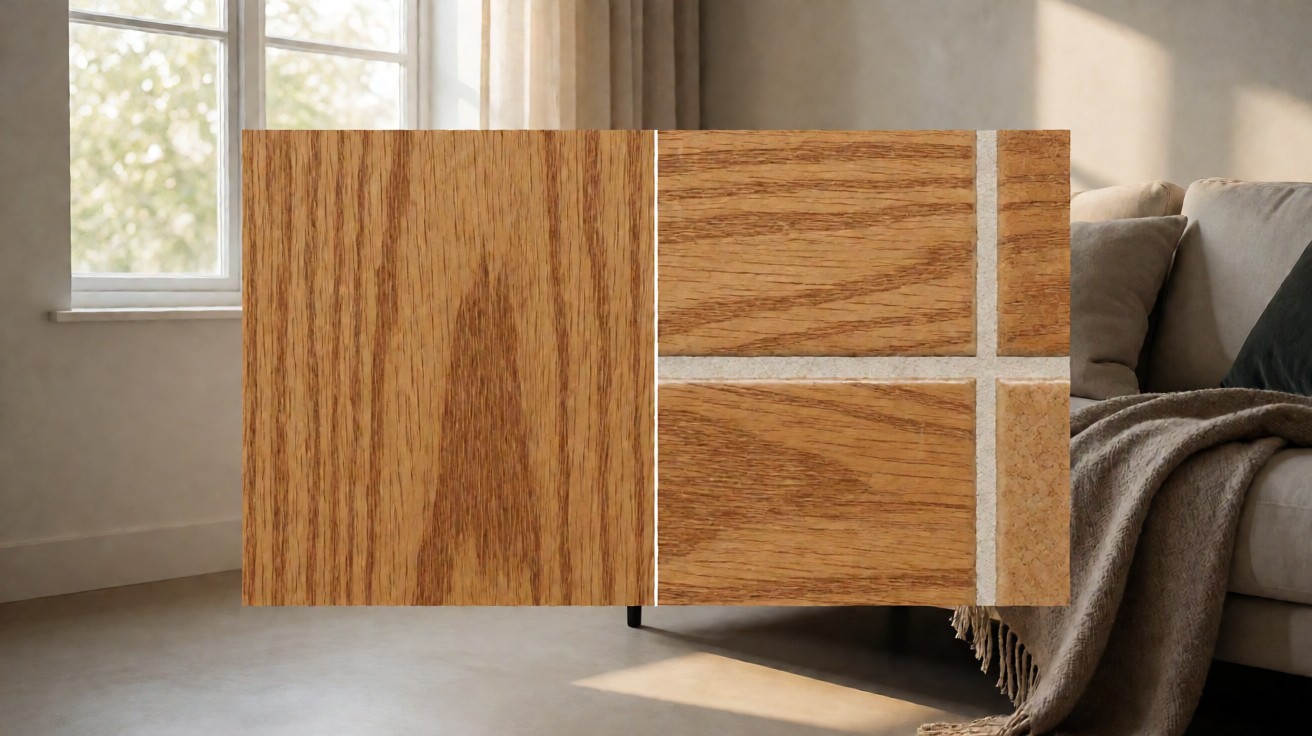
The HDF core, or high-density fibreboard core, is the bulk of the plank. It is made from finely ground wood fibres pressed with a resin binder under heat, and it is the layer that decides the structural behavior of the entire floor.
Because the core is wood fibres bonded into a rigid board, it gives laminate three properties at once: it makes the plank stiff, it makes the plank feel hard and dense underfoot, and it makes the plank noticeably hollow-sounding when walked on.
A cheap laminate floor and an expensive laminate floor feel different underfoot mostly because the core is denser and better milled, and an inexpensive engineered hardwood floor feels warmer because the plywood core absorbs more impact than HDF.
HDF is also where laminate gets its water sensitivity. The fibre matrix swells when it sits in standing water, and the swell is permanent because there is no grain for the fibres to return to. Plywood swells and recovers; HDF swells and stays swollen. This is why no laminate is genuinely waterproof despite what some marketing says.
The Backing Layer
The bottom layer is the backing, also called the balance layer. It is a melamine-saturated paper or a thin melamine sheet pressed to the underside of the HDF core.
It has two jobs. The first is mechanical: a melamine layer on both sides of the HDF keeps the core flat over time, because the wear layer on top and the balance layer underneath are tensioned together.
Without it the plank cups as it absorbs and releases moisture. The second is moisture protection: the backing slows water vapour movement from below, which is most relevant to installations over concrete slabs.
A good backing is invisible. A cheap or missing one shows up later as plank cupping in the middle of the floor and is one of the first things to inspect in a failed installation.
How the Layers Stack: HPL Versus DPL
The four layers are fused under heat and pressure, and there are two ways this happens.
High-pressure laminate (HPL) bonds the layers in a separate press and the resulting sheet is then glued to the HDF core. It is a harder, more durable product and is more common in commercial-grade and high-end residential laminates.
Direct-pressure laminate (DPL) fuses the layers together in a single press directly to the HDF core. It is faster to produce and is the standard for most residential laminate sold today. The visible difference between HPL and DPL shows up in dent resistance and edge durability rather than in the AC rating, and most residential buyers do not need to know the distinction.
‘
Where Each Layer Fails
Each of the four laminate layers has a different failure mode, and knowing which is which is how to read a warranty exclusion.
| Layer | What fails | Why |
|---|---|---|
| Wear layer | Wears through to the printed paper | Abrasion; covered by warranty in normal residential use |
| Decorative paper | Fades under UV over time | Direct sunlight bleaches the printed image |
| HDF core | Swells at the joints and chips at the cut edges | Standing water, or a subfloor that wicks moisture |
| Balance backing | Delaminates or curls | Improper subfloor or moisture migration through concrete |
Most exclusions on a laminate warranty reduce to a failure in the HDF core or the balance layer, and both are usually traceable to water rather than to mechanical wear. The wear layer failing is the rarest failure, and the printed paper fading is a slow and visible process that does not cause a structural problem.
Why HDF Makes Laminate Feel and Sound the Way It Does
The HDF core explains most of the things that distinguish laminate from wood underfoot.
The plank feels hard because the core is a fibreboard, not a natural wood with grain, and the wear layer on top is melamine plastic. Together they make a surface that does not give way at all underfoot.
The plank sounds hollow because the core is rigid and the layers above and below it are thin, so the floor transmits sound rather than absorbing it. This is one reason why a quality underlayment is mandatory under laminate: it absorbs the sound that the core is reflecting.
The plank is also stable once it is laid, more stable than solid wood, because the HDF does not move much with humidity. That is why laminate installs without expansion gaps on most walls, in long runs, and over radiant heat with much less fuss than solid hardwood.
Laminate Versus Vinyl Versus Hardwood, Layer by Layer
| Floor type | Wear surface | Core | Backing | Water handling |
|---|---|---|---|---|
| Solid hardwood | The wood itself, sealed | The wood itself | None | Sensitive to standing water |
| Engineered hardwood | Real wood veneer | Plywood | None or thin | Stable but veneer dictates limits |
| Laminate | Melamine with aluminum oxide | HDF fibreboard | Balance paper | Sensitive; HDF swells |
| Vinyl plank (rigid) | Clear wear film in mils | SPC or WPC composite | Foam pad | Waterproof |
| Vinyl sheet | Clear wear film in mils | PVC sheet | Felt or foam | Waterproof |
The cross-reference makes the laminate behaviour clearer: HDF is the unique layer and it is the limit. A floor that looks like laminate, wears like laminate, and feels like laminate but does not swell in water is not laminate, it is a vinyl plank with a printed film. The four layers make the trade visible.
Reading a Laminate Spec Sheet
Three things on a laminate spec sheet are worth checking first.
The AC rating (AC1 to AC6) tells you the abrasion class of the wear layer, and the AC rating explainer walks through that decision.
The total thickness in millimetres tells you how thick the plank is, which is usually 7 to 12 millimetres in residential product and a thicker plank sounds and feels denser. And whether the product is HPL or DPL is worth knowing for higher-traffic areas.
A long warranty is not a quality signal. Most laminate warranties cover against staining and against wear-through of the decorative layer under normal residential conditions, and they exclude water damage, which is the most common failure. The warranty is supporting evidence, not the spec.
Is laminate flooring made of real wood?
Partially. The HDF core is real wood fibres ground and pressed into a board, but the visible surface is a melamine-impregnated paper with a printed pattern and a transparent wear layer on top. There is no wood in the layer you walk on, which is why a laminate floor cannot be sanded and refinished the way a solid or engineered hardwood floor can.
Why does laminate flooring sound hollow?
The HDF core is dense and rigid, and the layers above and below it are thin, so sound passes through rather than being absorbed. A good underlayment underneath the floor takes most of the sound out, and a thicker plank (10 or 12 millimetres rather than 7 or 8) sounds denser because there is more material to absorb the impact.
Can laminate flooring ever be waterproof?
The fibreboard core swells in standing water, so a floor with a real HDF core cannot be made waterproof. Some products reduce this by sealing the edges of the planks or by using a water-resistant core formulation, and those products hold up better to a spill that is wiped up quickly.
They are not, however, waterproof in the way a vinyl plank is, and they should not be installed in a wet room on the assumption otherwise.
How This Fits With the Rest of the Choice
This page covers what laminate is built from. It does not cover the AC rating on its own, the wear layer spec, or how laminate compares to vinyl or hardwood.
For the material as a whole, the laminate flooring guide is the reference. For the wear layer and its rating, the AC rating explainer is the page to read. And if you are weighing laminate against the other flooring families, the material comparison sets them side by side.