
You have hardwood in the hall, tile in the bath, and carpet in the bedrooms, and you want all three of them to still look good in ten years from today.
The answer is simpler than it looks. The water level has to match the surface layer, and the product, the frequency, and the equipment all follow from that one rule.
Different floors fail in different ways. A damp mop is fine on sealed tile and can ruin an oiled wood floor, while a soaked pad on laminate pushes water to the edge where the plank swells. The method comes first, then the product.
What cleaning actually does to a floor
Cleaning is not really about dirt. It is about grit, oil, and water, because those three are what shorten the life of a floor. A vacuum removes grit before anyone walks on it, and that one habit does more for a finish than any product bought later.
Grit underfoot is abrasive. A single grain of sand dragged across an oak plank by a shoe sole works like sandpaper on a dulling wheel, and the dulling happens long before the finish is visibly worn through.
Water is the second half of the problem. When moisture reaches a seam, it swells the core, lifts the edge, and changes the dimension of the material. A plank that has moved cannot be cleaned back into place, and the fix becomes replacement rather than maintenance.
The useful question is not which cleaner looks best on a shelf. It is how much water the surface layer can take, and how fast the floor can dry if something spills. The finish type and the material underneath it set that limit.
Dirt is the symptom. Grit and water are the cause.
The four cleaning methods and how far each one goes
How far does each cleaning method actually go?
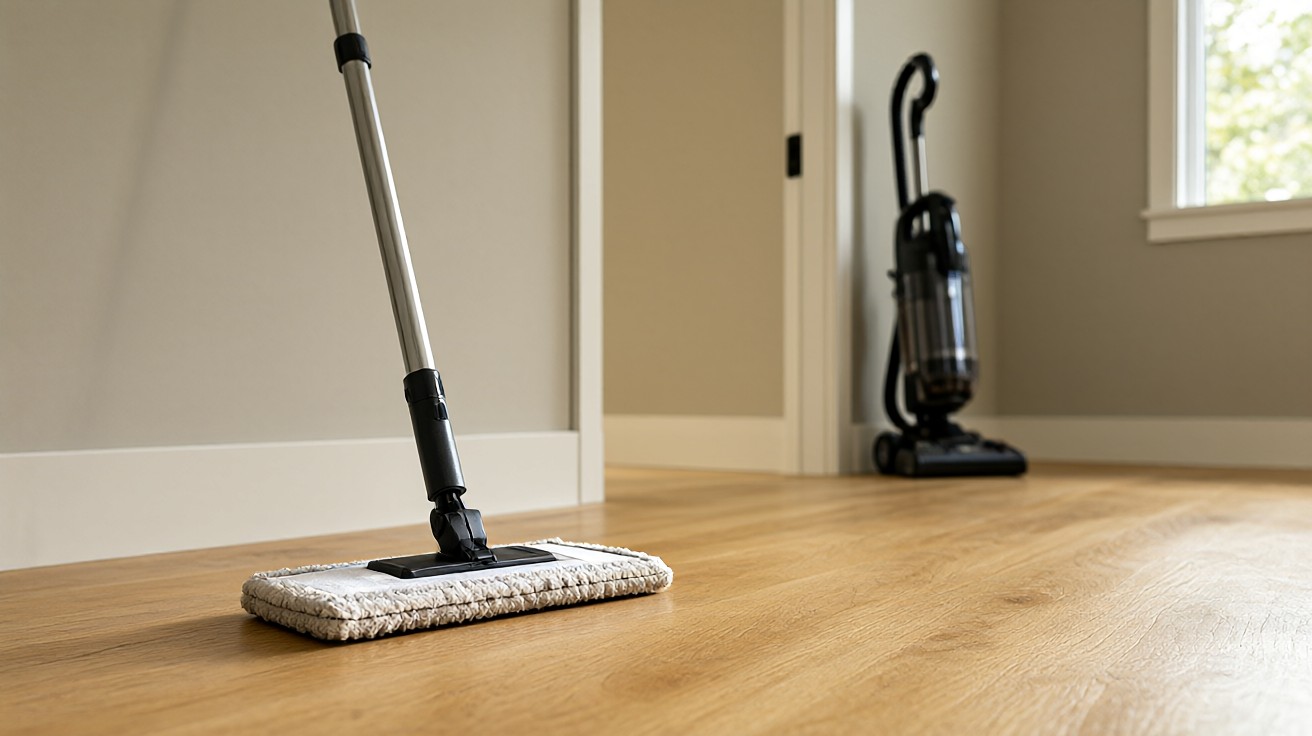
There are four levels of cleaning, and the only thing that separates them is how much water reaches the floor. The first is dry cleaning, which uses no liquid at all: a vacuum with a brush or felt head, a dust mop, or a dry microfiber pad.
The second is damp mopping, which lays a controlled amount of moisture on the surface. It lifts a thin film of grime and leaves the seams essentially dry, and it is the routine most wood floors are built around when the finish allows it.
The third is wet mopping, which saturates the surface and floods the joints. A sealed, impervious floor can absorb that if it dries properly, but most wood, laminate, and cork floors cannot, because the water goes straight to the core.
The fourth is steam cleaning, which heats water into vapor and drives it into the surface under pressure. It is the most aggressive of the four methods and the least forgiving, and the hardwood industry advises against it almost without exception.
Past dry cleaning, every method is a decision rather than a default.
| Method | Water reaching the floor | Where it fits |
|---|---|---|
| Dry cleaning | None | Any finished floor, and every floor before any wet method |
| Damp mopping | A controlled film | Factory-finished wood, laminate, and resilient floors that allow it |
| Wet mopping | Enough to flood the joints | Sealed tile and sealed resilient floors only |
| Steam cleaning | Vapor driven under pressure | Sealed hard surfaces and grout, never wood or laminate |
Matching the method to the material
Which method does your material allow?
Start with the weakest link in the floor. The surface layer is what water and chemistry hit first, and everything below it, the adhesive, the core, the pad, is more sensitive. If the finish tolerates water, the rest of the build can usually be managed with drying time.
On solid and engineered wood, the limit is the finish and the seam. On laminate and many engineered constructions, the limit is the particleboard or fiberboard core, which swells irreversibly once it takes on water. On resilient floors the limit is the wear layer and the adhesive.
Tile looks like the most forgiving material, and mostly it is, because the body of the tile does not absorb. The weak points are the grout and the sealer. If the grout is unsealed, a wet mop carries dirty water into the joint instead of lifting it out.
For luxury vinyl plank and sheet vinyl, the finish is a factory coating over a wear layer, so the real limit is the seam and the adhesive. If the floor is click-lock, water that sits at the edge has nowhere to go and stays there.
Carpet is the opposite case. The fiber tolerates moisture, but the padding and the subfloor do not, and a soaked pad keeps a wet pocket against the slab for weeks. A carpet routine is mostly about extraction and drying speed.
Once the water limit is known, the product choice gets easy. The step-by-step routine for vinyl plank, including the mop pad and cleaner that suit the wear layer, is set out in the guide to cleaning LVP floors.
What each material tolerates and what voids a warranty
A manufacturer warranty is a written promise about what a floor will tolerate, and most of them are voided the moment you use a product they did not approve. Read the care document that came with the floor before you buy a cleaner, not after.
Mohawk cleaning and care guidance is blunt about wood. The guidance says to never damp mop wood flooring unless it is covered by a Wet Resistance Warranty or greater wet warranty, and to never steam mop wood flooring unless it is covered by a Steam Mop Warranty.
The same document rules out flood mopping, because mop water may damage the floor and leave spots. It warns against pouring liquid directly on the floor, against an excessively wet mop, and against letting liquid puddle or stand as moisture on the floor.
Bruce and Armstrong go further for hardwood, laminate, and WPC products: do not clean with water or steam, because it may permanently damage the floor and may void the warranty on your hardwood or laminate floor.
The same guidance bars ammonia-based cleaners, acrylic finishes, wax-based products, detergents, bleach, polishes, oil soap, abrasive cleaning soaps, and acidic materials such as vinegar, since many of them can pit or etch the finish.
Those patterns repeat across products and across finishes, so the tolerances of solid wood, its wear layer options, and its care requirements are covered in depth in the hardwood flooring guide.
| Material | Routine that is safe | Limits and warranty triggers |
|---|---|---|
| Solid and engineered wood | Vacuum, then damp mop only if the finish allows it | Never damp mop without a Wet Resistance Warranty, never steam mop without a Steam Mop Warranty |
| Laminate and WPC | Vacuum or dust mop, and a barely damp cloth | Do not clean with water or steam, and keep moisture out of the seams |
| LVP and sheet vinyl | Damp mop with a neutral pH cleaner | Avoid abrasive cleaners and solvents, and keep standing water off the seams |
| Ceramic and porcelain tile | Damp mop, and wet mop on sealed surfaces | Keep water out of unsealed grout, and rinse and dry the joints |
| Natural stone | Damp mop with a neutral pH cleaner | Acids such as vinegar etch the surface, and an abrasive cleaner dulls it |
| Cork | Vacuum, then damp mop with a barely damp pad | Standing water swells the material quickly |
| Carpet | Vacuum, then extract and finish with a dry pass | Rotary equipment is not recommended, and most makers advise rinsing with water only |
| Polished concrete | Dust mop, then damp mop | Keep acidic cleaners off the surface |
Neutral pH cleaners and why the label matters
A neutral pH cleaner sits close to 7 on the pH scale and is built to clean without etching a finish. Wood floors are usually protected with a urethane, acrylic, or wax layer, and those coatings react badly to anything acidic.
Reading the label beats guessing, because damage from the wrong chemistry shows up slowly. A finish that is etched or dulled holds dirt in the micro-scratches, and from there every pass spreads the problem a little further across the floor.
An abrasive cleaner is the other half of the label problem. Powders, grit additives, and scouring soaps leave scratches that never come out, and they also strip the finish until the underlying layer starts to look different from the unworn areas.
If a product says it is for scrubbing, it is not for a finished floor. If it lists ammonia, bleach, wax, or vinegar, leave it in the closet and pick up something labeled neutral and rinse-free instead.
The label is the specification. Read it before the bottle is opened.
Dry cleaning versus wet cleaning
Should the first pass always be dry?
The first pass should always be dry, whatever the material. Vacuuming or dust mopping first removes grit that a wet mop would merely spread around and press into the seams. On carpet this matters even more, because grit left in the pile is what wears the fibers down.
The vacuum itself has to be the right kind. The head must be brush or felt, and a wand attachment is preferable. Vacuums with beater bars or hard heads are not for finished floors, because they drive grit into the finish and scratch it.
Bentley Mills gives the clearest numbers for carpet and high-traffic floors. For high-traffic areas, slow the vacuum to approximately 1.8 feet per second and make a minimum of four passes, two north-south and two east-west.
For moderate traffic, two passes are enough, and strokes should be no longer than 2 to 3 feet. Longer strokes slow the work down and let the vacuum’s suction fade before the grit is pulled off the fiber.
On carpet, work with the pile direction rather than across it, and start at the farthest point from the doorway and work back toward the door, so you can step out when you finish.
Vacuum, sweep, or dust mop a wood floor once a week, or more if needed, and treat the entryway mat as part of the floor rather than as furniture. Mats collect grit before it reaches the finish, and they are cheap to clean.
Where steam does not belong
Is steam ever the right answer?
On wood, the answer is no. The American Cleaning Institute reports that, as a general rule, the hardwood flooring industry does not recommend using steam mops on wood floors of any type, because using other products and machines will void the warranty.
The advice is to contact the manufacturer of your flooring to get their cleaning recommendations, which is also the fastest way to find out whether a specific warranty has been extended to steam or wet resistance.
Steam also has a physical cost on wood. Vapor under pressure drives moisture into the seams of every plank, and on engineered construction it reaches the core layer, where the damage stays hidden until the floor has already cupped.
Tile is different, because the body of the tile and the grout can take a wet cleaning when the grout is sealed. Even there, keep the machine moving and stay off the sealer, because a damaged sealer lets water into the grout line.
The same caution applies to laminate, where the core is a fiberboard that does not recover from water, and to cork, which absorbs quickly and swells. If a floor is not sealed tile, treat steam as a tool for spills rather than as a routine.
No steam on wood. No exceptions.
Matching the routine to the finish
What does the finish type change?
The finish type sets the water limit, and it is the first thing to identify on a floor that is already installed. Factory-finished floors carry a coating applied under controlled conditions, and site-finished floors carry one applied in the room, so both wear differently.
A factory finish is generally more forgiving, because it was cured and inspected before it reached your house. A site-applied finish is the more common failure point, because the last coat went down in the room where the floor lives.
Oil finishes and wax finishes are the least forgiving of all, since both are penetrated surfaces with no film to seal them. A damp mop on an oil finish lifts the oil rather than the dirt, and no amount of drying brings it back.
On resilient floors, the finish protects a wear layer, and that wear layer is what gives the floor its service life. Cleaning that dulls or scratches the surface shortens that life, so an abrasive cleaner in the wrong bottle matters more than the mop.
The routine that suits a floor is therefore a function of the finish, not only of the material. If the finish is film-forming, damp mopping is usually fine. If it is penetrating or open, then dry cleaning is the safer default.
| Finish type | What it tolerates | Routine that fits |
|---|---|---|
| Factory-applied film finish | Damp mopping, no steam | Vacuum weekly, then damp mop with a neutral pH cleaner |
| Site-applied film finish | Damp mopping with care | Vacuum weekly, then damp mop, and keep the mop barely damp |
| Penetrating oil finish | Dry cleaning only | Vacuum or dust mop, and spot clean with a barely damp cloth |
| Wax finish | Dry cleaning, minimal water | Dust mop, and renew the wax rather than washing the surface |
| Coating over a wear layer | Damp mopping, sealed surfaces only | Damp mop, and never use an abrasive cleaner |
Cleaning routines for high-traffic and wet rooms
What changes in a kitchen, bath, or entryway?
Traffic changes the frequency, not the method. The method that works in a bedroom works in an entryway, and the only difference is that an entryway gets vacuumed every day instead of once a week. High-traffic carpet needs the slower vacuum pass described earlier.
Rugs do more than protect. Area rugs are recommended in front of kitchen sinks, at all pivot points, and within high-traffic areas, but they must be made of a breathable material to prevent moisture entrapment under them.
Avoid rugs with solid rubber or vinyl backings, because they trap moisture against the floor and hold it there. If a rug sits on a floor that gets wet, lift it and dry both the rug and the floor underneath rather than putting it straight back.
Wet rooms are the case where speed matters more than any product. Mold will not grow if wet or damp items are dried within 24-48 hours, and hard surface flooring should be vacuumed or damp wiped with mild detergent and allowed to dry.
If carpet takes water, remove it with a wet vacuum, pull the carpet and pad off the floor, and dry with a fan and a dehumidifier. That sequence matters because the pad is what holds the water against the slab.
Drying beats cleaning. It is the only step that cannot be skipped.
The maintenance schedule that keeps the routine short
What belongs on a recurring schedule?
A maintenance schedule works because it keeps decisions out of the day-to-day routine. Vacuum or sweep once a week, or more if needed, spot clean as soon as something spills, and check the low points of a room where grime collects.
Control the room, not just the floor. Per the NWFA Installation Guidelines, appropriate conditions for solid wood are an interior environment controlled to stay within a relative humidity range between 30 percent and 50 percent, and a temperature range between 60-80 degrees Fahrenheit.
The same guidelines explain why those numbers are not universal. Some manufacturers intentionally produce flooring at higher (8-13 percent) or lower (4-9 percent) moisture content levels to accommodate different regions, and in some climates the ideal average humidity range can be higher (45 percent to 65 percent) or lower (20 percent to 40 percent).
Keep the relative humidity in your home between 30 percent and 50 percent, protect the floor from direct sunlight, and keep animal nails trimmed to minimize finish scratches. Those three habits cost nothing and prevent most of the complaints that show up later.
If the floor is in a region where the manufacturer’s moisture content spec is higher, then the interior humidity target shifts with it. Ask the manufacturer for the range that applies to your product and your climate, and hold to that.
Write the schedule down, then follow it.
What not to put on any floor
Some products are a problem on every material, so keep them out of the house entirely. Ammonia-based cleaners, wax-based products, detergents, bleach, polishes, oil soap, abrasive cleaning soaps, and acidic materials such as vinegar will pit or etch a finish.
On wood, the habit to break is pouring liquid directly on the floor. Mohawk guidance says not to do it, not to use an excessively wet mop, and not to allow liquid to puddle or leave moisture standing on the floor.
Allow the floor to dry completely before replacing interior mats, because a mat replaced early holds moisture against the surface and blocks the airflow that finishes the drying.
On carpet, the CRI 205 Residential Carpet Standard is the reference. It says to vacuum thoroughly to remove dry soil first, begin at the farthest point from the doorway, and work back toward the door so you can step out when finished.
It also requires extracting as much of the water as possible by making a dry pass after the initial wet pass, and it notes that multiple dry passes may be necessary and that this step should not be rushed.
Wait until the carpet dries before replacing the furniture or walking on it, which can take 6-12 hours, and place plastic or foiled tabs under furniture legs to prevent color transfer to the carpet.
Do not add other chemicals to the extraction water. Most carpet manufacturers recommend pre-spraying and rinsing with water only, and rotary equipment is not recommended for carpet cleaning.
The CRI Seal of Approval program certifies carpet cleaning solutions, equipment, and systems against published criteria including cleaning efficacy, pet urine and food removal, rate of resoiling, pH, optical brighteners, and colorfastness.
Read the label before you buy, not after the damage.
Where to go for the full routine on your material
This guide sets the decision layer: the water level a material can take, the finish that governs it, and the products that void a warranty. The daily routine for each material is long enough to deserve its own guide.
For laminate and WPC floors, the laminate flooring guide sets out the routine that keeps the core dry, and what to do about a plank that took on water.
For carpet, the carpet flooring guide covers pile direction, extraction passes, drying time, and the furniture tabs that prevent color transfer.
If the floor is already installed and the finish is unclear, start with the care document from the manufacturer and match the method to the water limit. If the floor is not installed yet, pick the finish first and the routine follows from it.