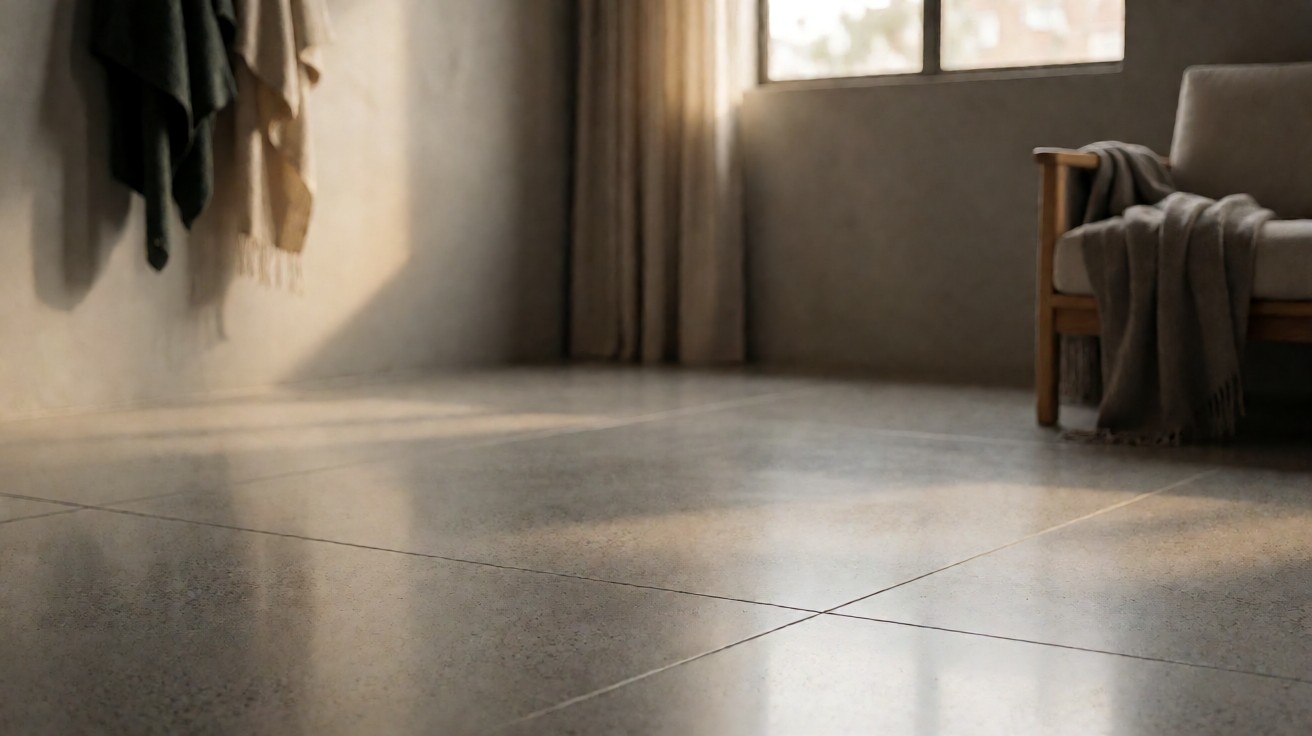

Polished concrete flooring is a concrete slab ground and refined until it reads as a finished floor, which is why it produces almost no demolition waste. There is no plank to lay, no underlayment to cut, and no old floor to haul away: the slab that was under the previous floor becomes the floor. That single fact is the reason polished concrete is the lowest-waste hard flooring available, and it is also the reason it is the most unforgiving hard flooring to live with. Concrete has no finish layer to hide behind. Every crack, every patch, and every colour variation in the slab is the finish, permanently, and the installer’s job is entirely in preparation.
What Polished Concrete Actually Is
Polished concrete is achieved by mechanically grinding a concrete slab through progressively finer diamond abrasives, typically from 30 grit up to 800 to 3,000 grit, and then optionally applying a penetrating densifier and a stain or dye. Grinding hardens the surface layer by exposing and polishing the cement paste rather than the aggregate beneath it, which is what produces the characteristic sheen. The process removes between 1/32 and 1/16 inch of surface, so it is genuinely a refinement of the slab rather than a coating applied over it.
This matters for the buyer because there is nothing to delaminate. A sealed concrete floor is not a finish sitting on a floor; the floor is the concrete, and the sealer only fills the porosity. A scratched polished floor can often be spot-repaired by grinding just that area back and re-polishing it, and a damaged section of slab is the only thing polished concrete cannot fix. The terrazzo versus concrete comparison covers how this relates to the poured-chip alternative, which shares the substrate but adds a visible aggregate layer.
| Gloss Level | Final Grit | Appearance | Maintenance Profile |
|---|---|---|---|
| Satin | 800 grit | Soft sheen, hides dust well | Easiest; dust does not show |
| Semi-gloss | 1,500 grit | Reflective but not mirror | Moderate; shows scuffs faintly |
| Polished | 3,000 grit | Near-mirror reflection | Most demanding; shows everything |
The Gloss Level Decision
The grit the contractor finishes at determines how much of the aggregate shows through and how much the floor behaves in daily use. Grinding only to 400 or 800 grit leaves a matte surface with almost no reflection, which is arguably the most forgiving option in a lived-in home because it hides dust, tracked grit, and light scratches that a reflective surface shows immediately. Finishing at 1,500 to 3,000 grit produces the reflective appearance most people picture when they hear polished concrete, and it is also the surface that shows every footprint, every scuff, and every streak from a mop left behind.
For a residential entry hall or a main living area, satin at 800 grit is usually the better long-term choice than a high polish. For a showroom-grade main room in a designed home, a high polish is defensible and will look excellent in photographs. For any room with pets, children, or wet weather tracked in, satin is the only realistic option. The gloss level is a daily-use decision dressed as an aesthetic one, and it is worth making with the maintenance schedule in mind rather than with a sample board.
Densifier, Stain, and Colour
A concrete slab is inherently porous and, when ground, becomes more porous still. Every polished concrete floor therefore starts with a lithium silicate densifier, which reacts with free lime in the cement paste to form additional calcium silicate hydrate and hardens the surface against dusting and staining. This is the single most important step in the process, and a floor that has been ground beautifully but not densified will powder underfoot within months and stain permanently with the first spill.
Colour comes in two forms. Concrete dye is a translucent, water-based pigment that soaks into the surface and produces a mottled, clouded variation that reads as concrete rather than as paint. Concrete stain is an acid-reactive stain that chemically alters the surface and produces a more variegated, earthier effect with genuine depth in the variation. Both are integral to the slab rather than surface films, so both fade rather than peel. Over the life of the floor, expect the dye colour to soften by perhaps 20 to 30 percent in the first two years, particularly in traffic lanes, and expect a periodic re-dye in those lanes to be part of maintenance rather than a failure.
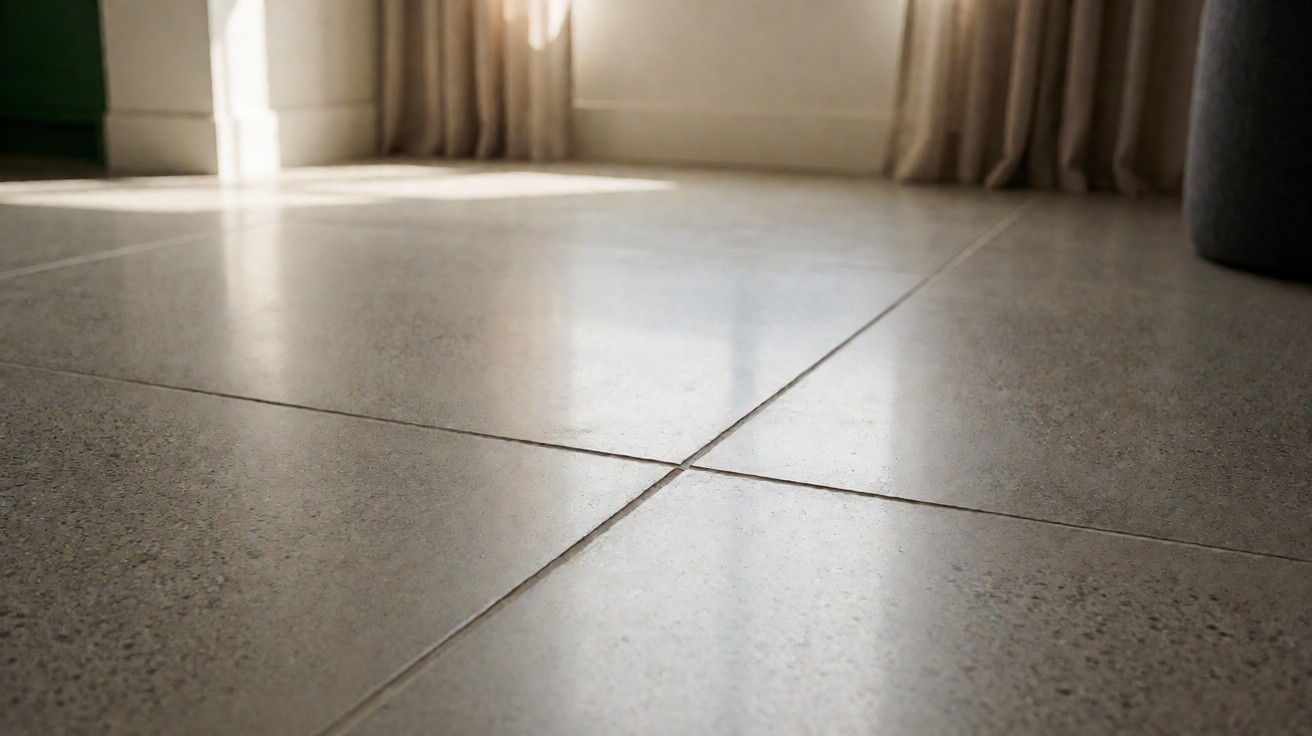
Subfloor and Slab Conditions That Decide the Result
The slab is the finish, so slab conditions that would be irrelevant under a plank become the entire design. A slab with a patched area shows the patch as a different colour and a different porosity, permanently, and there is no way to grind one patch to match another. A slab with a construction joint shows the joint. A slab that was poured badly and has surface scaling, dusting, or soft spots will grind unevenly and never reach a uniform gloss. All three are visible in a finished polished floor and none of them can be corrected afterwards.
This is why a polished concrete specification should include a slab assessment before grinding begins, not after. The contractor should walk the slab, identify the patches, joints, and any areas of previous repair, and either price their treatment or decline the job. A contractor who quotes a polished concrete floor sight unseen, without seeing the slab, is guessing at the single variable that determines whether the project succeeds.
Where Polished Concrete Belongs in a Home
Polished concrete is at its best where a hard, cool, reflective surface is an advantage and where the architecture already communicates the volume: main living areas in an open-plan home, a loft, a converted basement, a large entry hall, and a kitchen in a house where the slab was poured well. It handles foot traffic better than any wood product, it handles water better than wood, it needs no waxing and no recoating, and a fifty-year-old slab can be reground and refinished at any point in its life.
It is a poor choice for a bedroom, a child’s room, or any space where the comfort of the floor is the point: concrete is hard and cold, and it will transmit impact noise rather than absorb it. It is also difficult under a home with pets in a room where claws and tracked grit are constant, because the surface shows scratches and the saw cut joints collect debris. The honest summary is that polished concrete is a material chosen for how it looks and how little it needs, which makes it excellent in a designed space and a poor compromise in a family room.
| Room | Suitability | Reason |
|---|---|---|
| Open-plan living area | Excellent | Reflective surface reinforces volume; low maintenance |
| Loft or converted basement | Excellent | The slab is already the visual language of the space |
| Entry hall | Excellent | Handles grit and foot traffic indefinitely |
| Kitchen | Good | Water-tolerant, provided the slab is sealed |
| Bedroom | Fair | Hard and cold; comfort is not its strength |
| Child’s room | Poor | Hard surface, cold surface, little forgiveness |
| Bathroom | Poor | Sealing is critical and slip resistance must be specified |
Slip Resistance and Wet Areas
Polished concrete is inherently slippery when wet, and this is the safety issue that most buyers do not consider. A high-gloss polished floor in a wet area is a slip hazard, and the sealer and wax schedule that makes it look good is exactly what makes it slippery when wet. For a bathroom or an entryway that gets wet in winter, the specification should call for a slip-resistance additive in the sealer and a lower-gloss finish, and the surface should be textured rather than mirror-smooth. DCOF values under ANSI A326.3 are the way to verify this, and the answer should be in the specification rather than assumed. The threshold in that standard is a measured wet DCOF of 0.42 or greater for a level interior space expected to be walked on when wet. Below that, the standard treats the surface as suitable only where it will be kept dry when walked upon. The standard also states plainly that a DCOF figure is a comparison tool and is not by itself a prediction that a floor will not slip, because contamination, drainage, footwear, and maintenance all move the number in service.
For a kitchen, the same concern is much smaller, because kitchen floors get water briefly rather than continuously. What does matter in a kitchen is staining: an unsealed polished slab will take a wine or oil stain in a way that no coating on any other flooring type does. If the slab is polished, it needs the densifier and the sealer, and the sealer needs a maintenance schedule.
Cost and Installation
Polished concrete costs between $4 and $12 per square foot installed, depending entirely on the condition of the slab. A new, well-poured slab with no patching grinds and finishes at the lower end. An old slab with several patches, previous adhesive residue, or a failed coating grinds slowly and needs more steps to reach an even gloss, and that is where the cost climbs. Adding a dye adds material cost but no labor. Installing a new slab specifically to polish it later is rarely economical: the two operations together cost more than a good engineered floor, which is the comparison worth making before choosing this route.
The labor is the bulk of the cost and it is a grinding crew with large diamond-impregnated machines, not a flooring installer. That has two practical consequences: the work cannot be done in a lived-in house without significant disruption, and the contractor needs access to power and water on the slab itself. Both are worth confirming before signing rather than discovering during the work.
Polished Concrete Versus Alternatives
Against microcement and resin flooring, the distinction is the substrate and the thickness. Polished concrete refines an existing slab and removes material; microcement is a cementitious coating applied over a substrate, typically 2 to 3 mm thick, which allows a completely uniform colour but adds a layer that can delaminate. Both look similar in a photograph. They differ substantially in what happens when something goes wrong.
Against engineered hardwood, polished concrete wins on longevity, water tolerance, and zero maintenance, and loses on comfort, warmth, acoustics, and resale perception. Against polished porcelain or large-format tile, the two are visually close; the tile is easier to install over a bad slab, gives a grout line to hide slab joints, and is far more forgiving if the slab moves. The tile can be replaced in sections. A slab cannot.
Maintenance Over a Fifty-Year Life
A properly densified and sealed polished concrete floor needs almost nothing, and that is genuinely its strongest practical argument. There is no wax schedule, no recoating interval, no buffing, and no finish to strip. A dry dust mop or a vacuum with a hard-floor setting handles ordinary traffic, and a damp mop with a pH-neutral cleaner handles anything wet. Most owners end up sealing once after installation and then resealing every three to five years as a routine measure, which is optional rather than required if the floor has not worn.
The two things that do degrade a polished floor are unneutralised cleaning chemicals and grit. Acidic or high-pH cleaners etch the cement paste and will eventually dull the surface, and tracked grit under shoes acts like sandpaper on a hard floor. Both are avoidable with ordinary discipline. The one genuinely unavoidable change is colour: dye fades in traffic lanes over roughly five to seven years, and if the floor is dyed, a periodic re-dye in those lanes is normal maintenance rather than a defect. Undyed densified floors do not have this issue and are the choice for anyone who does not want to think about appearance for a decade.
Choosing and Specifying a Polished Concrete Contractor
The selection question is entirely about the slab assessment, and it should be the first thing discussed rather than the last. A contractor should visit, look at the slab, and tell you honestly whether it is a good candidate. Some slabs are not: heavy scaling, an uneven cure, an unpatched repair, or a slab that was poured over soft fill cannot be ground to an acceptable result, and a contractor who takes the job anyway is telling you something important about their standards.
Ask for the grit sequence they intend to use, whether the densifier is lithium silicate, what the sheen level will be, what the sealer spec is, and whether the price includes the stain or only the grind. Ask whether they have ground that specific slab type before, and whether they can show you a completed job in a building of similar age. The final question worth asking is what they recommend if the slab does not grind evenly, and the quality of that answer predicts the quality of the project better than anything else on the list.