
Carpet is the only common flooring that installs as a complete system. A roll of carpet is face fiber, a backing, and a layer of cushion or padding, all fastened to the subfloor as one assembly. That is why two carpets of the same fiber, the same color, and a similar price can wear so differently. One keeps its appearance in a hallway for fifteen years. The other goes bald at the door in three.
The deciding variables are rarely the fiber name on the sample board. They are construction (cut pile or loop pile), how tightly the yarn is twisted and bound to the backing, how dense the pile actually is, and what sits under it. Fiber content matters, but it is one variable among several rather than the whole story.
This guide walks through what a carpet is made of, how the five common fibers behave, how to read the specification sheet, how cushion grade and thickness change the feel and the life of the floor, what stain resistance does and does not promise, what installation and subfloor preparation actually require, and what a carpet project costs today.
What Carpet Is Actually Made Of
Every carpet has three working layers, and each one can be specified separately.
The face or pile is the part you see and walk on. It is the yarn tufted into the backing, and it is described by fiber content, pile height, construction style, and density.
The backing is what holds the tufts in place. Backs are made from jute (the natural fiber classic in broadloom), polypropylene, vinyl, or polyurethane, sometimes with a stabilizing layer. The backing carries the tension created during installation and distributes load across the subfloor.
The cushion, also called padding or underlayment, sits between the backing and the floor. It absorbs the impact of foot traffic, adds the softness you feel underfoot, protects the backing from the substrate, and it is the layer most often underspecified in a carpet job. A good carpet on a cheap cushion will feel mediocre and wear faster than the same carpet on a proper one.
Because all three layers are fastened together, they are normally treated as one assembly. Federal law requires that fiber content be disclosed on the label, and the FTC rules under the Textile Fiber Products Identification Act (16 CFR Part 303) specifically address this. Rule 303.11 covers floor coverings that contain backings, fillings, and paddings, and requires the fiber disclosure to be stated so that it clearly applies only to the face, pile, or outer surface rather than to the backing or padding. A compliant label reads something like “100% Cotton Pile” or “Outer Surface, 100% Wool.” If a sample board tells you nothing about the pile, ask for the fiber content disclosure in writing before you buy.
Cut Pile, Loop Pile, And Cut And Loop Styles
Construction describes how the yarn is formed on the backing, and it is the single biggest factor in how a carpet looks and wears.
| Style | How The Yarn Is Formed | Texture And Wear | Where It Fits |
|---|---|---|---|
| Level Loop | Uncut loops of uniform height | Clean, ribbed rows; hides soil well; very durable | Bedrooms, dens, low-traffic rooms |
| Multi-Level Loop | Loops at varying heights | Patterned, sculptural surface with good durability | Family rooms, main living areas |
| Level Cut | Sheared loops of uniform height | Soft, velvety, shows shading and seams more readily | Bedrooms, low-traffic formal areas |
| Multi-Level Cut | Sheared pile at varying heights | Bolder pattern, strong visual texture | Main living rooms, family rooms |
| Saxony (Tip Sheared) | Angled yarn tips sheared at the ends | Fine, subtle texture; the most refined cut pile look | Formal living rooms, low traffic |
| Cut And Loop | Loops and cut pile in the same roll | Patterned surface combining durability and softness | Whole-home installs, mixed traffic |
| Berber (Loop) | Tight, small loops, often with flecking | Very durable, easy to vacuum, shows wear patterns fastest | Hallways, stairs, basements, high traffic |
The Carpet and Rug Institute is direct about which of these variables decide durability. Its guidance is that regardless of fiber, the construction of the carpet is what makes it durable. For heavy traffic, CRI recommends a dense construction, meaning you should not be able to see or feel the backing through the pile. Shorter pile heights perform better in heavy traffic areas such as entryways, stairs, halls, and playrooms, so a pile height of one half inch or less is the durable choice in those spaces. For cut pile, a tighter twist holds up better than a looser twist. For Berber, smaller and tighter loops outlast larger, looser ones.
Carpet Padding And Why It Matters Most
Cushion is the cheapest part of a carpet job and the one most often reduced to save a few dollars per square yard. Density is the key property, and the Carpet Cushion Council defines it simply: density equals weight divided by thickness, measured in pounds per cubic foot. A heavy cushion that is thin can be dense; a light cushion that is thick is not.
There are three basic cushion families: foam, fiber, and rubber. Foam includes prime polyurethane (a firmer version of the cushioning used in furniture and seats), bonded polyurethane also called rebond, which is made by bonding chopped foam scrap into a single sheet, mechanically frothed polyurethane applied like a coating, and polyolefin foam produced by extrusion. Fiber cushion covers synthetic fiber, resinated recycled fiber, and textile fiber. Rubber cushion comes as flat and rippled sheet, and polyethylene foam is a further option.
The Carpet Cushion Council publishes minimum recommendations for residential use, revised July 15, 2024, which HUD has adopted under UM 72a as its cushion requirement for FHA-financed housing. Class 1 covers light and moderate traffic, meaning living rooms, dining rooms, bedrooms, and recreational rooms. Class 2 covers heavy duty traffic such as lobbies and corridors in multifamily facilities, plus all stair applications. Class 2 cushion may be used in Class 1 applications.
| Cushion Type | Class 1 Weight (oz/sq yd) | Class 1 Density (lb/cu ft) | Class 1 Thickness (in) | Class 2 Weight (oz/sq yd) | Class 2 Density (lb/cu ft) | Class 2 Thickness (in) |
|---|---|---|---|---|---|---|
| Prime Polyurethane Foam | 2.2 | 0.375 | Not recommended for Class 2 | |||
| Grafted Prime Foam | 2.7 | 0.250 | 2.7 | 0.250 | ||
| Densified Prime Foam | 2.2 | 0.313 | 2.7 | 0.250 | ||
| Bonded Polyurethane Foam | 5.0 | 0.375 | 6.5 | 0.375 | ||
| Mechanically Frothed Foam | 10.0 | 0.250 | 12.0 | 0.250 | ||
| Synthetic Fiber | 22 | 6.5 | 0.250 | 28 | 6.5 | 0.300 |
| Resinated Recycled Fiber | 24 | 7.3 | 0.250 | 30 | 7.3 | 0.300 |
| Flat Rubber | 56 | 18.0 | 0.220 | 64 | 21.0 | 0.220 |
| Rippled Rubber | 48 | 14.0 | 0.285 | 64 | 16.0 | 0.330 |
| Polyethylene Foam | 11.3 | 3.0 | 0.315 | 15 | 3.0 | 0.315 |
Two practical limits from CRI apply on top of that chart. If you choose cut pile, the cushion should be firm and no thicker than seven sixteenths of an inch. Berber carpet and most commercial carpet need a very firm cushion, no thicker than three eighths of an inch. Also note that the Carpet Cushion Council lists a maximum thickness of one half inch for any cushion product. Overly thick cushion is not softer in use, it just feels softer until the first chair hits it, and it can cause buckling at the seams.
Thinner is not automatically weaker either. In a tight weave with a firm backing, a high density cushion in the seven sixteenths range handles traffic well. In an open loop product, a thicker fiber cushion is usually called for so the loops stand up rather than flattening underfoot.
Carpet Fiber Types And How They Behave
Five fibers cover nearly all carpet sold in the United States. Angi, drawing on 8,740 verified projects, publishes average material cost per square foot for each, which is a reasonable way to read their relative price position.
| Fiber | How It Performs | Watch For | Avg. Cost Per Sq Ft (Angi, 2026) |
|---|---|---|---|
| Nylon | Strong abrasion resistance, accepts stain treatments well, hides dirt; the most common residential fiber | Can show shading from footprints and seams; price varies with twist | $2 to $5 |
| Polyester | Soft hand, good stain resistance, now made largely from recycled PET bottles | Historically the least resilient fiber, though modern construction has improved it | $1 to $3 |
| Olefin (Polypropylene) | Colorfast, chemically inert, inexpensive, solution dyed so color runs deep | Lower abrasion resistance, so best in low traffic or as a blend | $1 to $3 |
| Acrylic | Wool-like appearance and dyeability with better resistance to burn and mildew | Highest cost among common synthetics for what it adds | $3 to $8 |
| Wool | Naturally resilient, naturally flame resistant, excellent soil and odor resistance | Most expensive fiber, susceptible to insect damage if untreated | $4 to $20 |
| Cotton | Soft, low static, good dyeability | Absorbs moisture readily, so it is a poor choice below grade or where spills are routine | $2 to $7 |
| Triexta | Nylon-like softness and abrasion resistance with built-in stain resistance | Less widely stocked than nylon | $3 to $8 |
Repeat the point CRI makes, because it decides more arguments than any other single statement in this guide: construction beats fiber in most comparisons. A dense, tightly twisted, short pile nylon in an entryway will outlast a loose, long pile of a more expensive fiber in the same room. Fiber choice is most useful when you are matching a room’s conditions to a material, such as choosing a solution dyed olefin in a sunlit room or a wool content where natural fire resistance is worth its cost.
How To Read A Carpet Specification Sheet
The specification sheet is where the real buying decisions live. Most of it is standardized, and the methods behind it are documented.
What Is The Difference Between Pile Density And Face Weight?
Face weight is the weight of the pile yarn itself, in ounces per square yard, measured under ASTM D5848. It tells you how much fiber is in the product but says nothing about how tightly that fiber is packed. Density accounts for packing. CRI favors average pile yarn density, expressed in ounces per cubic yard, and the formula comes from HUD publication UM-44d. In it, W is the average pile yarn weight in ounces per square yard per ASTM D5848, while t is the average pile thickness computed per ASTM D6859 and ASTM D7241. For the two textures UM-44d calls F and G, namely cut pile heat set plied and cut pile heat set singles, T is the average tuft height determined per ASTM D5823. D, the result, is the average pile yarn density in ounces per cubic yard. CRI notes a generally accepted tolerance of plus or minus 7 percent on pile yarn weight, based on HUD administrative Advisory Letter No. 4.
The practical reading is this: two carpets can carry an identical face weight and perform very differently, because one spreads that yarn over a taller or bulkier construction and the other packs the same yarn into a shorter, denser profile. Always read density alongside face weight, never face weight on its own.
A note on how pile height gets measured. CRI is blunt that pile thickness and tuft height are laboratory determinations, and that the everyday practice of measuring pile height with a ruler or dip stick is fine for a rough check but not accurate enough for the density calculation. Gauge, the distance between rows of tufts, is the other construction number worth reading, since a tighter gauge generally means a denser product.
How Long Does Carpet Last?
There is no defensible single number, because fiber, construction, traffic, cushion grade, and maintenance all move it. The honest answer is a range tied to conditions rather than a warranty. A low traffic bedroom with a dense, tight twist, a firm cushion, and twice weekly vacuuming is the longest lived carpet situation you can build. A hallway with an open loop product, a thin cushion, and shoes tracked in from outside is the shortest. Rather than trusting a published average, judge the product you are actually buying by its density number, its fiber, and whether it is being installed over the cushion grade the manufacturer specifies.
Stain Resistance And What The Label Does Not Promise
Stain resistance is the most over-marketed term in flooring. What it means is a surface treatment that slows absorption, so a spill has time to be blotted up. What it does not mean is immunity.
Does Stain Resistant Carpet Mean Stain Proof?
No, and the federal flammability rules use similar wording carefully for a reason: a fire retardant treatment enables a product to meet an acceptance criterion, it does not make the product incombustible. Stain resistance works the same way. A fiber with good stain resistance still needs a cleaning schedule, and a spill left overnight will set.
The standard test is AATCC Test Method 175, Stain Resistance: Pile Floor Coverings, currently published as TM175-2024. A specimen of pile floor covering is stained with a small volume of a diluted aqueous solution of FD&C Red 40 dye adjusted to an acid pH. It is held at controlled conditions for 24 plus or minus 4 hours, rinsed to remove unused dye, and any residual stain is assessed after drying, using the AATCC Red 40 stain scale for rating. It is a comparative test performed in a laboratory. It does not simulate a two year old coffee or a pet accident.
Practical guidance from CRI for the floor you own: vacuum at least twice a week, and if you cannot manage the whole house that often, vacuum the high traffic areas twice a week. Have carpet professionally cleaned on the manufacturer’s schedule, which CRI puts at approximately every 12 to 18 months. CRI also notes that carpet that is wet cleaned should be dry within 12 hours, and that carpet properly extraction cleaned should not stay wet long enough to mold.
Fibers differ in how they behave before any treatment is applied. Wool is naturally soil resistant and is the traditional choice in high traffic and in hospitality settings. Olefin is solution dyed, so color is inside the fiber rather than on it. Nylon accepts stain blocking treatment well. Polyester retains stains more readily than the others, which is worth factoring in if the room has kids or pets.
Installation And Subfloor Preparation
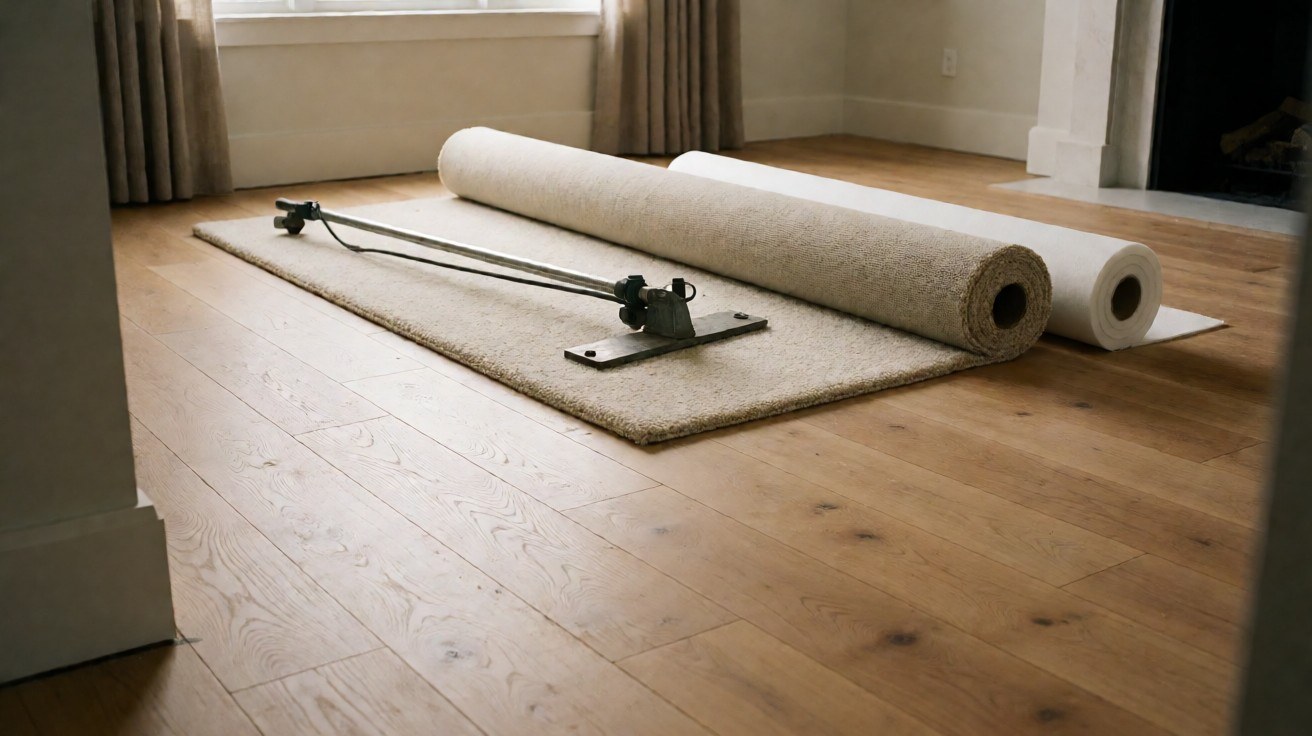
Carpet installation is not difficult, but it is unforgiving. Carpet is held in tension across the room, and every defect in the subfloor shows up later as a wrinkle, a ridge, or a stretched seam.
Can You Install Carpet Over A Concrete Basement?
Yes, and it is one of the most common residential applications, provided the slab passes the moisture test and the carpet is direct glued down rather than stretched in.
ASTM F1869 is the test method for measuring moisture vapor emission rate of a concrete subfloor using anhydrous calcium chloride. The result is expressed as pounds of moisture emitted per 1,000 square feet over a 24 hour period, and the standard is explicit that the value only reflects the condition of the floor at the time of the test. Carpet manufacturers publish their own maximum acceptable emission rate, so read the installation instructions for the specific product rather than relying on a general number.
The National Ready Mixed Concrete Association describes why basement slabs are difficult in CIP 28, its reference on concrete slab moisture. Ground water rises by capillary action when fine grained soil sits below the slab. Water vapor rises and saturates the subgrade, which measures close to 100 percent relative humidity below a slab on ground regardless of location. Granular fill placed between the vapor retarder and the slab can act as a moisture conduit through tears or improperly sealed penetrations, and NRMCA does not recommend a blotter layer directly under an interior slab on grade when moisture sensitive flooring will be installed. It recommends protecting against hydrostatic pressure with proper drainage and, where the water table is high, a six to eight inch layer of coarse gravel or crushed stone as a capillary break.
CRI 105, the standard for installation of residential carpet, lays out the full procedure, including moisture vapor emission rate testing, relative humidity testing, testing for alkalinity, and separate cushion selection for stretch-in work. Above grade, plywood subfloor should be dry, flat, clean, and free of wax, paint, oil, and sealer, and fasteners should be set below the surface. Over radiant heat floors, follow the carpet and cushion manufacturer’s temperature limits rather than guessing.
What Carpet Costs To Install
Carpet is priced per square yard as a material and per square foot as an installed project, and the gap between the two is where most surprises live.
Angi’s 2026 figures, drawn from 8,740 verified projects, put professional carpet replacement between $780 and $2,812 including carpet, padding, installation, and removal of the old flooring, with a national average of $1,777. Installed cost runs $3 to $11 per square foot, and material purchased directly runs $30 to $50 per square yard.
| Project Size (sq ft) | Average Total Cost Range In 2026 |
|---|---|
| 500 | $1,500 to $5,500 |
| 800 | $2,400 to $8,800 |
| 1,000 | $3,000 to $11,000 |
| 1,500 | $4,500 to $16,500 |
| 2,000 | $6,000 to $22,000 |
Angi also recommends budgeting an additional $600 for subfloor repairs and expecting separate charges for stairs, custom cuts, and stain protection. Those four line items are where quotes diverge most. Stairs are priced per step or per tread rather than by square foot, and a stair installation that uses the wrong pad or skips the tack strip is the most common place for a carpet to fail early. Subfloor repair is a contingency you are much better off planning for than discovering.
Get at least three quotes that separate material, cushion, and labor. A quote that does not name the cushion grade cannot be compared against one that does, and the cushion is where the hidden substitution usually happens.
Carpet Compared With Vinyl, Hardwood, Laminate, And Tile
Carpet competes on comfort, sound absorption, and warmth underfoot. It does not compete on moisture tolerance, scratch resistance, or cleaning convenience. If you are choosing for a wet room, our vinyl flooring guide covers the construction and moisture ratings that matter there. If the room is dry and you want a wood appearance with less upkeep, see the laminate flooring guide. Genuine wood and its refinishing potential is covered in the hardwood flooring guide, and hard, moisture tolerant surfaces are in the tile flooring guide.
| Flooring Material | Main Strength | Main Trade-Off | Consider It When |
|---|---|---|---|
| Carpet | Soft surface, warmth underfoot, sound absorption | Traps soil, requires a cleaning schedule, not suitable for persistent wetness | Bedrooms, family rooms, basements, and quiet spaces matter most |
| Vinyl | Wide design range and moisture tolerant options | Synthetic material, can scratch or dent | Kitchens, baths, basements, and entry areas where spills are routine |
| Laminate | Detailed wood look designs at varied price points | Water tolerance varies by product | Dry rooms where a wood look is the goal and upkeep should stay low |
| Hardwood | Natural wood character and refinishing potential | Cost and maintenance vary, moisture and scratches are concerns | You value genuine wood and long term refinishing |
| Tile Or Stone | Hard, wear resistant, strong moisture performance when properly installed | Hard underfoot and more involved to install | You want a hard surface and can accommodate the work |
Sound deserves its own note. CRI lists acoustics among the functional properties of carpet, and in a house with stairs, a hard surfaced main level, and upstairs bedrooms, the soft surface absorbs sound that would otherwise travel through the structure. That is a real quality of life difference in a multi level home and it is not something any hard flooring option delivers.
Safety And Indoor Air Quality Standards Carpet Must Meet
Carpet is a regulated product in the United States for both labeling and flammability, which is useful to know when reading a warranty or a compliance sheet.
On labeling, the FTC rules under the Textile Fiber Products Identification Act, published at 16 CFR Part 303, require fiber content disclosure. Section 303.11 is the one that matters for carpet, because it governs floor coverings containing backings, fillings, and paddings and requires that the disclosure be made in a way that indicates it relates only to the face, pile, or outer surface and not to the backing, filling, or padding.
On flammability, 16 CFR Part 1630 is the Standard for the Surface Flammability of Carpets and Rugs, known as FF 1-70. It covers any finished floor covering with one dimension greater than 6 feet and a surface area greater than 24 square feet. The test uses a timed burning methenamine tablet, and the test criterion is that the charred portion of a specimen must not extend to within one inch of the edge of the hole in the flattening frame at any point. Acceptance requires at least seven of eight individual specimens to meet that criterion. Smaller pieces fall under 16 CFR Part 1631, FF 2-70, which covers small carpets and rugs with no dimension greater than 6 feet and an area not greater than 24 square feet. Area rugs and stair runners often fall under the small carpet standard rather than the large carpet one.
For indoor air quality, CRI operates the Green Label Plus program, an independent testing scheme covering carpet, adhesives, and cushion with very low VOC emissions. Initial certification requires a 14 day testing process as specified by California’s Section 01350 standard practice for VOC testing, and products are evaluated against the full listing of Section 01350 compounds, including formaldehyde, benzene, toluene, and styrene, with the carpet category adding compounds such as 4-phenylcyclohexene, caprolactam, and nonanal. To earn and keep certification, products undergo a three tier testing process for continued compliance. CRI notes that a black and white Green Label Plus label means the same thing as the green and white label.
On the odor question, CRI addresses it directly. Most off gassing from new carpet is complete within the first 24 hours or so. Proper ventilation with good air exchange for approximately 48 to 72 hours clears the new carpet smell, and the claim that new carpets off gas for at least two years is not accurate.
How To Choose Carpet For Your Project
Work through these in order and the specification conversation with a dealer gets much shorter.
Map the traffic first. Entranceways, stairs, halls, and playrooms are heavy traffic and want a pile height of one half inch or less, in a small tight loop or a tightly twisted cut pile. Bedrooms and formal rooms can carry a longer, softer pile.
Read density, not just face weight. Density is the number that predicts whether you will see the backing through the pile, which is CRI’s own test for whether a carpet is dense enough for heavy traffic.
Match fiber to the room’s conditions. Solution dyed olefin for a sunlit room, wool content for naturally flame resistant and soil resistant performance, nylon for a treated and abrasion resistant balance. Confirm the fiber content disclosure on the label, which is what federal law requires.
Specify the cushion by grade, not by feel. Use the Carpet Cushion Council minimum for the traffic class you are in, or better, since the council itself says better grades are always recommended where possible. Remember the style specific limits on thickness: seven sixteenths of an inch for cut pile, three eighths for Berber and commercial products.
Get the subfloor tested, not assumed. ASTM F1869 on a concrete slab below grade, and a written moisture reading that stays with the job. Over plywood, confirm the deck is dry and the fasteners are set below the surface.
Ask for three itemized quotes separating material, cushion grade, labor, removal, stair work, and any subfloor repair. Compare cushion grades, not just totals.
Read the warranty against the installation method. Many carpet warranties require a specific cushion thickness and density, and require that the installation follow the carpet manufacturer’s instructions. A stretched in installation on the wrong cushion can void the coverage you thought you had.
Find Carpet That Fits The Room
Carpet rewards the room you give it. Put a dense, tightly twisted, short pile in the hallway and the stair landing, give the bedroom a fuller cut pile, and specify the cushion for each traffic class instead of buying one roll for the whole house. Get the numbers onto paper, the fiber content disclosure, the density, the cushion grade, and the moisture test, and the floor you end up with will still look right long after the sample board has been thrown away.