
Two bamboo quotes land on the same morning, one about a third cheaper than the other, and the price gap is not about the finish or the brand name.
Solid strand-woven bamboo costs more per square foot than engineered bamboo because it is the only one that can be sanded and refinished two or three times. A quote under about $3.00 per square foot installed is almost always an engineered plank with a 1.2 to 1.5 millimeter bamboo face glued to a softwood core.
What Bamboo Flooring Actually Is
Bamboo is a grass. It sits in the same family as rice and wheat, and it is not related to the oaks, maples, or walnuts that make up most hardwood flooring. The culm is harvested at five to seven years, split lengthwise into strands, then glued under heat and pressure.
That grass origin shows up in three places. Bamboo runs denser and harder than most hardwood at the same price, it takes finish differently, and it moves with humidity in a way a kiln-dried oak plank does not unless the spec sheet says otherwise.
A strand-woven board compresses long culm strands with adhesive and runs them the length of the plank. If the spec sheet says strand-woven, how strand-woven bamboo is made sets out what that construction actually buys.
The honest summary is that bamboo behaves like a dense hardwood that was never a tree. It is harder than oak, less forgiving of long-term wetting, and completely unforgiving of sanding if the board is thin.
What Bamboo Flooring Costs Per Square Foot
Material alone runs $2.50 to $6.00 per square foot for engineered bamboo and $4.00 to $12.00 per square foot for solid strand-woven. Installed, those bands become roughly $6 to $10 and $8 to $14 per square foot. The gap between the two columns is material price against installed price, and most disputes come from comparing one against the other.
Anything at or below $3.00 per square foot installed, removal included, is a reason to read the spec sheet before anything else. At that price you are buying a floor somebody upstream already decided was a downgrade.
| Product Type | Material Per Sq Ft | Installed Per Sq Ft | What You Give Up |
|---|---|---|---|
| Engineered, 1.2 to 1.5 mm face | $2.50 to $6.00 | $6 to $10 | Cannot be sanded at all |
| Engineered, 3 mm face | $4.50 to $7.50 | $8 to $12 | One light refinish |
| Solid strand-woven, 15 mm | $4.00 to $8.00 | $7 to $11 | Colour shift when sanded |
| Solid strand-woven, 19 mm | $8.00 to $12.00 | $11 to $15 | Nothing structural |
Box coverage is usually 20 to 25 square feet, or 1.9 to 2.3 square metres. A 300 square foot room needs 14 boxes before waste and 15 once you add 5 percent for cuts, and that assumes a straight lay.
Plank dimensions matter for the same reason. Standard bamboo is 3.5 to 5.25 inches wide and 36 to 72 inches long, and a 72 inch plank means 30 percent fewer end joints in a long room than a 48 inch one.
Strand-Woven Solid Bamboo Versus Engineered Bamboo
Solid strand-woven is one material from face to core. Engineered bamboo is a thin bamboo face bonded to a softwood or high density fibreboard core, which is why it is sold in thicknesses from 9 mm to 15 mm against 15 mm or 19 mm for solid.
| Attribute | Solid Strand-Woven | Engineered Bamboo |
|---|---|---|
| Total thickness | 15 mm or 19 mm | 9 mm to 15 mm |
| Core | Solid culm strands | Softwood or fibreboard |
| Refinishes available | 2 to 3 | None at 1.2 mm, one at 3 mm |
| Normal install | Nail-down or glue-down | Floating or glue-down |
| Perimeter gap | 6 mm | 12 mm if floating |
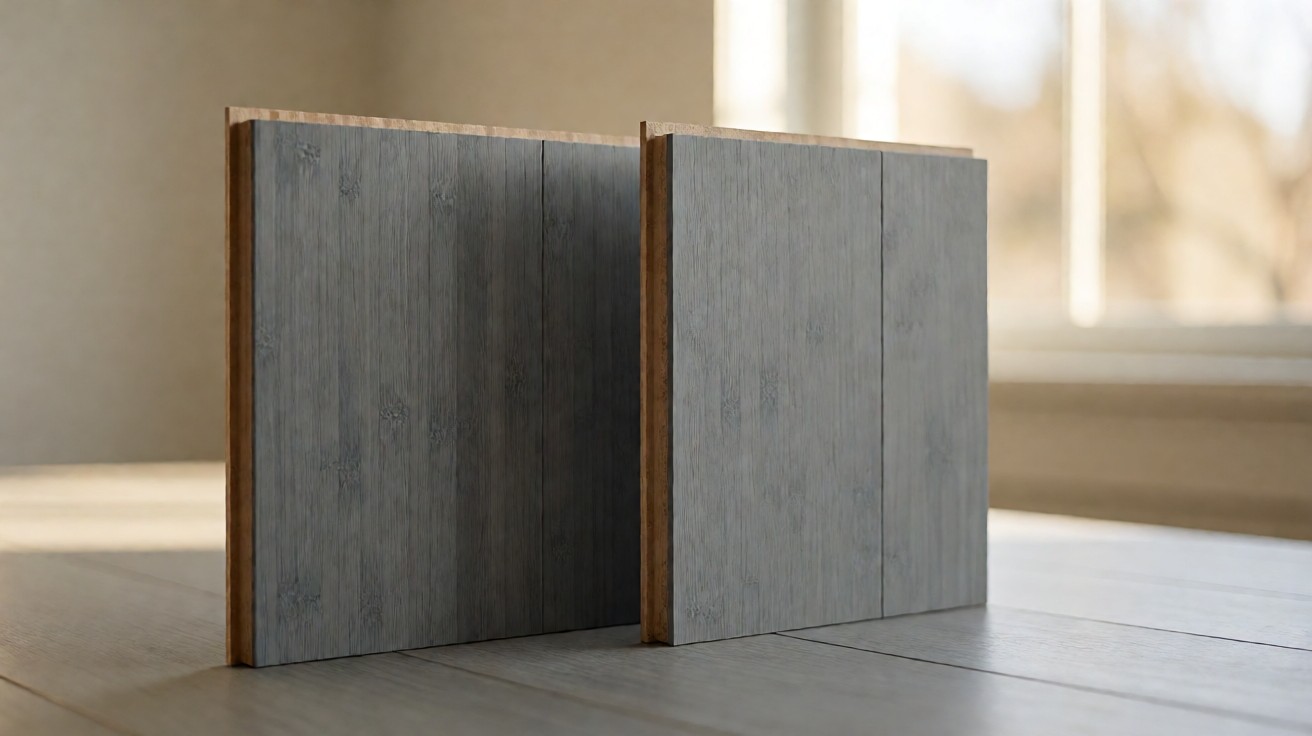
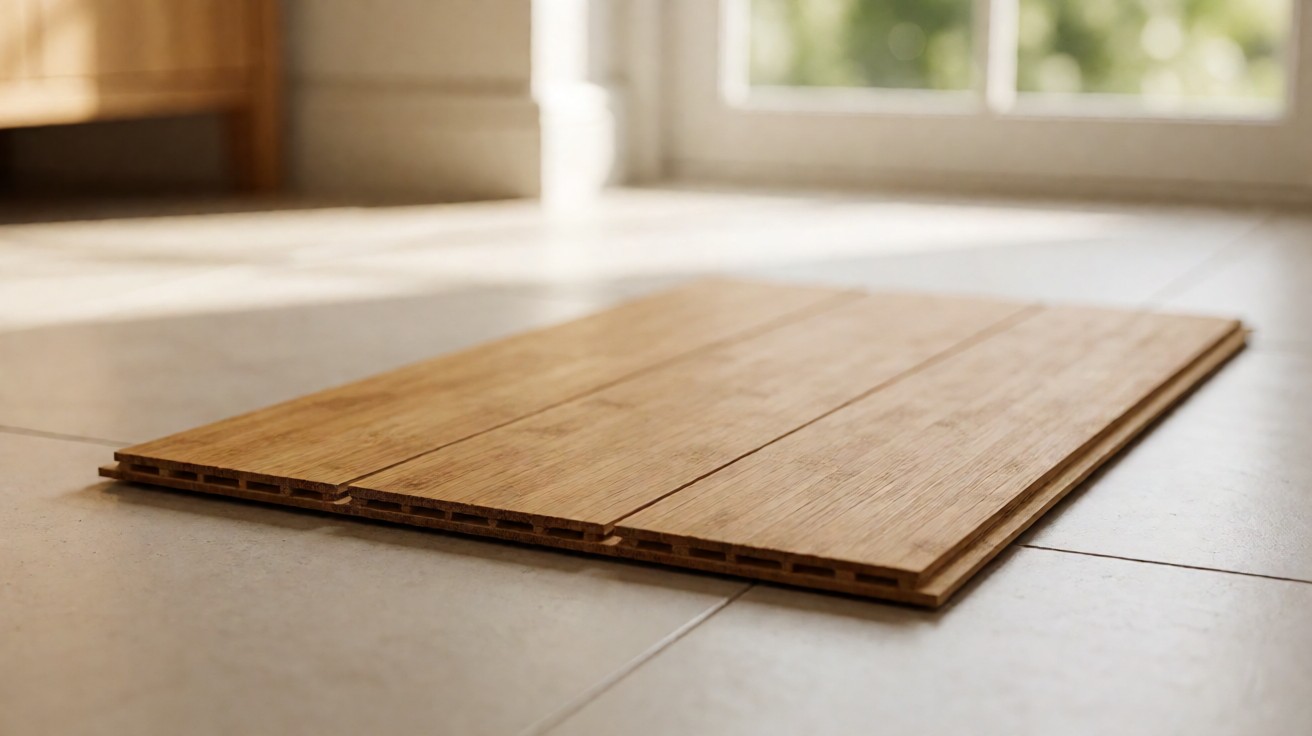
The cross-section settles the argument faster than a sample board. On the left, solid culm all the way through, so a sanding pass removes material from a 15 mm body that can take two or three of them. On the right, a 1.5 mm face on a softwood core, where the first pass reaches the glue line.
If you want to refinish the floor later, you need solid strand-woven at 15 mm or thicker. Engineered bamboo is not a cheaper version of the same thing. It is a different product with a different end of life.
What An Installed Bamboo Price Actually Contains
A legitimate installed price has seven lines, and a quote showing three of them is low. Material, underlayment or a moisture barrier, installation labour, trim and transition strips, moulding, removal and disposal, and a waste allowance.
Take a 300 square foot living room in a 1970s house with a plywood subfloor and 72 linear feet of wall. Straight layout, 22 square feet per box, 5 percent waste. Work the area through the square footage calculator first if your own numbers differ.
Material is the first line: 300 multiplied by 1.05 is 315 square feet, and 315 divided by 22 is 14.3 boxes, so 15 boxes at $76 each is $1,140. Underlayment at $0.90 per square foot is $285. Nail-down labour at $3.40 per square foot is $1,020.
Moulding and transition at $2.90 per linear foot across 72 feet is $209. Removal and disposal at $1.85 per square foot is $555. The total is $1,140 plus $285 plus $1,020 plus $209 plus $555, which is $3,209, or $10.70 per square foot installed.
The engineered version of the same room changes two lines. Material at $3.15 per square foot on 315 square feet is $992, and floating labour at $2.05 per square foot is $615. The total lands at $2,656, or $8.85 per square foot installed.
That $553 difference is what you pay for the right to sand the floor someday. Whether it is worth it depends on the room, not the marketing. For a hallway where one path takes every footfall, it is usually worth it. For a bedroom, it usually is not.
Moisture And Humidity: The Number That Decides
Interior relative humidity between 30 and 50 percent is the working range for solid wood and solid bamboo. The number that actually decides whether the floor belongs in the room is the moisture reading under the subfloor, not the weather outside the window.
Read a wood subfloor with a pin meter and stay at or under 12 percent moisture content before a nail-down. Over concrete, ASTM F2170 in-situ relative humidity probes below 75 percent pass without intervention, 75 to 85 percent require a membrane, and above 85 percent means water is still arriving and no membrane will hold.
The NWFA guidelines behind those numbers are worth quoting back to an installer who says the slab feels fine.
Where you install above grade with a crawl space, venting and a vapour barrier on the crawl side usually matter more than the flooring choice. Where you install below grade, measure the slab before you pick a product.
If the reading is above the limit, you need a moisture barrier or a different floor. In a basement, a membrane can add $1.50 to $3.00 per square foot, and that is the cheapest line item on the whole quote.
Hardness, Denting, And How Bamboo Compares
Strand-woven bamboo scores roughly 1,180 to 2,500 on the Janka scale. White oak sits near 1,360 and hickory runs past 1,800. A seller quoting a Janka number for engineered bamboo is usually describing the face layer, not the board you are buying.
Read the core, not the face.
Against oak, bamboo wins on scratch and dent resistance and loses on spot repair, because a sanded area takes new finish in a slightly different colour. The honest version is in bamboo against oak and maple.
Against rigid core vinyl, bamboo is far harder and far less forgiving. A dropped cast iron pan dents a 19 mm plank and bounces off a 20 mil wear layer without a mark, which is why vinyl is the cheaper sensible answer in a rental.
Where traffic is spread across a wide room rather than concentrated in one path, a wear layer rating of 20 mil or more is enough. Where there is one path, solid bamboo outlasts vinyl because the wear layer is the entire board.
One more figure belongs in the spec sheet. ANSI A326.3 measures the dynamic coefficient of friction, and 0.42 is the level accessibility codes reference for an interior walking surface. Below 0.42, a hallway or an entry is a slip liability regardless of how hard the floor is.
DCOF is a wet test. Check whether the number you were given was measured dry or wet.
Finish And Sheen: What The Coating Changes
Bamboo ships in three common finishes: factory urethane or acrylic lacquer, a matte hard wax oil, and a site-applied waterborne finish. Factory lacquer is the cheapest and hardest wearing, and it is also the one that goes white under standing water if the top layer is breached.
Hard wax oil is repairable, since you can re-oil a scratch without touching the whole floor, but it needs an extra coat every year or two and the matte surface shows dirt faster. If you want to rescreen rather than sand, specify a finish whose top layer survives a 100 grit pass.
Refinishing bamboo produces a colour shift. Sanded strand-woven reveals lighter, yellower material, and a tint has to cover the entire floor rather than the bare patch. For a like-for-like repair you need solid bamboo and you need the original sample board.
Matte and satin hides dust and shows wear. Gloss shows dust less and shows every scratch under a downlight. Where the room has a lot of glass and low afternoon sun, satin is the forgiving choice.
Where A Bamboo Quote Hides Money
Two lines routinely drop between the sales visit and the final invoice: removal, and anything at a doorway. Everything else tends to be priced, just at a level you did not expect.
| Line Item | Typical Cost | If The Quote Omits It |
|---|---|---|
| Underlayment or moisture barrier | $0.75 to $2.00 per sq ft | Dead sound, cupping over a damp slab |
| Moulding and baseboard | $1.50 to $4.00 per linear ft | An exposed 6 mm gap at the wall |
| Transition strips and thresholds | $12 to $40 each | A flexing scribe and a trip line |
| Removal and disposal | $1.25 to $3.00 per sq ft | Old floor stays, new floor sits high |
| Waste allowance | 5% to 10% of material | Short by one box mid-room |
| Pattern layout allowance | 8% to 12% of material | A herringbone room that stops two planks short |
Ask for every line as a per square foot number rather than a lump sum, because a lump sum cannot be compared between two quotes. If one installer prices a threshold at $40 and the other treats it as included, one of them is guessing.
Also ask who carries the waste. If the installer supplies the boxes, an 8 percent allowance is normal. If you are buying the material yourself, an 8 percent allowance means you are the one who finds out on a Thursday.
Bamboo And Sustainability, Honestly
Bamboo grows without a tap root, spreads by rhizome, and can be harvested without clearing the stand. It reaches harvest in five to seven years against fifty or more for an oak, and the clump regenerates from the same base. That is a real advantage and it is worth stating plainly.
What it is not is a carbon store. A culm locked into a plank with phenolic resin is a processed building product, and the resin is the part with a chemical profile, because strand-woven construction bonds everything with a heat-cured adhesive.
Read the emissions class before you read the word sustainable. Under EN 16516, E1 allows 0.124 milligrams per cubic metre of formaldehyde, E0 allows 0.050, and ENF allows 0.025, roughly one fifth of E1. Ask which class the adhesive conforms to, not only the face.
For indoor air quality, FloorScore certification means a score of 60 or below on a 100 point scale, measured under office ventilation assumptions rather than a closed house. GREENGUARD Gold requires total volatile organic compounds under 100 micrograms per cubic metre over one hour. Without either mark, the claim is marketing.
If you are still weighing bamboo against the alternatives rather than against a quote, comparing the floor families puts the whole set on one set of criteria.
Diy Or Professional Installation
A floating engineered bamboo floor is the one job most homeowners finish in a weekend. Click the boards, cut the last row, and the tools are a saw, a square, and a pull bar. Nail-down solid bamboo is a different trade entirely, because a floor nailer with paper tape and a square cutting jig are what separate a flat floor from a wavy one.
Labour runs $3.00 to $4.50 per square foot for a nail-down, $2.75 to $3.75 for a glue-down, and $1.75 to $2.50 for a floating floor. The glue-down buys a quieter floor that will not move, which matters more than most buyers expect over a crawl space.
If you have never installed a nailed or glued floor, the professional quote is the cheaper option once you price a second box, a flat substrate, and a seam that does not open in January.
Comparing Two Bamboo Quotes Line By Line
Read the material line first: construction, total thickness, face thickness, finish, and box coverage. Where those five do not match, the price difference is comparing two different floors, and the cheaper one is not the same purchase.
Then read the labour line for the method, because a floating floor at $1.75 and a nail-down at $4.50 are not the same job. Confirm the moisture specification, the perimeter expansion gap in the warranty, the finish warranty in years, and whether the installer pulls a permit.
The last comparison is the one nobody prints. Ask each seller how many times the floor can be refinished. Where a seller will not answer, that silence is the answer, and it decides the quote.
For the reference point on the other side of the aisle, hardwood flooring cost runs in the same installed band and has a longer track record of refinishing.
Where The Money Is Not Worth Spending On Bamboo
Do not pay for a thicker finish on a floor that lives under rugs. Do not pay for a deep bevel in a small room, where it is visible only at the threshold. Do not pay to install over a floor that has to come up anyway.
Where spending does pay: a moisture barrier on a slab that reads high, a matched transition where three materials meet, and a real perimeter expansion gap. Those three are structural, and each one costs less than the repair it prevents.
If the quote is cheap on every line at once, the answer is not that you found a good deal. It is that the board is engineered with a face too thin to restore, and you need to decide whether that matters before the crew starts.