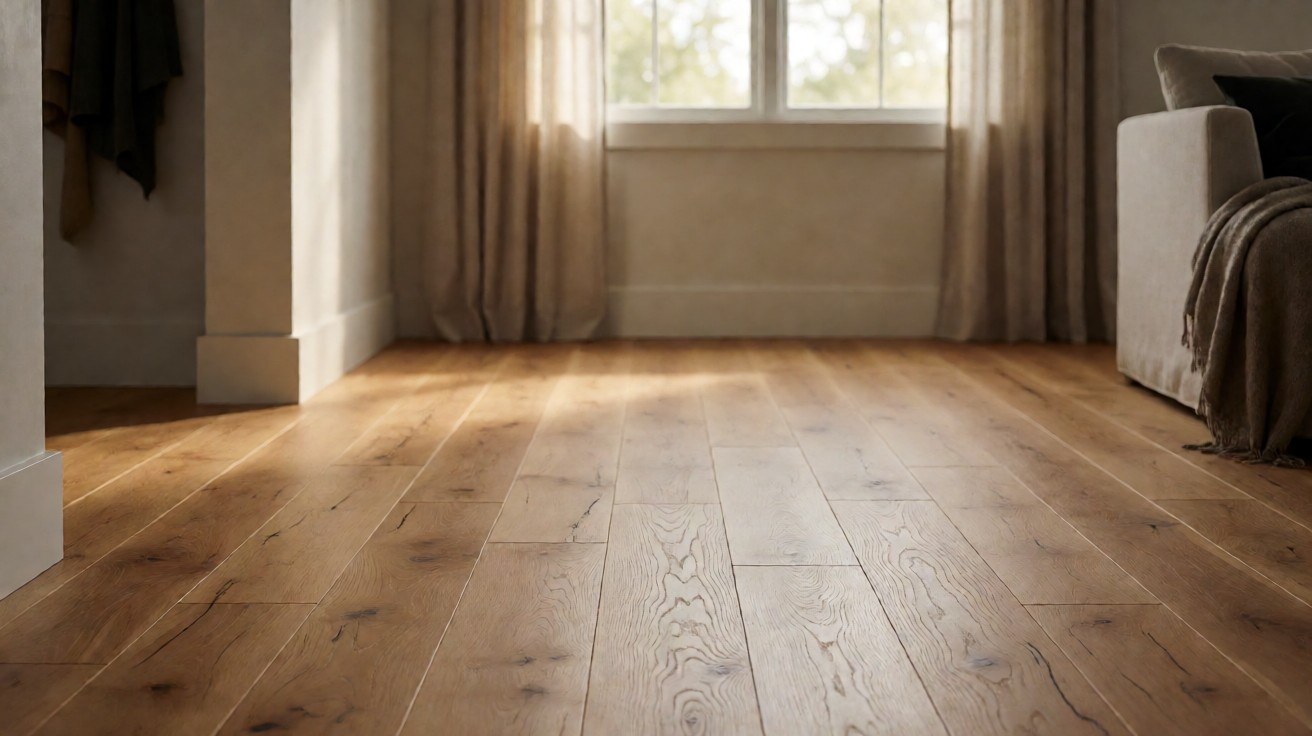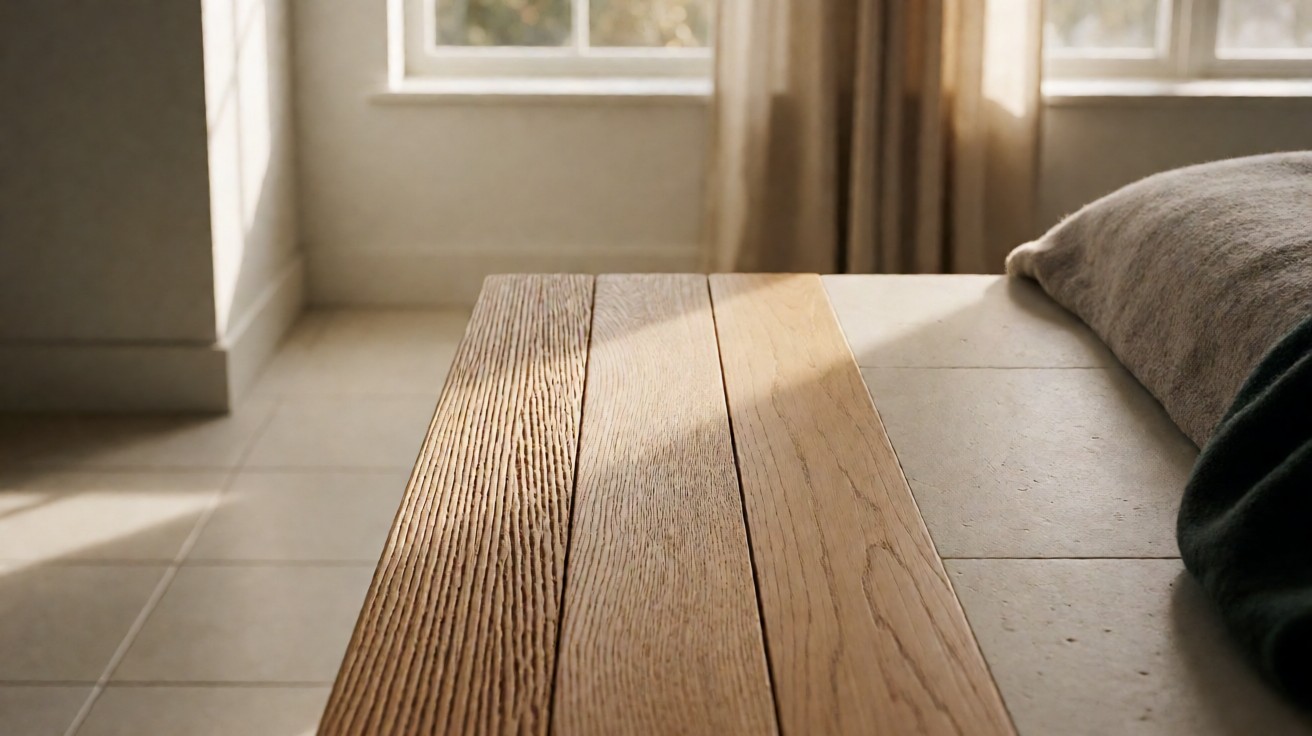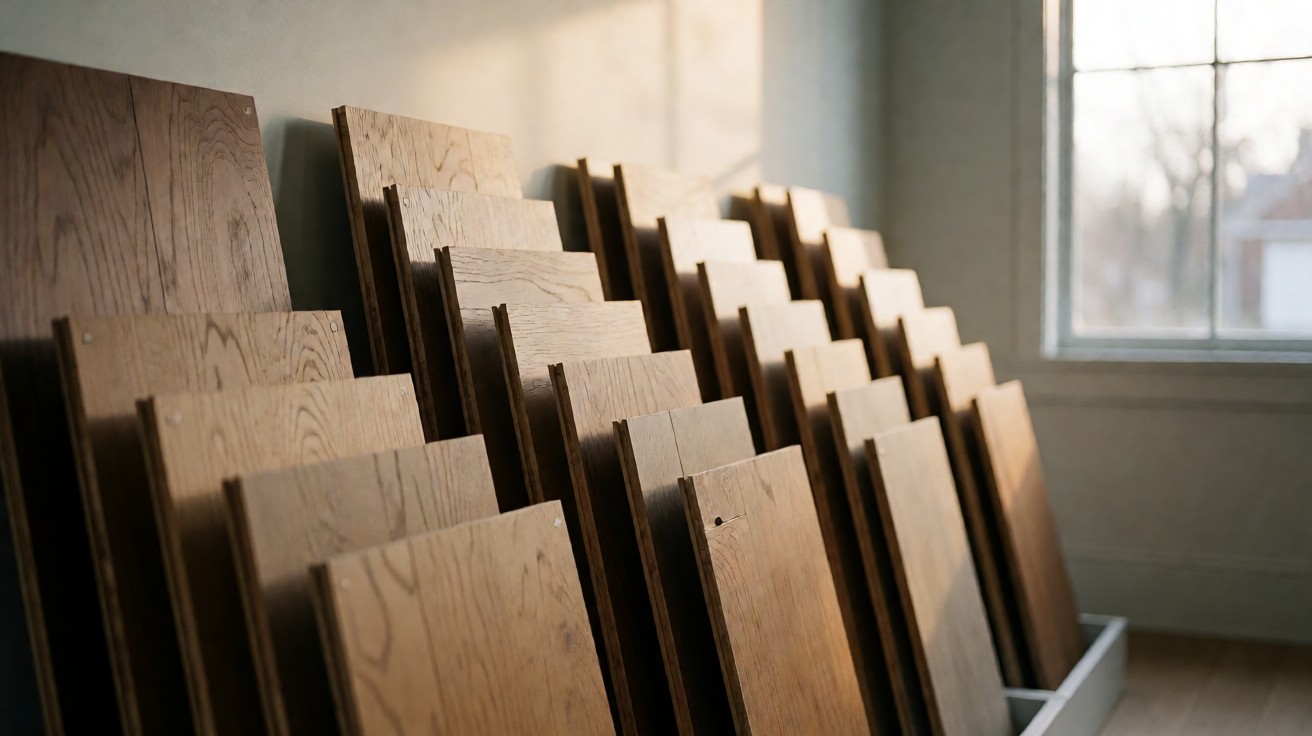

Two oak quotes for the same four hundred square foot room land forty dollars per square foot apart, and both contractors are being honest with you.
The answer is that the gap is almost never the oak. It is the board thickness, the veneer thickness, and how many times the surface can be sanded before there is nothing left to sand.
Hardwood Flooring Cost Is Four Numbers, Not One
An installed hardwood price is four numbers wearing one coat.
Material runs 5 to 15 dollars per square foot for solid oak and 4 to 12 for engineered. Nail-down labour runs 3 to 5 dollars per square foot, glue-down 4 to 7 dollars. Trim, transitions, removal and levelling sit on top.
Installed, solid hardwood lands around 8 to 20 dollars per square foot and engineered around 7 to 16 dollars in most North American and UK markets. Walnut and reclaimed timber push past both.
Read the material price, then divide it by the installed price. Under about 40 percent and the material is not where your money went. The material versus installed breakdown covers that ratio, and the main hardwood guide explains the boards.
| Line item | Typical range | What changes it |
|---|---|---|
| Material | 4 to 15 dollars per sq ft | Species, grade, width, finish |
| Subfloor prep | 1 to 4 dollars per sq ft | Flatness and moisture state |
| Labour | 3 to 7 dollars per sq ft | Nail-down, glue-down or floating |
| Trim and transitions | 8 to 25 dollars per linear ft | Doorways, stairs, thresholds |
| Removal and disposal | 1 to 3 dollars per sq ft | Existing floor type |
Species And What Actually Moves The Price
Species splits into two groups. Red oak, ash and hard maple are plentiful and milled in volume, so they price close together. Black walnut is not, and that scarcity is most of its price.
Walnut takes 80 to 150 years to reach a harvestable size and grows scattered rather than in blocks, so mills pay a premium for volume. Expect 12 to 25 dollars per square foot for walnut against 5 to 9 for red oak in the same grade.
White oak sits above red oak because rift and quarter sawn is cut differently and yields less lumber per log. Plain sawn white oak costs close to red oak.
Denting follows hardness, and the usual measure is the Janka scale. Red oak tests near 1290 pounds-force, white oak about 1360, ash about 1320, hard maple about 1450 and black walnut about 1010.
If you are fitting a hallway or an entry, specify a species above 1300 on that scale. If the floor is going in a bedroom, walnut at 1010 is fine and nobody is going to drop a dumbbell on it.
Solid Versus Engineered, Explained Structurally
Solid hardwood is the board itself. A 3/4 inch solid oak plank is 19 mm of oak from face to bottom, tongue and groove included. Nothing is glued to anything.
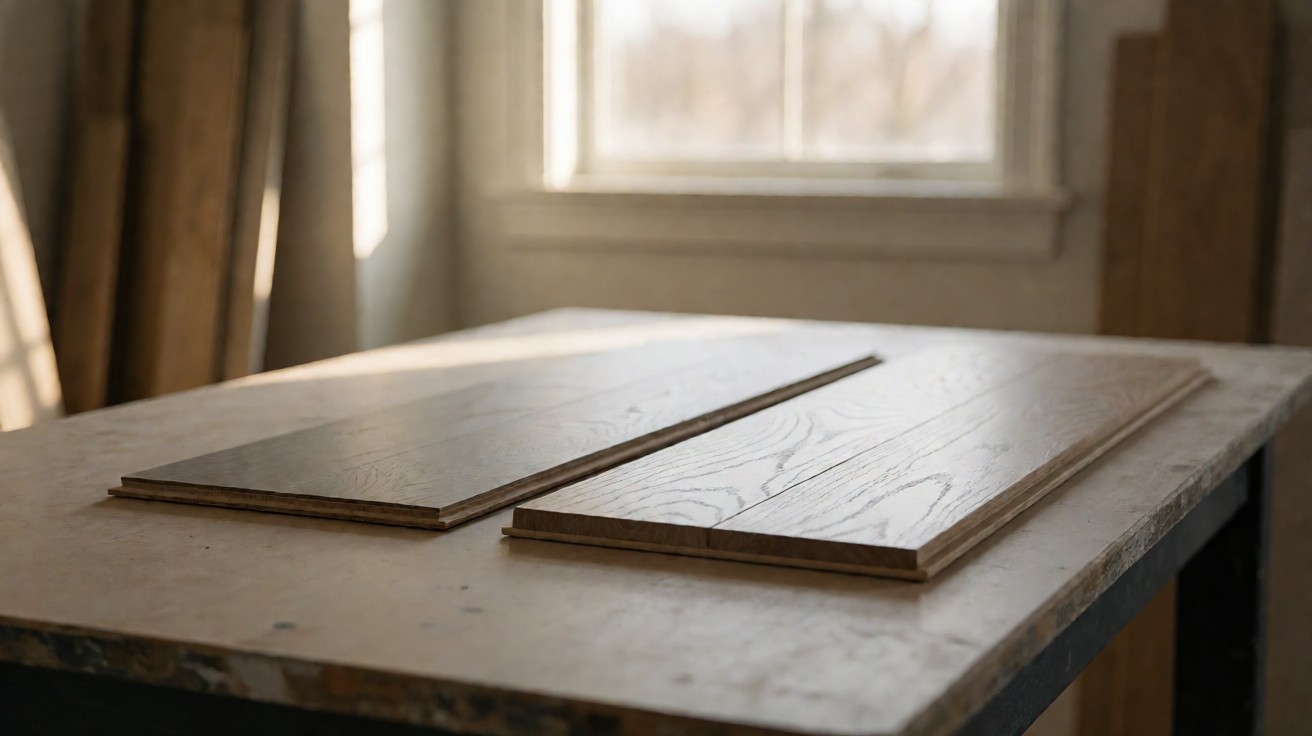
Engineered hardwood is a sandwich. A thin slice of real oak, the wear layer, is glued to a core of crossed wood veneers or a fibre board, and the finished panel is usually 1/2 inch or 5/8 inch thick.
That core is the whole price argument. It ships cheaper and stays stable across humidity swings because the crossed layers cancel each other’s movement. It is also why an engineered board cannot be sanded like a solid one.
Most quotes a homeowner collects are one solid and one engineered of the same species, and engineered hardwood cost is priced on the same four lines. It usually lands below solid for the same species, grade and width, and the gap widens at wide plank and long plank formats because the veneer and core are harder to produce at those sizes.
The core is also the part that brings regulation with it.
Hardwood plywood falls under the composite wood emission rules in TSCA Title VI and the CARB Phase 2 standard, which cap it at 0.05 ppm measured by the ASTM E1333 chamber test. Solid hardwood has no added core, so that cap does not apply to it.
If a quote sells an engineered board with a fibre board core rather than plywood, that is a different product at a different emission class.
The solid versus engineered comparison covers stability and installation. On price, engineered buys a lower entry price and charges for it at the first refinishing.
If the wear layer is under 3/32 inch, or 2.5 mm, the board cannot be sanded at all without cutting through to the glue line.
Grade And What It Is Worth
Grade describes appearance and nothing else. Under the NWFA/NOFMA International Standards for Unfinished Solid Wood Flooring, appearance alone determines grade, because every grade is equally strong in any application.
It replaced the Official Flooring Grading Rules previously published by the Wood Flooring Manufacturers Association, so grade names on an old bundle may not match what you are buying now.
Clear Oak is mostly heartwood with the least character. It admits bright sapwood up to 3/8 inch wide running the full length, or 1 inch wide for one third of the length, plus one thin brown streak 3 inches long every 6 feet.
Select Oak allows unlimited sound sapwood, one small tight knot every 3 feet, two flag worm holes every 8 feet, and a machine burn across the face under 1/4 inch wide. Sapwood there is not a defect, it is contrast.
No. 1 Common Oak is where character becomes obvious. It excludes broken knots over 1/2 inch across, excludes splits running through the piece, and allows no more than 20 inches of scant stock every 5 feet.
No. 2 Common Oak admits knot holes that will readily fill, scant thickness on the back, and machine burns no deeper than 3/64 inch. It is a legitimate floor and priced as one.
Mineral streaks in maple are not a defect at all. No grade excludes them, so a seller promising streak-free maple is describing a very short production run.
Manufacturers may ship up to 5 percent off-grade pieces in a higher grade, since anything admissible below is accepted above it. That is why a few Select Oak boards look like No. 1 Common.
If you are matching a small room, take No. 1 Common and let the knots be the floor, rather than paying Clear Oak money and hoping for a clean shipment.
Board Width And Length Are Priced, Not Free
The wide plank wastes more of the log.
A 2 1/4 inch strip and a 7 inch plank come off the same log, but the wide plank costs more per square foot because more of it is waste. Rift and quarter sawn adds 15 to 40 percent over plain sawn of the same species and grade, because that cut yields less lumber from each log.
Length works the same way. A board running 8 feet moves you closer to the footage you ordered and further from the percentage you threw away.
Solid flooring arrives in bundles, and older NOFMA packaging for 3/4 by 2 1/4 inch flooring was a bundle of 24 board feet. Engineered flooring arrives in boxes commonly covering 19.5 to 22 square feet. Read the box rather than assuming.
Order 10 percent over the room area for a straight lay, and 15 percent for a diagonal or herringbone pattern. The square footage calculator does the arithmetic once you know the box coverage.
If a quote lists boxes without box coverage, ask. A 19.5 square foot box and a 25 square foot box differ by nearly 30 percent on material, and nobody notices until they land on site.
The Full Breakdown, Line By Line
Start with a room of 400 square feet and work it through both products. A 10 percent waste allowance makes the order 440 square feet.
Engineered at 7 dollars per square foot of material is 440 times 7, or 3,080 dollars. Nail-down labour at 4 dollars is 400 times 4, or 1,600 dollars. A moisture barrier at 75 cents adds 300 dollars. Total 4,980.
Solid at 9.50 dollars is 440 times 9.50, or 4,180 dollars. With the same labour and barrier the total is 6,080 dollars. The difference is 1,100 dollars, which is 2.75 dollars per square foot of room.
The entire gap is the material line. That is the line to interrogate on any two quotes.
Subfloor preparation covers levelling, patching and moisture work, and runs 1 to 4 dollars per square foot. On a sound wood subfloor it is nearly nothing. On a slab it can double the labour line.
Removal and disposal are often assumed rather than quoted. Carpet over wood lifts fast. Tile over mortar is slow, and it may expose a subfloor never meant to take a nail.
Site-finished solid wood is its own category. Boards arrive raw, get sanded in the room and finished on site, which adds 3 to 5 dollars per square foot over prefinished.
If the subfloor is not flat, that line is a subfloor grinder levelling high spots, and it is priced per hour rather than per square foot.
| Cost line | What it buys | Skirting it costs |
|---|---|---|
| Material overage | 10 percent straight, 15 percent diagonal | Boxes short by 2 or 3 |
| Fasteners | 18 gauge staples, 15.5 gauge cleats | Wrong gauge for the board |
| Moisture testing | Subfloor and slab readings | Slab above 3 lb per 1000 sq ft |
| Thresholds and stairs | Saddles, risers, nosings | No price per step quoted |
| Subfloor levelling | Grinding or self-levelling compound | High spots over 3/16 inch in 10 feet |
Where A Quote Hides Money
Fastener specification is where quotes get vague. NWFA schedules call for 18 gauge staples at 3 to 4 inch spacing for engineered board under 5/8 inch thick, and 15.5 gauge staples or 16 to 18 gauge cleats at 6 to 8 inch spacing for solid 3/4 inch board.
Cheaper fasteners driven into denser board cause a floor to squeak two winters later, and no warranty covers it. Moisture testing is the second hiding place: under ASTM F1869, a slab reading above 3 pounds per 1000 square feet per 24 hours is not ready for wood.
Thresholds and stairs are the third. A stair is priced per tread or per step, not per square foot, because there is barely any footage on it. If the quote does not name that unit, price a stair before agreeing to a number that assumes you have none.
The overage factor is the fourth. If the material line covers exactly the room area with no allowance, the installer plans to run out of floor on the last day, and the remedy is a second delivery at full price.
If the quote is a fixed price rather than a rate, ask what happens when the subfloor turns out to be worse than the survey showed.
Concrete Slabs And Crawl Spaces
A slab and a crawl space are two different problems, and the products that solve them are not interchangeable.
Slabs get tested before they get covered. The ASTM F1869 calcium chloride test returns moisture weight per 1000 square feet over 24 hours, and 3 pounds is the usual ceiling for wood. The ASTM F2170 in-situ probe returns a percentage, with 75 percent the common cut-off.
If the slab reads over that, you have three choices. Wait for it to cure, which on a new slab can mean months. Apply a moisture barrier rated for the condition, adding 1 to 2 dollars per square foot. Or change material, which is the full slab installation decision.
On a slab, glue-down is normal because there is nothing to nail into.
Nail-down over a slab needs a plywood or OSB layer on top, which adds material, adds labour and raises the floor enough to catch the bottom of doors. That layer is why a slab job runs 2 to 5 dollars per square foot above the same boards on wood. It is a structural requirement, not a markup.
On a crawl space the job is the ground and the air. Check the moisture reading first, confirm the space vents, and lay a 6 mil vapour barrier over bare soil. It costs almost nothing and removes a variable nobody can warranty around.
Refinishing And The Cost Per Year That Decides It
Refinishing settles solid against engineered, and it is arithmetic rather than opinion. Sanding removes 1/32 to 3/64 inch of surface per job, and the number of jobs depends on how much wood sits above the tongue.
The NWFA Refinishable Program sets 3/32 inch, or 2.5 mm, as the minimum wear layer for factory-finished flooring and 4/32 inch for unfinished. Below that the floor should not be sanded at all.
Solid 3/4 inch oak carries roughly 1/4 inch of wood above the tongue, so it takes five or six sandings in ideal conditions and three or four in a real house. Engineered board with a 3 mm veneer has one refinishing and no second attempt.
Return to the 400 square foot example. Engineered at 4,980 dollars over 25 years is about 199 dollars a year. Solid at 6,080 dollars over 75 years is about 81 dollars a year, and one refinishing in year 20 extends that without new material.
If you are keeping the house 30 years or more, the solid premium buys back most of itself before you sell. If this is a rental you may replace in 7 years, engineered is the cheaper answer and the arithmetic is not close.
Diy Versus Professional Installation
Hardwood is the least forgiving common flooring to install yourself, because the floor either holds fasteners or it does not. Nothing clicks, and no floating layer absorbs a bad subfloor.
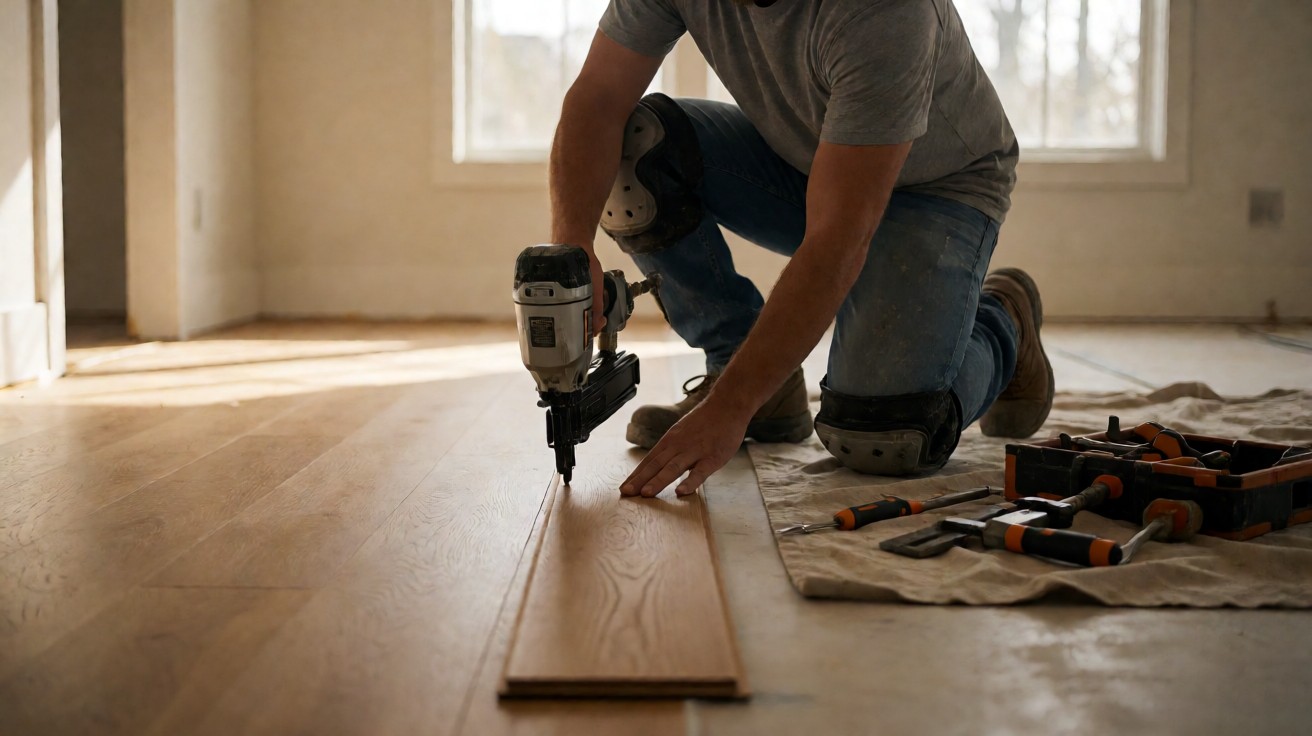
Nail-down on a wood subfloor is achievable with a pneumatic nailer. The risk sits in three places: a subfloor that is not flat, an expansion gap not left at the perimeter, and moisture content nobody measured.
Glue-down needs more than a trowel. It needs controlled open time, the right adhesive, and stable temperature and humidity through the cure.
A professional quotes a result and a warranty. A DIY job quotes a weekend. Over a slab, with glue-down, or on a staircase, the material savings are not worth taking.
Doing it yourself with prefinished boards is the sensible version. A site finish means you own the sanding equipment and the dust control, and one pass with the wrong grit shows for the life of the floor. The diy versus professional breakdown covers the rest.
Comparing Two Quotes Line By Line
Put both quotes on one page with identical rows. The difference usually becomes obvious in under a minute.
Match species and grade first. Two quotes 4 dollars apart often differ because one moved from red oak Select to white oak rift quarter sawn, a real price difference rather than a markup. Then match the board: width, length, thickness and finish must be identical before any number is comparable.
Then match the method. Nail-down against glue-down is worth 1 to 4 dollars per square foot on its own, so a glue-down price beside a nail-down price is not a disagreement about material.
Then match scope. Does the second quote include removal, levelling, moisture testing, thresholds, stair treads and disposal? A lower total with three missing lines is not a lower price.
Finally, check the measurement. One square foot is the same everywhere, but a quote on gross area against one on net area after a closet differs by more than people expect.
Where The Money Is Not Worth Spending
Premium finish on a board you cannot sand again is close to thrown away. Under a 2.5 mm wear layer, nothing above standard is ever recovered.
Wire mesh or screening under solid wood is a waste. It was sold to solve cupping, and moisture control plus a correct expansion gap solves it properly.
Moisture barrier over a dry, ventilated space above grade is usually unnecessary. Spend the money on the moisture test instead, because the test is what tells you whether the barrier was needed.
Sanding a sound subfloor is not preparation, it is delay. If a contractor quotes a full sand before nailing new boards over it, ask what condition they found.
The one place extra money earns its keep is the moisture test and the expansion gap. Both are cheap, and both decide whether the floor still exists in twenty years.