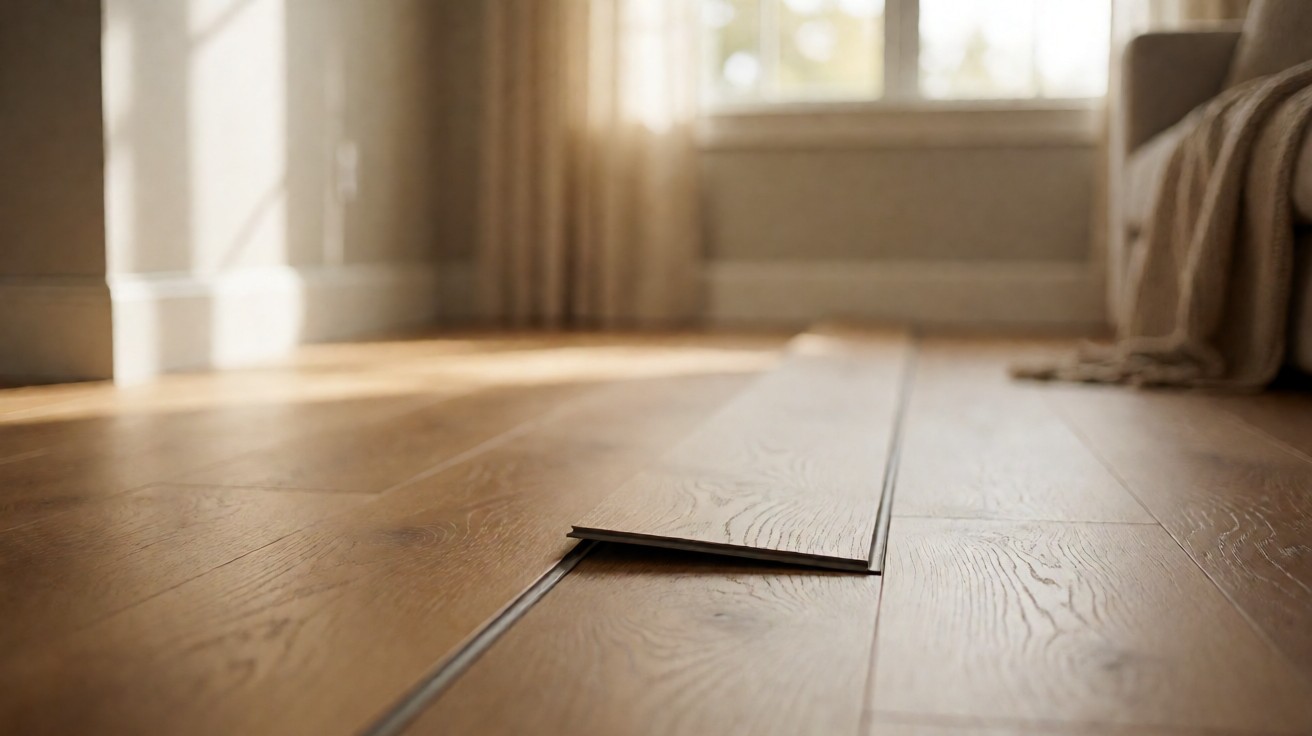

SPC, short for stone plastic composite, is the rigid-core vinyl that changed how people think about vinyl flooring. Where older vinyl was a thin sheet of flexible plastic, SPC is built on a core of stone powder and plastic, and that single change explains almost everything about how it behaves.
It is the most waterproof and dimensionally stable vinyl you can buy, and it is also the hardest, densest, and most demanding underfoot.
Whether that is the right trade depends entirely on the room. SPC is the correct floor for a wet bathroom, a basement slab, or anywhere standing water is a real possibility, because it will not swell, cup, or gap.
It is the wrong floor for a bedroom or a quiet room where softness underfoot and low sound matter more than water resistance, because a stone core feels like what it is.
This guide explains what SPC actually is, why its core makes it behave the way it does, and where it suits. It assumes you have chosen vinyl as your material. If you have not, the vinyl flooring guide covers that decision, and the LVT guide covers the tile format and the layer structure SPC shares with it.
What SPC Vinyl Is
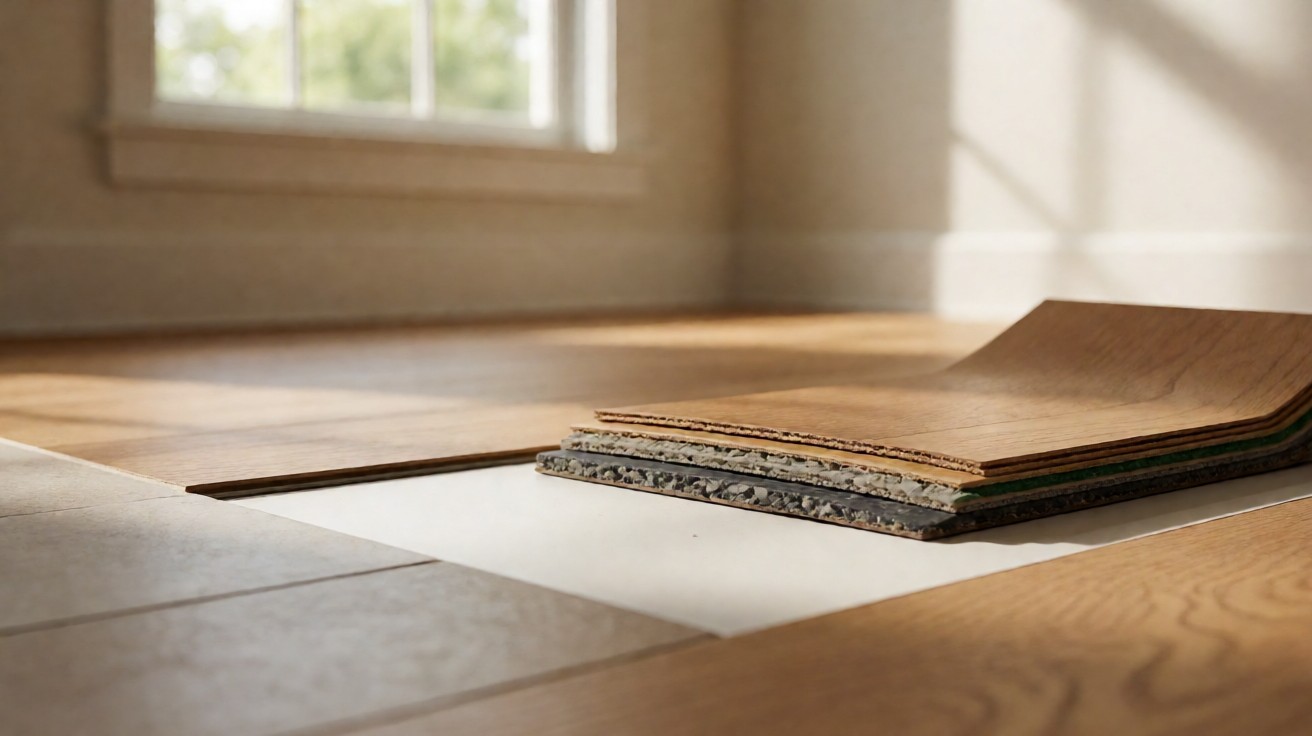
SPC is a rigid-core vinyl plank or tile. The product is manufactured in layers, and the middle one is the whole point: a composite of calcium carbonate powder, often called stone powder, bound in plastic. Above it sits a printed film that gives the plank its wood or stone appearance, and above that a clear wear layer that takes the abrasion.
Below the core there is usually an underlay pad, sometimes a foam or an IXPE layer bonded to the back. It exists to absorb the sound of footsteps and to give the plank something slightly compressible to sit on, which is one of the reasons SPC feels less punishing than it looks.
What you end up holding is something closer to a thin ceramic tile than to a sheet of vinyl. It is dense, it is stiff, it clicks together, and it is designed to be walked on for twenty years in a room that gets wet.
What Makes an SPC Core Different
The core is what separates SPC from every other vinyl, and the reason is chemistry more than marketing.
The core is mostly mineral. Stone powder does not absorb water, does not respond to humidity the way wood does, and does not lose its shape when it gets damp.
That is why an SPC floor will sit in a wet room for years without swelling, cupping at the edges, or gapping at the joints, which is exactly what happens to an organic-core vinyl that got wet and never fully dried.
The second property is dimensional stability. Because the core does not move, the plank keeps its shape across a season, across a slab that warms up in August and cools down in January. That is why SPC is the standard recommendation over a concrete slab or in a sunroom, where a floor that breathes with the temperature would eventually lift.
The same chemistry explains the hardness. A mineral-filled core resists indentation and will not scratch the way a cushioned vinyl does, so SPC wears slowly and holds its flatness. That is a genuine durability win, and it is also the source of the two real trade-offs.
Waterproofing and Dimensional Stability
Water is the reason most people end up on SPC, and it is the reason they are usually right to.
SPC will not absorb water. Not “resists” water, not “is water-resistant in normal conditions”, the core does not take it up at all. That means a spilled drink, a wet mop, or a bathroom that gets splashed daily does nothing to the plank.
It also means the floor can be laid over a damp-tolerant subfloor such as a concrete slab, which is not true of every flooring material.
The dimensional stability follows from the same property, and it is the one people forget. A floor that does not move cannot gap. So SPC does not need the seasonal expansion allowance that a wood or laminate floor needs, and it will not cup upward at the edges in a humid period and click back down when it dries.
The practical warning is that waterproof does not mean the floor is indestructible. A very hot spike from a stove, a dropped chisel, or standing water left for days over a slab with a vapour barrier problem can still cause damage at the seams. SPC resists water, it does not excuse a bad subfloor.
Thickness and the Click-Lock System
SPC is usually 5 or 6 millimetres thick, and most of it is core. That thickness is not padding, it is structure, and it is why the plank does not flex.
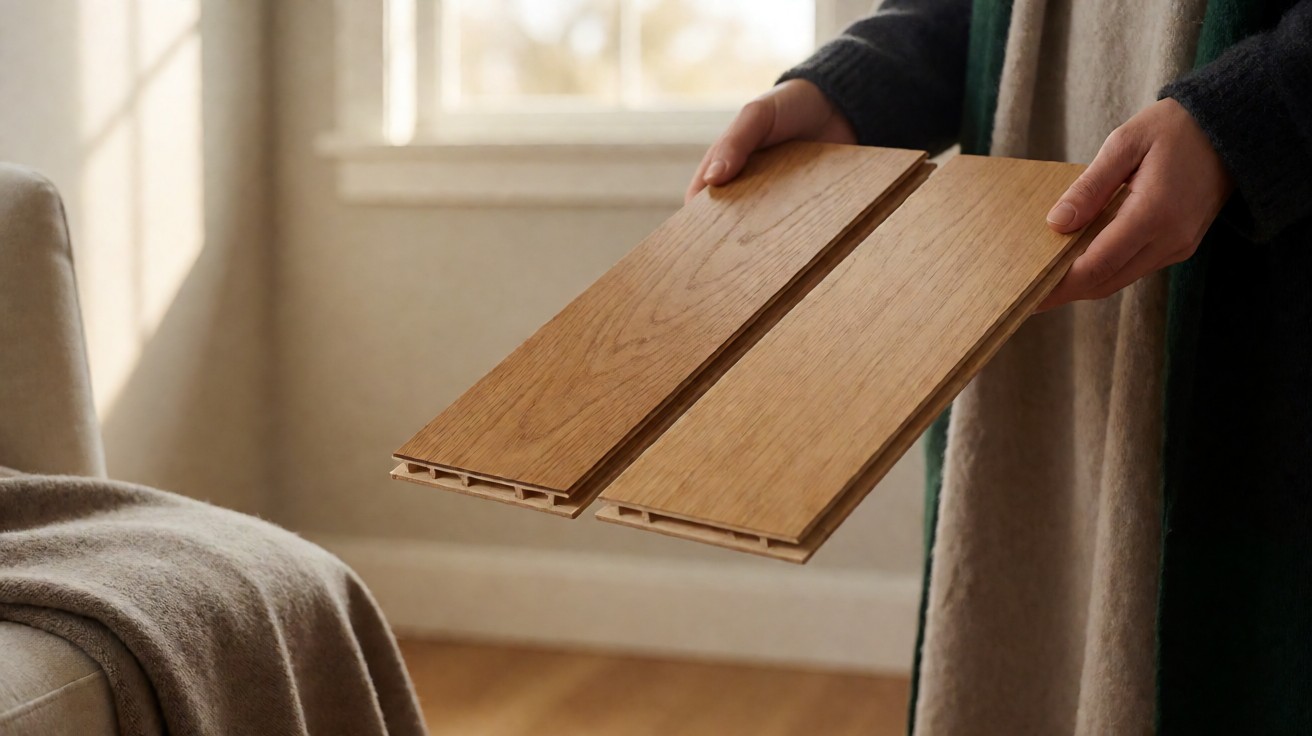
The edges carry an interlocking profile, commonly called an IOR or infinity lock, which is a tongue on one side and a matching groove on the other.
The planks click together and the assembled floor floats above the subfloor rather than being glued to it. That is why SPC installs quickly and why the floor can be lifted and relaid intact if you ever need to.
Because the floor floats, the subfloor has to be flat and clean. Gaps and humps in the base show up as a rocking plank and a visible joint line, and a floating SPC floor cannot be pulled down onto a dip the way a glued sheet can.
Most manufacturers specify flatness within a few millimetres over a two-metre span, and it is worth measuring before you buy rather than after.
Durability, Wear Layer and Heat Behaviour
The wear layer on top is what actually decides how the floor looks after five years. It is a clear coating measured in mils, and it works exactly as it does on any other vinyl: thicker means longer.
Because the core is mineral, the plank underneath the wear layer is extremely dense and resists denting. This is one of the reasons SPC is the floor of choice for a busy hallway or a kitchen with a dropped pan, where a cushioned vinyl would show a permanent mark.
On heat, SPC is genuinely good. It tolerates temperatures that would genuinely bother some competing products, and it will not warp near a sunlit window or a patio door the way a soft vinyl sheet can. It is a common choice for a sunroom or an enclosed porch for that reason.
The trade-off nobody puts on the label is sound. A dense plank with a floating floor transmits footfall noise, and a hard surface with no cushioning means every dropped object is loud. In a quiet house or a top-floor apartment, that is worth thinking about before you choose it.
The Trade-Offs: Feel, Sound, and Subfloor Demand
SPC is the most demanding vinyl to install and the least forgiving to live with. Both facts come from the same mineral core.
Underfoot it is firm, closer to laminate or thin tile than to a cushioned vinyl. That is not a defect, but if you are used to a soft floor it is a change. The bonded foam underlay on the back of the plank softens it somewhat and takes the sharpest edge off the sound, but it cannot turn SPC into a quiet floor.
The subfloor demand is the real practical consequence. A rigid plank bridges nothing, so every dip and every hollow spot in the base is transmitted straight to the surface as a hollow sound or a visible joint. A glued sheet or a soft vinyl would have filled that. SPC will not.
So the honest summary is that SPC buys waterproofing and stability and pays for it in feel, sound, and installation difficulty. In a wet room, that is an excellent trade. In a quiet room, it is the wrong one.
The Comparison at a Glance
| Factor | SPC rigid-core | Sheet or cushioned vinyl |
|---|---|---|
| Core | Stone powder and plastic | Flexible PVC with foam backing |
| Water absorption | None | Minimal but not zero |
| Seasonal movement | None; does not gap | Some; needs an expansion allowance |
| Feel underfoot | Firm, closer to thin tile | Soft and cushioned |
| Footstep noise | Louder, less forgiving | Quieter |
| Subfloor | Must be flat; gaps show | Fills small unevenness |
| Thickness | 5 to 6 mm, mostly core | 2 to 3 mm with foam |
| Heat tolerance | Very good | Good but can warp in a sunroom |
| Best in | Bathroom, basement, wet room, sunroom | Bedroom, quiet room, low-traffic area |
SPC by Room
The comparison above sets the options against each other. This table turns the choice into a situation-level assignment, which is usually faster than reasoning about the specification in the abstract.
| Situation | Choice | Why |
|---|---|---|
| Bathroom or shower room | SPC | Will not swell or gap under standing water |
| Basement over a slab | SPC | Does not move with the slab through the seasons |
| Enclosed sunroom or porch | SPC | Tolerates heat without warping |
| Busy kitchen | SPC | Hard core resists denting and dropped items |
| Bedroom | Sheet or cushioned vinyl | Softness and quiet matter more than water |
| Quiet living room | Sheet or cushioned vinyl | Footfall noise is the deciding factor |
| Rental or flat that may be moved | Click-lock rigid | Can be lifted and relaid intact |
| Imperfect subfloor | Sheet or cushioned vinyl | Fills small unevenness SPC would bridge |
How to Choose SPC for Your Project
Choose SPC if the room can get wet or the floor sits on a slab. Those two conditions cover most of the cases where SPC is clearly the right answer, and they are the conditions under which a stone core earns its money.
Choose a cushioned or sheet vinyl instead if the room is quiet, the traffic is low, and comfort underfoot matters more than waterproofing. You will be happier with the softer floor, and the waterproofing advantage of SPC will not be used.
Whichever you pick, check the wear layer against the traffic rather than against the price, and check the subfloor flatness before you buy the material rather than after. On a floating SPC floor, the subfloor is doing more work than the planks are.
Is SPC flooring waterproof?
Yes, in the practical sense that the floor will not absorb water and will not swell, cup, or gap because of it. The core is a mineral composite that does not take up moisture.
That is why it is the standard choice for bathrooms, kitchens, and basements. It does not mean a floor can be left flooded indefinitely, because a moisture problem in the slab underneath can still come up through the joints.
Is SPC better than laminate?
For water, yes, and not marginally. A laminate board is a wood fibre product with a paper face, and standing water will swell and delaminate it. SPC will not.
For the rest, they are closer: SPC is harder and more scratch-resistant, laminate is softer underfoot and usually cheaper, and both are far more water-sensitive than a genuinely tiled or solid surface. The decision is mostly how wet the room gets and how much you care about feel.
How This Fits With the Rest of the Choice
This page covers SPC as a core type and explains what the mineral composite changes. It does not settle SPC against the other rigid core, and it does not decide the installation method, which are separate pages.
If you are weighing the two rigid cores against each other, the vinyl flooring guide lays out the full range of cores and formats.
If you want to see how the layer structure works in a different shape, the LVT guide covers the tile format. And if you are still deciding between vinyl and the other materials entirely, the material comparison sets them side by side.