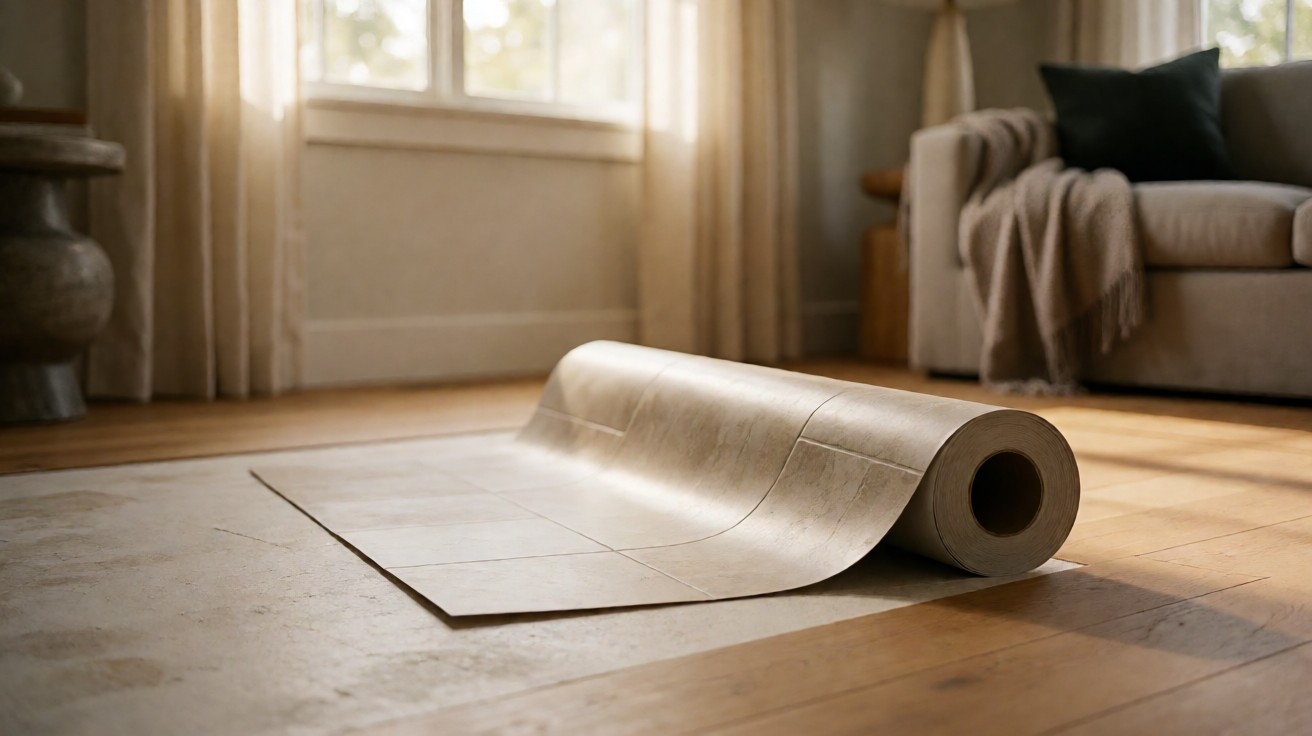
Sheet vinyl is the oldest and in some rooms still the best vinyl format. It comes off a wide roll as a continuous sheet, gets cut to your room, and has no repeat pattern and no tile edges to align.
That is why it survives in bathrooms, laundry rooms, and small irregular spaces where a tiled floor would need cutting around every corner, and why it has quietly disappeared from everywhere else.
Sheet vinyl is also the one vinyl format where the type matters more than it does elsewhere. A homogeneous sheet has its colour running all the way through the material, so it keeps looking new even when the surface is scratched.
A heterogeneous sheet has a printed top layer over a backing, which looks more like real stone but wears through when the surface is gone. Getting that one choice right is the difference between a sheet floor that ages and one that scuffs.
This guide covers what sheet vinyl is, how it differs from LVT and LVP, the two types and the two backings, and when the roll format is genuinely the right answer. If you have not chosen vinyl as your material yet, the vinyl flooring guide covers that, and the material comparison sets vinyl against the other options.
Sheet vs. LVT vs. LVP: Which Format
There are three vinyl formats and they differ in shape more than in material.
Sheet vinyl is the continuous roll format, cut to the room. It has no tile edges and no repeat pattern, which is its whole advantage and its whole limitation. It suits small rooms, wet rooms, and awkward shapes.
LVT is the square tile format and LVP is the plank format. Both are rigid, waterproof, and come in the same wear layers, and both suit the open rooms where you want a modern wood or stone look.
The practical split is this. If the room is small, wet, or an awkward shape, sheet is genuinely hard to beat. If the room is open and you want a specific modern look, a rigid tile or plank is the better product and it is easier to install.
Homogeneous vs. Heterogeneous Sheet
This is the single most important choice in sheet vinyl, and it decides how the floor ages.
Homogeneous sheet vinyl has the colour and pattern running all the way through the thickness of the sheet. There is no printed layer on top. That sounds like a small technical detail and it is the most important fact about sheet flooring, because it means a scratch does not remove the pattern.
The mark goes into the surface, and below it there is still the same colour. Homogeneous sheet is the durable choice, and it is the one specified in hospitals and schools for exactly that reason.
Heterogeneous sheet vinyl has a printed top layer sitting on a vinyl or felt backing, and that print is what gives you the realistic stone or wood look.
It is a printed image on the surface, which means it can wear through in a heavily trafficked area, and when it does, the backing shows. In return it looks considerably more like real stone than homogeneous does.
So the choice is durability versus realism. Homogeneous for wear and longevity. Heterogeneous for a convincing stone look in a room that sees light traffic. Most homeowners buying a printed sheet in a living room are choosing realism in a place where homogeneous would have served them better.
Felt-Backed vs. Glue-Down Sheet
Beyond the type, sheet vinyl is either felt-backed or glue-down, and that changes how it is laid and how permanent it is.
Felt-backed sheet has a felt layer on the back. The installer applies a thin layer of adhesive and then rolls the sheet into the adhesive, which bonds it to the subfloor. The felt makes the sheet easier to handle and it gives some underfoot softness. It is the format most commonly found in residential bathrooms and kitchens.
Glue-down sheet has no felt and is bonded directly, or laid loose. Loose-lay sheet is simply laid and held by the weight of the material and the friction of the floor. It is the quickest option to put down and to take up, and it suits a floor you might replace.
The practical difference is permanence. Felt-backed and glued sheet is a permanent floor that is hard to remove. Loose-lay sheet can be lifted, which is why it is used in rentals and in rooms where the flooring is temporary. Neither is designed to float the way a click-lock tile does, so a sheet floor cannot be picked up and relaid intact.
Widths, Rolls and Why the Format Suits Small Rooms
Sheet vinyl is sold on rolls of standard width, most commonly 6 feet, 6 feet 6 inches, and 13 feet wide. The width is what makes the format useful, because it determines how few seams your floor will have.
In a small bathroom that fits inside one roll width, there is no seam at all. The sheet is cut to the room and it goes down in one piece. That is why sheet is still the standard bathroom floor.
In a larger room you will have a seam, and because the sheet has a pattern direction, the two halves must be laid so the pattern runs continuously across the joint, which is skilled work.
This is also the honest weakness of sheet in a big room. The pattern has to match across a seam, the sheet is heavy and awkward to move, and cutting a room perfectly takes experience.
In an open-plan living room, a tile or plank format is simply easier to get right, which is why sheet has retreated from those rooms while still owning the small wet ones.
How Sheet Compares on Comfort and Water
Sheet vinyl is softer underfoot than a rigid tile, because it is a thicker, cushioned material with a felt layer rather than a thin rigid core. In a bathroom or a laundry room where you stand for a while, that difference is noticeable and it is one of the format’s quiet advantages.
On water, sheet is excellent. It is waterproof, it does not absorb moisture, and a properly bonded sheet in a wet room will last for years. The one thing that will fail it is a standing water problem underneath it, because a sheet floor traps whatever is below it, so the subfloor has to be sound and dry before the sheet goes down.
On warmth, sheet is warmer than tile and cooler than carpet. It is one of the more comfortable hard-floor options to stand on for a long period, which is why it is still the default in laundry rooms and busy bathrooms.
How Long Sheet Vinyl Lasts, and Replacing It
Sheet vinyl is one of the shorter-lived hard floors, and knowing why helps you decide whether it is the right choice.
A heterogeneous printed sheet, which is what most people buy, has a life governed by the print. In a quiet bathroom or laundry room it can look good for many years.
In a hallway or an open room where the top layer takes the traffic, it eventually wears through in the middle of the busiest path, and once it does, the whole sheet usually comes up.
A homogeneous sheet lasts much longer for the reason described earlier: the colour runs through the material, so a worn area still looks like the floor. That is why homogeneous sheet is specified for high-traffic institutional floors and why it is the better choice in a room that will be walked on constantly.
Replacing sheet is more disruptive than replacing a click-lock floor, because a bonded sheet has to be pulled up, and often the old adhesive comes with it.
If the floor underneath is still sound it can be recovered, but in practice a bonded sheet in a bathroom is often the moment a floor is taken up and replaced entirely, which is a good reason to think about the format carefully before committing.
The Comparison at a Glance
| Factor | Sheet vinyl | LVT / LVP |
|---|---|---|
| Format | Continuous roll, cut to room | Square tile or plank |
| Seams | None in a small room; a matched seam in a large one | Many tile edges or plank joints |
| Best in | Bathroom, laundry, small or awkward room | Open rooms, kitchen, basement |
| Underfoot | Softer, cushioned, warmer | Hard, thin, rigid core |
| Water resistance | Waterproof, traps what is below it | Waterproof, does not absorb |
| Durable type | Homogeneous, colour runs through | Thick wear layer |
| Permanence | Glued is permanent; loose-lay can be lifted | Click-lock can be lifted and relaid |
| Install | Heavy roll, needs a skilled cut | Fast; click-lock needs little skill |
Sheet or Luxury by Room
The comparison above sets the options against each other. This table turns the choice into a room-level assignment, which is usually faster than reasoning about format in the abstract.
| Room or situation | Choice | Why it fits |
|---|---|---|
| Small bathroom | Sheet | One piece, no seams |
| Laundry room | Sheet | Soft, warm, waterproof |
| Kitchen, small | Sheet | Quick, seamless in a small space |
| Open-plan living room | LVP or LVT | Easier install, better looks |
| Basement | Click-lock LVT | Rigid core over the slab |
| Rental bathroom | Loose-lay sheet | Easy to remove at turnover |
| Hallway | LVT | Tile or plank is a better wear surface |
| Utility or mudroom | Sheet | Tough, waterproof, no grout |
How to Choose Sheet Vinyl for Your Project
Choose sheet if the room is small, wet, or an awkward shape and you want one continuous piece with no seams. That is the honest case for it and it is a strong one in a bathroom.
Choose homogeneous if the room sees real traffic and you want it to last. Choose heterogeneous only if you want the stone look and the traffic is light enough that it will not wear through.
If the room is open-plan and you want a specific modern look, do not choose sheet just because it is the cheapest vinyl. A rigid tile or plank will be easier to install, easier to replace, and easier to extend later, and in a big room it will look better. The roll format is a room-specific answer, not a budget default.
Is sheet vinyl better than luxury vinyl tile?
It depends on the room, not on quality. Sheet is better in a small or awkward wet room, because it has no seams and it is soft underfoot.
LVT is better in an open room, because it is easier to install, easier to replace, and it comes in a far better range of stone and wood looks. Neither is the better product; they are different tools for different rooms.
Does sheet vinyl need to be glued down?
Not always. Felt-backed sheet is bonded with adhesive and is the most permanent form. Loose-lay sheet is simply laid and is held by its own weight and friction, which makes it quick to put down and easy to lift again. Glue-down gives a longer-lasting result, which is why it is the form most often used in a room you are keeping.
How This Fits With the Rest of the Choice
This page covers sheet vinyl as a format: what it is, the two types, the two backings, and where the roll format is the right answer. It does not cover the installation technique or the cleaning, which are separate pages.
If you are weighing the formats against each other, the vinyl flooring guide lays out all of them. If you want to see the rigid tile format, the the LVT guide covers it. And if you are still choosing the material overall, the material comparison sets vinyl against hardwood, tile, carpet, and the rest.