
Solid hardwood and engineered hardwood are the same species of timber and completely different products once you examine the cross section of the board. Engineered hardwood is not a cheaper imitation of solid wood; it is a different engineered product that happens to use the same veneer on top. The solid board is thick enough to survive five or six full sandings, which is where most of its reputation comes from, and that capability simply does not exist in an engineered plank no matter how good the top layer is. Everything else follows from what is underneath.
What Each Product Actually Is
Solid hardwood is one piece of timber from face to back, milled from the trunk and usually air dried or kiln dried and then conditioned to the interior humidity of the room it is going into. A solid board is commonly three quarters of an inch thick, and every one of those 19 millimetres is the same species. Its grain runs continuously through the thickness, which is exactly what allows it to be resurfaced.
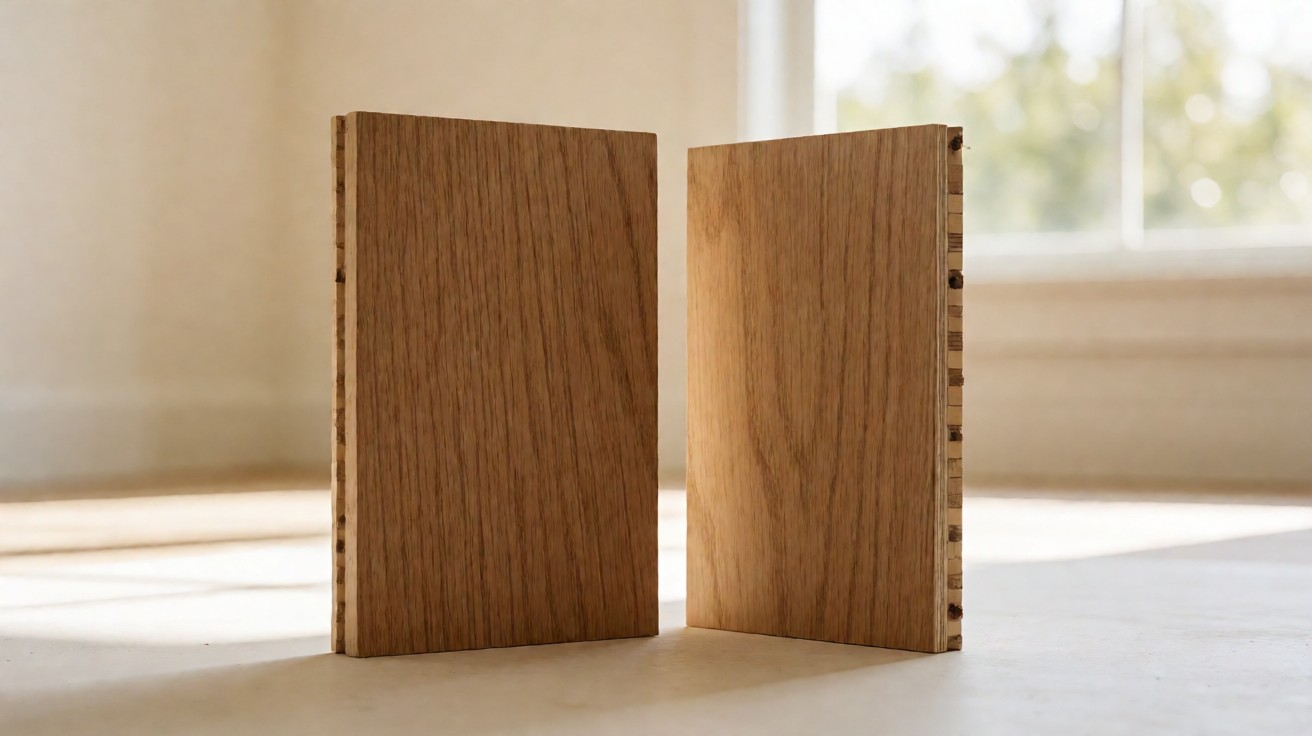
Engineered hardwood is a hardwood veneer, typically 3 to 6 millimetres thick, bonded under heat and pressure to a core. The core is cross plied plywood in a good product and high density fibreboard in a cheaper one, and the plies run in alternating directions so the panel resists movement in both directions at once. The engineered construction page covers that core in detail.
Why the Veneer Layer Exists
Timber moves with humidity in a well-known way: it swells when it takes on moisture and shrinks when it dries. A wide solid board moves across its width by enough to visibly gap against a wall or buckle in the middle of a room in a dry winter. Cross layering the core underneath a thin veneer largely cancels that movement, because each ply is pulling in a different direction.
That is the entire reason engineered hardwood exists, and it is a genuinely better engineering answer for over a slab, in a wide room, in a climate with big seasonal swings, or over radiant heat. It is not a compromise designed to undercut solid wood. It solves a problem that solid wood has.
What the Cross-Section Shows
A cut edge settles the argument faster than any specification sheet. In solid hardwood the growth rings run through the full thickness, uninterrupted. In engineered hardwood there is a visible horizontal boundary near the top and then a series of alternating layers beneath it, which is the cross ply doing its work.
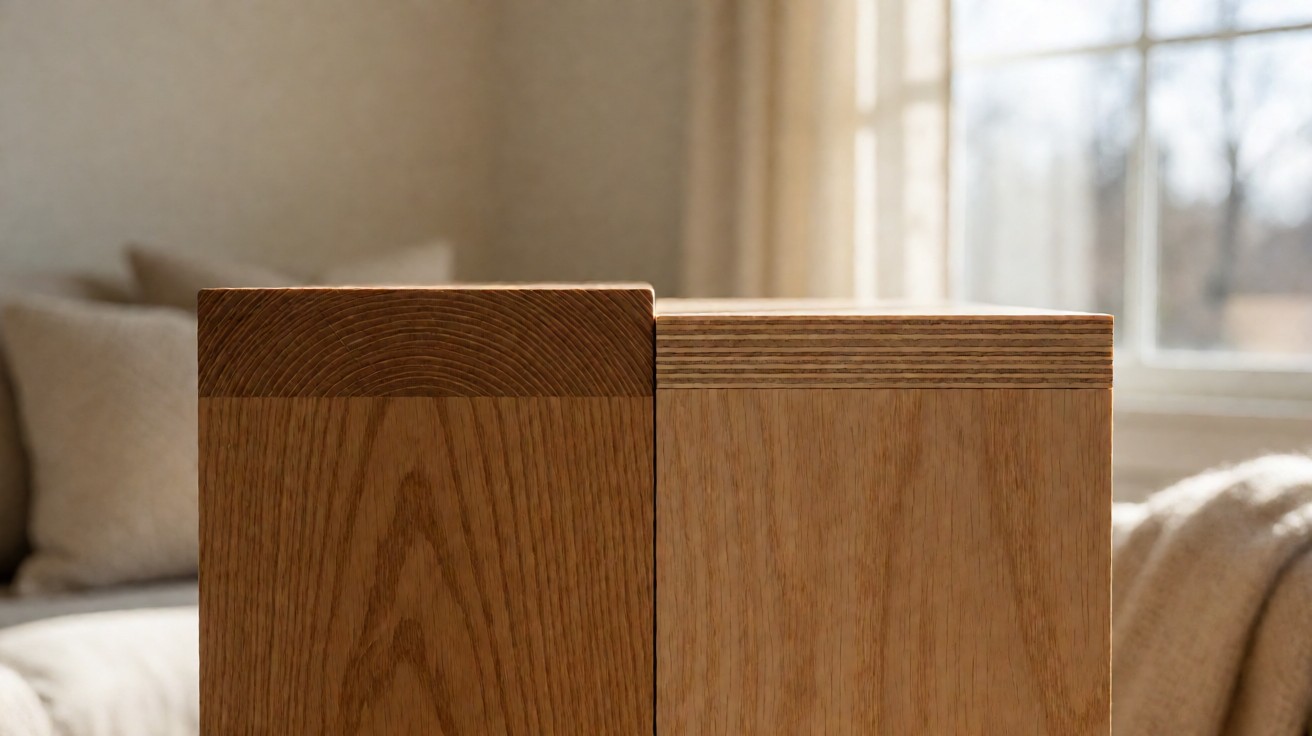
Dimensional Stability
This is the one area where engineered wins and it is not marginal. A quality engineered floor rated for a slab, a wide span, or a heated floor will tolerate conditions that will visibly ruin a solid board of the same species. Over a concrete basement slab that is cool and occasionally damp, solid hardwood needs to be installed well above grade with a vapour barrier and adequate ventilation, and it can still cup. Engineered tolerates that assembly directly.
The reverse case exists. If the room is above grade, the subfloor is dry wood, the house stays within a normal humidity range, and the floor will be sanded once in twenty years, solid hardwood is the more resilient choice because it has more material to give. The honest summary is that engineered hardwood is more forgiving of the installation environment, and solid hardwood rewards the environment for being right.
Resanding Capability
NWFA technical staff guidance is that a solid wood floor can be sanded six to eight times across its service life, because a full sanding removes between 1/32 and 1/16 inch of actual material and a sound three-quarter inch board still has well over a quarter inch above the tongue afterwards. That capacity is why solid wood carries a lifetime of value in a house that is kept.
Engineered hardwood can be refinished once, and sometimes twice, and only if the veneer is thick enough for the sanding. A 3 mm veneer on a product rated for refinishing can survive a light rescreen and recoat. A 1.2 mm veneer cannot be sanded at all without exposing the core, and the word to look for is the actual veneer thickness rather than the total board thickness. A product described as engineered for a floating floor is usually not engineered for a refinish.
Installing One on Top of the Other
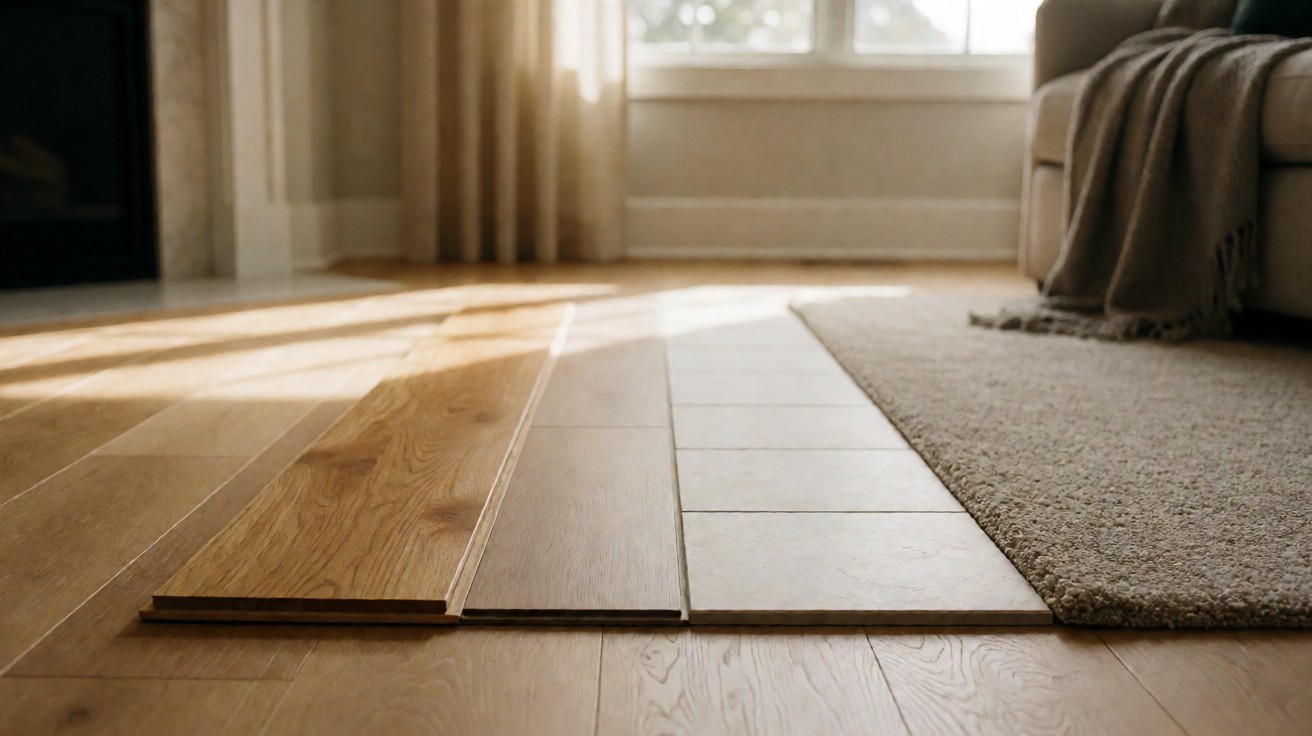
A solid board cannot be laid over an existing floor; it needs a flat exposed subfloor and a nailer. An engineered plank can be floated over an existing floor with a pad, glued down, or nailed, and the click and glue-down methods are how most engineered floors are installed. That difference matters more to the total cost than the material price does, because a solid floor in a room with an old floor that must come up costs several times what the material suggests.
There is a real tradeoff. A floating engineered floor moves with its underlayment and can feel slightly hollow under foot, where a nailed solid floor is quiet and dead. It also cannot be taken up and relaid without damaging the boards. Neither is wrong; one is a renovation shortcut and the other is a permanent installation.
Moisture, Slabs, and Basements
Over a concrete slab, solid hardwood is a poor default. The slab is cool, it holds moisture, and a solid board responds to that from below as well as from above. The traditional answer is to build a wood subfloor on sleepers well above the slab with a vapour barrier and ventilation, which is a considerable amount of construction for a floor that engineered wood would have taken directly.
Engineered hardwood over a slab is now common practice, subject to the product’s own moisture rating and a slab moisture test. That does not make it universally suitable; a slab in a wet climate still needs a tested vapour barrier. It does mean that the basement question, which used to rule out hardwood entirely, now has a hardwood answer with a different specification attached to it.
| Situation | Better Choice | Reason |
|---|---|---|
| Above grade, dry wood subfloor | Solid | Resanding capacity and no movement risk |
| Wide room or long plank runs | Engineered | Cross ply resists seasonal movement |
| Concrete slab or basement | Engineered | Tolerates the assembly solid cannot |
| Radiant heated floor | Engineered | Stable across cycling heat |
| House held 25 years or more | Solid | One resand extends it another 25 years |
| Renovation over an existing floor | Engineered | Can float; solid cannot |
| Budget-first on a good subfloor | Engineered | Thinner wear surface, lower material cost |
| Formal room in a forever home | Solid | Deepest patina and the longest horizon |
Hardness and Species Are the Same Question
Janka hardness, which is the measure of resistance to indentation, applies to both products identically for the top layer, because in both cases the surface is the same species of wood. If white oak is hard, white oak engineered is hard. The core does not change the hardness of the surface you walk on, and claims that one construction is harder than the other for the same species are marketing rather than material science.
Where the constructions genuinely differ on wear is in the repair. A deep scratch or a gouge that gouges solid wood can be screened and blended or removed entirely by the next full sanding. The identical gouge in an engineered board goes through a thin veneer, and the repair is a filler, not a resurfacing.
Thickness, Weight, and Handling
A three-quarter inch solid board weighs roughly twice what an engineered plank of the same dimensions weighs, and it is stiff, awkward, and unforgiving to cut. Handling is a real cost: a 500 square foot room of solid hardwood takes three people and a good deal of stair work, while the same room in engineered is two people and a morning. Anyone pricing a floor should include the labour and see the total, because the material difference is often the smaller half of the invoice.
Thickness also changes what you can do underneath. Solid hardwood is nailed or stapled through to a wood subfloor. Engineered can be installed the same way, glued to a concrete slab, or floated, which is why it is the usual choice over a slab or where the subfloor is not wood at all.
Cost and the Twenty-Five Year Number
Solid hardwood material typically runs $8 to $20 per square foot and engineered $5 to $14, and the labour difference is usually larger than the material difference because solid is slower and heavier to install. For a typical living room the all-in gap lands somewhere between $2,000 and $5,000.
Against that, engineered is sometimes specified with a veneer too thin to resand, which turns a fifty-year product into a twenty-five-year one. Read the veneer thickness. A product specified at 3 mm or more with an explicit refinishing rating is a different investment from a 1.2 mm wear layer marketed as engineered. The hardwood versus luxury vinyl plank comparison covers the other side of the wood-look market.
How Buyers and Resale Markets Read Each
Buyers and their agents describe a solid hardwood floor as a premium feature and an engineered floor as hardwood, which is accurate and reads as slightly less. The distinction is real in the listing conversation because engineered floors are associated with the budget end of the wood market, and that association outlives the actual quality of the product under discussion.
It weakens with age in a way that is worth weighing. An engineered floor that has been lived on for twenty years still reads as a hardwood floor, particularly if it has been rescreened, and it has performed the only test that matters over that period. The market perception is strongest in the first five years and weakest after fifteen, which tracks almost exactly with the resale window of most buyers.
What to Ask Before Buying Either
Four questions separate a good engineered product from a cheap one, and all four have a numeric answer. What is the veneer thickness in millimetres, and is the product explicitly rated for refinishing. What is the plywood core or is it a high density fibreboard, because the two perform differently over a slab. What is the total board thickness, which determines whether it can be floated, glued or nailed. And what is the finish, oil or polyurethane, because an oiled floor can be rescreened without the full sanding a coated floor needs.
For solid, the questions are simpler and the answer is usually visible. Confirm the thickness, confirm it is kiln dried to a moisture content appropriate for the interior, and confirm the grade, because grade and colour variation is a larger visual difference between two solid floors than the difference between solid and engineered of the same grade.
| Dimension | Solid Hardwood | Engineered Hardwood |
|---|---|---|
| Structure | One piece, full thickness | Veneer over cross ply |
| Typical thickness | Three quarter inch | 5/8 to 1/2 inch |
| Core material | Same species throughout | Plywood or high density fibreboard |
| Sanding capacity | Six to eight full resands | One, sometimes two |
| Seasonal movement | Significant across the width | Very low, cross ply cancels it |
| Over a concrete slab | Poor default | The standard answer |
| Install methods | Nail or staple only | Nail, glue, float or click |
| Over an existing floor | No | Usually yes |
| Veneer to check | Not applicable | 3 mm or more to refinish |
| Material cost per sq ft | $8 to $20 | $5 to $14 |
How to Choose Between Them
Choose solid when the room is above grade, the subfloor is dry wood, the house will be held for decades, and a resand in fifteen or twenty years is part of the plan rather than a surprise. Choose engineered when the subfloor is concrete, the room is wide, the house has big seasonal swings, the install needs to float over an existing floor, or the budget matters more than the refinishing horizon.
The question that separates them in one line is whether you intend to resand this floor. If yes, solid, and the veneer thickness on an engineered product will tell you whether that particular product can do it too. If no, engineered gives up very little and asks less of the room it goes into, which is usually the better trade.