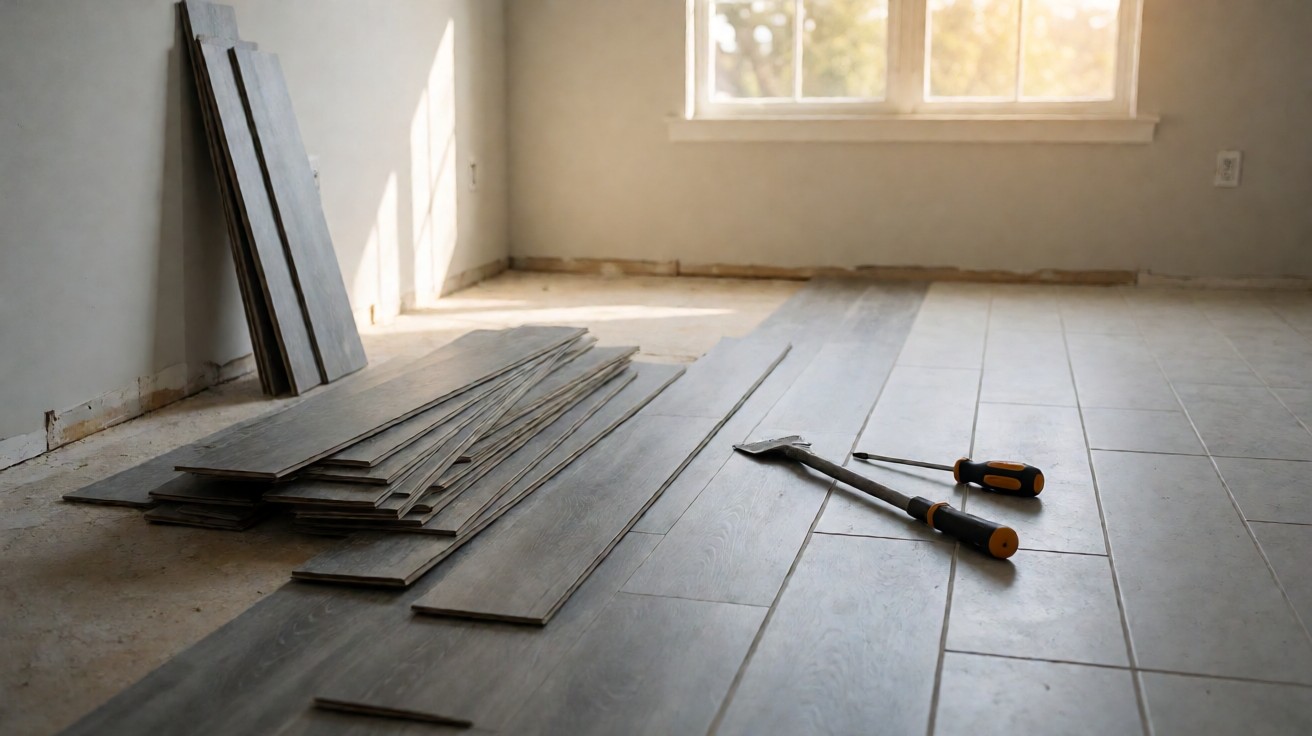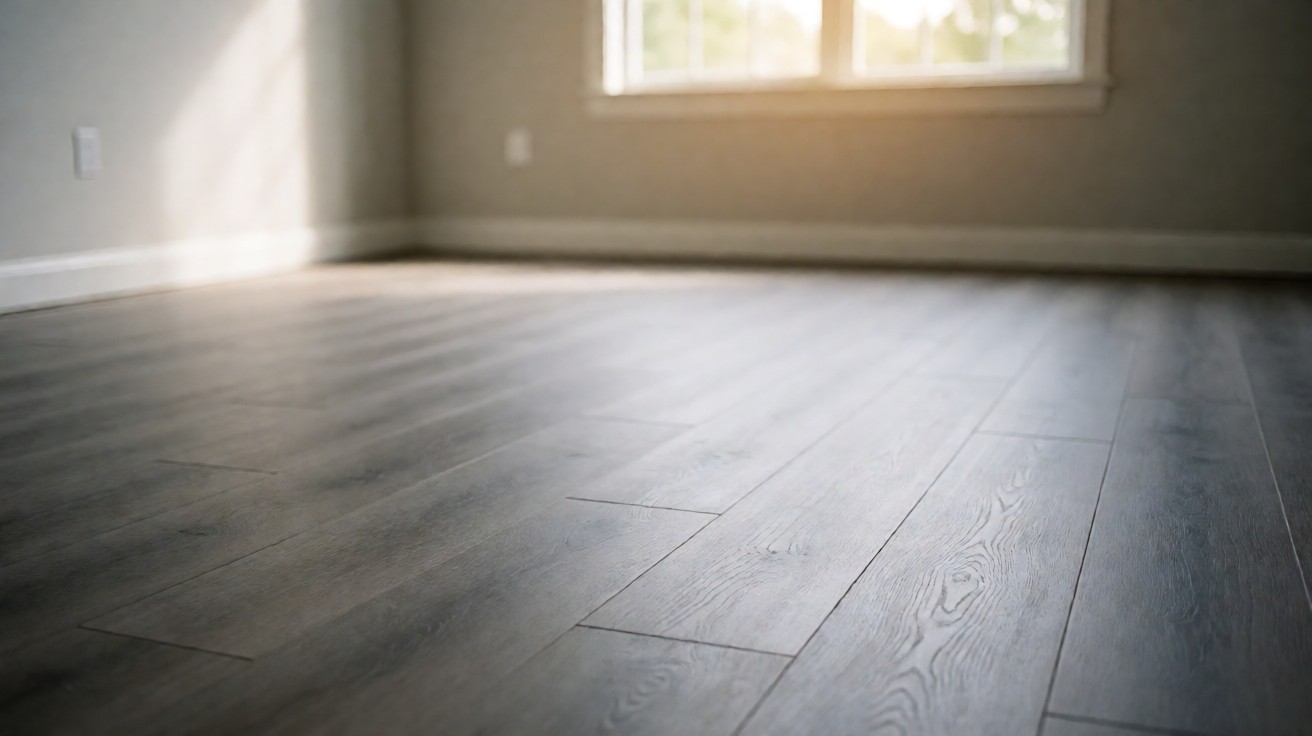

Two laminate quotes come back for the same 300 square feet, one about half the other, and the gap sits in four lines nobody pointed out on the sample.
The answer is to price the core and the install, not the top surface. Mid-range laminate lands between 3 and 7 dollars per sq ft installed, and inside that band the AC rating, the board thickness, and what the quote leaves out decide whether the floor lasts 8 years or 25.
What Laminate Flooring Cost Is Actually Made Of
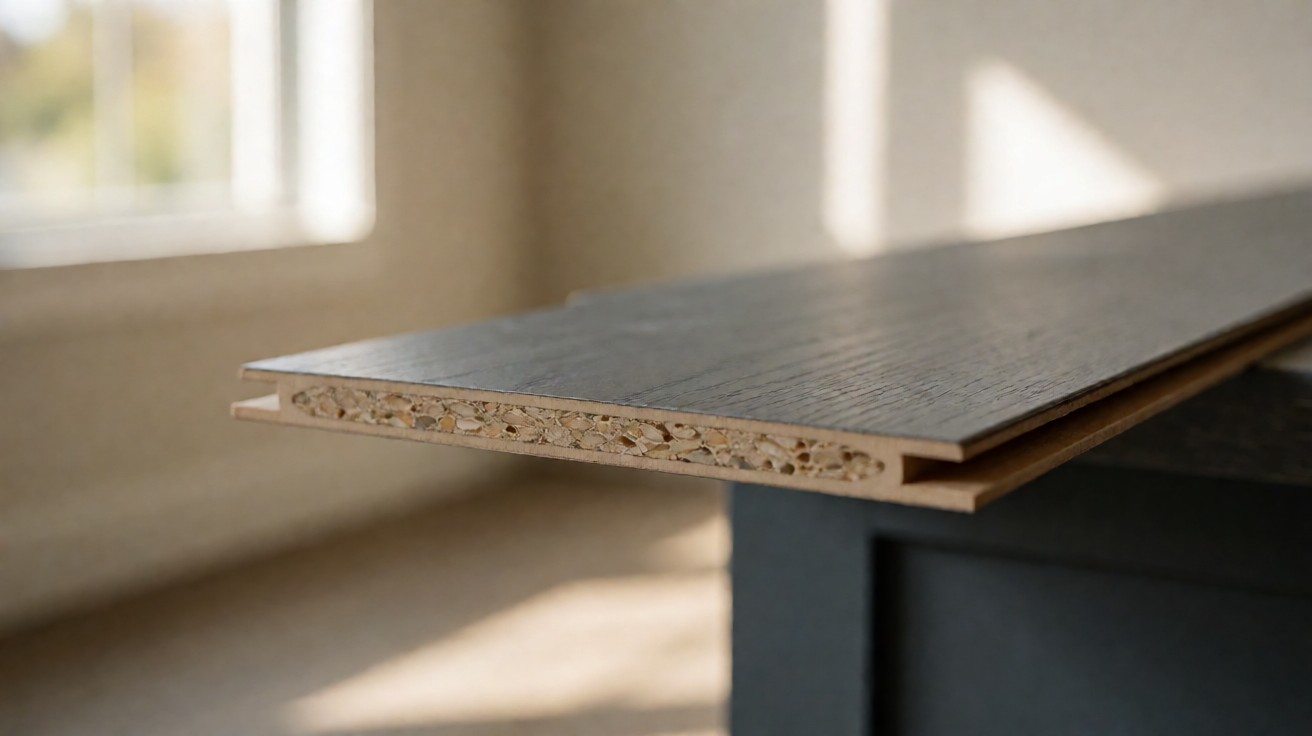
A laminate plank is four layers pressed together, and only one of them fails in normal household use.
The wear layer is a clear melamine or aluminium oxide film. Its thickness, from 0.2 mm on entry boards to 1.0 mm on commercial product, sets how many years of traffic the surface survives before it goes matte.
Under that sits a printed decorative paper imitating oak, walnut, or slate. It never wears out in use, which is exactly why it tells you nothing about durability.
A thin overlay of 0.5 to 1.5 mm follows, then the core: particleboard at 7mm or high-density fibreboard at 8mm through 12mm.
The layer breakdown in the laminate flooring guide runs deeper than most retail spec sheets.
The core decides the floor. Particleboard swells, softens, and crumbles when it takes water, and once the edges lift a plank cannot lie flat again.
If the room has a dishwasher, an ice maker, or an exterior door that drips, that is the failure mode to price in.
Entry, Mid, and Premium: What Each Tier Buys
Laminate is priced in three bands, and the bands are set by AC rating and core, not by finish. The printed grain is identical across all three.
| Tier | Core and thickness | Installed per sq ft | AC rating |
|---|---|---|---|
| Entry | Particleboard, 7mm | 2.00 to 3.50 | AC2 or AC3 |
| Mid | Fibreboard, 8mm | 3.50 to 5.50 | AC3 |
| Upper mid | Fibreboard, 10mm | 5.50 to 7.00 | AC4 |
| Premium | Fibreboard, 10mm to 12mm | 7.00 to 11.00 | AC4 or AC5 |
AC3 is the residential workhorse. It carries 10 to 15 years of ordinary household traffic, and it is the right specification for a bedroom, a hallway, and most living rooms.
AC4 is rated for light commercial traffic and buys roughly 20 to 25 years in a home. Choose it for a rental unit or a house with dogs.
AC5 is heavy commercial grade and costs 60 to 100 percent more per sq ft. In a residential job it is money spent on a specification the room will never use.
A longer comparison of standard versus premium tiers breaks the same bands down by wear layer and core density.
Below AC3 sit AC1 and AC2, rated for light residential use only. They are still sold, and buyers on a hard budget are sometimes handed one without being told what the number means.
The European grading system runs in parallel, from class 21 for domestic light use through class 23 for domestic heavy to class 33 for heavy commercial. Class 23 equals AC3.
Thickness, Wear Layer, and What the Millimeters Buy
Board thickness is the number buyers argue about and the one that changes least in practice.
Going from 7mm to 8mm adds roughly 0.30 dollars per sq ft and buys a denser core that resists swelling. That is the useful step.
Going from 8mm to 12mm costs another 1.50 to 3.00 dollars per sq ft, cuts sound transmission by about 5 dB, and deepens the tongue so the floor tolerates a slightly uneven subfloor.
If the subfloor is flat within 3/16 inch (5mm) over 10 feet, the extra 4mm buys comfort and quiet. If it is out by more, no amount of board thickness fixes it.
If the floor is going down over something uneven, the flooring for uneven subfloors shortlist is worth reading before you order.
Wear layer thickness is the number to read on the spec sheet rather than the box. At 0.2 mm you have a 2 to 3 year surface in a busy room. At 0.5 mm you have the practical residential minimum.
Where a Laminate Quote Hides the Money
A laminate quote looks complete because the flooring line already carries a per sq ft price that sounds installed. Usually it is not.
| Hidden line | Typical range | Why it slips off |
|---|---|---|
| Underlayment | 0.25 to 1.10 per sq ft | Folded into the flooring line |
| Moulding | 2.00 to 5.00 per linear ft | Priced as an add-on at the end |
| Transitions | 8 to 22 dollars each | Counted after the old floor is gone |
| Thresholds | 8 to 22 dollars each | Not shown on a sample board |
| Removal | 1.00 to 2.50 per sq ft | Assumed the owner is doing it |
| Disposal | 0.50 to 1.00 per sq ft | Landfill fee billed at pickup |
| Waste at 10 to 15 percent | 3 to 8 percent of material | Measured at exact area |
Underlayment is the first omission. Foam runs 0.25 to 0.50 dollars per sq ft and fibreboard runs 0.60 to 1.10, so a quote naming no underlayment is either supplying the cheapest foam or skipping it.
Skipping it is not free. With no moisture barrier and no cushion layer, the core takes every drop the floor sees.
Moulding is the second. Baseboard and shoe mould run 2.00 to 5.00 dollars per linear ft, and a job replacing 24 linear ft without listing it is quoting a floor with no finished edge.
Transitions and thresholds are the third. A T-mould between laminate and tile, a saddle at the exterior door, and a reducer at a step run 8 to 22 dollars each installed.
Removal and disposal are the fourth, at 1.00 to 2.50 dollars per sq ft, and they are the line most often discovered on the final invoice rather than the estimate.
Waste is the fifth. A rectangular room running planks along the long wall takes 10 percent. A room with a hallway, a bay, or two run directions takes 15 percent.
Click-Lock Versus Glue-Down
A floating click-lock floor is mechanically locked at the tongue and groove and sits on the underlayment, nothing more. Glue-down bonds every plank directly to the slab or subfloor.
Labour runs 2.00 to 3.25 dollars per sq ft for click-lock and 2.75 to 4.50 for glue-down. The extra 0.75 to 1.25 pays for adhesive, rolling with a 100 pound roller, and curing time the crew cannot bill elsewhere.
The moisture difference matters more than the price difference. A floating floor tolerates a damp slab because the underlayment does the breathing. Glued laminate does not.
If adhesive goes down over a slab reading above 75 percent relative humidity by ASTM F2170 in-situ probes, you will be chasing lifted planks in the second wet season.
If the slab is dry and flat, glue-down wins on sound and on dimensional stability. If it is damp, on new construction, or in a basement you cannot verify, click-lock is the only sensible choice.
Over a wood subfloor, click-lock leaves the floor floating, which absorbs seasonal movement in the joists. Glue-down transfers that movement to the surface and produces squeaks and cupped planks by February.
Over a Concrete Slab Versus Over a Wood Subfloor
Over a slab you add three things: a moisture test, a membrane or sealer, and a flatness check. A 300 sq ft slab is flat enough only if the high spot stays within 3/16 inch (5mm) over 10 feet.
Skim coat or self-levelling compound to fix a high spot runs 1.20 to 3.00 dollars per sq ft. Skipping it is how a floating floor ends up rocking on a dip it found for itself.
A polyethylene vapour barrier runs 0.10 to 0.30 dollars per sq ft and keeps slab moisture out of the core.
Over a wood subfloor you need no membrane, but you do need panel thickness and joist spacing. Half inch plywood at 16 in centres deflects under a rigid floor and prints its grid into the planks.
If the existing floor is solid hardwood at least 3/8 inch thick and stable, laminate can go straight over it, which is the cheapest speed win in the job.
If the existing floor is cupped or soft in places, take it up. Laminating over a problem floor locks that problem into the new one.
Water Resistance: What the Label Actually Means
Water-resistant on a laminate carton means the wear layer and the overlay do not stain when you mop them. It does not mean the core is sealed.
A spill standing 15 minutes wipes up. A spill standing overnight reaches the edge joint, because the tongue and groove is a mechanical fit with no seal in it, and the board swells from the bottom.
Waterproof is a term used for vinyl and for porcelain tile. It is not a legitimate claim for laminate.
In a bathroom, a laundry, or a mudroom, laminate is the wrong choice regardless of price. Vinyl with a 20 mil wear layer costs less to install once you count the moisture work.
The LVP versus laminate comparison sets out that head to head in detail, including the underlayment and floor preparation lines.
If the room has a drain, laminate does not go in it. If it has a dishwasher and no drain, AC4 with disciplined habits is defensible, and you should know what a replacement floor costs in 10 years.
Slip Resistance and Formaldehyde: Two Numbers Quotes Omit
Slip rating for a level interior surface is measured as a dynamic coefficient of friction, and the threshold accessibility codes work from is 0.42 under wet conditions.
ANSI A326.3 is the standard that governs how laminate is rated for that figure. A matte, textured oak-look board usually posts a higher number than a glossy one, so the finish changes the measurement even when the core is identical.
The practical consequence is simple. If a corridor, a stair landing, or an entry is in scope, ask for the wet DCOF number rather than a marketing claim of slip resistant.
ANSI A117.1 is the accessibility standard those provisions are written against, and it is the reason the 0.42 figure shows up on specifications at all.
Formaldehyde is the second number. Under EN 717-1, panels are classed E1 at 0.124 mg of formaldehyde per cubic metre, E0 at 0.050, and ENF at 0.025.
ENF is the tightest class and the one worth paying for in a bedroom or a child’s room. If the seller cannot name the class, treat the panel as E1 and ventilate the room for the first few weeks.
For underlayment, water vapour permeance is reported under ASTM E96, usually as a perm rating. Anything above 1 perm under a concrete slab is a warning that moisture is still reaching the core.
A Worked Example: 300 Square Feet, Two Quotes
Take a 15 ft by 20 ft living room, 300 sq ft, and two quotes for the identical board at the identical specification. Run the room through a square footage calculator before you accept either area.
Order enough material for the room plus waste. At 10 percent waste you need 330 sq ft. On a box of 28.1 sq ft that is 11.7 boxes, so you buy 12.
Quote A prices those 12 boxes at 42.00 dollars each, adds underlayment at 0.35 per sq ft, and adds click-lock labour at 2.10 per sq ft. Nothing else appears.
Its total is 504.00 for boxes, 105.00 for underlayment across 300 sq ft, and 630.00 for labour, which comes to 1,239.00 dollars or 4.13 per sq ft installed. Removal, moulding, and thresholds are not in it.
Quote B prices the same 12 boxes at 68.00 each, uses fibreboard underlayment at 0.85 per sq ft, labour at 2.75 per sq ft, and adds removal, disposal, moulding, and a threshold.
Its total is 816.00 for boxes, 255.00 for underlayment, 825.00 for labour, 330.00 for removal and disposal, 81.60 for 24 linear ft of moulding at 3.40, and 65.00 for the threshold. That is 2,372.60 dollars, or 7.91 per sq ft.
The gap is 1,133.60 dollars across 300 sq ft, or 3.78 per sq ft. Of that, 476.60 is the four lines Quote A omitted, 150.00 is the underlayment upgrade, 312.00 is material, and 195.00 is labour.
| Line item | Quote A | Quote B |
|---|---|---|
| Boxes, 12 at size | 504.00 | 816.00 |
| Underlayment | 105.00 | 255.00 |
| Click-lock labour | 630.00 | 825.00 |
| Removal and disposal | Not included | 330.00 |
| Moulding, 24 linear ft | Not included | 81.60 |
| Threshold | Not included | 65.00 |
| Total | 1,239.00 | 2,372.60 |
| Per sq ft installed | 4.13 | 7.91 |
That arithmetic is the entire decision. You are not choosing between a cheap floor and an expensive one. You are choosing between a 7mm board on foam with no finished edges and a 10mm board on fibreboard in a room that is actually done.
Comparing Two Quotes Line by Line
A quote is not a number. It is a list of line items with quantities attached, and comparing two takes ten minutes once you know which columns carry weight.
Record four things for each quote: board thickness in mm, AC rating, wear layer thickness, and whether underlayment, removal, moulding, and thresholds sit inside the total or beside it.
The material versus installed price breakdown matters here, because the flooring line and the labour line are priced on different bases by different people.
If two quotes differ by more than 1.00 dollar per sq ft on material alone at the same AC rating and thickness, one is not selling the board the other is.
If one quote is glue-down and the other is click-lock, the labour difference is normal and the moisture expectation is not. Ask each contractor what slab reading they require.
Ask whether a manufacturer warranty transfers to the next buyer. A warranty naming only the original owner is worth nothing in a resale.
A quiet number on any quote is the waste factor. Ten percent on a 12 box order is one box, and a quote with none runs short on the last row.
DIY Versus a Professional Install
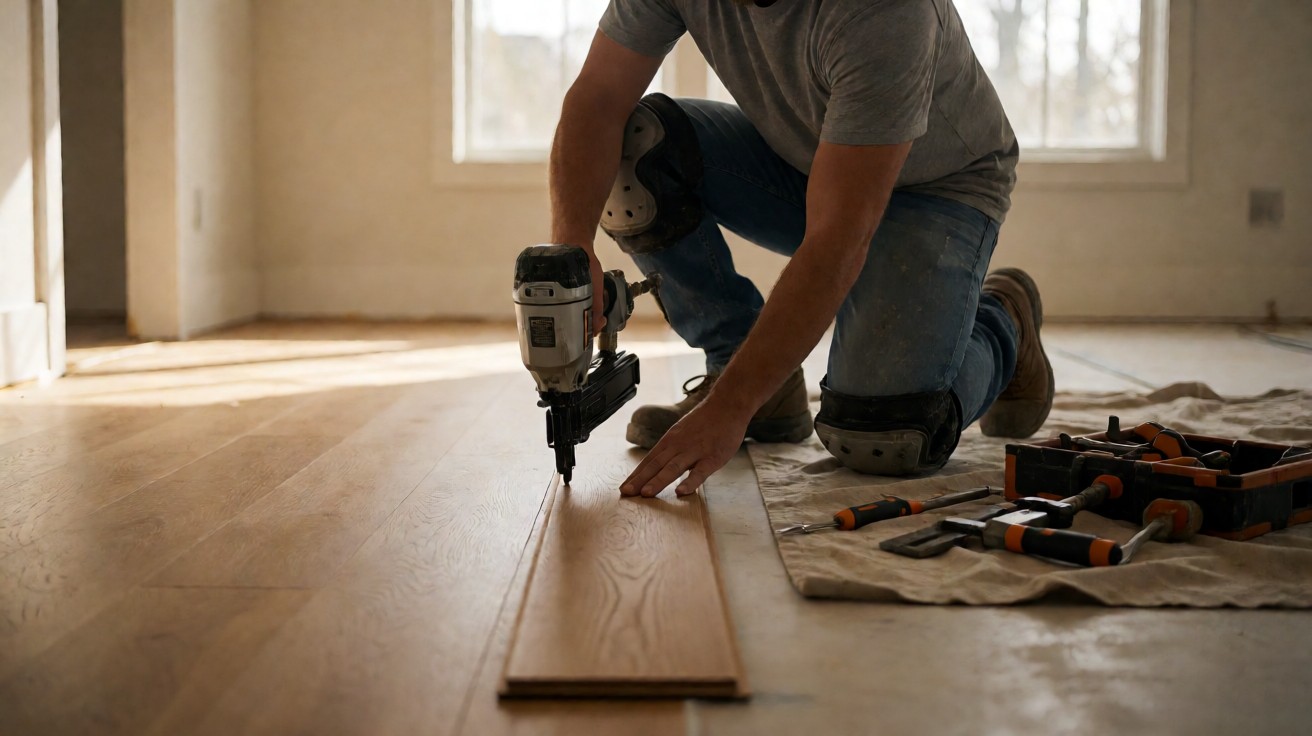
Click-lock laminate is the most DIY-friendly floor there is, and that is a consequence of the profile rather than a marketing claim.
No glue, no wet rooms, no cure time. A pull bar, a rubber mallet, and a knee pad are the entire kit.
A 15 ft by 20 ft room is a weekend for a patient first-timer. The saving is real: 2.00 to 3.25 dollars per sq ft, or 600 to 975 dollars on 300 sq ft.
That is the largest single line item you can remove from the invoice.
What you give up is the flatness check, the moisture test, the transition work, and the workmanship warranty. A crew’s first hour on a slab goes entirely into deciding whether the floor can go down.
If the room is square, the subfloor is flat and dry, and you can hold a 3/8 inch (10mm) expansion gap along every wall, do it yourself. If any one of those is untrue, hire it out.
Landlords should weigh one more factor. A click-lock floor installed badly can be lifted and reset, and that reversibility has real value in a turnover.
Where the Money Is Not Worth Spending on Laminate
Premium laminate money goes on features that do not survive contact with a mop, a dog, or a moving sofa.
A 12mm board over a flat subfloor in a bedroom is money spent on comfort. The same 8mm board with a 3mm felt pad beneath absorbs nearly as much sound for a fraction of the cost.
Chasing a continuous grain pattern across a long run is worth less than the 0.20 dollars per sq ft you keep by buying the mid tier in a low traffic room.
Wax and polish products sold for laminate do nothing. The wear layer is a cured melamine film and it cannot be polished back to life.
Spend instead on the underlayment, on the moisture test over a slab, and on AC4 rather than AC3 in a room that takes real traffic.
The one place premium pays for itself is a rental or a resale. An AC4 board with a 0.5 mm wear layer hands the next owner a usable floor, and a 15 year AC3 board gets discounted at the inspection.