
Your installer has tapped the floor with a straightedge and told you the slab has to be level before the new floor goes down, and you want the number.
Choose the method by the depth, not by the quote. Patching isolated dips runs 1 to 2.50 dollars per square foot, self-leveling compound 2 to 6 dollars, grinding a slab back to tolerance 1.50 to 4 dollars. A quarter inch dip over a 10 foot span is the dividing line.
Why A Flat Floor Matters, And Which Floors Care
A floor laid on a slab inherits every variation it cannot cover.
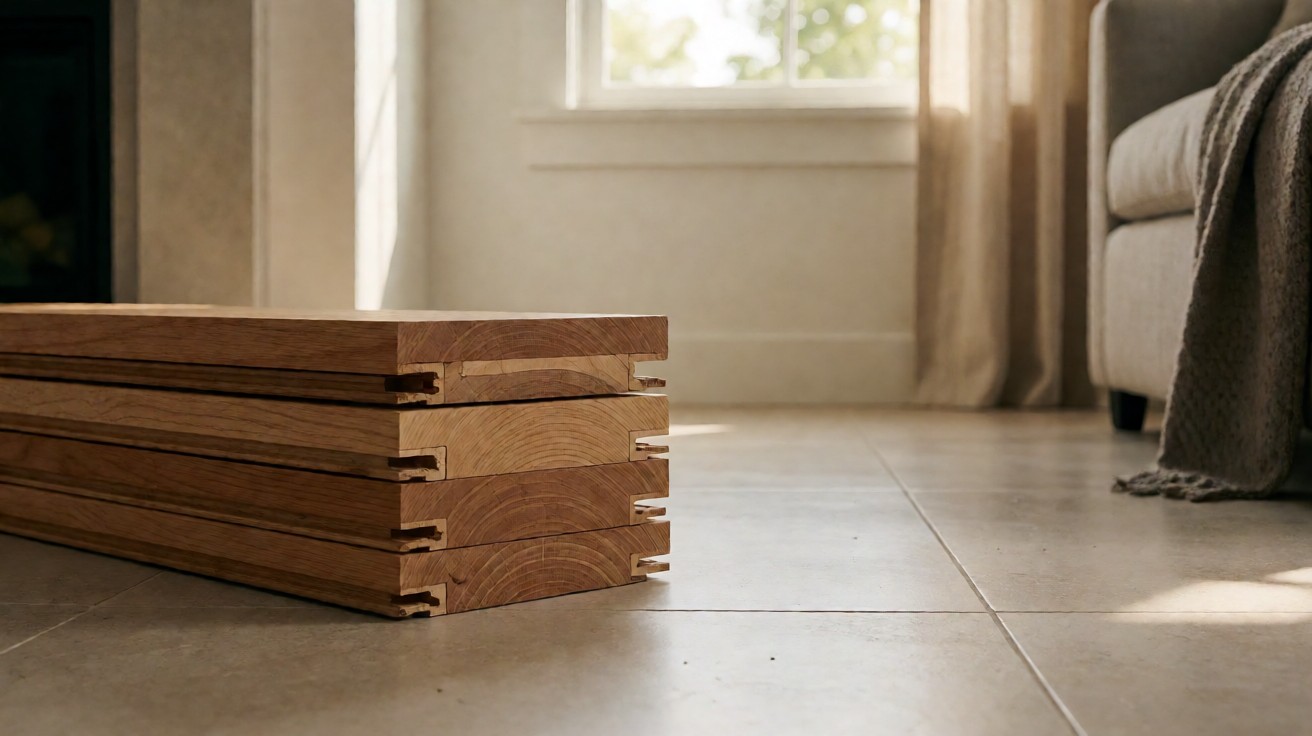
Floating floors bridge. A click-together laminate or engineered plank moves on its own and carries a foam or fibreboard underlayment that spans small hollows.
Glued and nailed floors do not bridge. Sheet vinyl, luxury vinyl tile, and thinset-set tile bond straight to the slab, so anything the slab does, the floor does, and a dip under a click-lock plank simply disappears under the pad.
Ask which system is going down. If it is a floating floor on a rated underlayment, the tolerance you need is looser than most quotes assume.
The categories are worth sorting by tolerance before the quote arrives. Flooring for uneven existing floors ranks them by how much variation each one spans.
High spots wear first, hollows collect dust, and a floor that rocks underfoot is what anyone notices. On a wheelchair route it is a code question.
The Three Methods And What Each One Costs
There are three ways to make a slab flat, and the quote in your hand is doing one of them, chosen by the depth of the worst dip.
Repair mortars and hydraulic cement fill a void without levelling the room, and a patch rated to 3/4 inch holds a shallow hollow that would otherwise telegraph.
Self-leveling compound is a pumpable cement or gypsum screed that flows out as a liquid and hardens flat. It covers the whole area rather than the defects, so cost tracks volume poured, and volume tracks depth.
Grinding and sealing removes proud areas rather than filling low ones, then seals the surface. It suits a floor close to tolerance, and does nothing for a dip half an inch deep.
| Method | Typical Cost Per Square Foot | Best When | Main Limitation |
|---|---|---|---|
| Patch the dips | 1 to 2.50 dollars | Isolated voids under 3/4 inch | Does not correct a sloping slab |
| Self-leveling compound | 2 to 6 dollars | Dips and high spots up to 1 inch | Depth drives bag count and drying time |
| Grind and seal | 1.50 to 4 dollars | Close to tolerance with proud areas | Dust, noise, no depth correction |
| Screed or underlayment pour | 3 to 7 dollars | Severe irregularity or below grade | Long cure and raised floor height |
Here is the arithmetic behind the compound line.
A 400 square foot room has a low spot measured at 3/4 inch across about 4 feet by 4 feet. A patch will not hold that, so the answer is a pour averaging 3/8 inch across the room.
A 50 pound bag covers roughly 200 square feet at 1/8 inch, the figure printed on most bags. At 3/8 inch the volume triples, so one bag covers about 67 square feet.
400 divided by 67 is 6, so six bags cover the floor and a seventh absorbs the trough where the pour runs thin. At 24 dollars a bag that is 168 dollars, and one gallon of acrylic primer at 60 dollars brings material to 228 dollars.
The crew is the larger number. Three people for 4 hours is 12 hours at 68 dollars, or 816 dollars. Total 1,044 dollars, or 2.61 per square foot. Pour the same room at 1/8 inch instead: four bags at 96 dollars, same primer, same crew time, 972 dollars, or 2.43 per square foot.
That is the useful part. Once the crew is on site with primer down, depth is the smallest variable you control. The large saving comes from not mobilizing a crew at all, which is what a floating floor or a filled void allows.
How Much Out Of Tolerance Is Too Much
There is a number, and it is written down. ASTM F2679 measures concrete slab flatness and reports it as an F-number. Each step between F-numbers is 1/10 inch, so F25 allows 1/4 inch of difference between two points 12 inches apart, and F15 allows 3/16 inch.
A slab at F25 is generally acceptable under resilient sheet and vinyl tile as it stands. F15 is what thinset tile and glued hardwood ask for. Above F35 in a traffic lane you are filling holes, and filling is a different price.
This is where experienced installers and the specification part company. F-numbers are averaged, so a floor can come in at F25 and still feel like rolling hills at 6 foot intervals. Measure as the specification says, then walk it.
ASTM F710 is the other document, the standard practice for preparing concrete floors to receive resilient flooring. It is practical rather than theoretical: the slab must be clean, sound, free of laitance and curing compounds, within tolerance, and dry enough. A slab that passes its numbers and fails the surface has failed.
Accessibility codes reference ANSI A326.3, the sheet vinyl standard, for the dynamic coefficient of friction, and the figure cited for a level interior walking surface is 0.42. Grading that surface is the finish floor’s job, not the slab’s.
Grinding changes how the new floor sits on the slab. A ground surface is open and porous where it was dense and sealed, so water moves up faster and anything bonded onto it needs a sealer first. That is why a polished concrete quote prices the grinding as a finish.
What The Leveling Line On Your Quote Actually Covers
A leveling line is not one number. It bundles five things, and a quote showing only the total hides the one you can negotiate.
| Part Of The Line | Usual Figure | What To Check |
|---|---|---|
| Material | 15 to 30 percent | Bags and gallons, with waste added |
| Labour | 60 to 75 percent | Crew hours rather than square feet |
| Drying time | 24 to 72 hours | Which product, what humidity |
| Primer or membrane | Its own line or assumed | A skipped primer voids the warranty |
| Callback | Rarely written down | Who pays if it fails in 90 days |
Material is the smaller half. Compound and primer typically account for 20 to 30 percent of a pour, and the crew takes the rest. A cheap quote is cheap on labour, not on bags.
Drying time is the item that gets left off. Without a named product and cure window, the crew may be pouring a fast-set screed ready in a day, or a general purpose one needing 3 days. The second is the default you inherit.
The callback clause is the one to get in writing. A missed dip or a pour that did not bond is invisible on the day and appears weeks later with the floor down, by which point the floor comes up too. Nobody inspects a screed after it is covered.
Concrete Slab Or Wood Subfloor: Two Different Problems
On concrete the defect is a shape, and you change the shape. On wood the problem is movement, and no quantity of compound fixes movement.
A wood deck that dips between joists is deflecting. The joists are too widely spaced, too small in section, or bearing on nothing, and the dip moves when someone crosses the room and comes back. Compound over it makes a floor flat until the next footstep.
The repair is structural: straighten or add joists, add blocking at mid-span, or glue a solid layer across the deck. That is carpentry, priced separately, and sometimes the larger line. If your installer quotes leveling on wood and will not discuss the joists, ask why.
Moisture is the other gate, and on a slab it comes before flatness. ASTM F2170 measures relative humidity in place, and most resilient flooring manufacturers cap it at 75 percent. Above 85 percent you are watching water arrive from the ground.
Below grade, or over a crawl space with no vapor barrier, the honest scope is a membrane first and leveling second. Grinding and sealing is not a moisture strategy.
When You Can Skip Leveling Entirely
Most of the saving comes from not booking the crew. Four situations make zero the correct scope.
Choose a floating floor and small dips stop mattering. Where the underlayment is rated for the span and the product is click-lock, the floor floats over the substrate and tolerates the 3/16 inch hollows that would ruin a glued install. If the material is unchosen, flooring for concrete slabs sorts the categories by tolerance.
Leave the old floor in place. If it is sound and the new material is designed to go over it, a floating system goes down without touching the subfloor. Over carpet or sheet vinyl on a deck, the answer is often a demolition credit.
Make the slab the finish. Polished or sealed concrete still wants a flat slab, but a floor meant to read as concrete tolerates more variation than a resilient one, because the variation stays visible instead of being printed into the wear layer.
Skip it when the dip is shallow. Where the floor is floating and a 10 foot straightedge shows under 1/8 inch of gap at the worst point, most of that gap disappears under the underlayment. You give up rigidity and a little noise.
Skip it on a glued floor and you get shadow lines under raking light, with nobody to blame but yourself.
The Drying And Cure Time Trap
Almost every failed leveling job is a schedule failure dressed as a workmanship failure.
A standard gypsum or cement screed is walkable in 4 to 8 hours, and walkable is not ready. Manufacturers usually want 24 to 72 hours before resilient flooring goes down, and a 28 day cure before furniture loads. Fast-set screeds reach install readiness in hours, at higher cost.
Humidity breaks the schedule. A cool, dry house in February can take a screed in a day. A warm slab in a humid afternoon can hold its water for a week, and a surface reading says almost nothing, which is why the ASTM F2170 in-place test governs. Low room temperature slows it just as badly.
What goes wrong early is not a squeak. It is adhesive arriving at a slab above the specified maximum, and the bond failing weeks later on the first cold morning.
Get the product name and install-ready window in writing, then lay it against the scheduled floor date. If the two are close, the schedule is wrong.
How To Check Your Own Floor Before You Pay For It
This is the one part of the job you can do in an afternoon with a straightedge.
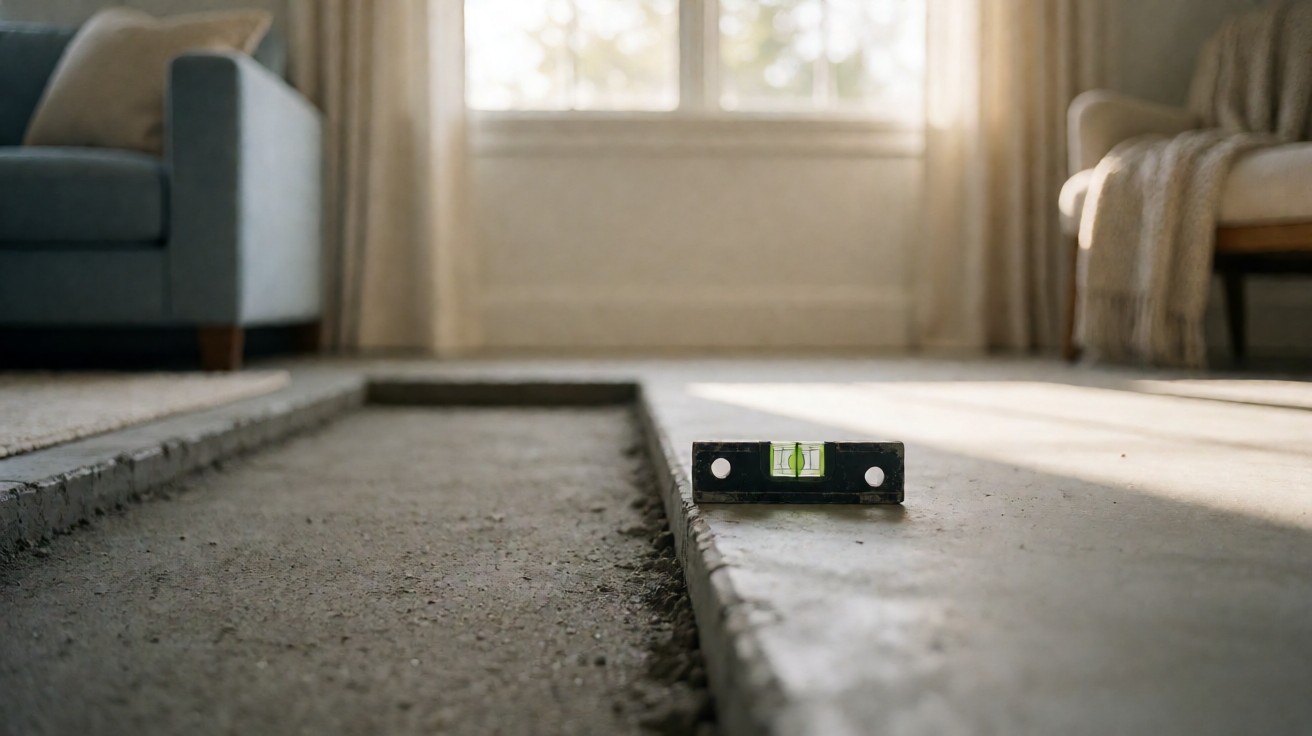
Lay the straightedge on the slab in a grid, not down the middle only. Mark everywhere the edge lifts, and mark everywhere it rocks. Both are defects, and the rocking ones no filler will solve.
Measure depth at the worst mark with a feeler gauge. You want one number: the deepest gap on the floor, in inches. Under 1/8 inch is a floating-floor question. Between 1/8 inch and 3/16 inch is a patch question. Past 3/16 inch you are into compound.
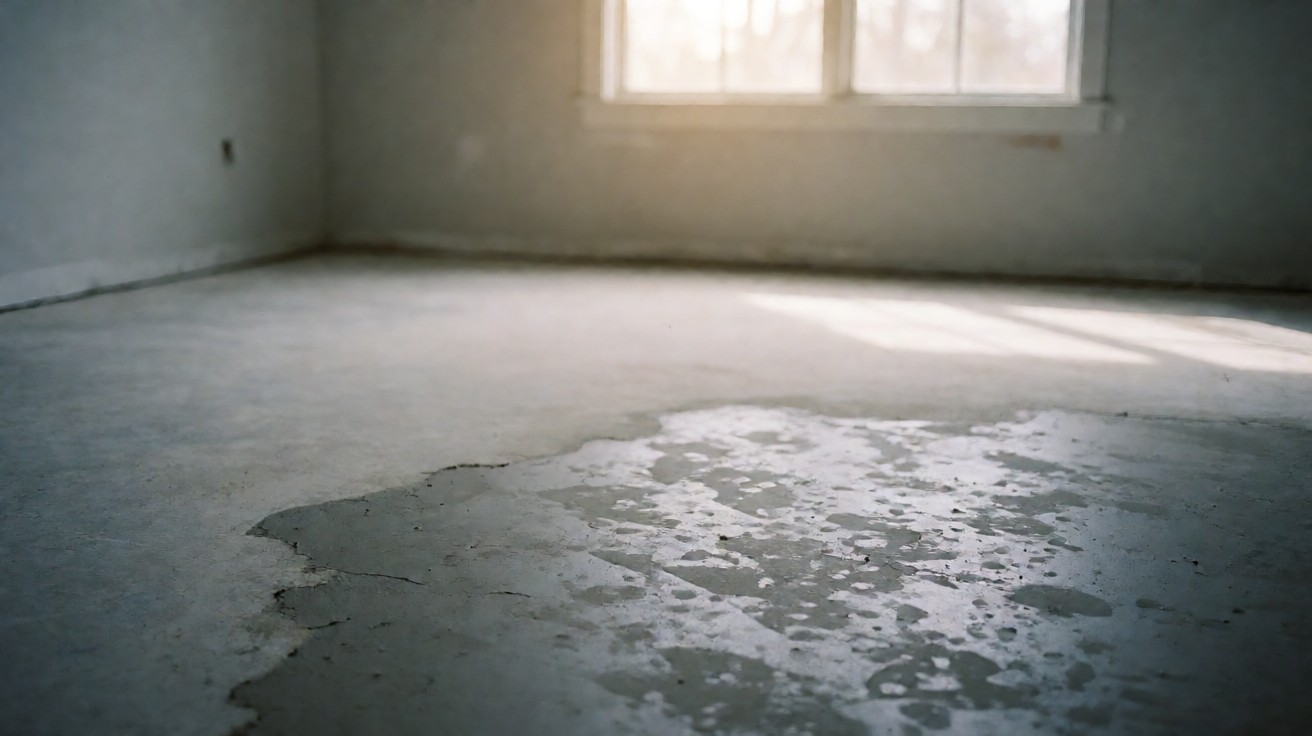
Then look at the surface. Drag a flat edge across the slab and watch for grinding powder or a grey laitance film under your finger. Concrete that dusts under a palm is weak and wants grinding.
DIY Versus Hiring A Leveling Contractor
Leveling a concrete slab is one of the more reasonable pieces of flooring work to attempt yourself. Grinding is not.
What you can do: survey with a straightedge, fill isolated voids, and pour compound in one small room. Pumpable screeds mix with water and a drill paddle, and the usual failure is over-water, leaving a soft surface you can find with a coin.
What you should leave alone: skimming to a line drawn across the room, pouring over a damp substrate, grinding with a rental machine you have never run. Dust control in an occupied house is a real problem.
The trade-off is exposure, not skill. A crew carries liability for the bond between screed and slab, and that bond is what fails. A self-levelled pour has nobody behind it, so the risk is yours.
Doing it yourself, reduce the scope rather than the care: one small room, no furniture, no deadline, and a bag stating both walkable and install-ready time. Keep the pour continuous, because a cold joint between two batches is a weak line.
Comparing Leveling Quotes Line By Line
Compare leveling lines by unit and assumption, not by total.
Two quotes at 2.40 and 4.10 per square foot are often the same job priced on a different assumption about depth. Ask both what average pour depth they carry, and the gap either closes or becomes explainable. Material versus installed price is that comparison across the floor.
Five questions settle most of it. What area in square feet is treated. What average depth of pour. Which product and what install-ready window. Whether the primer, moisture test, and crack membrane sit in the price or are assumed. And what happens if a missed dip appears later.
A leveling line dramatically cheaper than the rest usually means one of three things: the area was measured small, the depth was assumed rather than measured, or nobody priced the drying time. All three surface once you ask.
A lump sum per room with no unit is harder to compare than a higher quote with a rate. Multiply the lump by your own measured area before calling it cheap.
Where The Money Is Not Worth Spending
Leveling is the easiest line on a quote to overspend, because it disappears under the floor.
Depth you do not need is the common waste. Where the floor is floating and the worst gap is under 1/8 inch, a 1/4 inch pour pays for flatness the assembly conceals.
A whole-room pour to solve four local voids is the second. Those can be filled in a morning, while the pour buys labour, and labour runs 60 to 75 percent of the line.
A moisture barrier over a dry slab is the third. Where relative humidity reads under 75 percent above grade, a membrane buys protection against a problem the room does not have.
Where money earns its keep is preparation: grinding a weak surface, filling cracks properly, sealing after grinding, testing for moisture first. A square footage calculator keeps the area honest before anyone quotes.
If the slab is sound enough to be the finish, a concrete flooring cost comparison usually beats leveling and covering, because a floor allowed to look like concrete tolerates more variation than one that must hide it.