
Polished concrete and porcelain tile both outlast the house they are installed in, and they disagree completely about comfort, repair, and what a floor is for. One is poured, sealed, and part of the structure; the other is laid, set, and grouted. Neither is a carpet, neither is soft, and both are the answer to a very specific kind of room rather than to a house. Choosing between them is a decision about what the floor is supposed to do rather than which one looks better in a showroom.
What Each One Actually Is
Polished concrete is the slab itself, ground with progressively finer diamonds and finished with a penetrating sealer, a hardener, and sometimes a chemical stain. There is no added layer, no substrate beneath, and no grout. It is the floor and the foundation at the same time. The polished concrete page covers the process in full.
Porcelain tile is fired ceramic, laid over a prepared substrate with thinset, and grouted. It is a material set on top of the structure rather than the structure itself, and it comes in bodies, finishes, sizes, and performance classes that each change what the floor can do. The porcelain page and the porcelain versus ceramic comparison cover that range.
Comfort, Sound, and What It Feels Like to Be in a House With Either
Both are hard and cold underfoot, and neither can be softened except by a rug or an area carpet in the room where it matters. Polished concrete is slightly warmer than porcelain in a cold climate because the slab has more mass and the finish is a thin layer of the actual structure, but the difference is modest. A bare foot in winter on either will lead to the same conversation.
Sound behaves differently. Polished concrete is a single large surface and does not ring or hallow out the way a tile over a substrate can. Impact noise transmission is dominated by the slab in both cases, and the difference is mostly in the room above rather than between floors. For a basement floor either is quieter than a timber floor on joists; for an upstairs floor, neither is a soft one and both need the same underlayment conversation.
Water, and What Each One Tolerates
Polished concrete is the more forgiving of the two. There is no grout for water to find and no joint where a slab movement can crack a tile, and a properly sealed slab tolerates a spill that a tile floor has to have been mopped up from in time. A standing water event will find its way under a floating floor of either material, and neither tolerates a leak left for a day.
Porcelain tile with a high PEI and a low water absorption rating is the correct answer in a wet room, and it is the only one of the two that is approved for a shower pan. Polished concrete can be used as a shower floor with a sloped finish and a properly sealed surface, but it is a specialised specification and most installers will not put their name on it.
| Situation | Better Choice | Reason |
|---|---|---|
| Basement living room | Polished concrete | No added layer, no grout, and the slab is the structure |
| Shower or wet room | Porcelain | Approved with a proper substrate and membrane |
| Kitchen | Either | Both are wipe-up surfaces; porcelain is slightly more durable in heavy traffic |
| Entryway with heavy grit | Porcelain | Highest PEI and the best scratch resistance of the two |
| Radiant heated floor | Polished concrete | Thermal mass and low thermal resistance in the slab |
| Upstairs in a quiet house | Either | Both transmit footfall; a pad does not help a poured slab |
| Budget-first renovation | Polished concrete | Usually the cheaper option over a good slab |
| Patterned or multi-colour floor | Porcelain | The range of printed bodies and sizes |
Repair, and What Happens When a Floor Is Damaged
A chipped porcelain tile is replaced. The damaged tile is broken out, the new tile is set in fresh thinset, grouted, and the joint is matched to the surrounding grout colour. The match is close but not always exact, because a later production run is a different batch and the tile guide covers the batch question at length.
A mark on polished concrete is different. A deep scratch or a chemical burn in the stain layer is ground out with a diamond and resealed, and the repair is invisible over a larger area. The limit is that the sealer is a surface treatment, and a stain or a deep etch that has reached the body of the slab is not repairable in place the way a tile can be replaced. Both materials are repairable; they just do it differently.
Installation and What It Commits You To
Porcelain tile is a skilled job. The substrate has to be flat, rigid, and clean; the thinset has to be worked correctly; the tiles have to be level because lippage on a hard floor is felt immediately; and the grout is a real material that has to be mixed, laid, and cleaned. It is not a first project and it is not fast.
Polished concrete is a machine job on top of a pour that may already exist. In a new build the slab is poured and then polished, and the polish is a series of passes with progressively finer diamonds on a floor saw, which takes a day or two and leaves a floor that will outlast any other finish in the house. In a renovation, the existing slab is ground and finished in place, and that is a genuine advantage over a substrate that has to be ripped up and rebuilt for tile.
Cost and What the Invoice Actually Says
Polished concrete commonly runs $5 to $12 per square foot on top of a good slab, and that is usually the whole number. It is often less than a mid-range porcelain tile job and frequently less than a budget one. The two surprises that move that number are the condition of the slab and the finish chosen. A slab with cracks, a moisture event, or significant deflection will need repair before it is polished, and that can add $2 to $5 per square foot.
Porcelain tile installed commonly runs $6 to $20, and the spread is driven by the tile itself and the finish. A large format porcelain tile at $12 per square foot plus installation labour at $4 to $6 is a $16 to $18 floor, and it will outlast the house it is in and not need resealing for the whole time. The comparison is not close over a long hold, and it is close over a ten year one.
| Dimension | Polished Concrete | Porcelain Tile |
|---|---|---|
| Structure | The slab itself | Material set on the substrate |
| Grout | None | Real, and a design element |
| Thermal mass | Very high | High |
| Warmth underfoot | Warmer | Cooler |
| Wet room approval | Specialised specification | The standard answer |
| Repair of one unit | Grind and re-seal, invisible over area | Replace the tile, visible at the batch |
| Re-sealing | Every 3 to 5 years | Not needed unless a stain has set |
| PEI rating | Not applicable | The deciding number for busy rooms |
| Cost per sq ft installed | $5 to $12 | $6 to $20 |
| Service life | Life of the building, with re-seal cycles | Life of the building |
Slip Resistance and Where It Is Measured
Polished concrete has a slip coefficient measured under the DCOF framework used for wet surfaces, and the number depends heavily on the final finish. A matte or honed finish gives a higher coefficient than a high gloss one, and a high gloss polished floor in a wet room is a genuine and frequently unacknowledged liability.
Porcelain tile comes with a slip rating as well, and it is quoted the same way. The tile finish comparison covers the full range. The rule that applies to both is that a bathroom and an entryway need a matte or textured surface and a number that meets the standard for that use, and a polished or highly glossy floor in either location is the wrong specification regardless of which material it is.
What Each One Looks Like, and How to Match It
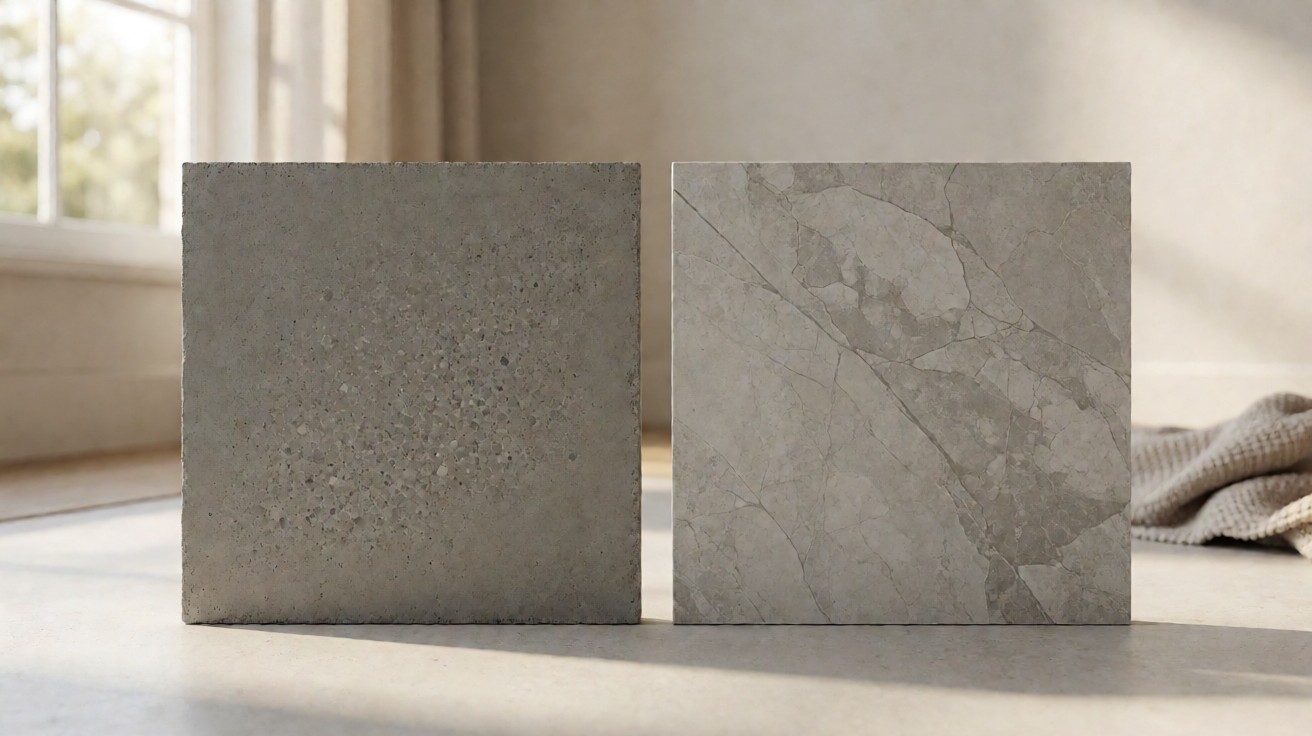
Polished concrete reads as a floor and a building at the same time. It is a continuous surface with no grout lines and no joints other than the control joints in the slab, and that is both its strength and its limit. It can look striking and it can look like a garage, and the difference is the staining, the sealing, and the level of finish chosen.
Porcelain tile reads as a chosen floor. A large format tile with a matching grout has a continuous look and a subtle pattern; a smaller tile has a visible grid. The range of printed finishes is enormous, and the ability to match a specific colour or pattern at a later date is genuinely better in tile than in any other flooring. That is a real advantage in a house that will be opened up in stages.
What Resale Buyers Think
Neither reads as a budget finish, and both read as a deliberate decision. A well-finished polished concrete floor is a feature in the listing conversation, and a quality large format porcelain floor is the same. The perception gap is not large, and it is not where the decision usually comes from. The room does it.
What it does read as is a permanent choice. Neither material can be ripped up and replaced in the way a plank or a carpet can, and that is the reason the decision has to be made on what the floor will be in the room for the whole life of the house rather than what it looks like today.
How to Choose Between Them
Choose polished concrete when the slab is good, the room is above or at grade, and the priority is a continuous floor with the most warmth and the least maintenance. Choose porcelain tile when the room is a bathroom or shower, when the specification calls for a specific pattern, when a floor above grade needs a particular look, or when a house will be re-opened in stages and matching matters.
The mistake in each direction is choosing the material before the room. Porcelain chosen for a cold basement living room in a northern climate will feel like a cold floor for the whole time. Polished concrete chosen for a bathroom or shower is a specification that should not exist. The room is decided before either one is considered, and that is the only reliable order for this decision.