
A salesperson quotes a lifetime warranty on the planks and moves to color, but that single phrase is doing most of the selling work in the showroom.
A residential wear warranty and a structural warranty are two separate promises on the same floor, and limited lifetime means prorated over the expected service life, not forever.
What A Salesperson Means By Lifetime Warranty
On luxury vinyl, laminate, and hardwood alike, the same two words sell the floor: lifetime, warranty. The specific promise the salesperson is quoting is one of four on the box; the other three hide in smaller print.
That distinction matters because a floor that fails at the surface fails at a different moment, on a different schedule, than one that fails at the core. The promise that answers each failure is a different document, and the claim path is different too.
The warranty question usually arrives while the rest of the decision is still open. The buying guide walks the whole path from room to order, and its warranty section is where the short version lives: the buying guide.
Wear Warranty Vs Structural Warranty
The wear warranty covers the surface. It answers what happens to the finish after years of foot traffic, furniture, sunlight, and spills: does it fade, scratch, or stain within the stated limits? The structural warranty answers what happens to the panel itself, from delamination to joint integrity, when the core starts to move.
If the finish wears through but the planks still lock tight, you have a wear claim. If the planks delaminate or warp under clean, dry feet, you have a structural one. Naming which promise broke is the first step of a claim, and it decides which document the review starts with.
What “Limited Lifetime” Actually Means
Limited lifetime is not one promise; it is a schedule. Mohawk’s solid prefinished hardwood warranty runs limited lifetime residential, prorated over 33 years. In year one, the claim recovers the full value of the affected floor. In year twenty, it recovers less. The word lifetime sets the outer edge of the schedule.
The word limited sets how much of the value remains at any point inside it.
Proration also explains why a warranty can say lifetime and still be worth less in year fifteen. The recovery value follows the schedule, not the label on the box.
The Four Layers Of A Modern Flooring Warranty
Rigid core and luxury vinyl lines usually stack four layers on one product: a wear warranty, a structural warranty, a waterproof or moisture warranty, and, on some lines, a light commercial layer. Laminate and hardwood carry fewer layers, but the same logic applies.
What Does a Residential Flooring Warranty Actually Cover?
Under normal residential use, the layers cover the surface, the panel, and, where the line states it, the water:
- Finish wear, fading, and staining, on the wear warranty
- Delamination, warping, and joint integrity, on the structural warranty
- Surface water, and on some lines radiant heat use, on the waterproof or moisture warranty
- Pet resistance and other add ons, on their own terms
Waterproof and moisture are not synonyms. A waterproof warranty answers water that lands on the surface: standing puddles, a spilled drink, a hose left running. A moisture warranty answers how the core behaves in a wet environment, which is a different failure mode.
NovoCore’s RLVT carries a moisture warranty alongside its wear and structural warranties; some lines pair the waterproof layer with a radiant heat warranty instead.
The exclusions are the point. Flood damage, pipe leaks, and appliance leaks sit outside these warranties on the lines that state them, which means the warranty answers what the floor does with water, not what the house does to the floor.
The table below sets the layers against each other, using the terms the major lines actually ship with.
| Warranty type | What it covers | What it excludes | Term pattern |
|---|---|---|---|
| Residential wear | Finish abrasion, fading, and staining in residential use | Flood damage; commercial traffic | Limited lifetime, 20 years, or 30 years |
| Structural | Delamination, warping, and joint integrity | Moisture trapped under the floor; installation faults | Limited lifetime, prorated over 33 years, or 25 years |
| Waterproof or moisture | Surface water; radiant heat use on some lines | Flood, pipe leaks, and appliance leaks; slab moisture over the limit | Lifetime, or stated years |
| Light commercial | Wear under light commercial traffic | Heavy commercial use | 5 years |
| Installer workmanship | Installation labor only | Material defects; water damage | 6 months to 1 year |
Read the table as a map, not a menu. One box carries five rows, and each row has its own clock.
Real Warranty Terms From Real Manufacturers
Warranty terms are public documents, and the range across lines is wider than the store signage suggests. The examples below are factual references; none of them is a recommendation.
Rigid Core And Luxury Vinyl
Shaw’s SMARTCORE LVP line is the deepest stack: a limited lifetime residential wear warranty, a limited lifetime structural warranty, a lifetime pet resistant warranty, a lifetime waterproof warranty, and a 5 year light commercial wear warranty. Claims are based on the original invoice, and flood damage is excluded. The line is distributed by Lowe’s.
NovoCore’s RLVT pairs a wear warranty with a structural warranty and adds a radiant heat warranty and a moisture warranty. The exclusions name flood, pipe leaks, and appliance leaks, so a radiant heated room is covered while a burst pipe is not.
Laminate Terms
Shaw’s MATRIX laminate carries a 30 year limited residential wear warranty plus lifetime structural and lifetime waterproof warranties. The wear layer is timed, the rest are not, and that gap is what the fine print argues about at year fifteen.
Mohawk’s laminate line runs a 20 year limited warranty covering joint integrity, stain resistance, fade resistance, and wear resistance under normal residential use. The stated exclusion is moisture trapped under the floor, which keeps the claim alive when the slab moves.
Hardwood Terms
Mohawk’s solid prefinished hardwood carries a limited lifetime residential warranty that is prorated over 33 years, so the recovery value declines on schedule from the day the invoice is cut. Lawson’s solid hardwood runs a 25 year residential warranty and a 5 year commercial one, and its prefinished lines carry a 300 hour moisture resistance rating.
The 300 hour rating matters in wet rooms, because it is the figure the installer tests against before the floor goes down.
Mullican’s prefinished terms show how far a warranty defines its own defects: defects must be discoverable at inspection, post installation splitting or cupping is attributed, in the document’s own words, usually to the indoor environment, and minor width variation between boards is not a defect at all.
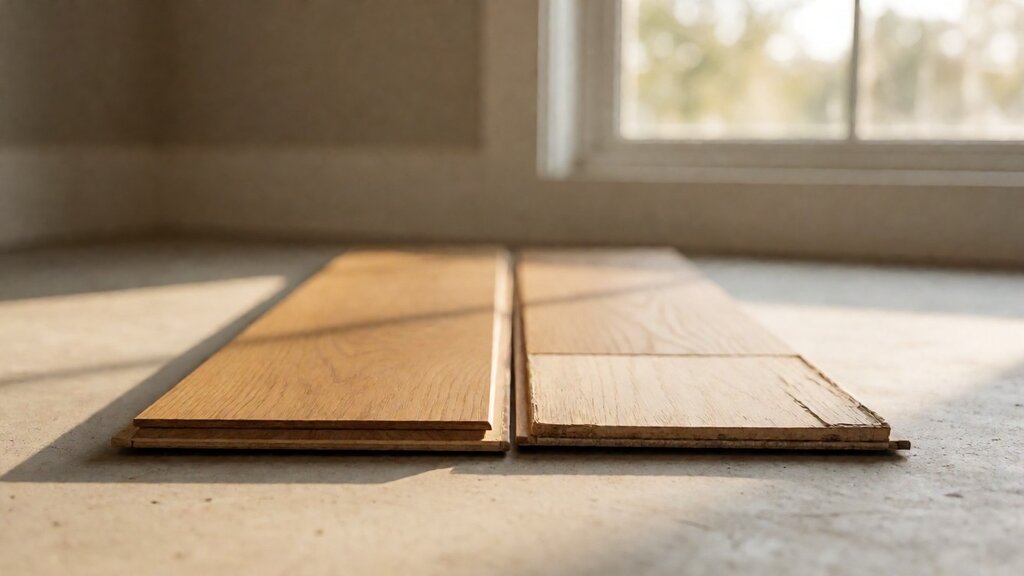
When a claim is filed, the samples decide it. A scraped surface and an intact one, cut from the same lot and photographed at the edge, are what a reviewer reads before the paperwork.
How To Read The Exclusions
Exclusions are not boilerplate; they are the second half of the promise. A warranty that covers finish wear but excludes the room you are installing in is a warranty written for a different house than the one you live in.
Floods, Leaks, and Standing Water
The surface water line is where most confusion lives. A waterproof warranty answers what happens to the floor when water lands on it. It does not answer what happens when water comes up through it, down a pipe, or out of an appliance, because those events are the named exclusions on the lines that state them.
The installer’s paper is cleaner still. The workmanship warranty covers installation only, and it excludes material defects and water damage. A pipe burst under the hallway floor is not a workmanship claim and not a material claim; it is an insurance one.
What Manufacturers Do Not Call Defects
Warranties define the word defect, and the definition can be narrower than you expect. On Mullican’s prefinished terms, minor width variation between boards is not a defect, and post installation splitting or cupping is attributed, usually, to the indoor environment. Both readings shift the burden away from the panel and onto the room.
That shift is why the discoverable at inspection rule exists. If a defect shows before installation, the claim is clean. If it shows only after the floor is down, the document has already told you where to look: at the environment, not the panel.
Why Do Most Claims Get Denied?
Denials cluster around four causes. First, moisture: the slab or the room stayed wet, and the warranty excludes moisture trapped under the floor. Second, class: a commercial rated product was installed in a home, so the residential warranty does not apply.
Third, paperwork: the claim is based on the original invoice, and the invoice is gone. Fourth, installation: the stagger was short, the joints hinge, and the fault sits in the work, not the wood.
None of these surprises a claimant who read the terms first. All of them surprise the one who did not.
Registration, Transfer, And Selling The House
The two questions that travel with a floor are whether the paperwork started on time, and whether the promise outlives the owner.
Registration And The Original Invoice
Some warranties activate by registration inside a stated window, and the window is printed on the paperwork. Read that line before you store the box, because an unregistered claim can be a voided one even when the product is still inside every limit.
Claims are often based on the original invoice. The SMARTCORE terms say it plainly: claims reference the invoice. If the store hands you a receipt without the invoice number the warranty program tracks, ask for the one that does.
Does a Warranty Follow You If You Sell the House?
The warranty attaches to the product and its class of use, not to the name on the deed. If the house changes owners and the floor stays residential, the promises generally ride with the planks, provided the claim follows the original paperwork. What rarely travels is the registration: an unregistered warranty is one the new owner cannot prove.
The transfer clause, when one exists, decides the rest. It names who may claim, what proof the new owner needs, and whether the clock keeps running. Read it in the same sitting as the registration window.
The 6 Inch Stagger Rule
The most common installation fault that voids a material claim is the one you can see from the doorway: end joints in a row.
The Stagger Number
The NWFA installation guidelines set a minimum 6 inch end joint stagger for 3 inch planks, which is two times the plank width. The stagger keeps adjacent joints from sharing a load line, so movement shows at one joint at a time instead of across the room at once.
If the stagger falls short, cupping or hinging at the joints is an installation fault, not a panel defect. The consequence lands on a different document: the workmanship warranty, if the installer wrote one, runs 6 months to 1 year and covers the work only. The manufacturer’s warranty does not answer a joint that hinges because the joints were laid in a line.
When A Commercial Rating Changes Everything
Rating classes are not decoration. They decide which warranty schedule applies when the same panel sits on your kitchen floor.
How AC Ratings Set The Class
Laminate certification runs AC1 through AC5 under NALFA certification standards, with AC5 as the commercial class. The number is the traffic rating: residential, light commercial, or commercial.
The Warranty That Stays Commercial
An AC5 commercial product installed in a home usually carries the commercial warranty, and the residential one does not apply. The panel is not the weaker product; the promise is. If the line you are buying is certified for traffic your house will never see, the claim schedule that protects you is the commercial one, not the one on the box.
Which class a room needs is an upstream question, and the types comparison lays out the materials and the ratings side by side: the types comparison.
Moisture: The Number That Decides Most Claims
Of the four denial causes, moisture is the one with a number, and it decides the claim before anyone lifts a plank.
The Two RH Thresholds
Per ASTM F2170, a concrete slab sits within limit at 75 percent relative humidity without a vapor barrier, and at 80 percent with one. Those are the thresholds the installer’s meter checks, not the manufacturer’s.
The consequence is why moisture damage is the most common denied claim: warranties exclude moisture trapped under the floor, so a slab that reads over the limit has already lost the argument.
For the rooms that take on water, the material decision comes first. The bathroom guide picks the floor for the moisture load, and the slab test then decides whether the room passed: the bathroom guide.
48 Hours of Acclimation
Before the first plank clicks, the boxes open and the material conditions in the room, and installation guides commonly call for 48 hours of acclimation. The panel reaches the room’s equilibrium, so post installation movement is not measured against a panel that never got there.
Skip the window, and the floor settles into the room while you wait, exactly the post installation movement the environment clause points at. The meter reading and the acclimation record are the two documents that keep a moisture claim alive.
Who Handles A Claim, And Who Pays
A claim is two documents in conversation: the manufacturer’s warranty and the installer’s workmanship warranty, each with its own clock and its own scope.
The Path of a Claim
The homeowner starts the claim, usually through the installer, with the invoice, photographs, and, where the terms ask for it, cut samples from the failed area. The reviewer works the claim against the specific layer the failure sits in: the wear layer for a stained finish, the structural layer for a delaminated panel, and the environment clause for the rest.
The pattern across lines is stable enough to table:
| Claim trigger | Usually covered | Usually denied | Who pays |
|---|---|---|---|
| Worn finish in residential use | Wear warranty, on schedule | Commercial use; flood damaged rooms | Manufacturer replaces the affected planks |
| Delamination or joint failure | Structural warranty | Moisture trapped under the floor | Manufacturer, on the proration schedule |
| Cupping or hinging at end joints | Panel defect only | Installation fault, such as a stagger under 6 inches | Installer’s workmanship warranty, if one was written |
| Flood, pipe leak, or appliance leak | None, named exclusion on every line above | Every layer | Homeowner, through the insurance that covers the leak |
| Splitting or cupping after installation | Defect discoverable at inspection | Post installation environmental change | Manufacturer if the defect showed at inspection; homeowner otherwise |
Where The Installer Pays
The installer’s paper runs 6 months to 1 year and covers installation only. It excludes material defects and water damage, so the two documents are read back to back: if the panel is the fault, the installer points at the manufacturer; if the work is the fault, the manufacturer points back; and if neither wrote a warranty, the homeowner pays.
That triangle is the whole economics of a floor claim. The manufacturer holds the panel’s promise, the installer holds the work’s, and the homeowner holds the paperwork that decides which one answers.
The Magnuson Moss Rules Behind The Fine Print
The warranty documents the store hands you are not free form contracts. They sit under the FTC’s Magnuson Moss rules, and two of those rules do most of the work for you.
Plain Language Requirements
Under the Magnuson Moss rules, warranty terms must be written in plain language, in a way the buyer can actually use to make a decision. If the terms read like a law review article, that is not just a style problem; it is a defect in the document itself.
An express warranty cannot disclaim the implied ones without a conspicuous written disclosure. The disclaimer has to stand out, on its own, in writing. The implied warranty of merchantability, the promise that the floor does what a floor does, sits under the express terms, and it survives unless the document names it in writing.
What To Ask Before You Sign The Order
The warranty conversation takes five minutes in the store, and it changes the order if the answers are not the ones you assumed.
Five Questions to Ask in the Store
Five questions, asked in the order that matters:
- Which layer is the lifetime one, the wear layer or the structural one, and is it prorated over a stated number of years?
- Is the claim based on the original invoice, does the warranty register, and does it transfer when the house sells?
- What are the named exclusions, and do any of them describe the room you are installing in?
- If the product carries a commercial rating, which warranty class does a residential install fall under?
- Is there a written workmanship warranty, how long does it run, and what does it exclude?
Each answer points to a document, and each document has a clock. Warranty is one attribute on the spec sheet, and the spec comparison guide lines every attribute up against every other: the spec comparison guide.
Read the terms once, with those five questions in front of you, and the fine print stops being fine.