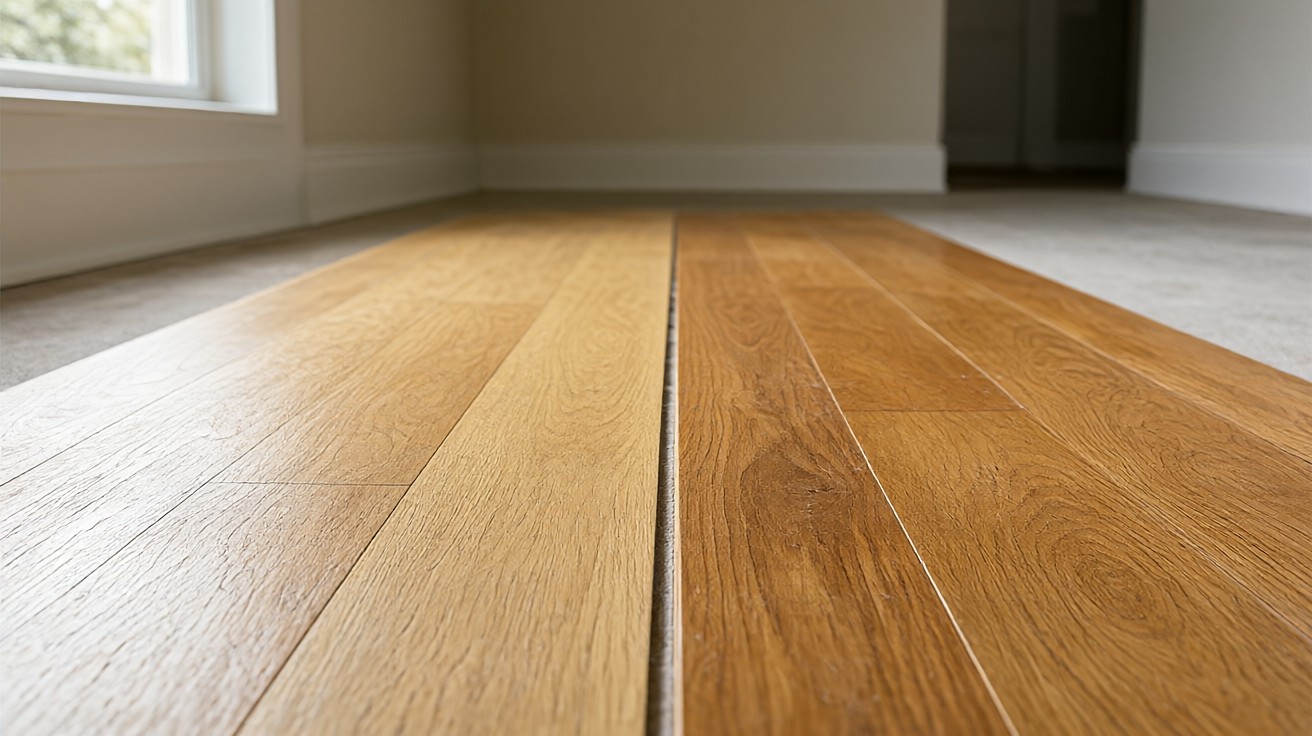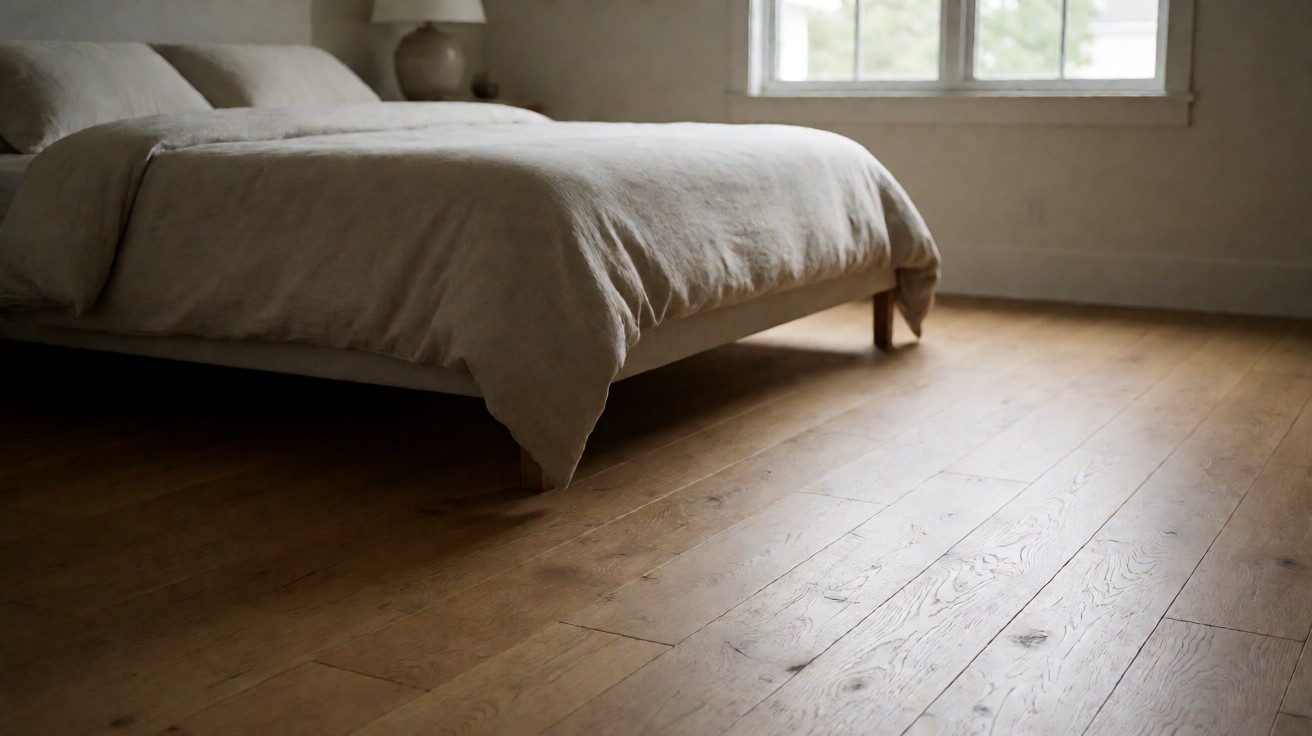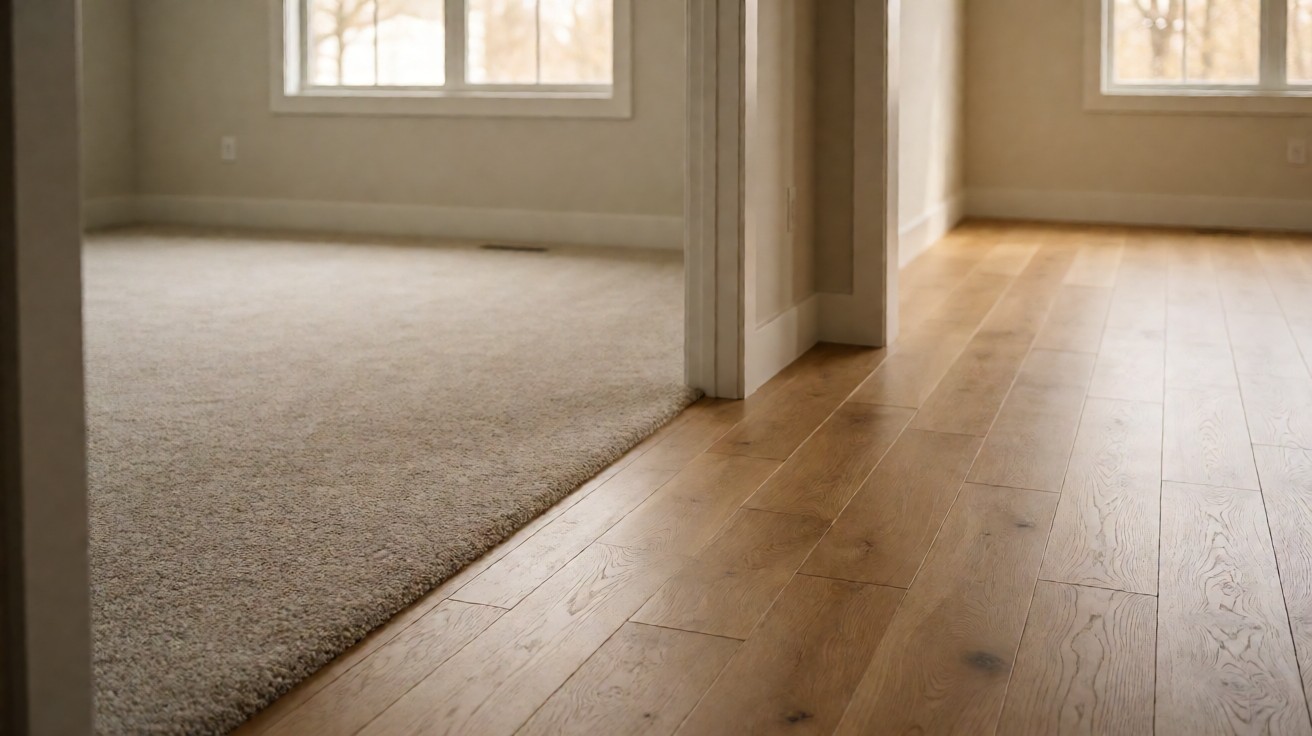

The best living room floor for a dog is the one that takes claws, spills, and zoomies without showing it, and that floor is usually vinyl, not hardwood.
Quick Answer: for a dog indoors, choose a rigid-core luxury vinyl plank with a 20 mil wear layer and a textured finish, or porcelain tile if it runs warm; avoid solid hardwood, loop carpet, and anything with a glossy finish.
Why Dogs Are Harder on Living Rooms Than Any Other Room
A dog does not just walk across a living room floor. It crosses it ten times a day at speed, skids to a stop on the same spot, drags its claws on every turn, and shakes water off at the door.
That is not traffic in the hallway sense. It is repeated impact, point loads from claws, and water all landing on the same surface, and most flooring is rated for only one or two of those.
The living room makes it worse because it is also the room you look at. A scratch that would be invisible in a hallway is the first thing you see under the coffee table, every day, for years.
Add a dog bed, a water bowl, and a favorite running path between the sofa and the door, and the wear pattern becomes visible within the first year on any soft or glossy surface.
For example, a 70 pound dog skidding on oak leaves a mark every time.
The Three Failure Modes: Claws, Spills, and Zoomies
Every dog floor failure traces back to one of three things, and they need different answers, so it helps to name them before comparing materials.
Claws are a surface problem. They mark finishes, and the mark depends on finish hardness and texture more than on the material underneath.
Spills are a moisture problem. Water that reaches the core swells laminate and hardwood, and it pools under vinyl if the seams are not tight.
Zoomies are an impact problem. A running dog hits the floor with force concentrated in four small points, and that dents soft surfaces and cracks brittle ones.
A floor that solves one of these can still fail on another, which is why the ranking below scores each material on all three.
A 70 pound dog hitting a turn at full speed delivers more point load than a person in heels, and that is the number that matters more than any wear rating.
| Failure mode | What it asks of the floor | Where it shows first |
|---|---|---|
| Claws | Hard, textured finish | Under furniture and along the dog path |
| Spills | Non-porous surface, tight seams | Bowl area, door, crate |
| Zoomies | Impact resistance, no brittleness | Turning points and stops |
Ranking: Best to Worst for a Dog in the Living Room
The ranking below assumes a medium to large dog with daily access to the room, and it scores durability first and looks second.
Luxury vinyl plank and porcelain tile take the top two spots because they are non-porous and hard. Engineered wood and laminate sit in the middle. Solid hardwood and carpet are at the bottom for this use.
That order flips if the dog is small and the household cares most about warmth and resale value, which is why the decision framework later in this guide matters more than the ranking itself.
Cost also reshuffles the list. A budget vinyl at 6 mil wear layer ranks below a mid-grade laminate at AC4, even though vinyl is generally the safer material.
| Material | Claws | Spills | Zoomies | Comfort |
|---|---|---|---|---|
| Luxury vinyl plank | Good with texture | Excellent | Good | Moderate |
| Laminate (AC4+) | Excellent | Fair | Good | Moderate |
| Hardwood | Poor | Poor | Fair | High |
| Porcelain tile | Excellent | Excellent | Excellent | Low |
| Carpet | Poor | Poor | Fair | High |
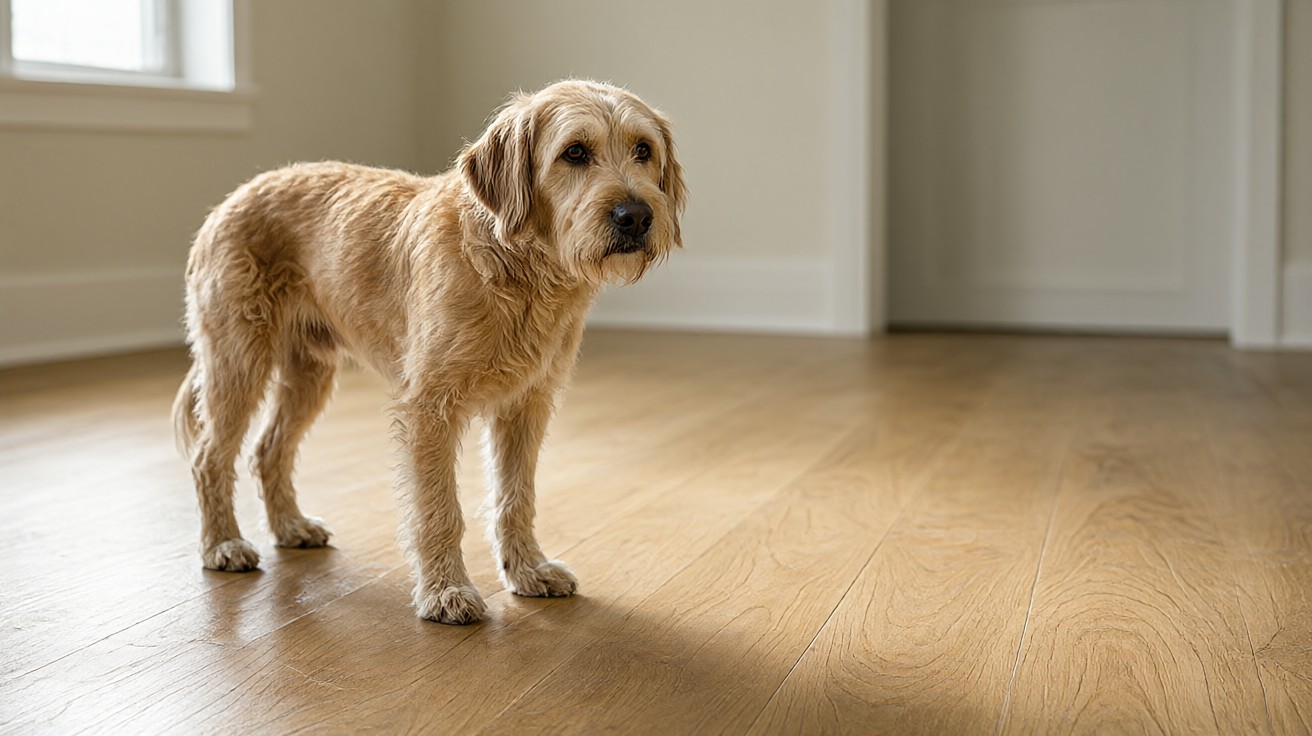
Luxury Vinyl Plank: The Default Pick
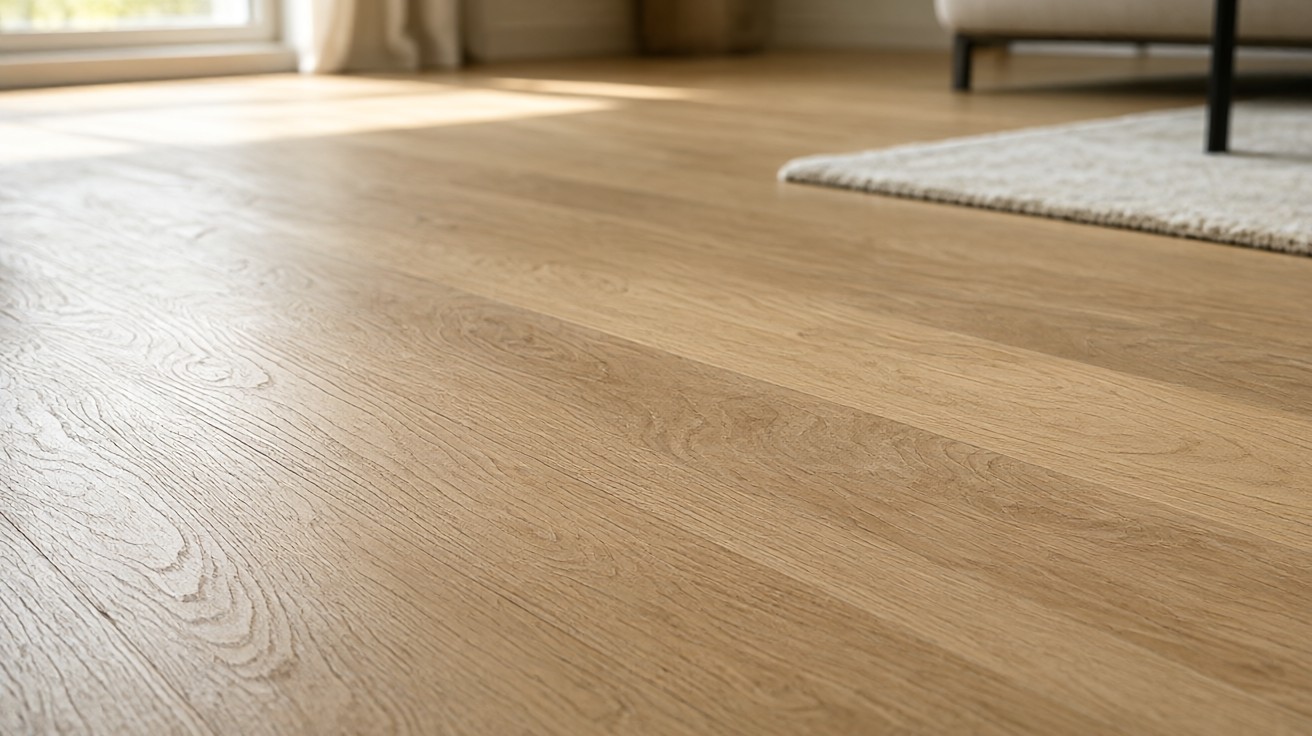
Rigid-core luxury vinyl plank is the safest default for a dog living room, and it is the floor most pet owners should start with and only move away from for a specific reason.
A 20 mil wear layer is the threshold worth paying for, because below that the finish thins under a dog’s daily path and shows traffic lanes within a few years.
Look for a textured or embossed finish rather than a smooth one. Texture hides claw marks and gives the dog traction, while a smooth glossy surface shows every scratch and makes skidding worse.
The core is waterproof, so a spilled bowl or a wet dog does not reach the subfloor. Seams still matter, though, because water that sits in a seam can lift an edge over time.
The trade-off is feel. Vinyl is warmer than tile but cooler and harder than wood, and it will not add resale value the way hardwood does. For most households with a dog, that trade is worth it.
Expect to pay roughly 3 to 7 dollars per square foot installed for a quality rigid-core plank, which sits between laminate and tile on cost.
A 12 millimeter thick plank with an attached pad also cuts sound transmission, which matters in a living room over a basement or a second floor.
ASTM F2716 wear resistance testing is the spec to ask for on vinyl, because a plank that passes at 20 mil holds its finish under a dog for the rated life.
Laminate: Good If You Match the AC Rating
Laminate is harder on top than vinyl, which makes it more scratch resistant, but the core is wood fiber and it swells if water gets in.
The AC rating is the number to check. AC4 is the minimum for a living room with a dog, and AC5 is better if the dog is large or the room is busy.
AC ratings describe wear resistance, not water resistance, so a high AC rating does not make laminate waterproof. Wipe spills promptly and avoid wet mopping.
The advantage over vinyl is price and the look of real wood grain. The disadvantage is that a single bad spill can ruin a plank, while vinyl shrugs it off.
Newer water-resistant laminates with a sealed core push the spill tolerance up, but they still cannot be wet-mopped the way vinyl can.
Hardwood and Engineered Wood: Beautiful but Honest
Solid hardwood is the floor most people want and the one most dogs damage. It dents under claws, scratches under skids, and cups if water sits on it, and it shows all three.
If you choose hardwood anyway, pick a hard species like hickory or white oak rather than pine or cherry, and choose a matte or wire-brushed finish that hides marks instead of highlighting them.
Engineered wood is more stable than solid wood over concrete or radiant heat, but the wear layer is thin, so it can only be refinished once or twice.
The honest framing is that hardwood in a dog household is a maintenance commitment, not a one-time decision. If you are not willing to refinish every few years, vinyl or laminate is the better call.
Janka hardness matters here: hickory sits around 1820 and white oak around 1360, while pine is near 380, and the gap shows up under a dog’s claws within months.
NWFA guidance puts the practical floor for a dog household at 1200 or higher on the Janka scale, which rules out pine and cherry but leaves oak and hickory.
Tile and Stone: Indestructible but Cold
Porcelain tile and natural stone are the most durable options on this list. They do not scratch, dent, or absorb water, and a dog cannot damage them.
The cost is comfort. Tile is cold and hard underfoot, and a dog lying on it for hours is not comfortable, which is why most dog households with tile add rugs.
Slip is the other risk. A polished tile is dangerous for a dog at speed, so choose a matte or textured tile with a dynamic coefficient of friction of 0.42 or higher under ANSI A326.3.
Radiant heating under tile fixes the cold problem and makes it one of the best combinations available, if the budget allows it.
Natural stone needs sealing and can stain, so porcelain is usually the better choice for a dog household even though stone costs more and looks richer.
Carpet: Comfort vs Hair and Smell
Carpet is the most comfortable option and the worst for a dog in most cases. It traps hair, holds odor, and stains permanently when a spill soaks through.
If carpet is the choice, use a low-pile synthetic with a moisture barrier backing, and accept that it will need professional cleaning more often than any hard surface.
Loop pile is a specific risk with dogs. Claws catch in loops and pull them, which creates runs that cannot be repaired without replacing the carpet.
For most dog households, a hard surface with an area rug is the better compromise, because the rug can be replaced when it wears out instead of the whole floor.
A cut pile under 1/2 inch with a solution-dyed nylon fiber is the least bad carpet choice, because it releases stains and does not fade as quickly.
Rugs and Runners: The Cheapest Fix
An area rug over a hard floor solves the comfort and traction problems without committing the whole room to carpet.
Choose a rug with a low pile and a washable or replaceable construction, and put a non-slip pad under it so it does not slide when the dog turns.
The honest downside is maintenance. Rugs collect hair and need frequent vacuuming, and a rug in a dog household is a consumable, not a permanent feature.
Washable rugs in a 5 by 7 or 8 by 10 size cost less than refinishing a hardwood floor, which is the comparison that matters when a dog ruins a surface.
Slip Resistance and Traction for Dogs
Dogs need traction more than people do, because they push off with their hind legs and land with their front, and a slippery floor causes injury and fear.
A textured finish helps, and so does a matte surface rather than a polished one. Glossy floors are the worst combination for a dog.
Nail length matters as much as the floor. Keeping nails trimmed reduces slipping and also reduces the scratching force on any surface.
If a dog is already slipping, add rugs in the high-traffic paths before replacing the floor, because the cost is a fraction of a flooring project.
Senior dogs with arthritis benefit most from traction, and a floor that is safe for an old dog is safe for a young one too.
If your dog is a senior, add a runner along the main path and a mat at the door, and budget 100 to 300 dollars for traction rather than replacing the floor.
Cleaning and Maintenance Reality
The floor that is easiest to clean is the one you will actually keep clean, and with a dog that means daily sweeping or vacuuming and weekly mopping.
Vinyl and tile tolerate wet mopping, which matters because dry sweeping alone does not remove the oils and dander a dog leaves behind.
Hardwood needs a damp mop only, and too much water damages it, which makes it the highest-maintenance option in a dog household.
A floor that looks clean but holds odor is not actually clean. If the room smells after mopping, the floor or the subfloor is absorbing something.
Enzyme cleaners handle the accidents that soap cannot, and using them on vinyl or tile is safe, while on hardwood they can dull the finish.
Keep a dedicated mop for the dog room, because cross-contaminating the kitchen mop is the fastest way to spread odor through the house.
Cost and Lifespan With a Dog in the House
The cheapest floor is not the cheapest over time if it has to be replaced twice. Vinyl at a moderate price often wins on total cost because it lasts the life of the dog without refinishing.
Hardwood can outlast vinyl if refinished, but refinishing costs as much as installing vinyl, so the math only favors hardwood if you already own it.
Tile is the longest-lasting option and the most expensive to install, which makes it a good choice for a forever home and a poor one for a short-term one.
Budget for a rug or two in any case, because even the best hard floor benefits from a soft landing for an older dog.
A 20 mil vinyl plank carries a residential warranty of 15 to 25 years, which is longer than the working life of most dogs, and that is the honest comparison to make.
Factor in a rug replacement every 3 to 5 years at 200 to 600 dollars, and vinyl plus rugs still undercuts tile plus rugs on total cost over a decade.
A Decision Framework by Dog Size and Household
Small dog, carpet-friendly household: engineered wood or laminate with a matte finish, plus a rug in the dog’s favorite spot.
Medium to large dog, busy household: rigid-core vinyl plank with a 20 mil wear layer and a textured finish. This is the default recommendation.
Senior dog or mobility concerns: tile with radiant heat, or vinyl with thick rugs for traction and warmth.
Multiple dogs or a breeder household: porcelain tile, because nothing else survives the combined traffic and cleaning demands.
If you are still unsure, the best flooring for living rooms guide covers the same materials without the pet lens, the best flooring for open plan spaces guide covers how the floor reads across connected rooms, carpet vs hardwood flooring settles the warmth question, and best flooring over concrete slabs covers subfloor limits.
These two guides go deeper on the same trade-off: Laminate vs LVP in a Living Room, and Protecting Living Room Floors From Furniture Dents and Scratches.
Last updated November 20, 2026.