
Quick Answer: the answer is LVP when pets, spills, and sun hit the same floor, and laminate when a warm wood look matters more than worry-free cleanup.
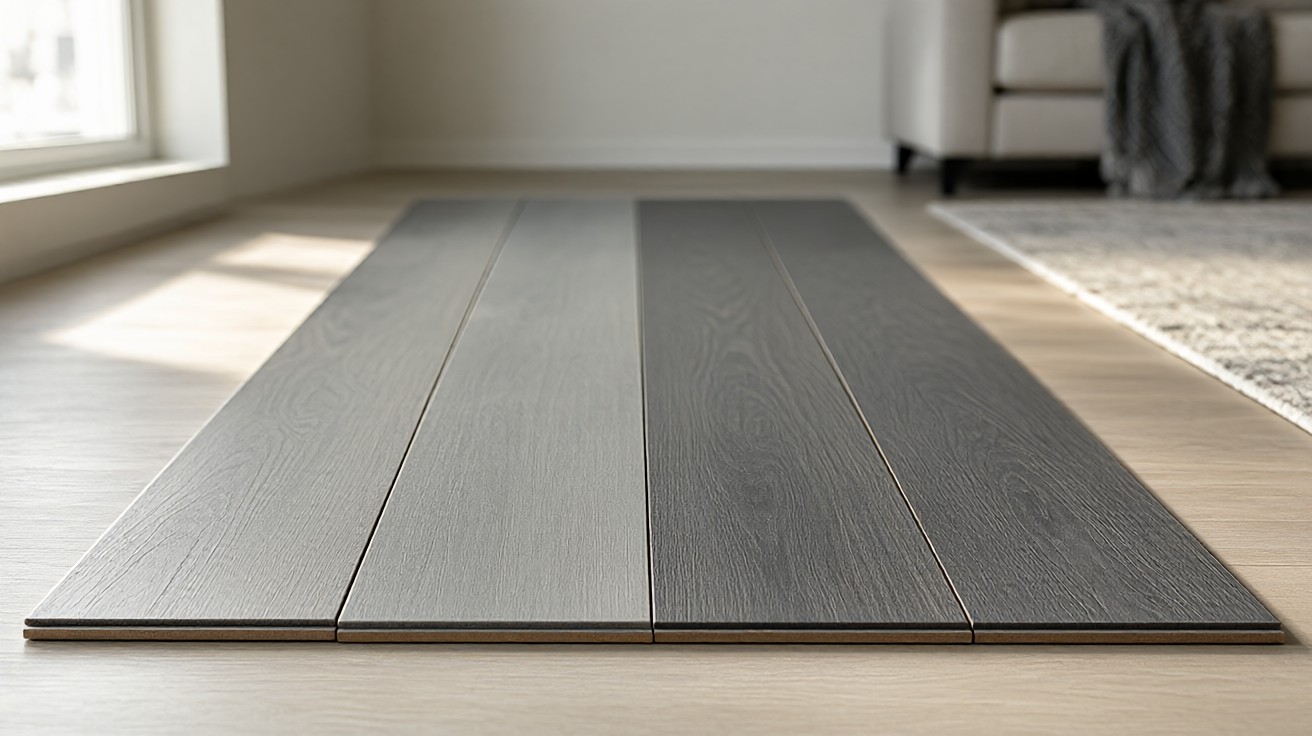
These two floors sit next to each other in the showroom aisle, look nearly identical under a rug, and get argued about with identical words: waterproof, scratch resistant, quiet. What separates them is what sits in the middle of the plank, and that part you can measure before you buy.
The broader best flooring for living rooms guide ranks all five families against each other. This comparison settles the two that imitate wood and get sold side by side, and it settles them on the core, because the core decides whether the floor still looks right in year ten.
If hardwood is also on your short list, the LVP versus hardwood comparison covers the third option in the same aisle. The general LVP and laminate comparison handles the format question away from any specific room.
What a Living Room Floor Actually Has to Survive
A living room takes three kinds of abuse that a bedroom never sees.
It takes concentrated point loads under sofa legs, bookcases and a media console. It takes the traffic lane between the front door and the television. And it takes whatever the dog brings in on a wet Tuesday afternoon.
It also takes light. A living room usually has the widest window wall in the house, and low raking afternoon sun is what exposes a repeating print, a hollow-sounding core, and a seam that has started to gap.
Each of those failures has a material answer, and each answer traces back to the core rather than to the finish.
The room also takes time. A living room floor stays in place through a move, a child and a dog, a change of sofa, and a decade of vacuuming. The material that keeps its shape for 20 years is worth more than the material that photographs better on day one.
Why the Core Decides More Than the Price
Comparing laminate and LVP usually stops at the price per square foot, and the price per square foot is the least informative number in the room.
Two floors that differ by a dollar and change differ far more in what happens in year eight than they do on the invoice.
The core carries the load, carries the sound, and decides whether a leaking dishwasher ruins a 400 sq ft room or a 12 sq ft patch of planks.
It also decides whether a damaged board can be lifted and swapped. That is the difference between a repair costing a few hundred dollars and a floor costing four figures to replace.
Laminate has one structural weakness that LVP does not, and it is not a small one. The pressed wood fibre core absorbs water, swells, and never shrinks back, so a wet seam stays swollen for the life of the floor. A rigid vinyl core has no fibres to swell, which is the entire reason it is the default answer in wet rooms.
How Laminate and LVP Cores Are Actually Built
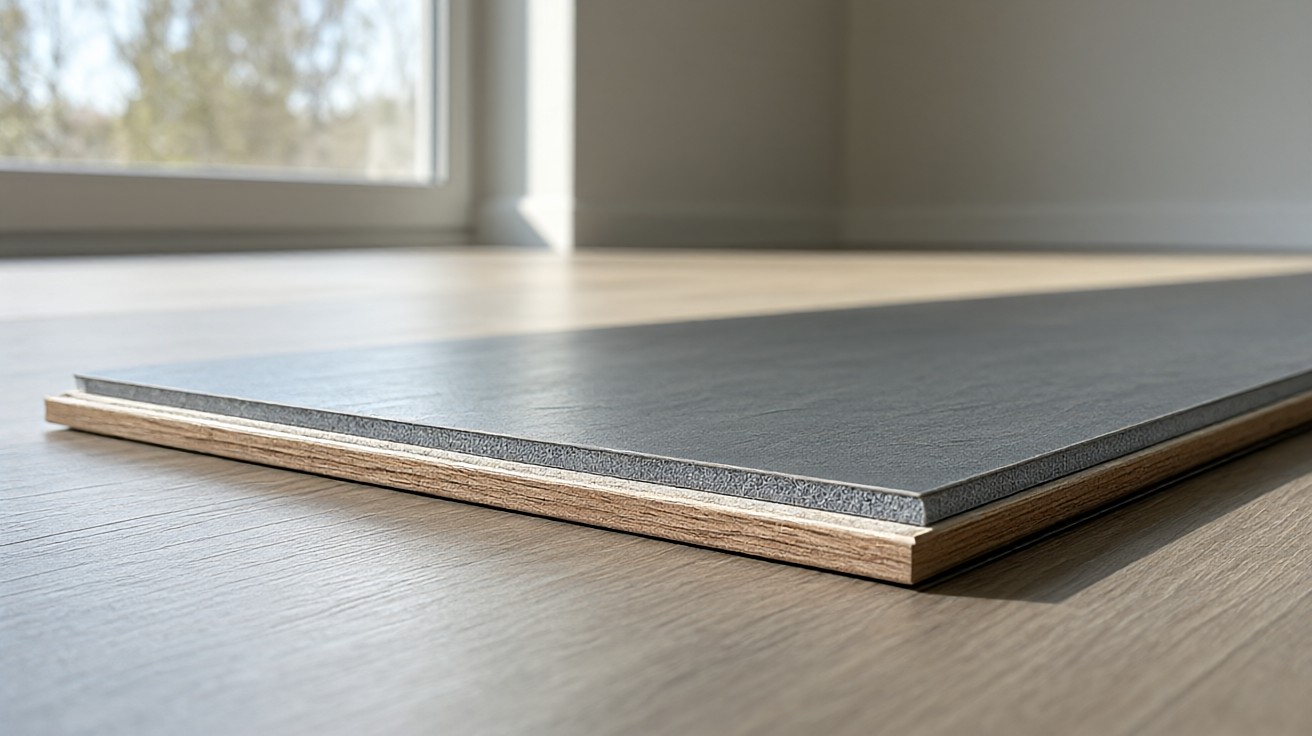
Laminate is a fibreboard floor. The build is a pressed wood core, a printed paper or vinyl decorative layer, and a clear wear layer fused onto the surface under heat and pressure.
The common core is an HDF core pressed at roughly 900 kg/m3. That density is enough to hold a click-lock joint and stiff enough to stay flat over a long span.
LVP is a polymer floor. The build is a mineral or wood filled PVC core, a printed film, and a transparent wear layer that carries the surface protection.
An SPC core is stone filled PVC at roughly 2,000 kg/m3, which makes it rigid and dimensionally stable. A WPC core mixes wood powder with recycled plastic at roughly 600 kg/m3, which makes it softer, thicker and warmer underfoot.
That density gap is why the same wear layer mil count feels different on the two floors. On laminate the overlay sits on a compressible fibreboard that absorbs heel strike. On SPC the same layer sits on rigid stone filled plastic that returns it. The surface specification is identical, and the walking experience is not.
Which core should a living room choose when the budget is fixed?
Core density is the number to compare first when two products quote the same wear layer. A 20 mil wear layer over an HDF core and a 20 mil wear layer over an SPC core are two different products with one headline specification.
| Specification | Laminate | LVP with SPC core | LVP with WPC core |
|---|---|---|---|
| Core material | HDF pressed fibreboard | Stone filled PVC | Wood powder and recycled plastic |
| Core density | about 900 kg/m3 | about 2,000 kg/m3 | about 600 kg/m3 |
| Total plank thickness | 8 mm to 12 mm | 5 mm to 7 mm | 8 mm to 9 mm |
| Wear layer options | 6 mil to 40 mil | 12 mil to 20 mil | 12 mil to 20 mil |
| Water behaviour | Water resistance only, seams swell | Waterproof core | Waterproof core |
| Expansion with humidity | Needs a 3/8 inch gap | Minimal movement | Moderate movement |
| Foot feel | Firm, hollow at the seam | Firm and dense | Soft and warm |
| Strongest use case | Dry, climate controlled rooms | Pets, spills, slabs | Basements and cold rooms |
Spills, Water, and Where Each Core Fails
Laminate offers water resistance, not waterproofing, because the seam is a mechanical interlock between two pieces of compressed wood.
Water that reaches that seam makes the fibreboard swell, and swelling is permanent. The plank edge lifts and stays lifted.
The working rule is simple. Laminate can hold a spill for about 30 minutes before the moisture reaches the core. Past that window the board usually has to be cut out and replaced.
The replacement is visible in a sunlit room, because a new plank never matches the faded one beside it.
LVP has no such clock on a sealed SPC or WPC core, because the core is plastic and the wear layer is a continuous film. A glass of red wine left overnight is an inconvenience on vinyl and a plank replacement on laminate. That single difference settles most living rooms with children, a water feature, or a kitchen that opens straight into the space.
Households with dogs should read the best living room flooring for dogs comparison before choosing on price, because a wet paw tracked across the room is the ordinary version of the same spill. The same answer holds if the living room sits over a slab, where LVP can go down over a vapour barrier while laminate needs a drier, flatter base.
Scratches, Pets, and Reading the Wear Layer Mil Count
Both floors put a wear layer between the room and the print, and both are sold in mils, where 1 mil is 0.001 inch.
Entry laminate often arrives at 6 mil or 8 mil. Mid-range sits at 12 mil or 20 mil. The top of the range reaches 28 mil or 40 mil.
LVP wear layers run 12 mil for ordinary residential traffic and 20 mil for a pet household, which is the number that matters when a dog circles the coffee table every evening. Above 20 mil the surface becomes substantially harder to cut through.
No wear layer is scratch proof, and that distinction matters when a salesperson uses the word. Grit tracked in from a driveway cuts through any wear layer eventually, so felt pads still earn their place. A dropped screwdriver marks both floors and cuts through a 6 mil overlay completely.
Below 12 mil, a laminate overlay wears through in a busy traffic lane in roughly 5 years and the print underneath becomes what you see. At 20 mil you are looking at about 15 years before the wear layer becomes the failure point. At 28 mil, about 25 years. The laminate wear layer and core guide explains how that count is measured.
A scratch layer sits above the print on better laminate builds, which is why a dragged chair on a top end board leaves a dull mark rather than a torn one. On LVP the wear layer does that job, so the comparison that matters is not the number of layers but the thickness of the one that protects.
Sound, Footsteps, and IIC Ratings
Sound is the most under-considered difference in a living room, because it is the only one the downstairs neighbour also experiences.
The governing number is the IIC rating, measured under ASTM E492, which rates impact sound transmission through a floor assembly on a scale from 50 to 100. ASTM F2411 sets the wear and sound testing expectations for rigid vinyl plank.
A bare concrete slab scores around an IIC of 45 to 48. A floating floor over a decent foam underlayment adds roughly 5 points, which puts a well installed laminate floor in the low 50s. An SPC LVP over the same underlayment lands in a similar range, because the rigid core returns footfall energy instead of absorbing it.
How much noise does a living room floor actually make?
The comparison that matters to you is the Delta IIC, the improvement the finished floor adds over the bare slab. Anything above 50 counts as a substantial acoustic upgrade, and above 45 as acceptable. A continuous sound underlayment with a built in vapour barrier does more for a noisy room than a thicker plank ever will.
Neither floor is quiet the way carpet is quiet. If the living room sits over a bedroom, both are a compromise, and the underlayment decides the compromise rather than the plank.
Four standards govern the numbers on these spec sheets, and they are worth reading before you compare two samples side by side.
ASTM E492 sets the impact sound test behind an IIC rating, and ASTM F2411 covers wear and sound testing for rigid vinyl plank. ANSI A137.1 covers resilient floor tile, and ANSI/TCNA A326.3 covers plank dimensions for wood based products, which is the spec most laminate planks are sold against.
NWFA guidance treats laminate separately from solid wood because the core is a fibreboard rather than a board cut from a log. CRI carpet labelling standards apply when the room keeps a large area rug over the floor, and FloorScore certification is the low VOC standard California uses for indoor air quality.
Static load matters as much as wear in a living room. A bookcase leg or a caster concentrates far more than 200 lbf onto a small patch of surface, and a rigid SPC core carries that load into the subfloor while a laminate core absorbs it, which is another reason a long, heavy bookcase belongs on felt pads rather than directly on the plank.
Warmth, Comfort, and the Cold Feet Problem
Laminate over a concrete slab or in a north-facing room feels cold underfoot in winter, because the fibreboard core is a poor conductor and the slab pulls heat out of your feet.
That is a comfort problem rather than a durability problem, and it is solved with the same underlayment that solves noise.
WPC LVP is the softer and warmer of the two vinyl cores, which is why it gets specified for basements and sunrooms where a cold floor is a daily complaint. SPC LVP is the harder and more rigid option, and it feels noticeably colder and more hollow underfoot than laminate does.
So the warmth ranking in a cold room runs WPC first, laminate second, SPC third, and the ranking flips in a warm climate where dimensional stability matters more than warmth.
Installation Reality and the Click-Lock Tongue and Groove
Both floors ship with a click-lock tongue and groove edge, a machined profile that folds into the previous plank at an angle and locks under pressure.
On paper that makes both a one-day install over a flat subfloor. In practice the difference between them shows up in the prep work.
Laminate needs a flat, dry and stable subfloor plus a 3/8 inch expansion gap around the perimeter, because the fibreboard core moves with the humidity in the room. It also needs a moisture barrier over any concrete or crawlspace floor, and that barrier has to be installed properly rather than folded.
SPC LVP tolerates a wider range of subfloor conditions and does not need a wide expansion gap, because the rigid core barely moves. It still needs a vapour barrier over a slab and a level surface, but a slab in an older house is a far less punishing starting point for SPC than for laminate.
Plank weight follows from the core. A 12 mm laminate plank weighs about 2.5 kg per square metre, while a 5 mm SPC plank weighs about 1.5 kg. One person can carry a day of SPC on a shoulder; laminate needs a second pair of hands.
Cost Over a Twenty Year Horizon
Installed cost for a 400 sq ft living room typically runs from 2.50 to 4.50 dollars per sq ft for laminate and from 3.00 to 6.00 dollars per sq ft for LVP.
The gap widens once you add the underlayment and the extra labour a thick laminate plank demands.
The honest comparison is repairability. A laminate plank with a swollen seam is cut out and replaced with a matching board, which takes about an hour and carries a fair chance of a visible colour mismatch under raking light.
An SPC plank lifts out and locks back in, but the subfloor and the locking edges of the neighbouring planks are usually the parts that need attention.
If the living room connects to a kitchen, a wet room or a mudroom, LVP is usually the cheaper answer across 20 years, because a single leak does not become a floor replacement. If the room is dry, climate controlled and quiet, the laminate price difference is money you keep.
Decision Rules With Thresholds
These thresholds decide the purchase, and each one is written so you can check it against your own room rather than against a showroom sample.
| Situation in the room | Choose | Why |
|---|---|---|
| Wet spill can sit longer than 30 minutes | LVP, SPC core | Swollen fibreboard seams are permanent |
| Dogs or children in the room daily | LVP with 20 mil wear layer | Handles claws, grit and spills without cutting through |
| Floor is over a concrete slab | LVP, SPC core | No fibre core to swell under the vapour barrier |
| Room is dry, warm and lightly used | Laminate, 20 mil or better | Warmer underfoot and cheaper per sq ft |
| Floor is over a heated floor | LVP, SPC core | Stable through temperature swings |
| Target IIC above 52 over a slab | LVP over 2 mm underlayment | Returns less sound than fibreboard |
| Budget under 3.00 dollars per sq ft installed | Laminate | LVP rarely fits below that price |
What should you buy for a busy family living room?
Read the table as a sequence rather than a menu. If two rows point at different materials, the wet row wins, because water is the only failure on this list that cannot be repaired in place.
Which Core Wins in Your Room
Picture a living room on the south side of the house, with a dog, a sectional sofa, and a kitchen that opens into the space. That room wants LVP with an SPC core and a 20 mil wear layer, because the spills and the claws arrive together.
Now picture a north-facing room with a bookcase, a rug, and no wet traffic. That room wants laminate with an HDF core and at least a 20 mil wear layer, because it is warmer underfoot and cheaper per sq ft.
Neither choice is a compromise when it matches the room. The expensive mistake is buying the wrong core for the space and then treating a core failure as bad luck.
Last updated: November 2026