
You love the speckled look of terrazzo, but the real question is which rooms in your house can actually take it, from the entry hall to the shower pan.
The answer is binder-first. Epoxy terrazzo belongs indoors, the cement rustic system is the exterior one, and the finish plus the sealer decide slip resistance, not the material name. Most rooms are a yes. The shower pan, the unmitigated wet slab, and any outdoor epoxy are the no.
The Short Answer: Where Terrazzo Works and Where It Does Not
Deciding where to use terrazzo flooring is a binder question before it is a room question.
The pillar on what terrazzo flooring is covers the material itself. Placement is the decision, and it splits cleanly: epoxy stays inside, cement rustic goes outside, and the finish plus the sealer carry the slip story.
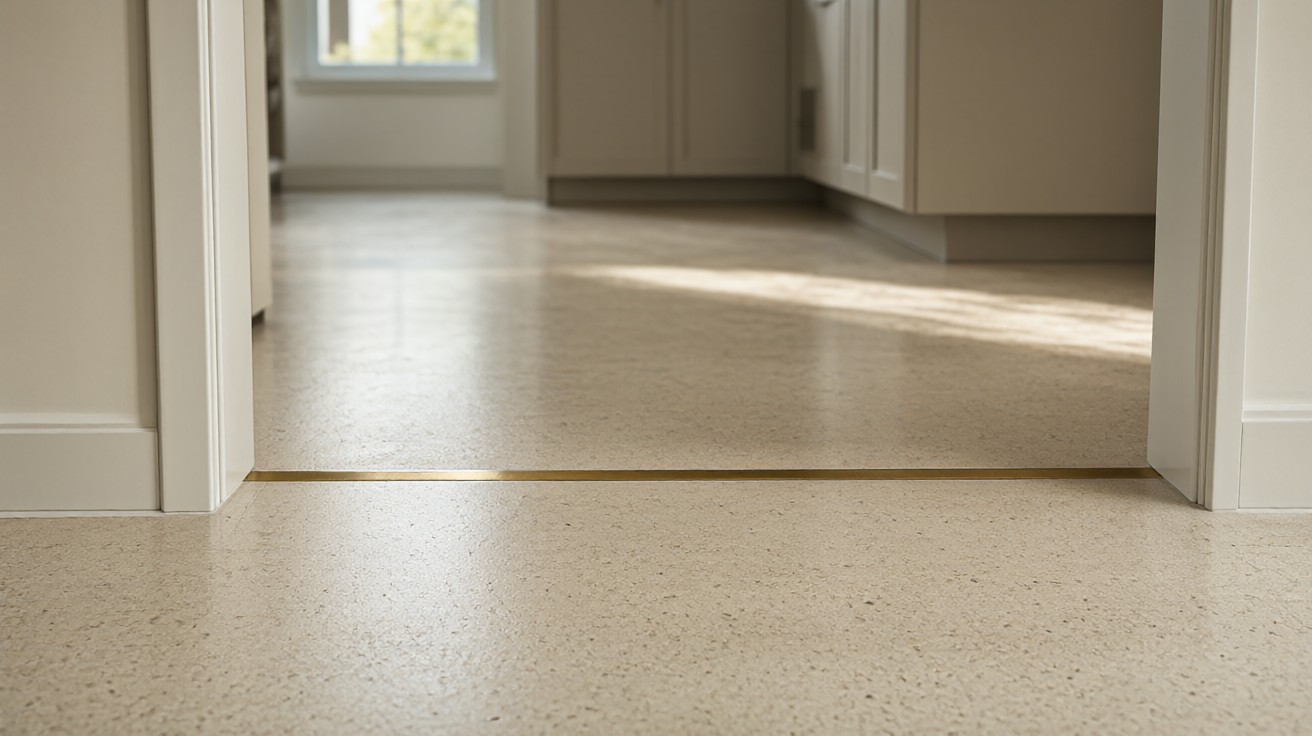
Most rooms in a house are a yes. The entry, the hallway, the mudroom, the kitchen, the living room and the bathroom floor outside the shower all take terrazzo well.
The bedroom is a yes with a comfort caveat. The no list is short and specific: a real-terrazzo shower pan, an unmitigated wet slab under epoxy, and any exterior epoxy.
For the general room-by-room material comparison, best flooring by room is the broader guide.
| Room | Verdict | Binder / system | Finish | Deciding condition |
|---|---|---|---|---|
| Entry, hallway, mudroom | Yes | Epoxy or cement | Honed or polished | Grit control; pattern hides wear |
| Bathroom floor (outside pan) | Yes | Epoxy or cement | Honed finish | Wet DCOF class; slope to drain |
| Shower pan | No (real terrazzo) | Porcelain / small-format tile | Textured | No normative DCOF limit; barefoot, soap, slope |
| Kitchen | Yes, with care | Epoxy or cement | Honed | Acid etches chips; grease film; trivets |
| Living room | Yes | Epoxy or cement | Honed or polished | Comfort; radiant heating optional |
| Bedroom | Yes, comfort caveat | Epoxy or cement tile | Honed | Cold underfoot; rugs or radiant |
| Outdoors (patio, walkway) | Yes, cement only | Rustic cement | Textured | UV; freeze-thaw; breathable sealer |
| Basement / below-grade | Yes, if dry | Cement, or epoxy on tested slab | Honed | MVER / RH test; mitigation |
The Two Binders Decide the Room Map
Epoxy terrazzo is an interior system. Ultraviolet light breaks down the resin, and the thermal expansion mismatch between a thin resin topping and its substrate moves the two against each other through seasonal temperature swings.
That is why epoxy fades, chalks and debonds outside, and why every terrazzo authority keeps it indoors.
Cement rustic terrazzo is the exterior system, because the cement matrix tolerates UV and the thicker section moves with the slab rather than against it.
Thickness and weight follow the binder and the format. An epoxy thin-set pour runs 1/4 inch to 3/8 inch. A cement rustic system is a 1/2 inch topping over a 3 inch sand cushion bed.
That bed is heavy and sits on a ground-floor slab. Resin terrazzo tile is thin, around 10 mm, while cement terrazzo tile runs 30 to 40 mm and needs a substrate that can carry the weight.
A poured resin field can be as thin as 6 to 8 mm. For the full binder chemistry, moisture limits and cost positioning, epoxy versus cement terrazzo is the dedicated comparison.
The room map only needs the fork: epoxy inside, cement rustic outside.
Bathrooms and Showers: Wet DCOF, Honed Finish, and the Shower-Pan Limit
A bathroom floor outside the shower is a strong yes. Specify a honed finish, because the matte texture raises wet DCOF where a smooth polish lowers it.
The room falls in the Interior Wet use class, where the 0.42 wet DCOF benchmark applies to level floors walked on when wet. Slope the field to the drain and keep it free of standing water.
Put waterproofing behind the assembly. The material name does not decide slip resistance; the finish and the sealer do.
Is terrazzo slippery in a shower?
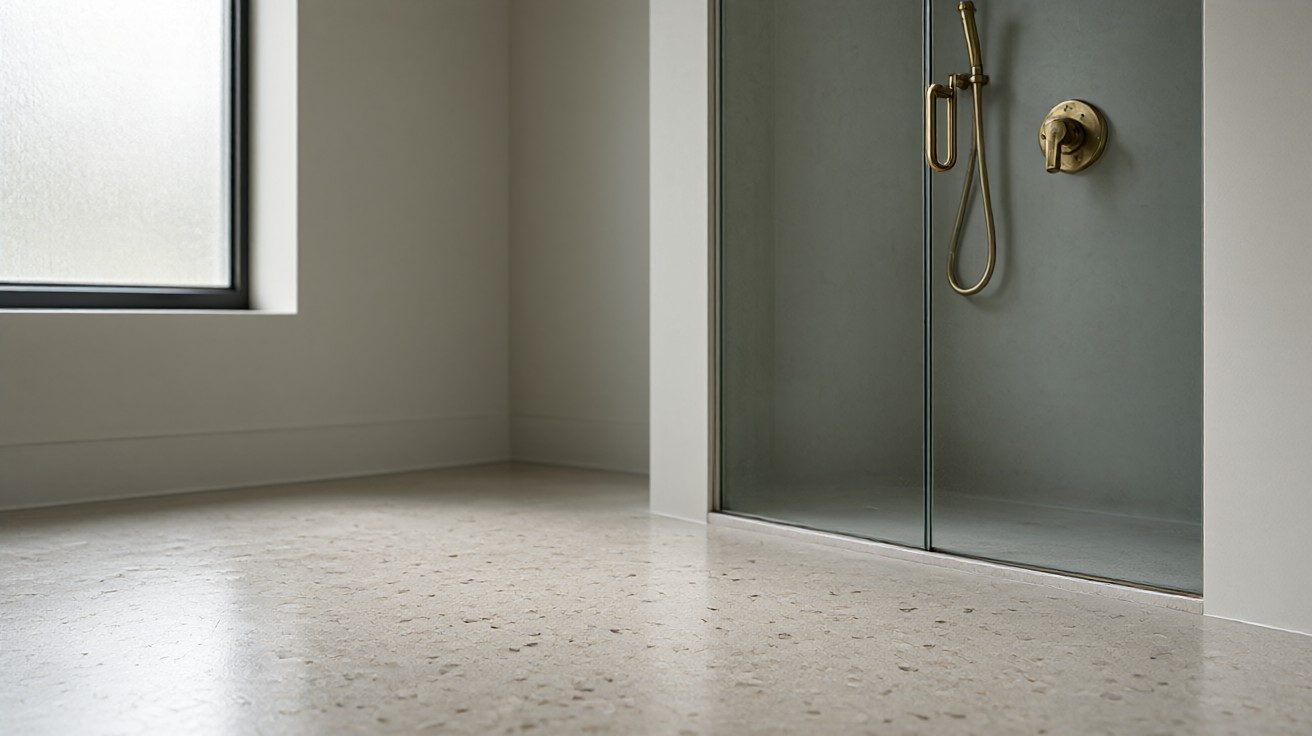
The shower pan is where real terrazzo is the wrong answer. ANSI A326.3 provides no normative DCOF limit for shower floors, because suitability there depends on drainage, surface structure, barefoot use and soap, not on a single number.
A smooth satin-finish terrazzo base is a slip hazard, and a design guide flags that risk for children and elderly people specifically. The warning is about the finish and the barefoot wet zone, not a verdict on the whole bathroom floor.
The practical substitute is terrazzo-look porcelain or small-format tile with a textured surface and a proper slope.
One cement terrazzo tile line declares shower-floor suitability with a waterproofing penetrating sealer and scored grooves. That is a manufacturer-declared exception, not a general green light.
For the wider material comparison, best flooring for bathrooms covers the alternatives.
Keep the slip-claim disagreement visible and scoped. The terrazzo association’s position is that the sealer dictates slip resistance. A supplier markets a finish as slip-resistant.
A design guide calls smooth terrazzo dangerous for the elderly. A fabricator answers that polished is slippery wet and honed is safer. All four are talking about different things: the sealer, the finish, the barefoot wet zone, and the wet-versus-dry condition.
None of them is a property of the word terrazzo. Specify the finish and the sealer, ask for the wet DCOF class or the manufacturer declaration, and the disagreement resolves into a specification.
Kitchens: Grease, Acid, and Heat on a Marble-Chip Floor
A kitchen is a yes with care. The vulnerability is the chip, not the binder. Most terrazzo aggregate is marble, which is calcite, so acid etches the chips even when the epoxy or cement around them resists the spill.
For example, a wedge of lemon left on the counter edge can dull a polished chip to a matte spot overnight while the binder never blinks. Vinegar, wine and citrus do the same.
That is why a stain-resistant binder does not make a terrazzo kitchen floor acid-proof, and why a honed finish hides etching better than a mirror polish.
Is terrazzo a good kitchen floor?
Yes, if you accept the etching and the grease maintenance. Cooking oil and fat leave a film that changes traction, which is exactly the condition the Oils/Greases use class addresses.
That class is manufacturer-declared, with no normative DCOF limit for non-water contaminants. Use trivets under hot pans on a resin-bound surface, and treat any supplier heat figure as a hot-pan caution, not a rating.
Seal by traffic, typically every 1 to 2 years in a busy kitchen, and keep the grease film off the field.
For the routine itself, caring for terrazzo floors is the dedicated care page, and best flooring for kitchens compares the alternatives.
Entries, Hallways, and Mudrooms: The Easy Yes
The entry is the easiest yes in the house. Grit off a shoe is the most abrasive thing a floor meets, and terrazzo’s hard chips shrug it off where a softer surface scratches.
The speckled pattern hides the wear path that would show on a uniform floor. A cement terrazzo tile line carries a V rating on a wear scale that runs from light residential to industrial.
Its own guidance splits the rooms: bathrooms and bedrooms sit in the light-residential band, while entries, hallways, kitchens and mudrooms sit in the heavy-residential band that must be kept free of abrasive grit.
The standard’s use guidance maps the entry precisely. Entry foyers appear in the Interior Wet note, among areas walked on when wet, provided the floor is level, clean, maintained and free of standing water.
Interior Dry covers home interiors without water sources that are kept dry. So a foyer that tracks in rain is an Interior Wet specification, not a dry one, and the wet DCOF class is the number to ask for.
Stairs take precast terrazzo treads and risers, cast or set as units. For the broader hallway material comparison, hallway and entryway flooring is the guide.
Living Rooms and Bedrooms: Comfort Is the Constraint
In a living room the constraint is comfort, not durability. Terrazzo is cold and hard underfoot because the dense mass pulls heat from a bare foot quickly.
Rugs solve the seating zone, and radiant heating solves the whole field. The material itself is overqualified for the traffic.
Cracking scope differs by binder: a resin topping is thin and follows the slab, while a cement system is thicker and carries its own reinforcement. The crack-isolation detail belongs to the binder choice rather than the room.
Weight decides the format upstairs. A poured field is heavy and belongs on a ground-floor slab; a tile format goes on upper floors because the substrate can carry it.
The choice between poured terrazzo versus terrazzo tile is therefore a structural question before it is an aesthetic one.
A bedroom is a yes with the same comfort caveat. A tile supplier markets terrazzo as scratch-resistant for bedrooms, but the honest scope is that the chips are hard while acid and grit still mark them.
Rugs or radiant heating carry the comfort decision. If polished concrete is the alternative on the table, terrazzo versus concrete flooring is the dedicated decision.
Radiant Heat: Compatible, With Conditions
Terrazzo suits radiant heating because the dense mass conducts and spreads heat evenly, and a thinner section warms faster than a thick one. Both binders work.
Heating coils embedded in portland cement terrazzo have a long service record, and epoxy terrazzo is compatible when the resin formulator approves the system.
The heat source belongs in the slab or the underbed, not in the terrazzo topping, and the heating medium should sit within 2 inches of the finished surface.
Metal divider strips must not touch the heating elements, which can mean shallower strips at the crossings.
Can you put terrazzo over radiant floor heating?
Yes, with the conditions. The association sets a surface cap near 100 degrees F and a slow setpoint change, around 1 degree F per hour, to avoid thermal shock.
LATICRETE lists cement terrazzo as an approved substrate under its STRATA_HEAT mat, rates the membrane to 280 degrees F, and gives a warm-up rule of thumb of 10 to 12 degrees F per hour.
It holds the thermostat off until the installation has cured, typically 7 days at 70 degrees F. Tubing or mat goes down before the pour, so a retrofit into an existing terrazzo field is impractical.
For the general surface-temperature caps and system types, flooring compatible with radiant heating is the guide.
Outdoors: UV, Freeze-Thaw, and the Rustic Cement System
Outside, the answer is cement rustic only. Epoxy is interior-only for the UV and thermal-expansion reasons above, and a polyacrylate or resin exterior claim is a niche product declaration, not a general rule.
Specify a textured rustic finish, because a glossy polish is slippery wet and the texture is what carries traction.
The Exterior Wet class is manufacturer-declared, and the standard provides no normative DCOF limit for exteriors. The EW label itself does not refer to frost resistance, so freeze-thaw is a separate question.
Can terrazzo go outside?
Yes, in the right climate and with the right system. Freeze-thaw spalls outdoor cement terrazzo because water in the pores expands when it freezes and opens microcracks.
A breathable water-repellent sealer is the defense: it sheds surface water while letting the substrate dry, which reduces efflorescence and freeze-thaw damage. Avoid de-icing salts, which abrade and stain, and slope the field to drain.
The classic exterior recipe is 70 percent or more coarse marble aggregate in 30 percent or less portland cement matrix, a mix federal preservation guidance ties to warm, dry climates.
In a freeze-thaw climate the scope narrows: a dense, air-entrained mix, a breathable sealer and positive drainage are the conditions. A southern patio is an easier specification than a northern walkway.
Basements and Below-Grade: Moisture Decides the Binder
Below grade, moisture decides the binder. Epoxy terrazzo is vapor-impermeable, so trapped moisture pressure breaks the bond and the topping delaminates on a wet slab.
Cement terrazzo breathes, letting vapor migrate through and escape, which is why it tolerates a slab that epoxy cannot. The room is a yes only if the slab is tested and, where needed, mitigated.
An unmitigated wet slab under epoxy is one of the short no-list items, and it is a failure mode rather than a maintenance issue.
Can terrazzo go in a basement?
Yes, if the moisture numbers are in hand. Test the slab before specifying: the calcium chloride MVER test per ASTM F1869 runs 60 to 72 hours, and the in-situ relative-humidity probe per ASTM F2170 equilibrates 72 hours before reading.
The masonry institute’s guidance holds slab relative humidity below 80 percent at installation unless the manufacturer sets a lower limit. It cures the slab at least 30 days and places a reinforced vapor barrier equal to or greater than ASTM E1745 15 mil directly under the slab.
Where the numbers exceed the limit, a moisture-vapor barrier per ASTM F3010 is the mitigation.
For the procedure and number interpretation, subfloor moisture testing is the dedicated page, and best flooring for basements compares the below-grade alternatives.
The DCOF Classes That Actually Apply
ANSI A326.3-2021 sorts hard-surface flooring into five product-use classes, and terrazzo is in scope: the terrazzo association sits on the consensus committee, alongside the tile, stone and masonry bodies.
The classes are the bridge between a slip number and a room decision, and the criteria are not all the same kind of number.
| Class | Criterion | Where it applies | Terrazzo implication |
|---|---|---|---|
| Interior Dry (ID) | 0.42 dry DCOF minimum | Home interiors without water sources, kept dry | Polished dry living areas; walk-off mats at entrances |
| Interior Wet (IW) | 0.42 wet DCOF or manufacturer-declared | Entry foyers, residential bathrooms and kitchens, level and free of standing water | Honed bathroom and kitchen fields |
| Interior Wet Plus (IW+) | Manufacturer-declared (informative 0.50 wet) | Public showers, locker and steam rooms, interior pool decks, covered exterior | Declare the finish and sealer; no single normative limit |
| Exterior Wet (EW) | Manufacturer-declared (informative 0.55 wet) | Patios, walkways, exterior pool decks; not frost resistance | Rustic cement, textured; climate-scoped |
| Oils/Greases (O/G) | Manufacturer-declared (informative 0.55 wet) | Back-of-house kitchens, food prep, automotive-fluid areas | Grease film changes traction; declare and maintain |
The threshold disagreement is real and must stay visible. A Canadian terrazzo association table lists flat minimums of 0.42, 0.42, 0.50, 0.55 and 0.55 across the five classes.
A tile manufacturer’s bulletin gives Interior Wet as greater than 0.42 wet and Interior Wet Plus as greater than 0.50 wet. The standard itself makes IW+, EW and O/G manufacturer-declared.
It offers 0.50 and 0.55 only as informative, generally accepted defaults in the absence of a superseding declaration. These are different kinds of statement, and averaging them invents a number nobody publishes.
Ask for the class and the declaration, not a blended threshold.
Two caveats carry the most weight for terrazzo. First, the standard provides no normative DCOF limit for shower floors, barefoot areas, exteriors, ramps, pool decks or non-water contaminants, so a single number cannot clear those rooms.
Second, a coated floor is dry-only unless the coating manufacturer declares otherwise, which means a sealer or coating applied after installation can change the class.
The Interior Wet use note is the one that names entry foyers and residential bathrooms and kitchens, provided the floor is level, clean, maintained and free of standing water. That note, not the material name, is what places the room.
Rooms and Situations Where Terrazzo Is the Wrong Answer
The no list is short, and each item is a failure mode rather than a preference. A real-terrazzo shower pan is wrong because the standard gives no normative limit for that barefoot, soap-slick, sloped condition.
The practical substitute is textured porcelain or small-format tile. An unmitigated wet slab under epoxy is wrong because the vapor-impermeable topping delaminates. Exterior epoxy is wrong because UV and thermal movement break it down.
An unheated bedroom where comfort is the priority is a poor fit because the mass is cold underfoot, and rugs or radiant heating are the fix rather than a different material.
One more limit is honest to state: a patch in a historic terrazzo field rarely color-matches the original aggregate and binder, so a repair is visible even when it is sound.
That is a material limit, not a reason to avoid the floor.
The decision rule across all of these is the same: if the room is barefoot and soap-slick, or the slab is wet and unmitigated, or the exposure is exterior UV, choose the system that is declared for that condition rather than forcing terrazzo into it.
How to Specify Terrazzo Room by Room
The specification checklist is short and room-specific. Ask for the binder and system, the finish, the DCOF use class or the manufacturer declaration, the sealer type and its cadence, the slope and drainage detail, the radiant plan if any, and the slab moisture test results below grade.
In a bathroom or entry, the wet class and the honed finish are the line items. In a kitchen, the Oils/Greases declaration and the etching honesty are the line items.
Outside, the rustic cement system, the breathable sealer and the climate scope are the line items.
Delegate the rest. The per-square-foot pricing and project totals belong to terrazzo floor cost, the installation steps and subfloor prep belong to the installation guide, and the cleaning routine belongs to the care page.
The placement decision is the one owned here: binder first, finish and sealer second, class and declaration third, and the room follows.
Get those four right and terrazzo is a yes in most of the house, a conditional yes below grade and outside, and a clear no in the shower pan.