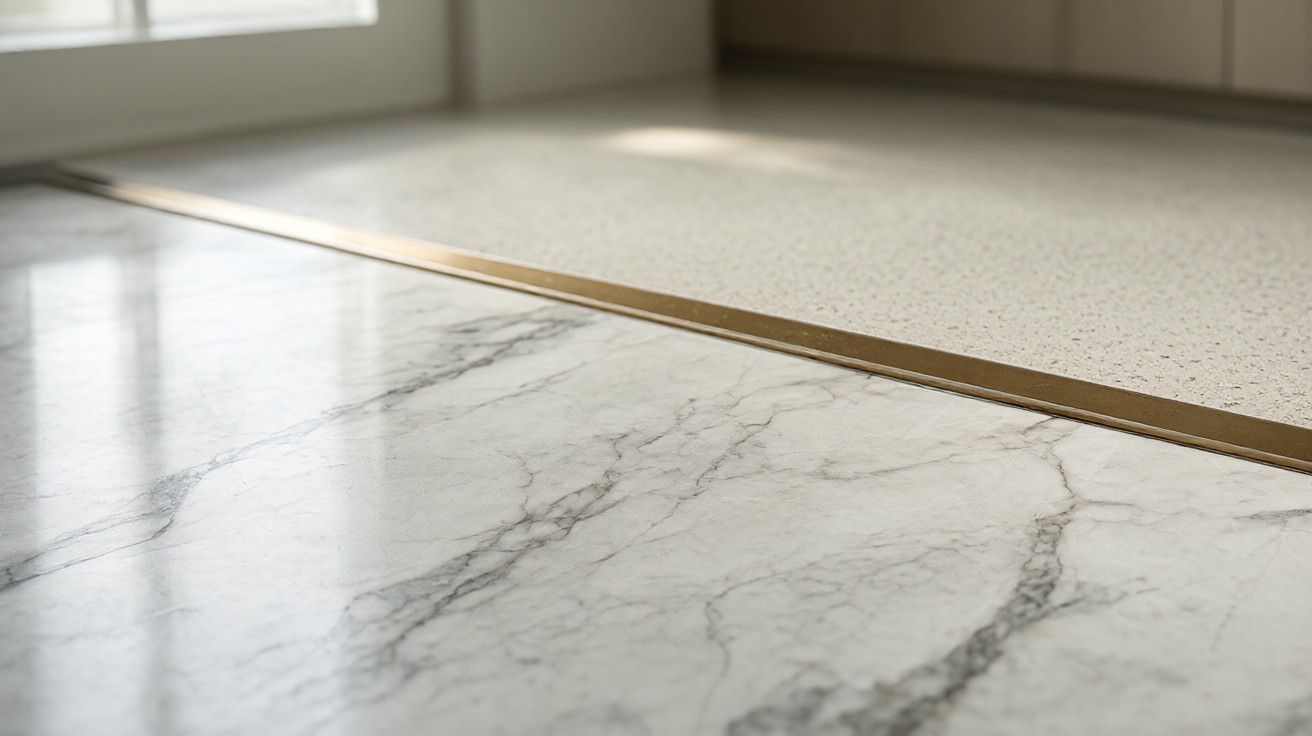

Terrazzo and marble share one weakness: calcite. Acid etches both, so the real choice is not durability versus delicacy but composite versus solid stone.
Choose terrazzo for a busy kitchen or entry where chips hide wear and an epoxy binder shrugs off spills; choose marble for a low-traffic formal room where the veining is the point. Both etch, both refinish, and neither is maintenance-free.
Composite vs Solid Stone: What You Are Actually Buying
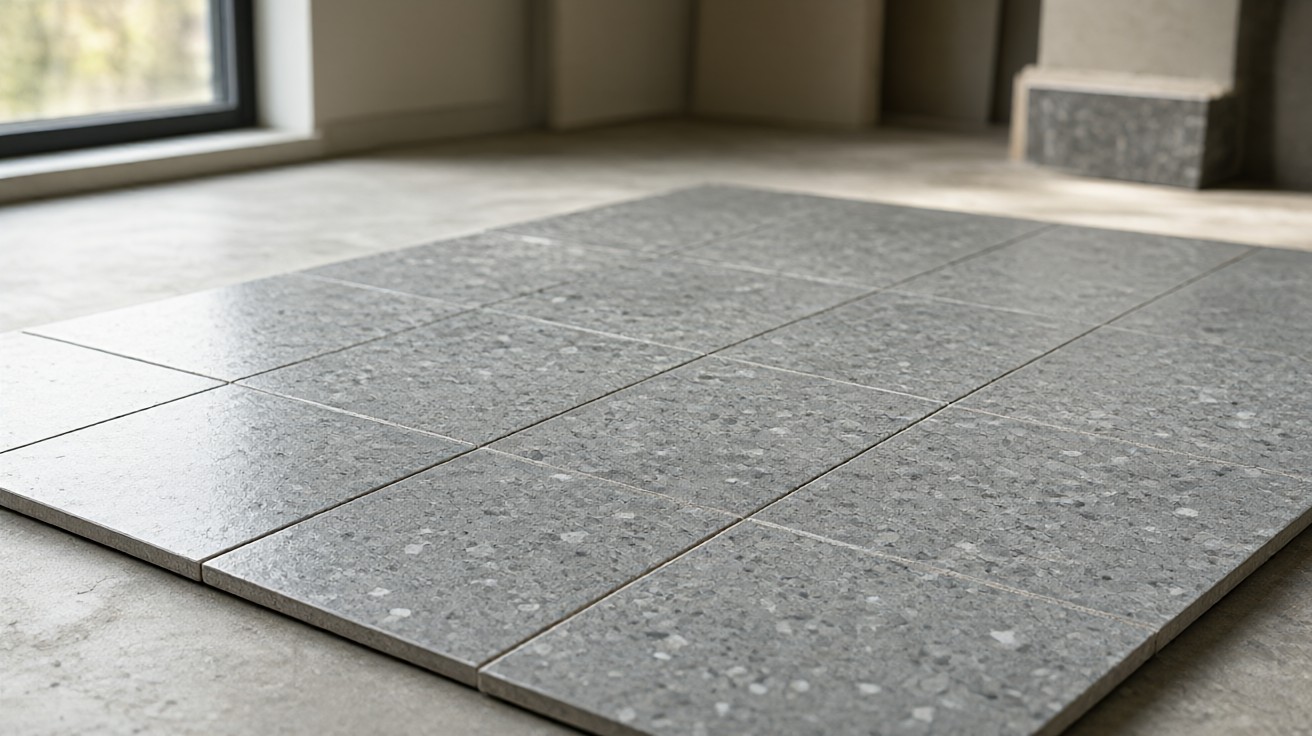
The terrazzo vs marble flooring decision starts with structure, not style. Terrazzo is a composite: chips of marble, granite, glass or shell locked in a cement or epoxy binder, then ground smooth to expose the aggregate. Marble is monolithic, a single slab or tile cut from a metamorphosed limestone bed.
One floor is assembled from many materials; the other is one material all the way through. That difference drives everything below: how each reacts to acid, how each stains, how each refinishes, and what each costs.
Whether terrazzo is worth it at all, room by room and against the whole hard-floor field, is the terrazzo pros and cons judgement.
Our terrazzo flooring explained guide covers the composite in depth, and the natural stone flooring guide covers marble alongside its stone siblings.
Neither is plastic, and neither is porcelain. Both are mineral surfaces that behave like mineral surfaces.
Veining vs Speckle: The Aesthetic Decision
Marble sells on veining. Each slab carries a one-of-a-kind pattern of mineral veins, so a marble floor reads as a continuous natural canvas with movement and depth. No two tiles match exactly, which is the point and the risk: bookmatching and dry-laying matter, and a single slab’s character can dominate a room.
Terrazzo sells on speckle. The aggregate chips create a scattered, confetti-like field whose color, chip size and binder tone you control. A designer can specify a pale binder with warm marble chips, or a dark binder with glass aggregate, and the floor is built to that palette rather than chosen from what the quarry sent.
If you want a natural pattern no one else has, marble wins. If you want a pattern you designed, terrazzo wins.
The trade-off is continuity. Marble tile shows grout lines and slab variation; poured terrazzo is seamless across a whole room, with no grout to discolor. Precast terrazzo tile reintroduces joints, so the seamless advantage belongs to the poured format, not to terrazzo in general.
The Acid Problem Both Floors Share
Here is the correction most comparison pages miss. The Natural Stone Institute’s Dimension Stone Design Manual lists terrazzo among the calcite stones, alongside marble, travertine, limestone and onyx, that contain calcium carbonate and react with acid.
Terrazzo is not a separate chemical category. When its aggregate is marble, the chips are the same acid-sensitive stone as a marble slab.
Does terrazzo etch like marble?
Yes, where the aggregate is calcite. Acid etching is a chemical burn, not a stain: lemon juice, vinegar, wine, tomato or coffee dulls a polished surface by dissolving a microscopic layer of calcite. In the Design Manual, even mild household acids attack calcareous stone, and urine is acidic enough to damage stone floors.
On marble the etch is a dull spot on a polished field. On marble-chip terrazzo the etch lands on the chips themselves, so a speckled floor hides small etches better than a uniform polished slab, but the chemistry is identical. A glass-aggregate terrazzo with an epoxy binder behaves differently: glass does not react with acid, and the binder shields the chips.
The pH scale is logarithmic, not linear. In the Design Manual’s example, a substance at pH 5 is ten times more acidic than one at pH 6, so a small drop in pH means a large jump in etching power. That is why a quick splash of citrus matters more than its volume implies.
A penetrating sealer does not stop etching. It repels water and oil, not acid.
This is the single most important scope label in the terrazzo vs marble debate. Vendor shorthand calls terrazzo acid-proof and marble delicate. The stone-care authority contradicts both halves: marble-chip terrazzo etches, and marble refinishes almost endlessly. Judge the floor by its aggregate and binder, not by the category name.
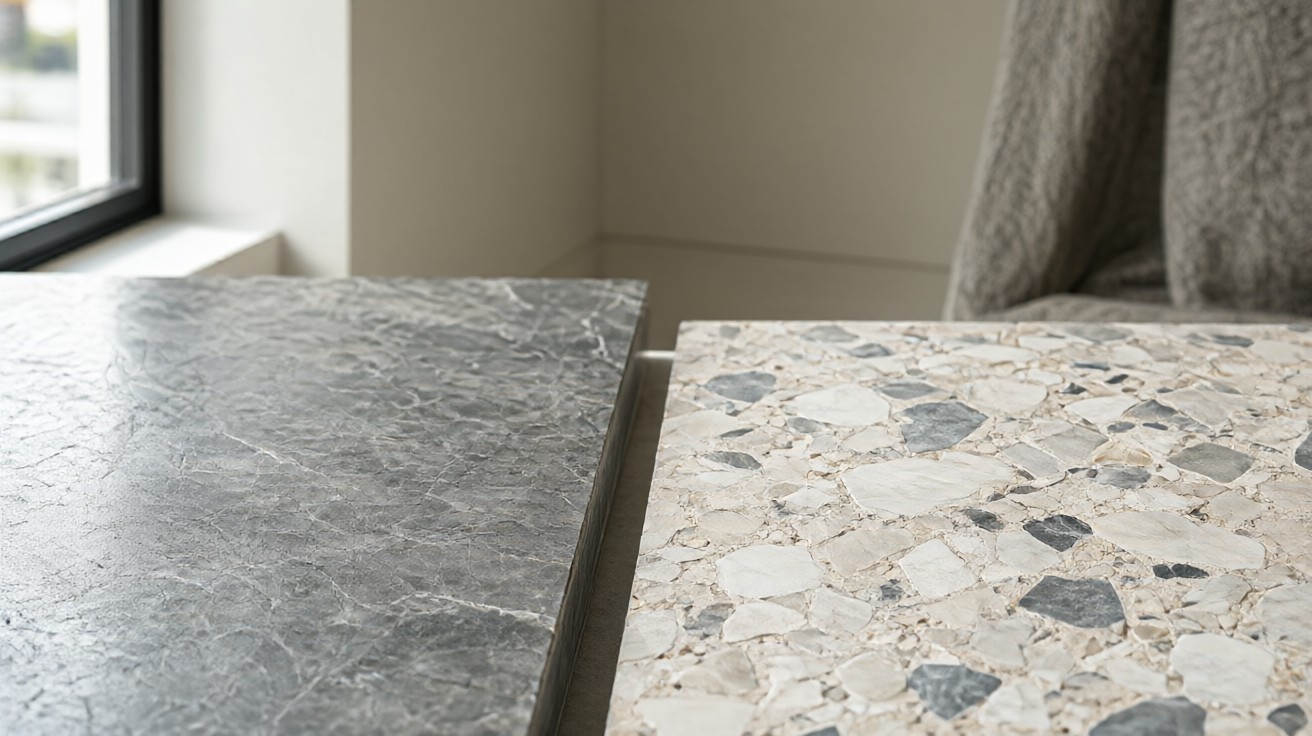
Porosity and Staining: Binder vs Stone
Staining is a different mechanism from etching. A stain is a liquid that soaks into pores and discolors the stone from within; an etch is surface dissolution. Marble is porous and stains if spills sit, especially oil, wine, coffee or rust. The fix is a poultice that draws the stain back out, plus prompt cleanup.
Terrazzo’s porosity depends on the binder. Epoxy terrazzo is low-permeability and virtually stain-proof; cement-binder terrazzo is porous and needs sealing to resist stains. A UK terrazzo specialist describes epoxy as non-porous and stain-resistant, while cementitious terrazzo is more porous and should be resealed periodically. So “terrazzo is stain-proof” is true only for the epoxy format, and only against stains, not acid.
Glass aggregate changes the picture again: glass chips do not absorb, so a glass-and-epoxy terrazzo resists both staining and etching far better than a marble-chip cement terrazzo.
For routine care, marble and marble-chip terrazzo share the same rule: a neutral cleaner near pH 7 to 8, no vinegar, no bleach, and no acidic spot tests. Mop with a damp microfiber head, rinse, and dry, because grit underfoot is abrasive on both surfaces.
Hardness, Scratching and Chipping
Marble is softer than the granite or glass chips often used in terrazzo, so it scratches more readily under grit and furniture legs. A terrazzo floor with hard aggregate resists scratching better than a marble slab, but a terrazzo floor with soft marble chips scratches about like marble. The aggregate, not the category, sets the scratch resistance.
The Dimension Stone Design Manual refuses to assign a single Mohs hardness number to a stone, because stone is a mix of minerals with different hardnesses, like asking the flavor of Neapolitan ice cream. So a single Mohs number for marble is misleading: the value depends on the specific stone and its mineral mix.
Mixing hard and soft aggregate creates a refinishing problem. In the Design Manual’s example, a floor with hard granite bands and a softer travertine field dishes and gouges when refinished with aggressive abrasives, because the soft stone wears faster. A terrazzo with mixed aggregate can wear unevenly for the same reason.
Chipping is an edge risk on both. Marble tile chips at exposed edges and corners; terrazzo chips where the binder is thin or the aggregate is brittle.
Underfoot, polished marble is slippery when wet, especially in a bathroom. A home-improvement guide describes terrazzo as more slip-resistant than polished marble, and a tumbled or honed marble finish as safer than polished.
The ANSI A326.3 standard sets a minimum wet dynamic coefficient of friction of 0.42 for level interior surfaces expected to be walked on when wet, and names polished surfaces as an example that can fall below it. Where a polished floor stays dry, that lower grip is acceptable; where it gets wet, specify a honed or tumbled finish or a higher-grip terrazzo.
Sealing and Upkeep: The Frequency Disagreement
Sealing cadence is where sources diverge most, and averaging the numbers would mislead you. The Natural Stone Institute’s consumer care site carries two marble specialists who disagree: one sets resealing at nine months to a year, the other at five to ten years, with good sealers lasting 15 to 20 years.
The Design Manual’s Group 2 maintenance schedule for calcite stones, which include terrazzo, calls for resealing every 2 to 3 years and a twice-yearly scrub with a 175 RPM buffer, a soft nylon brush and a neutral cleaner. A cost index lists marble resealing at every 3 to 5 years, while a restoration contractor’s pricing assumes annual professional sealing.
How often should you reseal marble?
It depends on the sealer, the traffic and the test, not a fixed calendar. The water-drop test is the practical answer: if a few drops darken the stone within 5 to 10 minutes, the sealer has worn and it is time to reseal. If the water beads, the sealer still works.
In a busy kitchen, plan on annual sealing; in a low-traffic formal room, every few years may be enough. A contractor’s Kansas City pricing lists annual professional marble sealing at $2 to $5 per square foot and professional polishing every 2 to 5 years. A cost index lists DIY resealing at about $0.75 per square foot every 3 to 5 years.
Terrazzo upkeep splits by binder. One restoration contractor’s comparison claims terrazzo needs no sealing, but that holds only for low-permeability epoxy terrazzo; cement-binder terrazzo is porous and should be resealed periodically.
A home-improvement guide describes terrazzo resealing as traffic-driven: twice a year in public spaces, every 5 years in a private home. For the day-to-day routine, see our how to clean natural stone floors guide and our terrazzo cleaning and maintenance guide.
Honed vs Polished: How the Finish Changes Behavior
The finish changes how damage reads, not whether it happens. A polished marble floor shows every etch as a dull spot against the gloss, and every scratch as a visible line. A honed marble floor has a matte surface that hides etches and scratches far better, because there is no gloss to interrupt. The acid still reacts; the matte finish just disguises the result.
Terrazzo behaves the same way. Polished terrazzo shows etches on the marble chips and scratches in the binder; honed terrazzo hides them. If you want the lowest-maintenance look on a calcite floor, specify honed over polished in a kitchen, an entry or a bathroom, where spills and grit are constant.
Polished is the high-gloss, high-visibility choice. Honed is the forgiving one.
For example, if you are installing a polished marble entry and guests track in winter grit, the gloss shows scratch lines within a season. The same entry in honed marble, or in a terrazzo field, hides them.
Refinishing cadence also follows the finish. In NSI’s consumer marble guidance, one specialist sets polished marble refinishing at every 2 to 3 years and honed marble at every 3 to 5 years, depending on traffic. A cost index stretches professional repolishing to every 15 to 20 years. The gap reflects traffic and wear tolerance, not a contradiction in the stone.
Restoration and Refinishing: Both Come Back
Can marble really be restored?
Yes, almost endlessly. A terrazzo vendor’s comparison page calls marble restoration nearly impossible and not cost-effective, but the stone-care authority contradicts that directly. In NSI’s consumer guidance, marble can be refinished almost endlessly, and a 100-year-old marble floor can look new after refinishing. The vendor claim is marketing, not stone science.
Marble restoration is mechanical, not magical. A professional wet-sands the surface to remove scratches and lippage, then works through cream or powder abrasives or diamond discs, and finally repolishes or rehones to the finish you want.
Because marble is solid calcite all the way through, there is always fresh stone beneath the damage. That is why it refinishes again and again.
Terrazzo restores too, but with a limit marble does not have. In the National Terrazzo & Mosaic Association (NTMA) restoration specification, color matching of existing aggregate may not be exact, because the chips are mined products that change over time, and not all staining can be removed. A terrazzo patch can be visible where a marble refinish is invisible.
A restoration contractor’s comparison observes that both floors are restorable and that marble restoration is generally less expensive than terrazzo restoration, because marble is uniform and terrazzo needs aggregate matching.
Chips in terrazzo are filled with color-matched epoxy and scratches are buffed out. The NTMA specification calls for a mockup and a meeting to set repair expectations before work begins, and uses aggregate in cracks wider than 1/4 inch. Marble needs no color match because the stone is the same throughout.
Price: Where the Direction Flips
Is terrazzo cheaper than marble?
Sometimes, and it depends on the format. Terrazzo tile and marble tile overlap at $15 to $35 versus $15 to $50 per square foot installed, so entry-grade marble can be cheaper. Poured terrazzo at $20 to $70 beats marble slab at $55 to $145.
But a seamless terrazzo floor can cost more than marble tile because the labor is intensive, and grade flips the direction too: D-grade marble at $3 to $7 per square foot material undercuts most terrazzo. The category name does not set the price; the format and the grade do.
Cost direction flips by format and grade, so a single “terrazzo is cheaper” or “marble is cheaper” line is wrong. Start with tile.
A cost index lists marble tile installed at $15 to $50 per square foot, with 12×12 inch tile at $15 to $30 and 12×24 inch at $18 to $37. A home-improvement cost guide lists terrazzo tile installed at $15 to $35 per square foot.
At entry grade the two overlap, and marble can even undercut terrazzo tile. Marble is graded A through D, with A-grade material at $19 to $60 per square foot and D-grade at $3 to $7, so a low-grade marble tile is cheaper than most terrazzo tile. The “marble is expensive” shorthand assumes premium grade.
Now flip to the premium formats. Poured terrazzo runs $20 to $70 per square foot installed, and a seamless terrazzo floor can cost more than marble tile because the labor is intensive. Marble slab, the large-format premium option, runs $55 to $145 per square foot installed. So terrazzo beats marble slab on price, but marble tile can beat terrazzo tile.
A restoration contractor’s Kansas City pricing lists epoxy terrazzo at $15 to $30 per square foot installed and cement-binder terrazzo at $20 to $50, against marble at $10 to $25 for standard varieties and $30 to $50 or more for exotic, plus $5 to $15 per square foot for installation.
The binder and the grade move the number more than the category name does.
| Format | Installed cost per square foot | Source scope |
|---|---|---|
| Terrazzo tile | $15 to $35 | Home-improvement cost guide |
| Terrazzo poured, epoxy | $15 to $30 | Restoration contractor, Kansas City |
| Terrazzo poured, cement | $20 to $50 | Restoration contractor, Kansas City |
| Terrazzo poured, general | $20 to $70 | Home-improvement cost guide |
| Marble tile, 12×12 inch | $15 to $30 | Cost index |
| Marble tile, 12×24 inch | $18 to $37 | Cost index |
| Marble tile, installed range | $15 to $50 | Cost index |
| Marble slab | $55 to $145 | Cost index |
For the full breakdowns, see our natural stone flooring cost guide and our terrazzo floor cost guide. In a home-services cost platform’s estimate, a 250 square foot marble floor runs $1,900 to $5,600, averaging about $3,700, with labor at $3 to $10 per square foot and professional sealing at $0.50 to $2.50 per square foot.
Over 30 years, one cost index totals Carrara marble tile at about $41 per square foot including sealing, repolishing and repairs.
Where Each Wins: Decision Rules
The answer is conditional, not categorical. Choose terrazzo over marble when you need a seamless, high-traffic floor in an entry, a kitchen, a hallway or a commercial space, when you want a custom palette, and when you can specify an epoxy binder with hard aggregate. The chips hide wear, the binder resists stains, and the floor refinishes.
Choose marble over terrazzo when the room is low-traffic and formal, when the veining is the design feature, and when you accept periodic sealing and the risk of etching. A honed marble finish in a powder room or a bedroom hides wear better than polished, and the stone refinishes almost endlessly if it dulls.
In a bathroom, specify honed or tumbled marble over polished for grip, or go with a glass-aggregate epoxy terrazzo that resists both water and acid. Over a concrete slab, poured terrazzo is a natural fit; over a wood subfloor, precast terrazzo tile or marble tile is the practical format, because poured terrazzo needs a stable, rigid base.
Where the floor gets wet, the ANSI A326.3 wet DCOF minimum of 0.42 is the grip benchmark; a honed or tumbled finish meets it more readily than polished.
If you want zero maintenance, neither floor is the answer. Both are mineral surfaces that need mineral-surface care.
For a rental or a flip, marble tile at entry grade is cheaper to install but costlier to keep pristine; terrazzo tile costs more upfront but hides tenant wear.
For a forever home where you will refinish rather than replace, marble’s endless refinishing is an asset, and terrazzo’s seamless field is an asset. The right choice depends on whether you value pattern or palette, and gloss or forgiveness.
Terrazzo vs Marble at a Glance
The table below summarizes the terrazzo vs marble flooring comparison by the factors that actually decide the floor. Read it with the scope labels in mind: terrazzo behavior depends on aggregate and binder, and marble behavior depends on grade and finish.
| Factor | Terrazzo | Marble |
|---|---|---|
| Structure | Composite: chips in a cement or epoxy binder | Monolithic natural stone |
| Pattern | Speckle; custom palette you specify | Veining; one-of-a-kind slab |
| Acid etching | Etches when aggregate is calcite; glass/epoxy resists | Etches (calcite) |
| Staining | Epoxy virtually stain-proof; cement porous | Porous; stains if spills sit |
| Scratching | Depends on aggregate hardness | Softer; scratches more readily |
| Wet slip | More slip-resistant than polished marble | Polished is slippery when wet |
| Sealing | Epoxy minimal; cement periodic | Periodic; cadence disputed |
| Restoration | Restorable; aggregate color match may not be exact | Restorable almost endlessly |
| Lifespan | 75 to 100+ years (contractor); up to 100 (guide) | 50 to 100 years; at least 25 |
| Installed cost | Tile $15 to $35; poured $20 to $70 per sq ft | Tile $15 to $50; slab $55 to $145 per sq ft |
Lifespan numbers vary by source and scope: a restoration contractor gives terrazzo 75 to 100+ years and marble 50 to 100 years, a home-improvement guide gives terrazzo up to 100 years, and a cost platform gives marble at least 25 years with proper care. Both outlast most flooring categories when maintained; the difference is upkeep, not longevity.
One more historical note: terrazzo floors laid in homes from the 1920s to the 1960s are often still intact under carpet, and a 1914 railroad-station terrazzo floor still serves after more than 100 years. Marble floors from the same era refinish to look new. Neither floor is disposable.