
Terrazzo floor cost swings from $9 to $100 per square foot because published averages mix tile with poured systems and small jobs with commercial scale.
Start with the system, not the headline number. Installed terrazzo runs $20 to $50 per square foot, poured-in-place $20 to $70, and precast tile $15 to $35. Standard commercial epoxy runs $30 to $65 and large simple floors $20 to $35. Your budget depends on the system, the area, and the design.
What a Terrazzo Floor Costs Installed
Installed terrazzo runs $20 to $50 per square foot on the blended national average carried across published cost surveys. That single number hides three different products.
The same published data puts poured-in-place terrazzo at $20 to $70 per square foot installed and precast terrazzo tile at $15 to $35. Unique multi-section poured designs can reach $100 or more.
Installer price lists we compared budget $30 to $65 per square foot for a standard commercial epoxy pour and $20 to $35 for large-scale straightforward designs. The full envelope reaches $20 to $100 or more with custom logos and intricate divider-strip patterns.
At the tile end of the market, published averages run $9 to $35 per square foot with a $4,400 average project. The same breakdown puts terrazzo tile at $9 to $22 installed and poured thin-set at $40 to $60.
For how the material is built, start with the terrazzo flooring guide. The ranges here price the installed system, not the chip pattern alone.
| Price basis | What it prices | Installed per sq ft |
|---|---|---|
| Published cost survey | Overall average (tile-heavy) | $9 to $35 |
| Published cost survey | Poured-in-place | $20 to $70 |
| Published cost survey | Precast tile | $15 to $35 |
| Installer price list | Standard commercial epoxy | $30 to $65 |
| Installer price list | Large-scale straightforward | $20 to $35 |
| Bid-based contractor quote | Basic thin-set (bid-based) | $15 to $40 |
| Supplier price list | Standard epoxy | $25 to $60 |
Why Published Terrazzo Prices Disagree
Four variables explain almost every gap between published terrazzo price ranges: the system, the project scale, the design complexity, and what the quote includes.
A range that mixes all four is a planning envelope, not a bid.
System type is the first split. Precast tile is set and grouted; poured epoxy is a thin resin veneer; poured cement is a thicker, heavier assembly.
Published price lists disagree on whether epoxy or cement is cheaper. Some put epoxy below cement for interiors; others place epoxy above cement because of specialty resins and colorants. Our read: installed cost is generally similar either way, and epoxy wins on lifecycle.
Epoxy is not automatically cheaper once design, substrate work and moisture control are matched. Scale moves the unit price because mobilization and grinding equipment are fixed costs.
Custom logos and divider-strip patterns run roughly 25 to 50 percent above the base price. Each additional color needs separate mixing and pouring.
Quote scope is the quiet variable: one proposal may include demolition, substrate repair, moisture mitigation, grinding passes and sealer, while another excludes them.
Poured Epoxy Terrazzo: The Commercial Standard
The National Terrazzo & Mosaic Association (NTMA) describes epoxy terrazzo as a nominal 1/4 inch or 3/8 inch resin-matrix veneer bonded to a flat interior concrete slab.
It is the best thin-set system, weighs 3 to 4 pounds per square foot, and needs no depressed slab. That makes it viable on upper floors and in renovations.
Published installed ranges cluster by scope. Standard commercial epoxy runs $30 to $65 per square foot, and large straightforward fields $20 to $35.
Complex patterns bid out at $25 to $60, and unique aggregates or small projects up to $100. Complex borders run $40 to $90.
Standard epoxy runs $30 to $65 and custom work $45 to $100 or more. Poured thin-set lands at $40 to $60 per square foot.
Poured terrazzo splits into $10 to $50 per square foot for materials and $10 to $20 for labor. Epoxy materials run $12 to $30, labor takes 50 to 65 percent of the total, and mechanics run $45 to $85 per hour.
Epoxy cures overnight and can be ground and polished the next day. It is interior-only; ultraviolet exposure discolors the resin.
Moisture is the gating condition. Pouring epoxy needs a slab moisture vapor emission rate below 5 pounds per ASTM F1869, and mitigation is standard above 75 percent relative humidity.
If the slab tests wet, specify mitigation or choose a cement system instead.
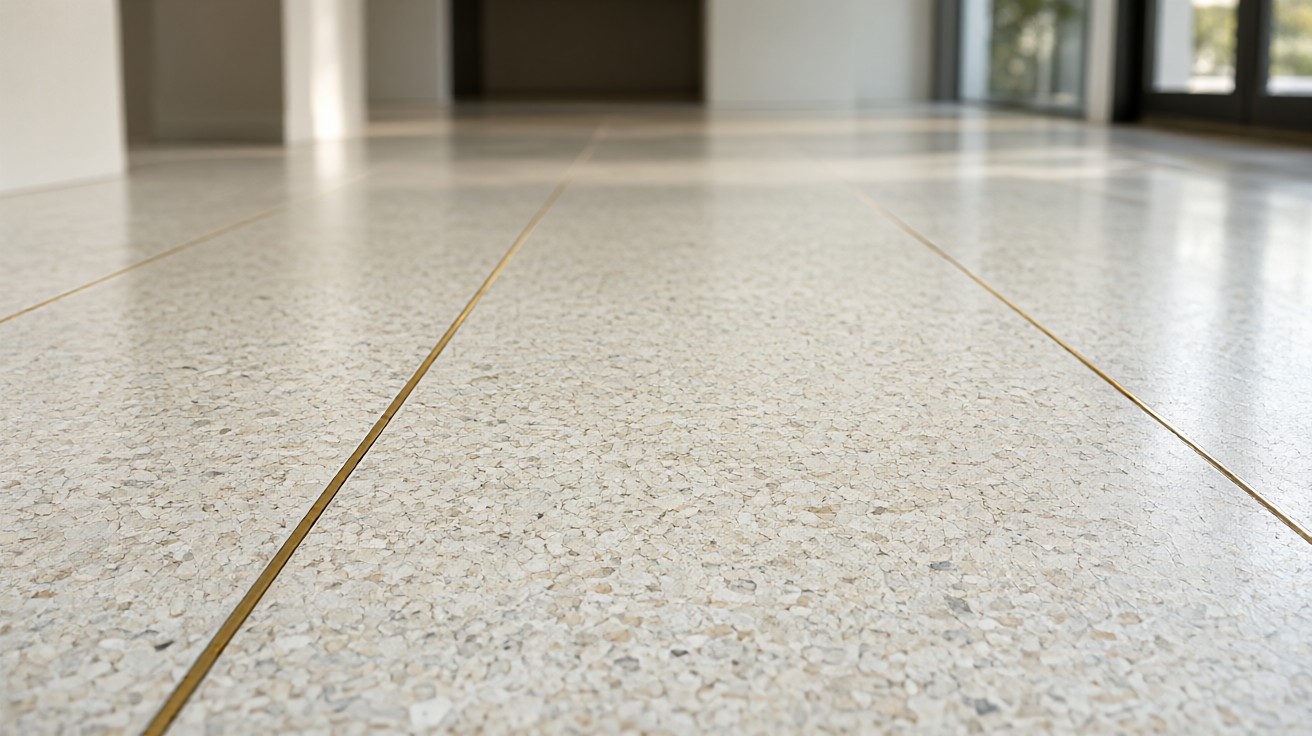
Before the first epoxy batch is troweled, a crew sets zinc divider strips over every control joint, then grinds the cured field through 3 to 5 progressively finer diamond passes over the next 1 to 3 days until the marble chips sit flush and bright.
Epoxy compressive strength runs 13,260 psi versus roughly 4,000 psi for cement.
Poured Cement Systems: Monolithic, Bonded, Sand Cushion, Polyacrylate, Rustic
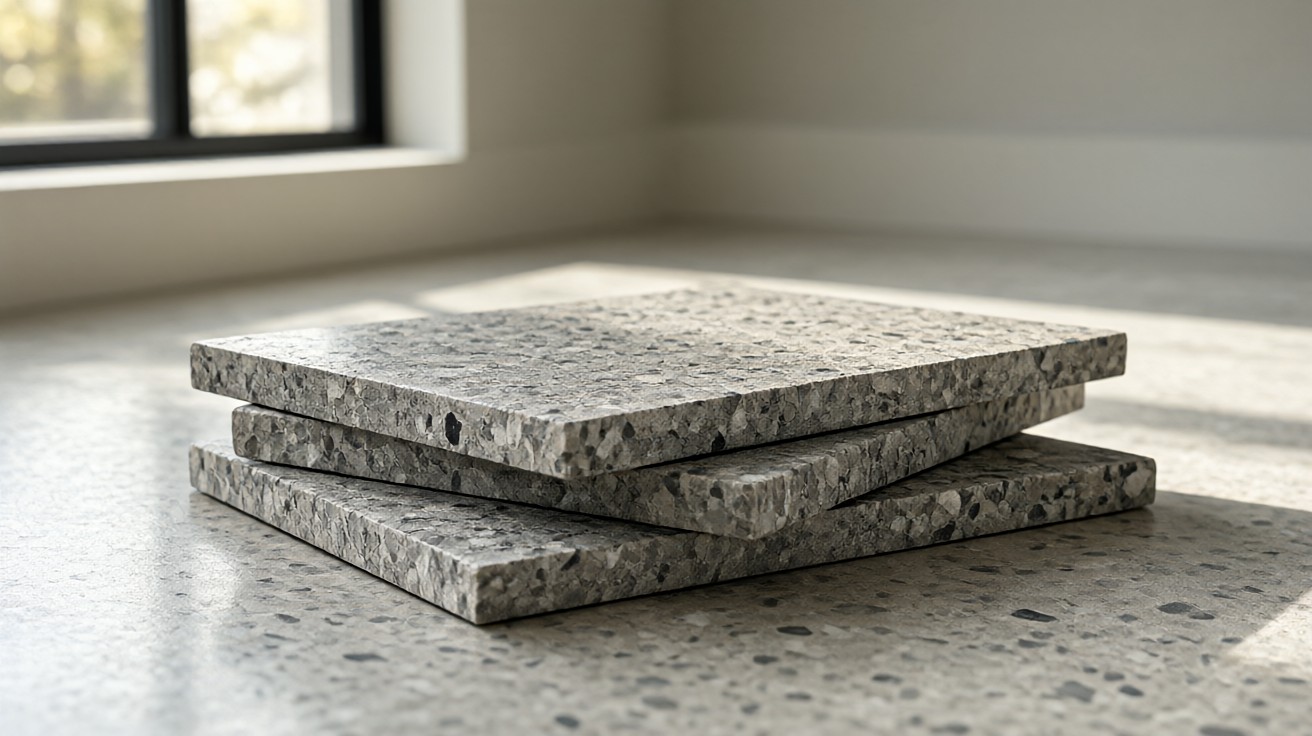
Cement terrazzo is the original system, thicker and heavier than epoxy, and it needs a depressed slab. The NTMA reference guide separates the assemblies by bond and thickness.
Which binder a project needs is decided by moisture, sunlight and thickness limits before price enters the picture; the epoxy versus cement terrazzo comparison sets out those rules.
| NTMA system | Thickness | Weight (lb per sq ft) | Installed cost |
|---|---|---|---|
| Monolithic | 1/2 inch nominal topping | 5 to 7 | $30 to $70 (cost survey) |
| Bonded | 2-1/4 inch total | 18 to 22 | Cement ranges below |
| Sand cushion | 3 inch total | 25 to 30 | $40 to $80 (cost survey) |
| Polyacrylate | 3/8 inch nominal topping | 4.5 | Cement ranges below |
| Rustic | Textured unpolished exterior finish | Varies by aggregate | Cement ranges below |
Monolithic terrazzo runs $30 to $70 per square foot installed and sand-cushion $40 to $80. Standard cement lands at $20 to $45, and high-end aggregate or color at $35 to $70.
Cementitious poured terrazzo runs $25 to $50 per square foot. Installed cement and epoxy costs are generally similar, with cement carrying higher labor and material because of its thickness and slower cure.
Monolithic is the budget-friendly cement option, a 1/2 inch topping bonded directly to the slab, but it is more prone to cracking if the slab moves or stays moist.
Sand cushion isolates the topping from the slab with a wire-reinforced underbed and isolation sheet, which is why it tolerates slab movement. The NTMA classifies it as an interior system.
For exterior terrazzo, specify a rustic cement finish: a textured, unpolished surface that sheds water and provides traction. Larger-aggregate Venetian and Palladiana styles add cost through material size and thickness.
The slab still governs. NTMA system data calls for flatness within 1/4 inch over 10 feet, and divider strips must sit precisely over concrete joints. Under ACI 302.1 joint placement, a 4-inch slab allows joints at roughly 12 feet, and a 6-foot corridor limits joints to about 9 feet.
Precast Terrazzo Tile: Material Plus Setting Labor
Precast terrazzo tile is factory-made, set with thinset mortar and grouted. It is the most DIY-accessible terrazzo format, and standard sizes run from 8 by 8 inches to 24 by 48 inches.
The price has two parts, the tile itself and the setting labor, and quotes do not always include both.
Which format a project should buy is a separate decision from what it costs, and the poured terrazzo versus terrazzo tile comparison covers the joints, logistics and repairability that the price line hides.
| Price basis | Material per sq ft | Setting labor per sq ft | Installed per sq ft |
|---|---|---|---|
| Published cost survey | $8 to $20 | $8 to $20 | $15 to $35 |
| Published cost survey | $4 to $12 | $5 to $10 | $9 to $22 |
| Bid-based contractor quote | From $18 | $10 to $15 | Quote-defined |
| Installer price list | $8 to $25 | Included in install | $15 to $35 |
| Supplier price list | Factory-finished panels | Not separated | $35 to $120 |
Tile starts around $18 per square foot for material and $10 to $15 for installation, but standalone setting is usually not offered; some contractors will grind and polish qualifying large-format tile installed by a setting contractor.
The $35 to $120 range covers factory-finished precast panels, a scope that can include large-format units ground and polished after setting. That is why it reads higher than set-and-grout tile.
Is terrazzo tile cheaper than poured terrazzo?
Usually, yes, per square foot. Tile runs 30 to 60 percent less than poured epoxy.
A 1,000 square foot comparison puts tile at $15,000 to $25,000 versus $30,000 to $50,000 or more for poured epoxy. The counter-argument is that poured-in-place can be more cost-effective overall because it delivers a seamless custom field with no grout lines.
For residential areas under 500 square feet, tile almost always makes more sense. Above 1,000 square feet of commercial space, poured terrazzo earns its premium. Between 500 and 1,000 square feet, get both quotes.
The Cost Drivers That Move a Quote
Beyond the system, six drivers move a terrazzo quote. Each has a mechanism, not just a magnitude.
| Driver | Why it moves the price | Magnitude |
|---|---|---|
| Project scale | Fixed costs spread over the area | 200 sq ft $60 to $80 vs 5,000 sq ft $35 to $50 |
| Design complexity | Separate mixing per color; precise strip layout for logos | Custom +25 to 50 percent; logos +$2,000 to $10,000 |
| Divider strips | Metal, gauge, width and layout add material and labor | Zinc $2 to $4, brass $5 to $10 per linear ft installed |
| Aggregate | Specialty chips cost more per pound; thicker topping | Glass +20 to 40 percent; marble $16 to $40 vs mother-of-pearl $80 to $100 per bag |
| Subfloor prep | Epoxy follows the slab; leveling and moisture control are separate | Prep $2 to $5, mitigation $3 to $6 per sq ft |
| Region | Labor rates and installer concentration | Northeast and West Coast 15 to 30 percent above Southeast |
Divider strips deserve their own line. Zinc runs $2 to $4 per linear foot installed and brass $5 to $10, with a materials-only range of $2 to $8 per linear foot.
Brass costs more than zinc or aluminum, 1/4 inch strips more than 1/8 inch, and curved or diagonal layouts more than rectangular ones. NTMA specifies 16 gauge or 1/8 inch as standard.
Subfloor preparation is where bids diverge most. Epoxy follows the slab contour; it does not level the substrate.
Citing the NTMA 2019 epoxy guide, moisture mitigation and crack suppression are separate conditional recommendations that must be specified to be included. A vapor barrier is not a crack-suppression membrane.
Old-floor removal is separate: demolition runs $1 to $3 per square foot. General flooring removal and disposal costs vary by material and are priced apart from the terrazzo finish.
Small Residential Pours vs Large Commercial Floors
Scale is the strongest single driver of terrazzo unit price.
A 200 square foot residential pour runs $60 to $80 per square foot, versus $35 to $50 for a 5,000 square foot commercial floor in the same system, because mobilization and grinding costs are fixed.
Most terrazzo contractors carry a 500 to 1,000 square foot minimum, so a small bathroom or foyer may be priced as a minimum job rather than by area.
Why do small terrazzo jobs cost more per square foot?
Because the fixed costs do not shrink with the room. A crew still mobilizes grinding equipment, still sets divider strips, still runs the same polishing passes, and still cleans up.
Economies of scale begin around 10,000 square feet; below a few thousand square feet, unit costs rise. Narrow corridors raise cost further because workers and equipment cannot move freely.
For example, multiplying the $20 to $70 poured range by a 200 square foot room gives a $4,000 to $14,000 planning interval, and the underlying published guide is dated February 2024.
Apply the small-job premium of $60 to $80 per square foot and the same room lands at $12,000 to $16,000. Precast tile at $15 to $35 installed would put that room at $3,000 to $7,000. These are planning arithmetic, not quotes.
At commercial scale the math reverses. A 10,000 square foot school corridor in institutional cementitious terrazzo runs $250,000 to $450,000, or $25 to $45 per square foot.
The large-scale epoxy range of $20 to $35 per square foot would put a 10,000 square foot simple field at $200,000 to $350,000. A simple 30,000 square foot bid at $18 per square foot shows where the economies land.
What a Terrazzo Quote Should Itemize
A terrazzo quote is a scope document, not a single number. Itemize the scope before comparing bids.
- System and manufacturer: poured epoxy, poured cement, precast or tile, and who sets any tile.
- Design: aggregate, binder color, divider-strip material, gauge and layout, plus an approved sample.
- Measured area: each room, hallway, threshold, stair and transition, with a waste allowance.
- Substrate work: removal, preparation, repairs, and who corrects unsuitable concrete.
- Moisture mitigation and crack suppression: included, alternate, unit cost or change order.
- Finishing: grinding passes, polish level and sealer.
- Precast components: cove base and stairs, with quantities and units.
- Schedule, floor protection, cleanup and warranty.
Price divider strips per linear foot, not in the field rate. 6-inch cove base runs $28 to $35 per linear foot and precast stairs $80 to $135 per square foot, separate units.
Allow a 5 to 10 percent waste allowance for offcuts and color matching, and ask for a bid that separates materials, labor, subfloor prep and finishing.
Ask for the grind level in writing. The NTMA standard finish is 120 grit, and a 200 grit or higher polish adds cost.
The general audit method is in read a flooring installation estimate. For terrazzo, confirm the system name and thickness, the divider-strip layout, the moisture-testing responsibility, and whether grinding, sealing and cleanup are included.
Choose licensed, bonded and insured NTMA-member installers, get 3 to 5 comparable estimates, and avoid extremely low bids. Sign a written contract and warranty.
Lifecycle Cost: Why Terrazzo Outlasts Cheaper Floors
Terrazzo’s premium is an upfront number; its value is a lifecycle number. Service life runs 40 to 100 years or more with proper installation and maintenance.
A properly installed terrazzo floor runs 75 to 100 years or more, versus 7 to 10 years for commercial carpet and 10 to 15 years for VCT.
Over a 40 year lifecycle, terrazzo runs $1.50 to $2.50 per square foot per year including maintenance, versus $3 to $5 for carpet, because terrazzo is ground and resealed rather than torn out.
Maintenance is modest but not zero. Weekly sweeping, damp mopping and periodic resealing cover it; budget $0.50 to $1.50 per square foot annually, with resealing every 1 to 3 years.
Terrazzo can be ground and resealed every 7 to 15 years depending on traffic. Epoxy is non-porous and skips periodic sealing; cement is porous and needs it.
Restoration is separate from new installation. Grinding, patching and polishing an existing floor runs $3 to $8 per square foot; regrinding after 15 to 25 years also runs $3 to $8 versus $25 to $65 for a new pour.
A restored surface may not match the original patina, so test a repair in an inconspicuous area first.
Is terrazzo always the cheapest floor over its lifetime?
No, and the honest answer depends on the model. An April 2023 study by Emily Lorenz, PE, modeled 18 flooring types for light-to-medium commercial office use under ASTM E917-17.
The study used 2020 average costs, a 75 year study period and a 3 percent real discount rate, with sensitivity analyses at 0, 5 and 7 percent. It was primarily funded by the Tile Council of North America (TCNA).
The author resolved ambiguous choices in favor of flooring types other than ceramic, porcelain and quarry tile. Treat it as a modeled office comparison, not a guarantee that terrazzo is always cheapest.
For the general method, see the flooring lifecycle cost comparison. Compare any lifetime claim on its maintenance plan, replacement assumptions, study period and discount rate before accepting it.
Terrazzo vs Polished Concrete vs Tile: The Price Gap
By comparison, polished concrete runs $3 to $15 per square foot installed, ceramic or porcelain tile $10 to $15, and marble $10 to $40, against terrazzo’s $20 to $50 blended average.
Polished concrete grinds and densifies the existing slab rather than adding a chip-and-binder topping, so it skips the material and strip labor that define terrazzo. For the full breakdown, see concrete flooring cost.
Choose polished concrete when the budget is the binding constraint and the slab is sound. Choose terrazzo when the design, color and seamless custom field are the point.
Against terrazzo tile the gap is narrower. Terrazzo tile at $15 to $35 installed overlaps the upper end of ordinary tile, but terrazzo tile can be ground and repolished like a poured floor.
Terrazzo-look porcelain is cheaper, but its printed surface cannot be restored by grinding, so its lifecycle is shorter.
When Terrazzo Is Worth the Premium
Terrazzo is worth the premium when the floor will stay in place long enough to amortize its upfront cost and when the design or traffic justifies it.
The rule is plain: it makes sense if you are staying 15 years or more, or holding a long commercial lease. It does not make sense for short-term flips, rentals or tight budgets.
Specify poured epoxy for interior high-traffic commercial space, multi-story buildings and renovations where a depressed slab is not available.
Specify cement terrazzo, usually a rustic finish, for exterior plazas and walkways, or for high-moisture and below-grade slabs where epoxy would need mitigation. Specify precast tile for small residential areas or a DIY setting job.
Choose standard marble chips over glass, mother-of-pearl or metal if cost is the constraint. Standard marble saves 15 to 30 percent on material, and straight divider runs cost less than curved ones.
Terrazzo cannot fix a bad substrate. Epoxy follows the slab contour, and neither binder corrects structural cracking, soft subfloor or unmitigated moisture.
It is hard and cold underfoot, which some rooms cannot live with. Poured terrazzo is not DIY; tile setting is possible with experience, but poured installation needs a professional.
A poorly done terrazzo job is not worth any price.
Does terrazzo add resale value?
In markets where terrazzo is appreciated, it can. Well-maintained terrazzo can add 3 to 7 percent to home value in regions such as Florida, the Southwest and urban loft markets.
Condition is key; a worn or poorly repaired floor does not command it. Treat the 3 to 7 percent figure as a market-dependent observation, not a guaranteed return.
Start with the system and the scale, and get 3 to 5 itemized bids from NTMA-member installers.
If the floor will serve for decades and the design is the point, terrazzo earns its premium. If the budget binds or the hold is short, polished concrete or precast tile is the honest answer.