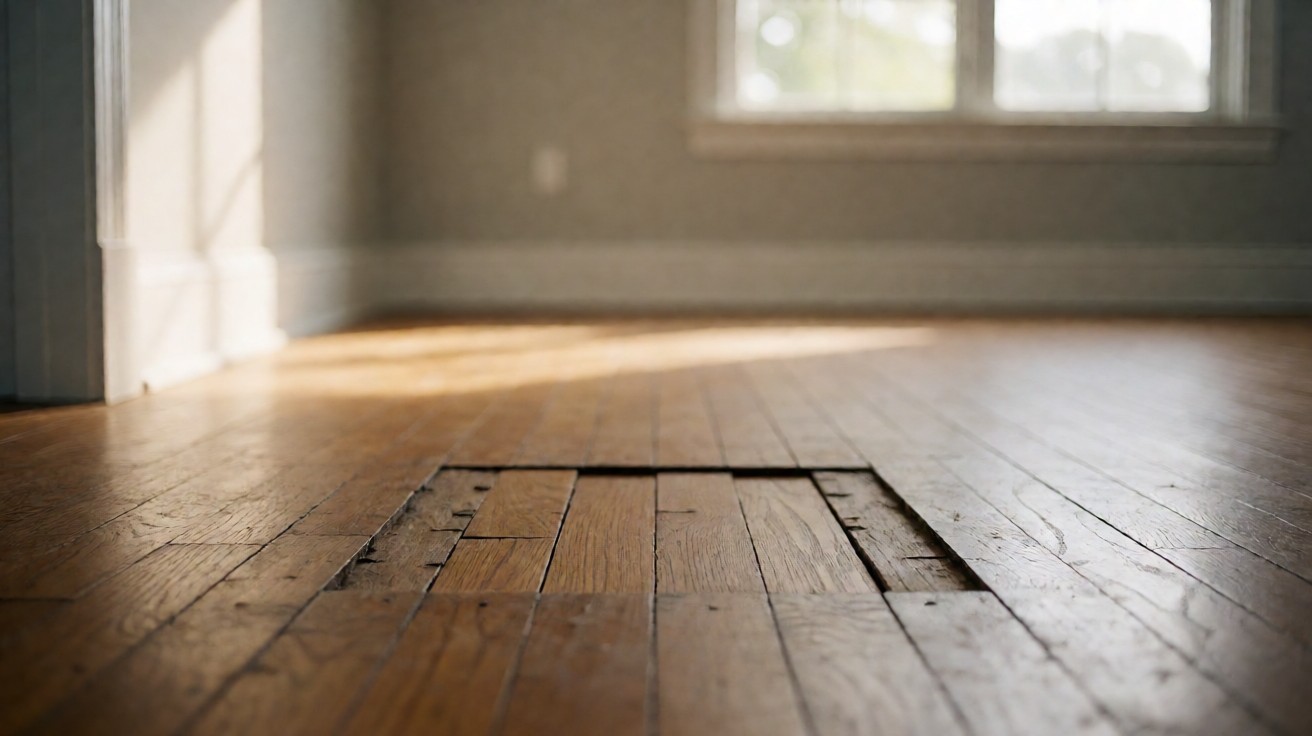

A leak has cupped two boards by the door, the dogs have scratched the finish in the hallway, and you are adding up what each fix would actually cost.
The answer is a fraction and a condition. Repair while the damaged area stays under about a tenth of the floor and the subfloor beneath it is dry, flat and firm. Take the whole floor out once damage passes a quarter of the area, or the moment the subfloor is soft.
The Decision Rule: Three Numbers That Settle It
A floor does not need an opinion. It needs three numbers measured on the day you look at it: how much area is damaged, what state the subfloor is in, and whether whatever caused the damage has stopped.
The fraction is the first test. Count the damaged area in square feet and divide by the total. If the damage sits in one or two places the fraction is small and repair wins. If it runs in a line or repeats in every room, it does not.
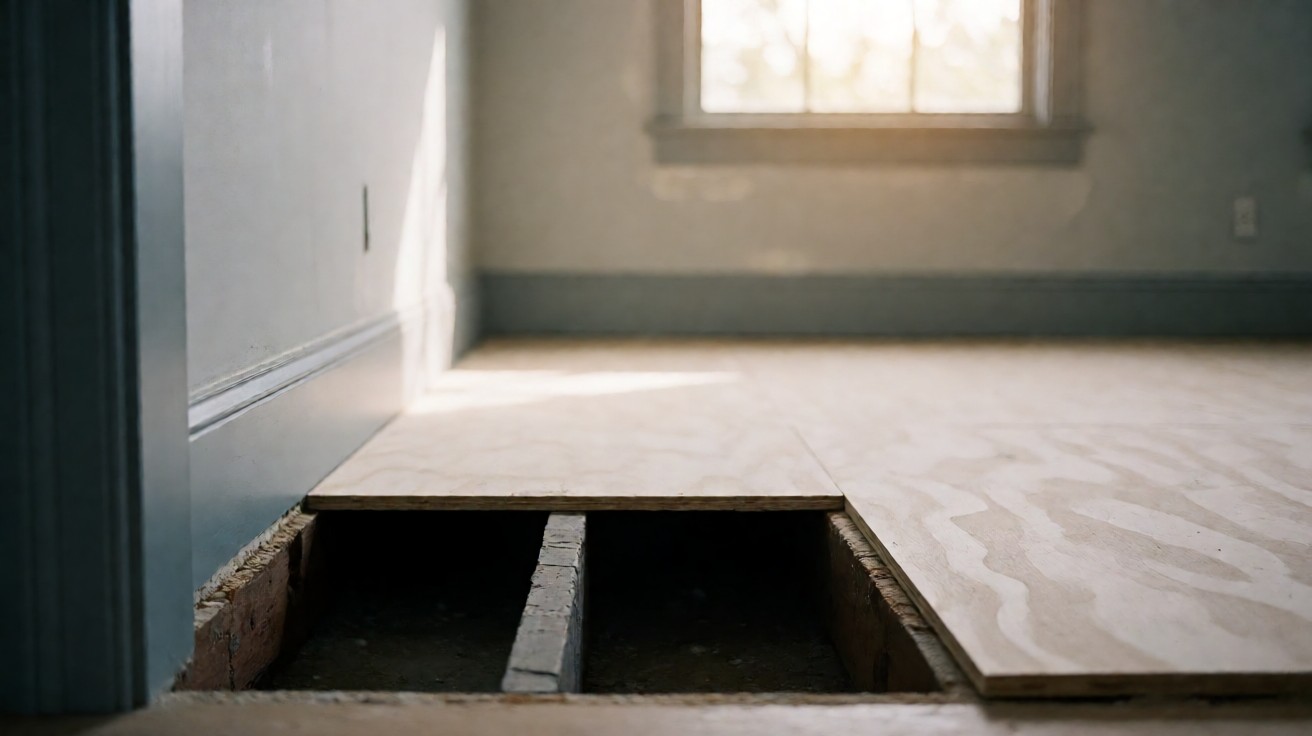
Subfloor second. Press hard along the damaged run with your weight on one heel. Solid resistance means the deck carries load as designed. A dull thud that leaves a footprint means the deck is soft, and every board fitted over it will move eventually.
Cause third, and this is the one people skip. If the leak has been shut off and the cavity dried out, you are repairing. If the dishwasher is still weeping into the subfloor, you are paying twice for the same floor.
Measurements, not impressions.
Where all three agree, the decision is easy to defend to a tenant, an agent or an insurer.
Repair Cost By Damage Type
Repairs are priced per event rather than per square foot, because a contractor charges for turning up. A one-board splice on hardwood runs 8 to 25 dollars a board including labour, and most trades carry a minimum service call of 150 to 400 dollars.
On carpet a seam repair or a re-stretch runs 60 to 200 dollars. On LVP, lifting two planks and resetting them runs 150 to 400 dollars, because the click-lock has to come up without chipping the edge.
On hardwood the number that decides it is not the board. It is the refinish. A spliced board will not blend into a finished floor until the whole room is sanded, and a sand-and-recoat runs 3 to 6 dollars a square foot across every square foot of the room, not only the damaged part.
| Damage type | Repair cost | Repairable | Replace instead when |
|---|---|---|---|
| Water in the boards | 8 to 25 dollars a board | Yes, if dry below 19 percent | The deck reads wet or sounds hollow |
| Scratch in the finish | 3 to 6 dollars a sq ft | Yes | Wear runs through to raw wood |
| Deep gouge | Board swap and blend | Yes, in solid wood | The wear layer is under 1.5 mm |
| Pet urine | Board swap and refinish | Sometimes | The tannin has blackened through |
| Impact damage | Board swap | Yes | The joist or deck is cracked |
| Deep stain | Bleach and recoat | Rarely | The stain reached the subfloor |
These are working ranges for a North American or UK market rather than a price list, and in most of them material is the smallest line. The material versus installed price breakdown shows why labour moves more than the board line ever does.
Replacement Cost By Material
Replacement is priced per square foot installed, and the number moves with material more than with room size. A 224 square foot room at 8 to 20 dollars a square foot for solid hardwood is 1,800 to 4,500 dollars of work on the floor alone.
| Material | Installed cost | What sets it |
|---|---|---|
| Solid hardwood | 8 to 20 dollars a sq ft | Thickness and species |
| Engineered hardwood | 7 to 16 dollars a sq ft | Veneer thickness |
| LVP, 20 mil wear layer | 5 to 8 dollars a sq ft | Wear layer in mils |
| Carpet | 3 to 8 dollars a sq ft | Pad density and dye lot |
| Removal and disposal | 1.50 to 4.00 dollars a sq ft | What is being lifted |
Removal is quoted separately almost every time, and it is priced by area for the same reason the rest of the job is. The removal and disposal cost guide carries the per-material breakdown; on this 224 square foot room it adds 336 to 900 dollars before a single new board arrives.
Water Damage And Why It Changes The Answer
Water is the one damage type where repair is almost never a local question, because water does not respect board boundaries. A supply line that ran overnight moves through the tongue and groove of every board it reaches, then pools in the cavity under all of them.
IICRC S100 sets the drying standard, and the number that matters is moisture content. Wood flooring put back down above 19 percent will cup as it finishes drying, so the reading has to be taken in the boards themselves rather than on the surface.
Drying a 224 square foot room with air movers and a dehumidifier runs 300 to 900 dollars for equipment and 2 to 5 days of monitoring. That is the price of the option that keeps the floor.
If the damage came from a leak and the leak is not fixed, repairing is spending money twice. If the water reached the deck and the deck is soft, every board you replace sits on a surface that will move under it.
What Makes A Floor Unrepairable, Not Merely Ugly
Ugly has a fix. Unrepairable does not, and the difference is usually one layer of material or one cause that is still running.
An engineered floor with a 1.5 mm wear layer cannot be sanded at all, because sanding takes the wear layer off and exposes the glue line beneath it. A deep scratch that reaches that layer is not a refinishing job. It is a plank replacement, and if the scratch goes through the face the plank is finished.
Pet urine is the other one. Urine reacts with the tannin in oak and the wood goes black, and that black is a chemical change in the fibres rather than a stain sitting on top of them. Bleach pulls the surface colour back and leaves the black underneath.
So the unrepairable list runs: no wear layer left to sand, tannin blackened through, mould in the cavity, an adhesive bond broken under a floating floor, a deck that will not carry load, and a cause that is still running.
If you are arguing with a landlord or an insurer, the argument is about whether the cause has stopped, not about whether the floor looks bad.
Matching An Old Board Years Later
This is where a repair stops being a carpentry problem and starts being a supply problem. A 15-year-old floor in a discontinued species and finish is in no current catalogue, and the board you eventually find will not match.
When it does match, the honest numbers are 4 to 12 dollars a board at a salvage yard and 30 to 80 dollars a board through a flooring distributor, plus a freight charge that often exceeds the boards. Nobody stocks one board.
The harder test is the finish rather than the timber. A 2005 oak floor and a 2025 oak board take polyurethane differently because the earlier one has oxidised. Sand the new board back a little and it still sits a shade lighter for the life of the floor.
Slip rating is the part of a finish change that is not optional. ANSI A326.3 measures a dry surface with a portable DCOF tester, and accessibility codes reference 0.42 for a level interior walking surface. A fresh patch with a glossier coat than the field around it can drop below that.
If you cannot match it, a board swap is still fine as long as you accept that it will read. Put the mismatched board where a rug or a cabinet goes.
The Subfloor Is Usually The Deciding Factor
A repair is a structure sitting on a structure, and the lower one has to be right.
ASTM F710 is the preparation standard for resilient flooring over concrete and it is specific about thresholds. The slab must be clean, sound and free of laitance, surface pH sits between 7 and 10, in-plane moisture stays under 5 pounds per 1,000 square feet in 24 hours, and relative humidity reads below 75 percent.
Those thresholds matter on a repair because a new plank bonds to whatever is under it. Skip the moisture test and the adhesive lets go between the first and third summer, and the failure shows up as a lifted corner rather than a floor that moves.
For a timber subfloor the same meter does the job. The NWFA moisture guidelines put interior wood flooring between 6 and 12 percent, with 19 percent as a hard ceiling rather than a target. If the deck reads high, dry the deck first.
A dip under the patch is a levelling question before it is a flooring question. A quarter inch dip across a 10 foot span is the dividing line between a patch compound job and a full pour, and the floor levelling cost guide prices both.
The Crossover Arithmetic, Worked Through
Take a 14 by 16 foot room, which is 224 square feet, finished in 3/4 inch solid oak. Replacement at mid-range is 10 dollars a square foot of material, 4 dollars of labour and 3 dollars of removal, so 17 dollars a square foot, or 3,808 dollars for the room.
The patch: 6 boards at 22 dollars each fitted and finished is 132 dollars. The room then has to be sanded to blend the new wood, at 4.50 dollars a square foot across 224 square feet, which is 1,008 dollars. Add the 150 dollar minimum service call and the patch lands at 1,290 dollars, about a third of the replacement price.
Now widen the damage. A 22 dollar a board patch against a replacement at 17 dollars a square foot, and an average 3/4 inch oak board covers about half a square foot. The crossover lands close to 120 boards, which is 56 square feet, or 25 percent of the room.
Under about a tenth of the floor area, repair is never a close call. Between a tenth and a quarter it depends on the finish and on whether a full-room refinish is happening anyway. Past a quarter, take the floor out.
Area, subfloor, cause, and a number.
Landlords And Tenants: What Habitability Requires
A landlord does not owe a tenant a floor that looks new. The obligation is habitability, and habitability is about safety and keeping weather out, not about finish.
In most jurisdictions that means the floor is structurally sound, presents no trip hazard, has no hole or soft spot a foot can sink into, and is not wet. A faded board, a colour difference between rooms and a scuff are none of those things.
So a patch that meets the habitability standard is defensible, and the defence is documentation rather than argument. Photograph the damage before and after, keep the invoice, keep the date, and note that the subfloor was checked.
What is not defensible is a patch over a known active leak, because the tenant can point at the next board that cups. Where the unit sits empty between tenants, taking the floor out is usually cheaper than arguing about it later.
Wear and tear is not a habitability failure. If the floor is old and tired and nothing is wrong with it, this is a capital decision, not a repair.
Insurance, Claims, And The Same Damage
The same water damage gets paid two different ways depending on why the water was there. Sudden and accidental, from a burst pipe or a failed supply line, is normally covered. A slow weep over months is often classed as wear, tear or deterioration, and is not.
Documentation is the whole game on a claim. Before anyone lifts a board, photograph the water source, the damaged area and a moisture meter reading. Afterwards, photograph the dry reading and the invoice. An adjuster can work from a meter reading, but not from a memory.
Mitigation is normally reimbursable even where the final claim is not. Stopping the leak and drying the floor is a duty rather than an admission of responsibility.
The other difference is scope. An insurer restores the property to the condition before the loss, not to a better one. If the old floor was eight-year-old carpet, the settlement pays for eight-year-old carpet, and the upgrade becomes a separate conversation paid out of your own money.
Replacing As An Upgrade, And The Waste It Creates
Sometimes the floor comes out anyway, and once the debris is out, changing material costs less than it did an hour ago. Removal labour is already paid, so the only new money is the difference between two material lines.
Dropping worn oak to LVP with a 20 mil wear layer on a rental is normally a straight saving, and it takes sanding out of the maintenance cycle entirely. Where the old floor was carpet, moving up to engineered hardwood is normally an addition rather than a saving.
The hardwood flooring cost breakdown and the LVP flooring cost breakdown set out the material and labour split for both, and the gap between them is where the upgrade decision lives.
On the environmental side, a 224 square foot hardwood floor is roughly 450 pounds of wood waste, and most of it ends up in landfill rather than a stream that will take engineered flooring. Weigh that against the carbon already spent manufacturing a replacement.
Replacing a floor is the right call when it is structurally necessary, not as a way to be greener, and a patch over a sound board beats a new floor on both counts at once. The exception is a floor being replaced anyway for a better reason, where the waste is a sunk cost you have already paid.
Where A Cheap Repair Quote Is A Trap
The trap is a per-board price with nothing around it. A quote of 22 dollars a board for six boards reads well against a replacement quote of 3,808 dollars, and it quietly excludes the refinish that makes the six boards match.
Four questions kill most of them. Does this include sanding and finishing the room. Is the subfloor being checked. Is the moisture reading on the deck under 19 percent. And is this the same labour rate as the replacement quote.
A second trap is a quote that never names the cause. If a contractor will not tell you where the water came from, they are pricing a symptom, and the symptom returns within a year at whatever the cause decides to do next.
The carpet installation cost guide carries the same warning in another material, where a cheap carpet quote excluding removal and disposal of the old carpet and pad is not cheaper at all. It is deferred.
A quote with no disposal line is the most common one of all. On paper it reads as an omission, and on the day it turns into a 150 to 300 dollar minimum charge nobody quoted.
DIY, Professional, And Comparing Two Bids Line By Line
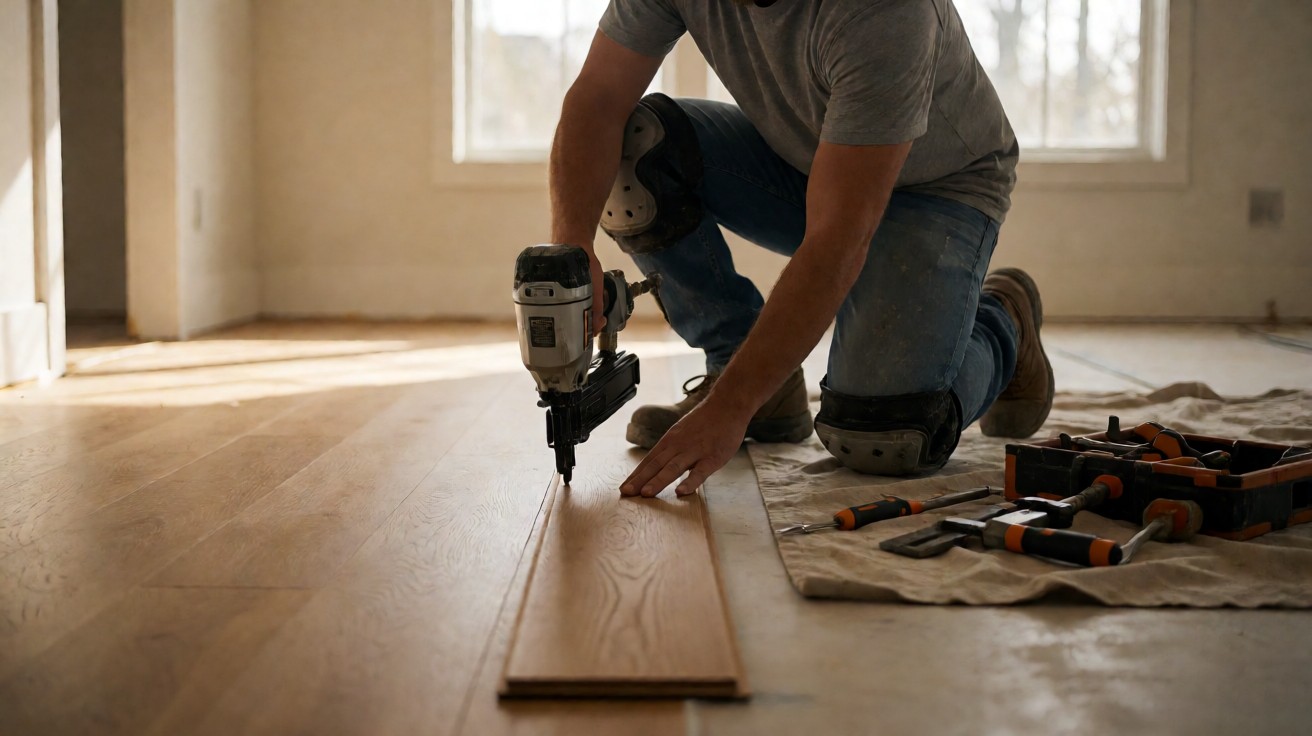
Patch a floor yourself when the damage is one board, the cause has stopped, and the subfloor below it reads dry and firm. Everything past that wants a floor nailer, a drum sander and liability cover.
Three checks before you lift anything: does the deck sound solid under a heel, does the meter read under 19 percent, and is the leak actually shut off at the source. If all three pass, a board swap is a weekend.
Then put the two bids on the same table. Line items, not totals.
| Line item | Repair bid | Replacement bid |
|---|---|---|
| Board or plank | 8 to 25 dollars each | Inside the material line |
| Room refinish | 3 to 6 dollars a sq ft | Not applicable |
| Subfloor check | 150 to 400 dollars | 1 to 4 dollars a sq ft |
| Moisture test | 40 to 120 dollars | Included |
| Disposal | 0 to 150 dollars | 150 to 300 dollars |
| Total on 224 sq ft | 600 to 1,500 dollars | 1,800 to 4,500 dollars |
Six lines, one labour rate, same subfloor allowance on both sides.
The comparison that carries weight is not repair against replacement in the abstract. It is one bid against the other on the same terms, so that a cheap line item has nowhere to hide.
Where the money is not worth spending: a 400 dollar colour match on a floor you will replace within three years, a 1,200 dollar refinish on a deck that still needs levelling, and a 600 dollar patch on a cause that has not stopped. Fix the cause, then price the floor.
Start with the fraction. Measure the damage, test the deck, confirm the cause is closed. Those three numbers will make the decision for you, and they will make it again on the next floor.