
Two stone quotes come back for the same 180 square foot kitchen, close to 4,000 dollars apart, and not one line on either sheet explains that gap.
The answer is that stone is priced by weight, by area and by cut rather than by piece. A 30 mm marble floor usually lands between 30 and 55 dollars a square foot installed, and the stone material itself is often less than half of that number.
Why Stone Is Priced By Weight And By Cut
A tile floor arrives as a count of identical pieces at a known thickness, so a supplier quotes it per piece and moves on.
Stone arrives as slabs cut from quarry blocks that were hundreds of tons before a diamond saw touched them, and every stage after that is priced off weight, area or cut length.
The consequence for a homeowner is that a stone quote and a tile quote are not the same kind of number.
The stone material is often 25 to 40 percent of the installed price, and what absorbs the rest is cutting, polishing, bed depth and the weight a crew has to carry through a doorway.
Before the money makes any sense it helps to know what the material actually is, so start with natural stone flooring explained.
What Each Stone Costs Per Square Foot
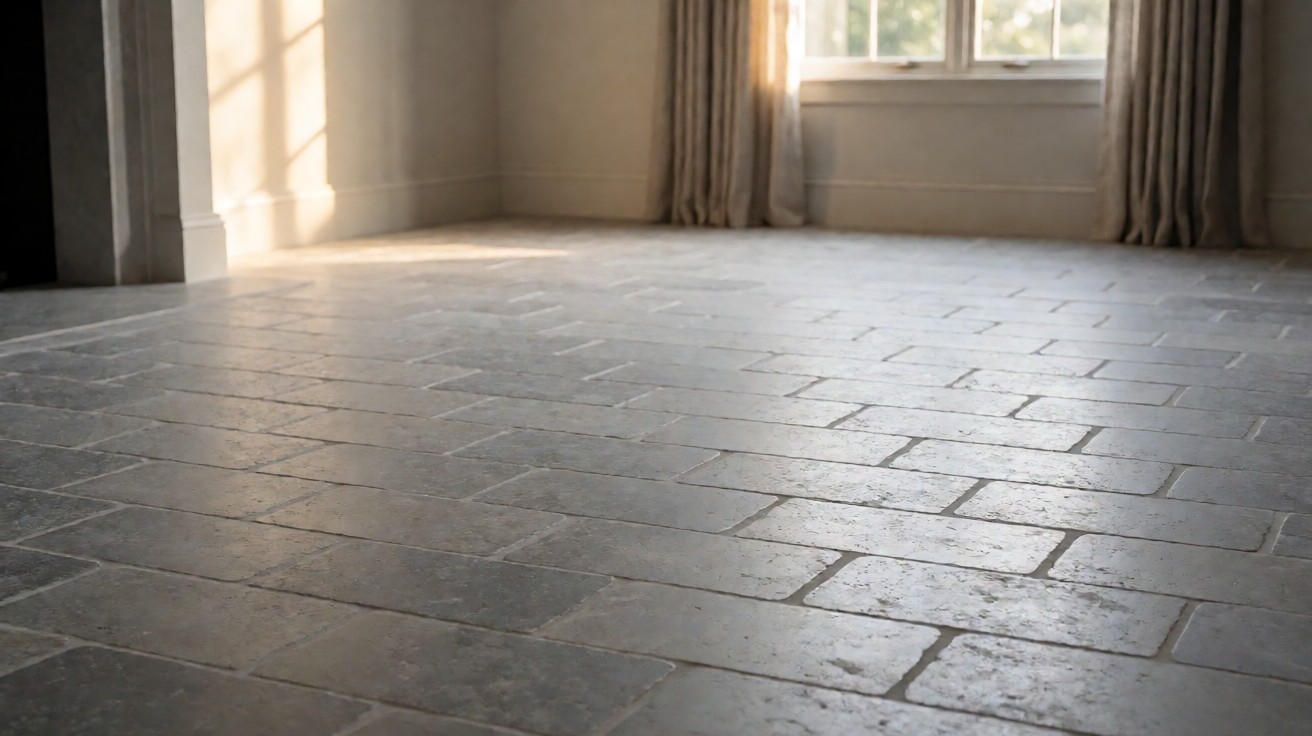
Six stones cover almost every residential quote: marble, granite, slate, travertine, limestone and quartzite. Five of them are set out for hardness, absorption and finish in marble granite slate travertine, and the price bands follow the same order as the density.
| Stone | Material per square foot | Installed per square foot | What moves the price |
|---|---|---|---|
| Marble | $12 to $30 | $30 to $55 | Polish grade, slab yield, import freight |
| Granite | $8 to $22 | $20 to $42 | Domestic supply, thickness, fabrication |
| Slate | $10 to $26 | $28 to $50 | Cleft faces, import freight, waste |
| Travertine | $7 to $18 | $22 to $40 | Filled or unfilled grade |
| Limestone | $9 to $24 | $24 to $45 | Fossils, thickness, distance to quarry |
Travertine and limestone sit low because the material is plentiful and cuts cleanly, but unfilled travertine absorbs 2 to 8 percent of its weight in water, and once sealing and wet-room preparation are priced in the gap narrows.
Marble carries the top of the range because polish is the finish most buyers ask for, and polishing happens after installation.
A honed marble floor sets for several dollars a square foot less than the same slab polished on site, and polished is the wrong choice where water regularly reaches the surface.
Granite holds a compressive strength under ASTM C170 that limestone never reaches, and that difference is already in the material price before a single hour of labour is counted.
Unless a room needs the stone to run wall to wall in one piece, granite usually gives the most surface for the money.
Where the floor is a laundry or a bedroom rather than an entry, the gap between granite and a mid-range marble rarely survives contact with daily life.
Where The Money Goes In An Installed Stone Floor
A stone quote is easiest to read when it is broken into lines, and most of the gap between two installers covering the same room is visible in four of them.
| Line item | Typical rate | Share of installed price |
|---|---|---|
| Stone material | $7 to $30 a square foot | 25 to 40 percent |
| Fabrication and cutting | $8 to $15 a square foot | 12 to 18 percent |
| Setting labour | $12 to $25 a square foot | 26 to 32 percent |
| Mortar and backer board | $4 to $8 a square foot | 8 to 12 percent |
| Sealer | $1.50 to $3.00 a square foot | 2 to 4 percent |
| Removal and disposal | $2 to $4 a square foot | 3 to 6 percent |
Take a 200 square foot kitchen in 30 mm domestic marble and rebuild the quote by hand. Material at 16 dollars a square foot is 200 times 16, which is 3,200 dollars, and 12 percent waste on a slab layout adds another 384.
Fabrication at 9 dollars a square foot is 1,800 dollars of cutting, polishing and edge work. Setting labour at 14 dollars a square foot is 2,800, mortar and backer board at 5 dollars a square foot is 1,000, and sealer at 1.50 dollars a square foot is 300.
The total is 9,484 dollars, or 47.42 dollars a square foot installed. Material is 38 percent of it, and fabrication plus setting labour is 49 percent, which is where to argue when a quote feels high.
Thickness is where stone fights the specification. MIA, the Marble Institute of America, publishes dimensional tolerances for slab and tile because quarries cut stone to a minus tolerance, so a slab sold as 20 mm can arrive at 18 mm at its thinnest point.
The bed then gets set to the stone that actually arrived rather than the stone on the order, and shimming a bed for 18 mm stone costs labour somebody has already quoted by the hour.
Domestic And Imported Stone, And What The Difference Buys
Most domestic stone comes from quarries in the Northeast, the Southeast and California, and it reaches a job by truck. Imported stone pays ocean freight, customs handling and inland trucking first, and it routinely quotes 20 to 40 percent above the domestic equivalent of the same thickness and finish.
The premium buys consistency rather than beauty.
One imported lot can still be matched years later for a repair, and the thickness and finish stay uniform because the same block is being cut.
Where the gap runs 30 dollars or more a square foot, that money spent on a better fabricator usually buys more for the floor.
Unless the stone is unavailable in the domestic market, an import premium is hard to defend.
Small rooms narrow the case as well, since freight spreads over fewer slabs. If the quote arrived without a country of origin or a named quarry, that is the first question to ask.
Seams: Why They Exist And What Each One Costs
A slab is limited by the size of the block that came out of the quarry, usually around 5 by 10 feet.
A 12 by 14 foot kitchen at 168 square feet needs four slabs once 12 percent waste is added, and a layout that size leaves five to seven seams running across the floor.
Seams are arithmetic rather than a defect, and they cost real money. Fabricators charge 8 to 15 dollars a linear foot for a seam, so a 40 foot run of joints is 320 to 600 dollars before anybody counts the colour matching.
Every seam is also a place where a slab can move, crack or settle.
That is why slabs get numbered, dry-laid in the room and fitted in one sequence. A full dry layout adds most of a day of labour, commonly 600 to 1,200 dollars, and it is the first line a cheap quote leaves out.
Slab Or Tile: The Labour Difference
Weight changes the crew.
A 12 by 12 inch tile of 30 mm marble weighs about 17 pounds, a 2 by 2 foot piece cut from the same slab weighs about 66 pounds, and a 5 by 10 foot slab runs to roughly 830 pounds.
Slabs arrive on an A-frame or a crane rather than over a shoulder, which is why the setting crew costs more per day.
Stone tile commonly sets for 8 to 16 dollars a square foot, and slab installation runs 12 to 25 dollars a square foot because of the bed, the handling and the seams.
Ceramic tile sits lower again, and the difference is broken down in tile installation cost.
If the room is under about 150 square feet, tile can cost less than slab once seams are counted.
In a small bathroom where a full slab is impractical, tile is usually the sensible answer. Above that size, or where the pattern has to run continuously, slab is the only way to get one piece of stone across the floor.
Sealing, Absorption And The Wet Room Question
Absorption decides which stone belongs in a wet room.
ASTM C97 is the test used for absorption and flexural strength, and the working threshold installers use is 0.5 percent by weight: below it a stone is generally acceptable where water lands, above it the stone drinks and gives it back.
Granite and most marbles test under 0.5 percent. Travertine, limestone and most sandstone sit between 2 and 8 percent, which makes sealing compulsory in a shower and means the tile has to be bedded differently to let water drain.
Slip resistance is the other half. ANSI A326.3 measures the dynamic coefficient of friction, and the figure accessibility codes reference for a level interior surface is 0.42.
A polished marble floor can read above that dry and below it wet, so polished stone in an entry or a shower is a slip question and not only a look.
Honed or textured stone is the safer answer where water reaches the surface.
Sealing costs 1.50 to 3.00 dollars a square foot for the first coat, and a gallon covers 300 to 500 square feet, so a 200 square foot floor uses one gallon and leaves most of it in the container.
Re-sealing is a recurring line rather than a one-off.
Marble and travertine usually need it every 12 to 24 months, and honed granite every 24 to 36 months.
On a 200 square foot floor at 2 dollars a square foot every second year, that is 200 dollars a year, or roughly 17 dollars a month across the life of the floor.
Over A Concrete Slab Or Over A Wood Subfloor
Where a stone floor runs over a concrete slab, the job is preparation.
The slab has to be flat within 1/8 inch over a 10 foot span, cracks get filled, and a primer goes down before the mortar bed.
Grinding and levelling adds 2 to 5 dollars a square foot, and that is the line most often left as an estimate.
Over wood the job becomes structural as well as technical. A 30 mm marble floor is about 17 pounds a square foot and the mortar bed adds roughly 8 more, so the finished floor puts about 25 pounds a square foot of dead load on the framing.
Unless the joists are doubled and the subfloor is 3/4 inch plywood, that load deserves a structural opinion before the first slab is cut.
Where framing has to be rebuilt it adds 3 to 6 dollars a square foot, which is small next to a floor that has to come back out later.
Where A Stone Quote Hides Money
Waste is the first hiding place. A slab layout carries 12 to 15 percent waste while the same stone sold as tile carries 8 to 10 percent, and the difference is real because slab offcuts are too small to sell back.
Then come the lines nobody itemises.
A second delivery for stone that did not fit the first load runs 150 to 400 dollars, and bullnose or mitered edge processing adds 6 to 18 dollars a linear foot.
A stainless threshold runs 150 to 400 dollars installed, and disposal runs 2 to 4 dollars a square foot when an old floor has to come up.
If a second piece of stone is ever needed, a matching slab from the same lot is worth more than the discount on the original, so specify that a duplicate is set aside. If the quote does not allow for it, the saving has already been spent.
Measure the room properly rather than trusting a drawing before comparing two quotes, and the square footage calculator turns a rough dimension into the waste figure a fabricator will use. If two bids are based on different areas, the comparison is meaningless before the prices are even read.
DIY Versus Professional: Why Stone Is The Least Forgiving Floor
Stone is the hardest floor a homeowner can attempt.
Cutting needs a wet saw and a diamond blade, a dry cut chips the edge, and a chipped 30 mm slab is a scrapped slab rather than a re-cut one.
Expect 5 to 10 percent breakage on a slab job, and the material cost leaves with it.
Setting needs a bed level in both directions and slabs dry-laid and numbered before the first one is bedded. Where the floor sits over wood there is a structural question on top of everything else, and failure shows up months later as a cracked slab or a hollow joint.
The work worth doing yourself is the part with no stone attached.
Demolition and disposal runs 2 to 4 dollars a square foot, and clearing the room is easy money.
Once a slab is on site, the cost of an error is high enough that a professional crew is the cheaper half of the decision.
Comparing Two Stone Quotes Line By Line
Two quotes are comparable only once they sit on the same basis, and the basis is the slab rather than the total. Put the same lines on both sheets before reading any price.
| Line to check | Question to ask | Red flag |
|---|---|---|
| Stone | Name, thickness, quarry | “Similar marble”, no thickness |
| Waste | 12 percent included? | Area taken from a drawing |
| Fabrication | Per square foot or per slab? | One total, no cut detail |
| Seams | Count and price per foot? | Seams not mentioned |
| Subfloor | Levelness check included? | Prep assumed, no number |
| Sealer | Product and coverage rate | “Sealed” with no price |
| Change orders | Rate for hidden conditions | No clause at all |
If the two quotes differ by more than 15 percent after that normalisation, the difference is usually one of four things: thickness, waste, seam count or who does the fabrication. Ask which one changed before deciding that one installer is charging more for identical work.
Material price and installed price are different numbers and the gap between them is the room. The split is set out in material versus installed price, and a quote listing only material per square foot has not answered the question a homeowner is actually asking.
Where The Money Is Not Worth Spending
Bookmatched slabs in a 40 square foot powder room, 30 mm stone on a bedroom floor where 20 mm is structurally sufficient, or imported stone in a laundry all cost more without changing anything the household touches.
The premium buys a finish in a room where nobody stands still long enough to see it.
If a budget stops where this one stops, the alternatives are compared in flooring types compared, and a porcelain or ceramic floor at 8 to 20 dollars a square foot installed handles the same wet rooms and the same traffic for a fraction of the money.
Where a stone floor is being cut back rather than abandoned, take the saving on the stone grade and keep the money on preparation, fabrication and the fabricator. A cheap slab laid badly fails in three years, and a mid-range slab laid well still looks like the same floor in a decade.