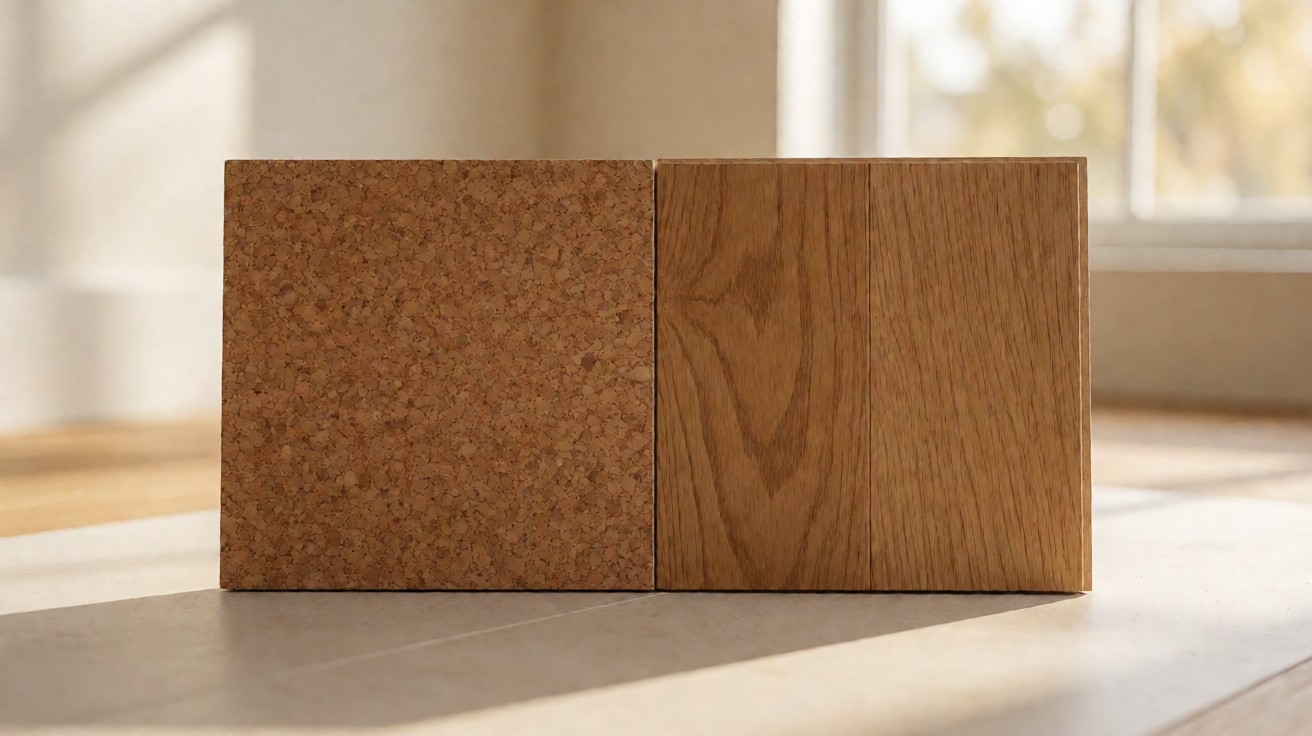

Cork and hardwood are opposites in nearly every property a buyer cares about, and the difference that decides where each belongs is not the one buyers expect. The one most people miss is damage. Cork is soft enough to absorb an impact and recover, and hardwood is hard enough to resist an impact and keep the dent forever. That single physical property decides cork in a bedroom and a child’s room, and hardwood in a hallway and a dining room, and it decides the resale conversation differently again.
What Each Material Actually Is
Hardwood is milled timber. Solid hardwood is one piece from the trunk, engineered hardwood is a hardwood veneer over cross plied plywood, and both respond to moisture by swelling and shrinking and both can be finished and, in the right conditions, refinished. The hardwood guide covers both constructions.
Cork is the bark of the cork oak, harvested without cutting the tree down, which makes it one of the few genuinely renewable building materials. It is compressed into blocks or granulated and bonded, and the granulate form is the common residential product. It is sold as tiles, planks, and sheets, and it is finished the same way wood is finished. The cork page covers the material in depth.
Warmth, Sound, and What You Walk On
Cork is one of the warmest common floorings. It has a very low thermal conductivity for a hard surface, which means a bare foot on cork in January is a fundamentally different experience from a bare foot on tile or even on hardwood, and rooms over slabs feel warmer under cork than under almost anything else.
It is also quiet. Cork has an open cellular structure that damps footfall, and cork underlayment is used beneath hardwood for exactly that reason. The carpet versus hardwood comparison covers the other soft-versus-hard decision in more depth.
How Damage Works, and Why It Decides the Room
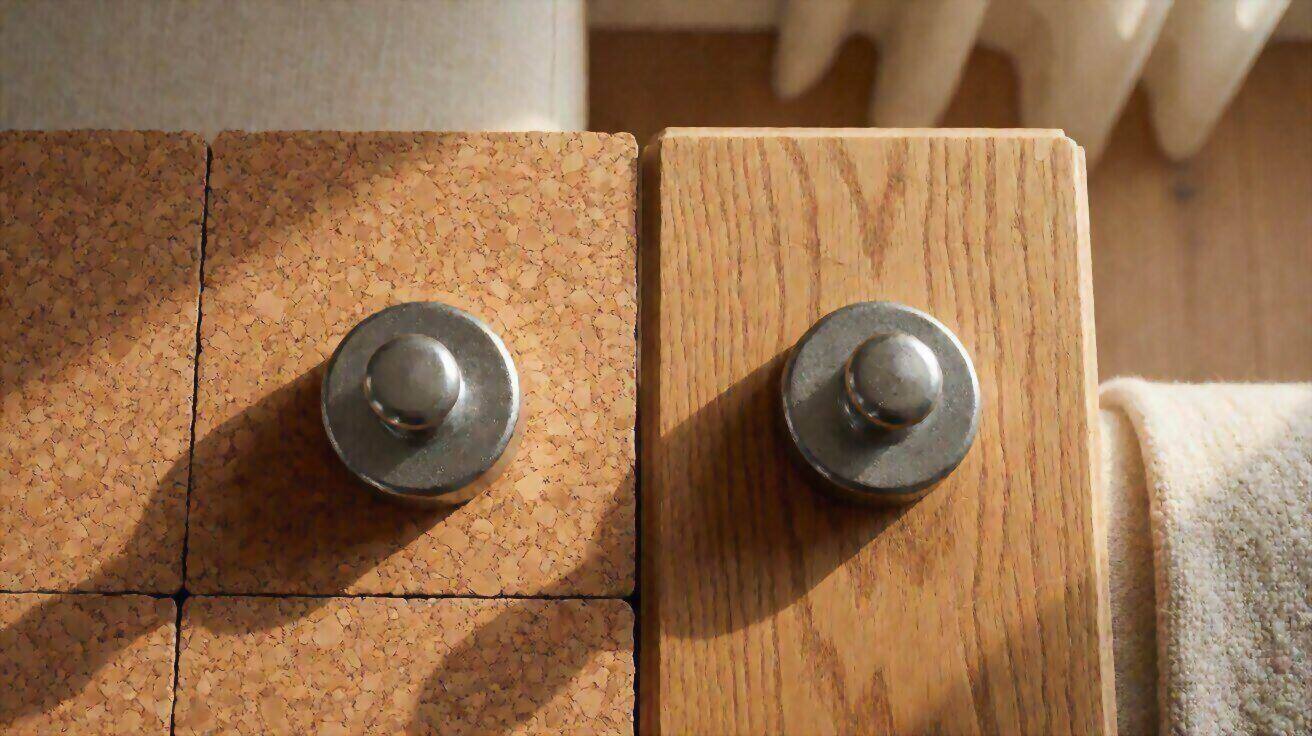
This is the axis that matters most and it runs opposite to the expectation. Hardwood is the harder material and resists the initial impact, but a dent in wood is permanent because the fibres have crushed and there is nothing to push them back out. Cork is the softer material and takes the full impact, but it compresses elastically and recovers, so the same load leaves a dish that is gone by the next morning.
The consequence is a room decision. In a hallway, a dining room, or an entryway, hardness wins because the traffic is concentrated and the objects dropped are hard. In a bedroom, a playroom, or a room where someone walks with bare feet all day, cork wins because nothing ever gets crushed and nothing gets scuffed in a way that marks permanently.
Water and Where Each One Belongs
Neither material belongs in a wet room. Cork has the higher water resistance rating of the two because its granules are sealed inside the binder and it does not wick, and a good cork floor tolerates a spill that has been left for an hour. It does not tolerate a flood, and it should not be specified in a shower or a wet room.
Hardwood is more vulnerable to standing water because timber moves with moisture, and a board that has taken water into its edge will cup and will not return to flat when it dries. A finished cork floor over a properly prepared subfloor can go in a kitchen. A hardwood floor in a busy kitchen can go in as well, with a good finish and an acceptance of the risk. Neither is a wet room product and the difference between them is one of degree rather than of kind.
| Situation | Better Choice | Reason |
|---|---|---|
| Bedroom or quiet room | Cork | Warmest, quietest, and nothing marks |
| Child’s room or playroom | Cork | Impacts compress instead of denting |
| Living room with a sofa | Cork | Furniture legs and barefoot traffic |
| Hallway or entryway | Hardwood | Concentrated traffic and dropped objects |
| Dining room | Hardwood | Chair legs and hard dropped items |
| Home office or study | Cork | Roller chair wheels and long hours standing |
| Kitchen | Either, with care | Cork tolerates spills better than wood |
| House held 25 years or more | Hardwood | Cork is refinishable once at best |
Where Cork Genuinely Loses
Cork has three real weaknesses and they are not small. The first is edge and corner damage: a cork tile that gets chipped at an exposed corner cannot be filled the way a gouged hardwood board can be sanded and filled, and a chipped tile is replaced or lived with. The second is the finish, which wears unevenly in a traffic lane because the surface is granular and the high spots take the coating first. The third is availability, and it is a practical problem rather than a material one: a spare cork tile in a matching batch is much harder to source years later than a spare hardwood plank offcut.
None of those make cork a bad floor. They make it a floor for rooms where those three things matter less than warmth and quiet, which is exactly how the rest of this comparison resolves.
Durability, Maintenance, and Refinishing
Hardwood can be sanded repeatedly. Cork generally cannot. A cork floor can be recoated or rescreened depending on the finish, and a good cork floor can sometimes be refinished once, but the granular surface means a full sanding can chew into the granules. This is the same argument that separates engineered from solid hardwood, applied between two very different materials.
Maintenance favours cork. Cork is finished with the same polyurethane, urethane, or wax systems used on wood, it accepts a damp mop, and it needs nothing beyond routine cleaning. A sealed hardwood floor needs the same. The practical difference is that cork hides wear rather than showing it, because a compressed and recovered area looks exactly like the surrounding surface and a scuffed area in hardwood stays scuffed.
Installation and What It Commits You To
Cork tiles glue down directly and are laid in a staggered pattern, which means the layout has to be planned around the room and the installer has to work from a centreline. Cork planks can be floated over an underlayment, and that is the easier installation in an occupied house. Neither is a first project; a good cork tile job needs a full spread and the tiles have to be rolled.
Hardwood cannot be laid over an existing floor. It needs a flat exposed subfloor and a nailer or an adhesive depending on the construction, and a solid board is the slower of the two. Cork plank over an existing floor is the only version of either material that can be installed without demolition, which is a genuine advantage worth more than the material price in a renovation.
Cost and Value Over Time
Cork material and installation commonly runs $8 to $16 per square foot and hardwood $6 to $15 installed, so the two are close and the invoice is not where this comparison is decided. Cork is usually a little more expensive per square foot and noticeably more expensive per usable foot in a small room, because cork tiles carry waste and a repair tile is harder to source than a plank offcut.
Over a long hold the two separate. A hardwood floor in a hallway can be resanded twice and outlives the building around it. A cork floor in the same hallway is a twenty-year floor. The solid versus engineered hardwood comparison covers the refinishing question in the hardwood family in detail.
Appearance, Colour, and Matching a Floor
Hardwood has an enormous range of colour and grain because there are hundreds of species and every board differs. Cork is a much narrower palette, mostly in the tan and warm brown range, and it is more uniform between tiles. A room built around a very pale or very dark floor is easier to achieve in hardwood; a room that wants warmth and a slightly rustic read is easier in cork.
Matching an extension to an existing floor is the practical version of the same question. Hardwood can be matched reasonably well by species and stain, and a good installer blends new boards into an old floor. Cork is far harder to match once installed, because the tiles fade with light exposure at a different rate and a later batch will not blend seamlessly. Anyone extending either floor should buy enough material for the whole job at once.
Acoustics and the Room Below
Cork wins here and the margin is real. Its cellular structure damps impact sound measurably better than hardwood over the same assembly, which makes cork a genuinely good choice for a bedroom over a living room or for an apartment where neighbours are a factor. It is not carpet quiet by a wide margin, but it is a clear improvement over any hard wood floor.
The airborne sound comparison is closer. Sound travelling through the floor structure is dominated by the assembly and the subfloor rather than the finish, so a good resilient underlayment under hardwood closes most of what is left. Cork helps most where the problem is footfall rather than conversation.
| Dimension | Cork | Hardwood |
|---|---|---|
| Material | Granulated bark of the cork oak | Milled timber |
| Warmth underfoot | Warmest common hard floor | Cool |
| Impact response | Compresses and recovers | Resists, then dents permanently |
| Impact sound | Best among hard floors | Good with an underlayment |
| Water tolerance | Better of the two, still not a wet room | Cups if water reaches the edge |
| Refinishing | Recoat, occasionally one sand | Repeated full resands |
| Over an existing floor | Yes, in plank form | No |
| Hides wear | Yes | No |
| Typical service life | 15 to 25 years | Life of the building with resands |
What Buyers and Resale Markets Read
Hardwood is universally recognised as a premium floor. Cork is recognised as a flooring, but as a speciality one, and a buyer unfamiliar with it will sometimes read it as a cheap substitute rather than as a distinct material with its own reasons. That perception is the same effect described in the bamboo versus hardwood comparison, and it is worth pricing into the decision.
Against that, cork does something hardwood cannot in a listed house: it looks like a considered material choice rather than a default. In a house where the floor reads as a deliberate choice rather than a default, that perception reverses. It is a weaker effect than the hardwood premium and it is not something to base an investment on.
Sustainability, Briefly and Honestly
Cork is harvested from the bark of the cork oak without felling the tree, and a tree can be harvested repeatedly on roughly a nine to twelve year cycle for more than a century. That is a genuinely strong sustainability case and it is the reason cork is used in tightly sealed applications as well as flooring.
It should not be oversold. The binder, the finish, and the adhesive in a glued installation are all conventional, and a floor that lasts twenty-five years in a room where hardwood lasts a century has not conserved much over its life. The environmental argument is strongest where cork replaces a material with a shorter life in a room that suits it, and weakest where it replaces a hardwood floor in a room hardwood would have suited.
How to Choose Between Them
Choose cork in a bedroom, a playroom, a child’s room, a home office, or anywhere the priority is a floor that is warm, quiet, and unmarked rather than one that resists. Choose hardwood in a hallway, an entryway, a dining room, a living room in a formal sense, or anywhere the house will be held for more than twenty-five years.
The mistake in either direction is choosing on feel alone. Cork chosen for a hallway looks soft and inviting in the showroom and wears into a visibly uneven surface at the traffic line, and hardwood chosen for a child’s room shows every scuff and dent at exactly the age when nobody wants to. The floor that hides wear is the right floor for a busy soft room, and the floor that takes wear gracefully is the right floor for a hard room.