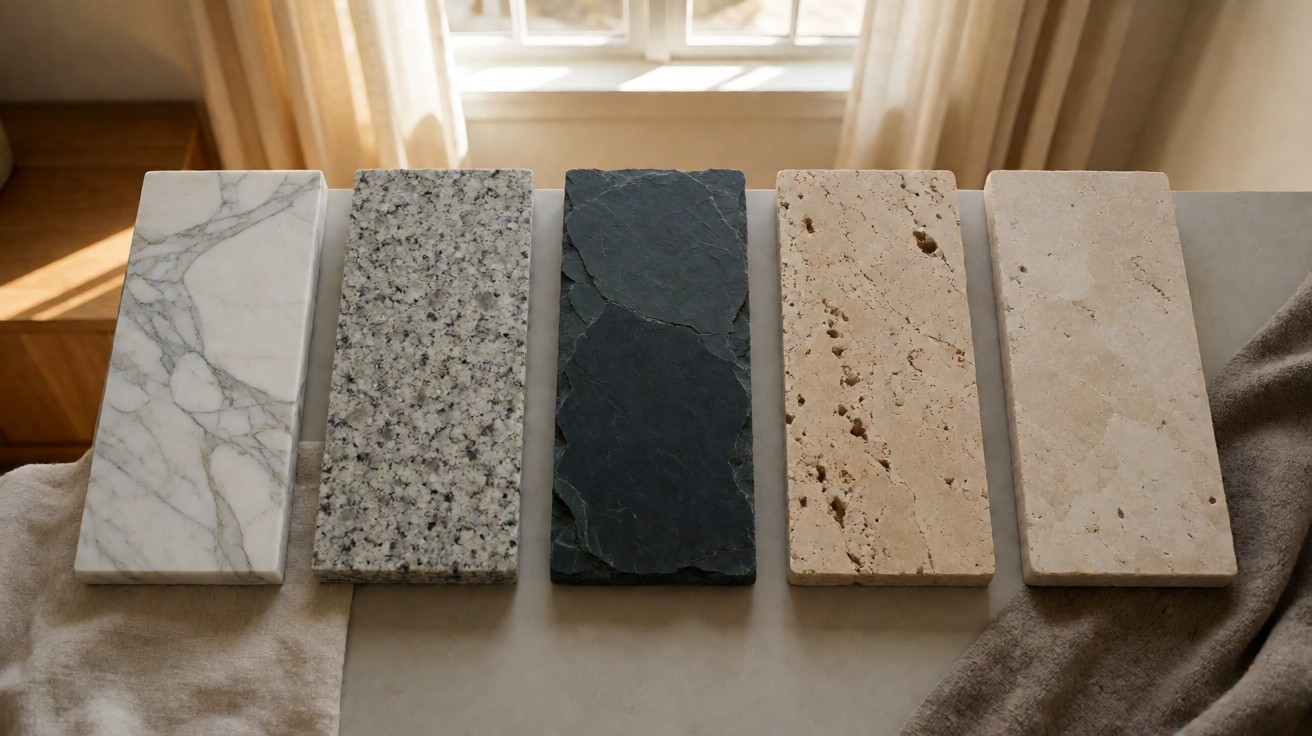

Natural stone flooring is one of five common materials sold under the same label, and the specific stone you pick changes how the floor ages and weathers.
Stone floors cost more than any tile floor and last longer than almost every other option, but the gap is wider than people expect. A marble floor and a slate floor are both called natural stone and they share a price range, and they behave nothing like each other in a kitchen, a bathroom, or a hallway.
The five stones sold most often as floor tile are marble, granite, slate, travertine, and limestone, and each one has a different mineral composition, a different porosity, and a different behavior under traffic and water.
This guide walks through each one in turn, then makes the practical decision about which is suitable for which room. For the cross-material comparison against porcelain or ceramic, the natural stone versus porcelain tile page covers it, and the tile flooring guide sits above both as the umbrella. For the day-to-day maintenance, the how to clean natural stone floors page is the reference.
What a Stone Floor Is, At the Material Level
Natural stone is rock, cut and finished into tiles. That is the whole difference from a porcelain or ceramic tile, which is a manufactured clay body pressed into shape. The mineral composition of the rock decides almost everything about how the floor behaves, and the finish on the tile decides how it looks in use.
Three properties matter most for choosing between stones. The hardness is the resistance to scratching and abrasion. The porosity is how much water the stone absorbs, which decides whether it can sit in a bathroom and how it reacts to a spill.
The acid sensitivity is whether the stone reacts to a drop of lemon juice or a splash of vinegar, which decides whether it survives a kitchen. Each stone has a different combination of those three numbers, which is why no single one is the right choice for every room.
The practical advice is to start by ruling out the stones that are wrong for the room, then narrowing among the survivors. Marble is wrong for a kitchen because of acid sensitivity.
Sandstone and limestone are wrong for an entryway because of porosity. Slate or granite handles most residential rooms, with marble reserved for a bathroom or a low-traffic formal room where the patina is part of the look.
Marble
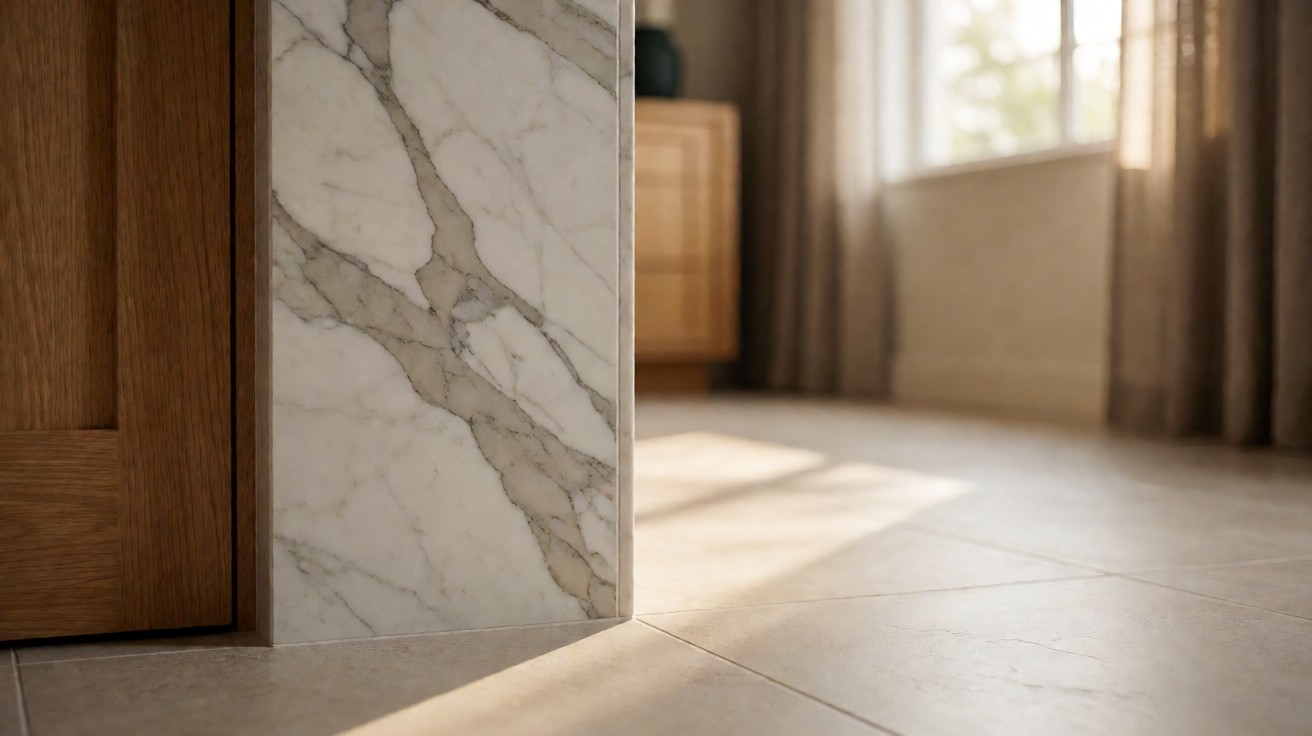
Marble is metamorphosed limestone, which means it started as a sedimentary rock and was transformed by heat and pressure into a denser crystalline material. The pattern people recognise as marble is the way the recrystallised calcite catches light, and the swirl is not paint: it is the geology of the slab.
What this means in a house is two things. First, marble is a relatively soft stone compared to granite, and it scratches under traffic. Second, marble is calcium carbonate, which reacts chemically with acids, so a drop of lemon juice, vinegar, or red wine leaves a permanent etch mark unless it is wiped immediately and the stone has been sealed.
That combination makes marble a luxury surface rather than a workhorse. It is the right answer for a foyer, a bathroom, a primary suite floor, or anywhere the room is seen rather than used.
It is the wrong answer for a kitchen and a hazardous answer for an exterior patio in a wet climate. With sealing every 12 to 18 months and an understanding that it will patina, it can last for generations.
Granite
Granite is the hardest stone on this list, an igneous rock formed from cooled magma, and its mineral content is mostly quartz and feldspar with smaller amounts of mica and other minerals. The visual variety comes from those minerals, and the speckled or layered pattern is what distinguishes granite from the other stones.
What this means in a house is that granite is close to scratch-proof, takes heat without damage, and absorbs very little water. A granite kitchen floor is genuinely workable, a granite entry handles mud and grit, and a granite bathroom holds up to water indefinitely.
The flip side is that granite does not look like the marble a luxury kitchen might be after. It is more speckled, more uniform, and harder to scratch, but the surface reads less romantic.
A honed or leathered finish softens the look. Granite is also the heaviest stone to ship and one of the more expensive, although it is still cheaper than marble in most markets.
Slate
Slate is a metamorphosed sedimentary rock formed under pressure, and it has a layered structure that allows it to be split into thin tiles with a natural cleft surface. The cleft is the visual cue: slate tiles are not perfectly flat, they have a slightly rippled surface that catches light unevenly.
That texture is what makes slate both appealing and slightly awkward in a home. It is genuinely slip-resistant, which is why slate is the stone often installed on patios and pool decks.
Inside, the texture reads as character in a foyer and a kitchen, but it also collects dust and is harder to clean than a polished stone. A honed slate is smoother and easier to live with, but it loses the look that made slate slate.
Slate is dense and absorbs very little water when sealed. It handles a kitchen, a bathroom, and an entryway, and a slate floor that gets reasonable maintenance will outlast the house it was laid in.
Travertine
Travertine is a sedimentary limestone deposited by mineral springs, and what makes it distinctive is the network of small holes and voids that survive in the finished tile. Travertine tiles are sold in two forms: unfilled, which leaves the surface pitted and is genuinely textured, and filled, where the voids are filled with cement or resin and the surface is ground flat.
Travertine is lighter in colour than most stones, often cream or beige with subtle banding, which gives it a warmer feel than marble or granite. It is also softer and more porous than marble, which makes the unfilled form painful to live with and the filled form workable only in dry, low-traffic rooms. A travertine kitchen floor requires patience and a sealing schedule.
The honest read is that travertine is a warm-climate stone. It is common in the Mediterranean and the American Southwest because it tolerates the climate, and it is less common in northern markets because the sealing and the softness are a poor match for wet boots and road salt.
In the right room with realistic expectations, it ages beautifully. In the wrong room, it stains within a year.
Limestone
Limestone is sedimentary calcium carbonate, and it is broadly a softer, more porous, more neutral cousin of marble. Limestone tiles are typically pale cream to beige, sometimes grey, and they lack the dramatic veining of marble. Many limestone floors are technically a marble if they have undergone metamorphism, which is why the two stones sometimes blur at the supplier.
In a house, limestone behaves like the brother of marble that is more porous and less reactive. It absorbs water more readily, so a limestone bathroom needs a sealing that is kept up to date.
It does not etch from acids the way marble does, because the surface is denser and less crystalline, but it is still calcium-based and will react to strong acids. It scratches more easily than granite.
Limestone is the right answer in a living room or a bedroom, where the soft tone suits the colour palette and the traffic is low. It is the wrong answer in a kitchen and a risky answer in a wet bathroom. With sealing every 12 to 24 months and an honest assessment of the room, it lasts for decades.
The Five Stones Side by Side
| Stone | Hardness (Mohs) | Porosity | Acid sensitivity | Best room | Worst room |
|---|---|---|---|---|---|
| Marble | 3 to 5 | Low to moderate | High | Bathroom, formal room | Kitchen |
| Granite | 6 to 7 | Very low | None | Kitchen, entry, bathroom | None |
| Slate | 3 to 5 | Very low when sealed | None | Kitchen, entry, exterior | Formal room (visual mismatch) |
| Travertine | 3 to 4 | High | Moderate | Sunroom, warm climate | Kitchen, wet bathroom |
| Limestone | 2 to 4 | Moderate to high | Moderate | Bedroom, formal living | Kitchen |
The table is the shortcut. If the room is a kitchen or an entry, the answer narrows quickly to granite and slate. If the room is a bathroom, all five can work with sealing. If the room is a formal living room, the answer opens up and the choice is visual.
Finish and How It Changes the Stone
The finish on a stone tile changes both the look and the behavior, and a polished granite floor and a honed granite floor are not interchangeable.
Polished is the highest gloss and the most reflective. It is the finish usually associated with marble in luxury installations. It shows scratches, particularly in dark stones, and it is the most slippery when wet. Honed is matte or low-gloss, smoother than the stone natural surface but not reflective.
It is the most forgiving finish in a kitchen or an entry, because it hides wear and is more slip-resistant. Leathered is a textured finish that retains some of the natural cleft and adds depth to the colour. It is more modern in feel and works on granite, marble, and some slates.
The finish also changes the porosity reading. A polished stone is slightly less porous than a honed stone of the same material, because the polishing closes the surface pores. The difference is small and sealing handles it, but the finish is part of the maintenance plan.
How to Read a Stone Sample
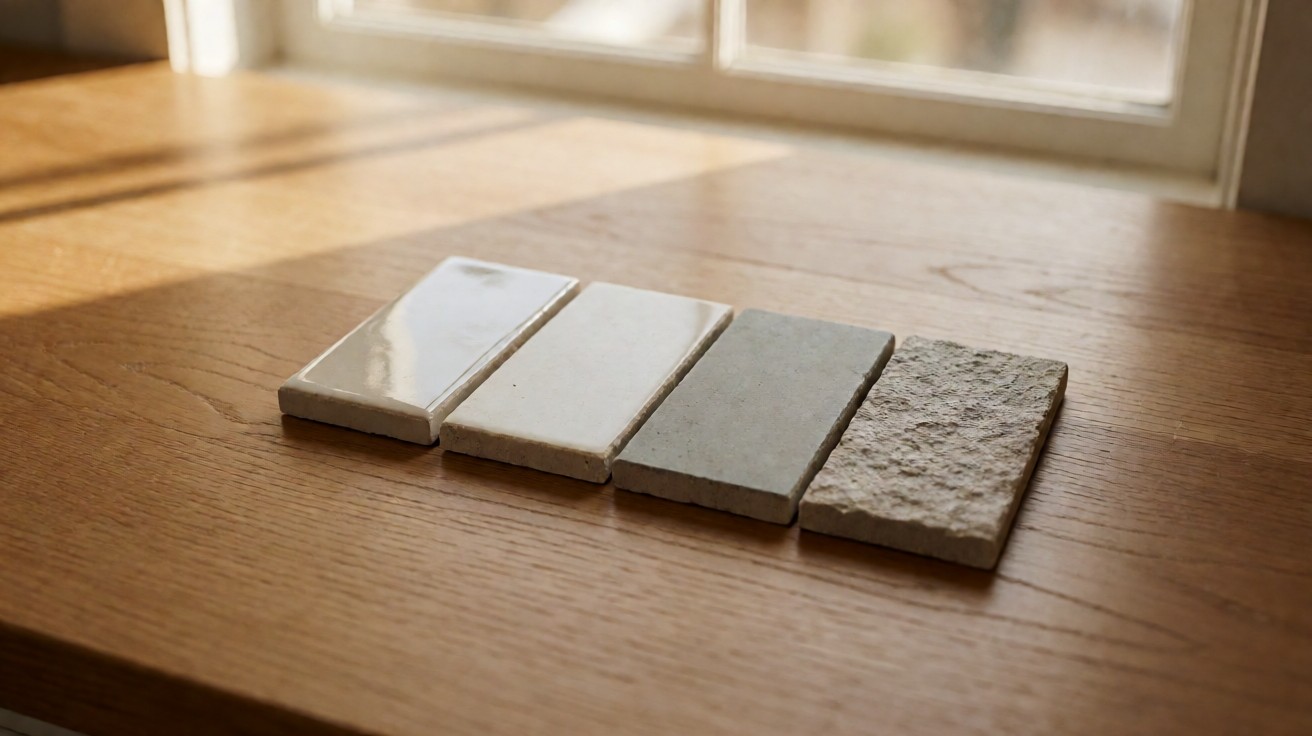
A stone sample at a showroom shows colour and pattern, and only those two. The same slab can look entirely different in the room once it is cut, sealed, and lit, and three things to check on the sample are worth a minute before committing.
First, the colour consistency across the slab. Many natural stones have wide variation between tiles, and a sample the size of a swatch does not show this. A first-quality shipment is delivered sorted, while a lesser shipment is delivered unsorted, and the choice is a budget signal.
Second, the surface finish. The sample may be polished while the order will be honed, or the sample may be honed while the order will be polished. The visual difference between the two finishes is significant on the same stone.
Third, the edge. A bullnose edge for a step or threshold, a straight cut for a standard tile, or a chiseled edge for a feature row. The sample does not show edge, and the edge is specified at the order time.
| Sample check | What to ask the showroom | What the answer means |
|---|---|---|
| Colour consistency | Is the shipment sorted by grade? | Sorted is first quality, unsorted is commercial or utility grade |
| Finish match | Will the shipment match the sample finish? | Honed samples often get filled; polished samples often get sealed |
| Edge profile | What edges are needed for the room? | Bullnose, straight, or chiseled |
| Slab dimensions | What sizes ship from the same quarry? | Larger tiles cost more, cut larger waste |
| Sealing plan | Is the stone sealed at the factory? | Factory sealing is a convenience but not a substitute for site sealing |
Sealing and the Maintenance Reality
Every natural stone floor is sealed after installation, and most are resealed on a schedule. The interval depends on the stone and the wear.
Granite and slate are typically resealed every 3 to 5 years, sometimes less often because the surface is hard and absorbs very little. Marble is resealed every 12 to 18 months because the surface is more porous. Limestone and travertine are resealed every 6 to 18 months, sometimes more often in a kitchen or a bathroom.
The schedule is not strict, and the test is straightforward: a few drops of water on the surface. If the water beads, the seal is working. If it soaks in within a few minutes, the floor needs resealing.
The cleaner matters. A neutral pH stone cleaner is the right product. Acidic cleaners (vinegar, citrus-based, “tile and grout” products with acid) will etch marble and limestone immediately. Alkaline cleaners can dull polished stones. The two cheapest mistakes in stone care are using vinegar on a marble floor and using a generic tile cleaner on a travertine floor, and both are permanent.
Which natural stone is the most durable?
Granite, by a wide margin. It is the hardest of the common flooring stones, the least porous, and is not affected by acids.
Slate is durable in terms of abrasion resistance and water handling, but it scratches and chips more easily at the edges. Marble, travertine, and limestone all rank below granite on durability, although each one is durable in the sense of lasting decades with sealing.
Is marble a bad choice for a kitchen floor?
Marble in a kitchen is workable but not ideal. The issue is acid sensitivity: drops of lemon juice, vinegar, wine, or tomato sauce will etch the surface if not wiped within seconds.
A sealed marble with realistic expectations of patina can be a beautiful kitchen floor; a marble kitchen floor expected to look pristine after a decade of cooking will be a disappointment. Granite is the safer kitchen stone and slate is a texture-forward alternative.
Can natural stone be installed in a bathroom?
Yes, with sealing. Granite and slate handle bathroom moisture best because they absorb almost no water when sealed. Marble works in a low-traffic bathroom with a sealing schedule. Limestone and travertine need a more careful sealing routine and should not sit in standing water. Avoid acidic cleaners, use a squeegee after a shower, and reseal on the recommended schedule.
How This Fits With the Rest of the Choice
This page covers what each stone is, at the level of mineral composition and porosity. It does not cover the comparison with porcelain or ceramic as a material, the cost numbers, or the cleaning specifics.
For the comparison with porcelain, the natural stone versus porcelain tile page is the reference. For the umbrella material on the tile side, the tile flooring guide is the umbrella. For the maintenance plan, the how to clean natural stone floors page covers the routine. And for the cost picture, the natural stone cost page covers that decision.