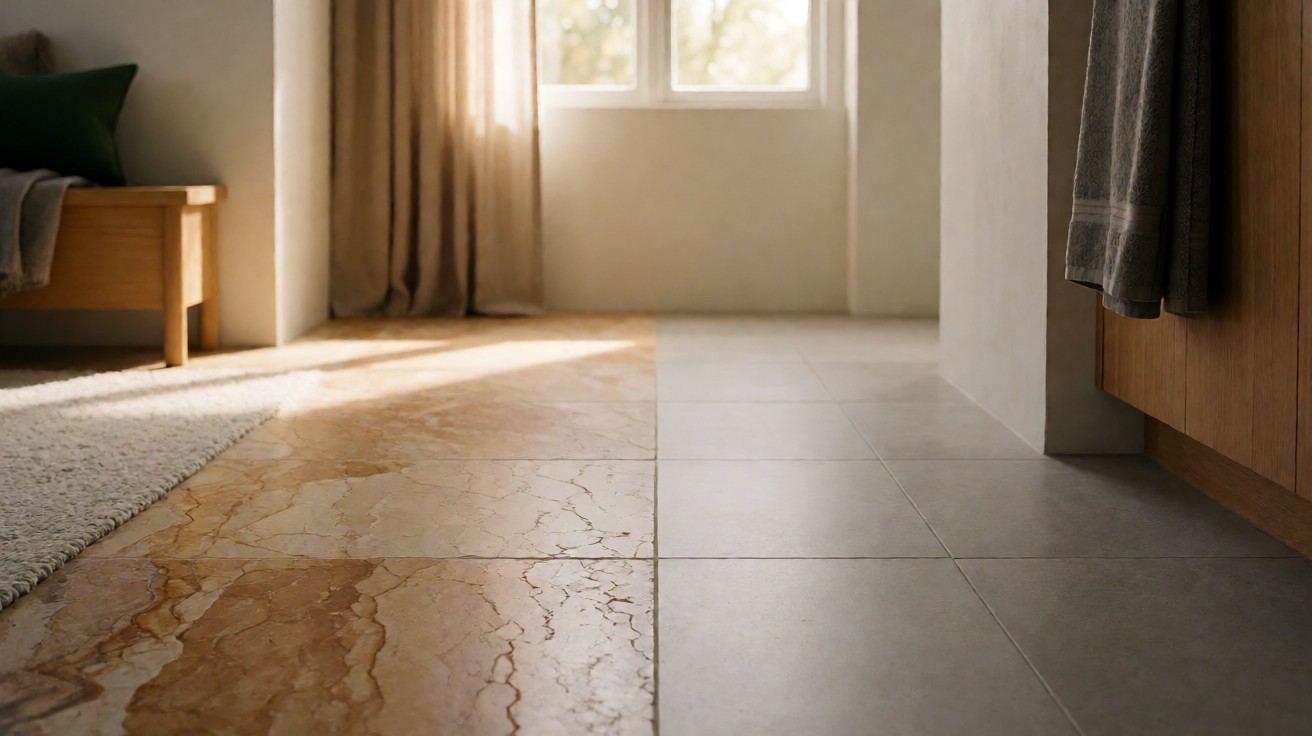

Natural stone or porcelain tile, both look like a hard floor in a showroom photo, but one is quarried and one is fired, and that decides almost everything. Stone is cut from the ground, so every slab is unique, the colour shifts across a floor, and a damaged piece cannot be matched by anything bought later. Porcelain is manufactured, so every tile from the same batch is identical, a replacement piece matches exactly, and the floor stays uniform for its whole life. That single difference propagates through appearance, maintenance, repair, installation, and resale. The porcelain flooring guide covers the material in detail, and the natural stone guide does the same for stone, so this page is about the decision between them.
What Each Material Actually Is
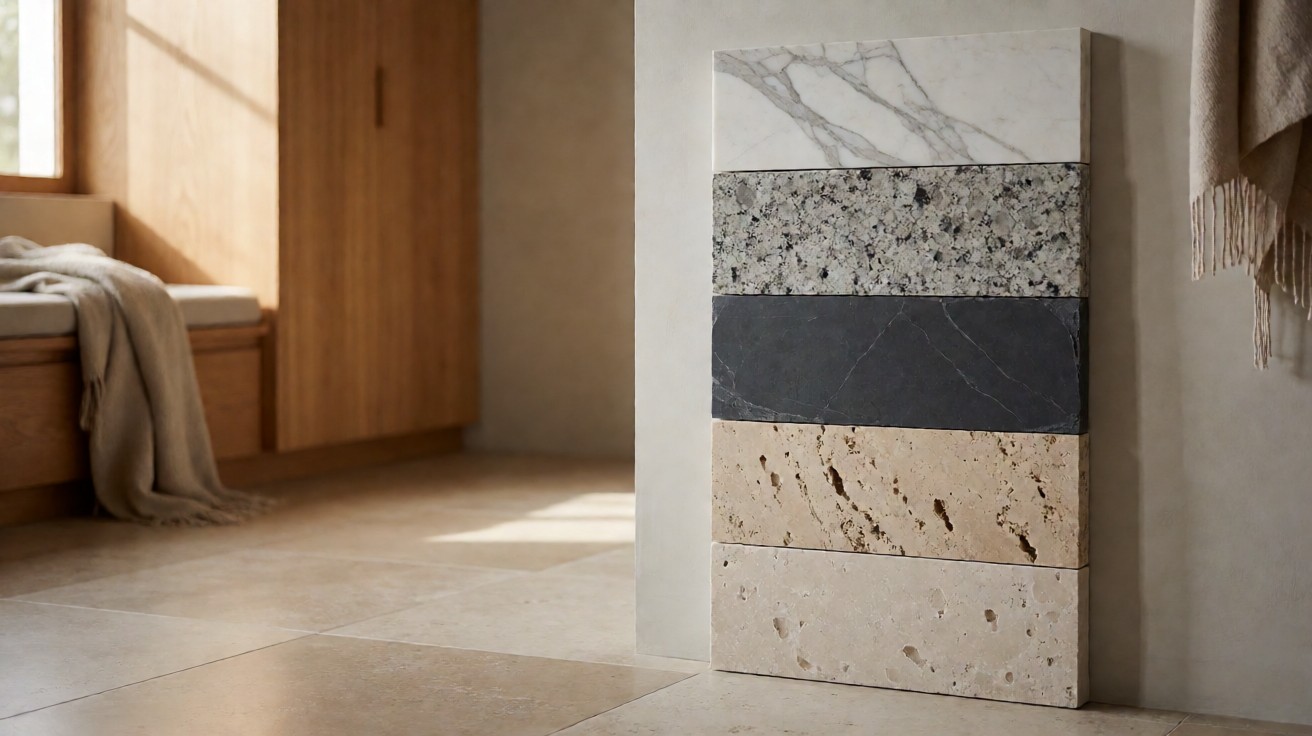
Natural stone flooring is quarried limestone, marble, granite, slate, or travertine, and it is sold as slabs that are cut and calibrated to a consistent thickness. The material is what the ground produced: crystalline structure, natural fissures, inclusions, and a variation between slabs that is unavoidable because it reflects the geology of the quarry it came from. Stone is dimensionally stable but it is permeable to a degree, it is chemically reactive with acids, and its surface can be honed, polished, or brushed.
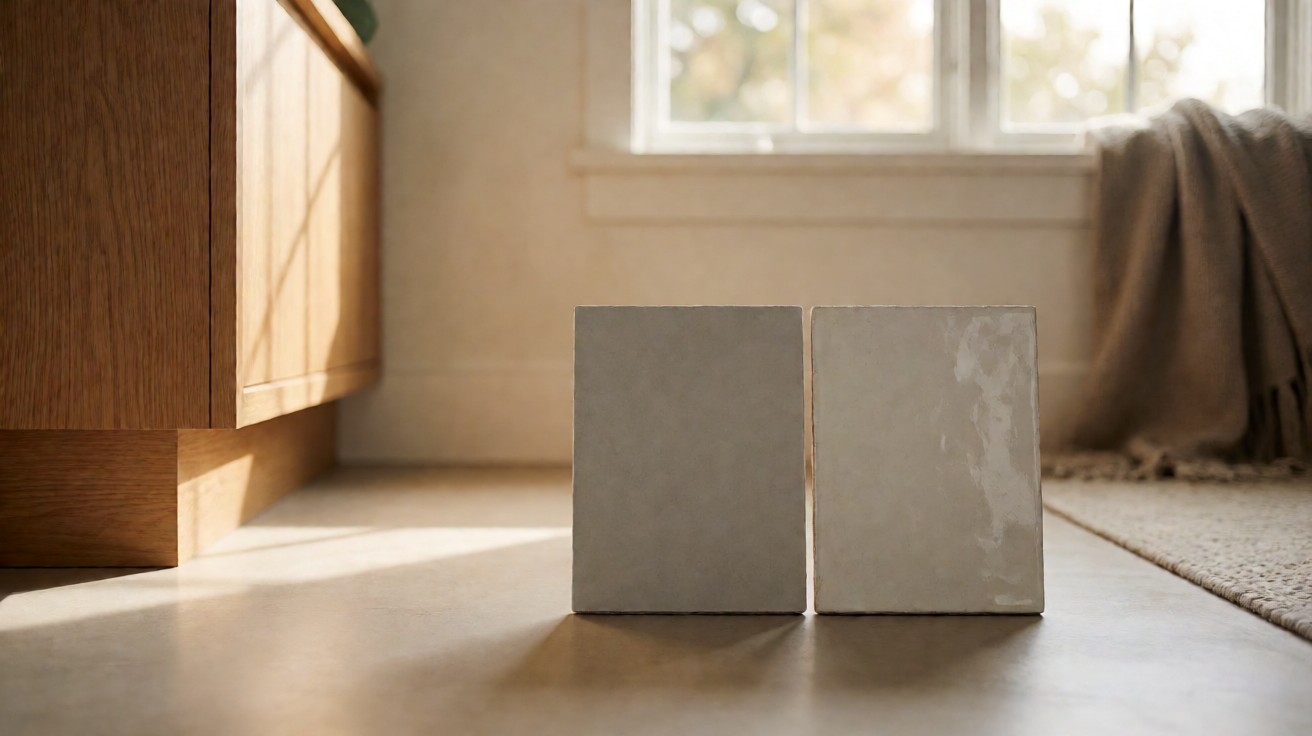
Porcelain tile is a manufactured product. Clay is pressed into shape, fired at temperatures above 1200 degrees Celsius, and vitrified, which produces a body with essentially zero water absorption and a surface that carries either a glaze or a through-body print.
The consequence of manufacturing it is consistency: the colour, the calibre, and the surface are the same on every piece in a batch. Porcelain is also dimensionally very stable and needs no sealing, which is a real practical advantage in a wet room.
| Property | Natural Stone | Porcelain Tile |
|---|---|---|
| Origin | Quarried, each piece unique | Manufactured, batch uniform |
| Water absorption | Low but non zero, sealing dependent | Under 0.5 percent, no sealing |
| Acid reaction | Reacts, etches on contact | Unaffected by most household acids |
| Repair of a damaged piece | No match available later | Exact match from stored stock |
| Thickness tolerance | Calibrated, may need levelling | Consistent, warpage minimal |
| Long-term appearance | Patinas, intended or not | Stays as installed or fades in lanes |
Appearance and the Expectation Gap
This is where most disappointment with either material happens, and it happens in both directions. Buyers who choose natural stone for its uniqueness are frequently surprised by how much the floor varies from slab to slab, and some read that variation as a defect when it is the reason they chose it.
The sample is a foot square; a floor is four hundred of them, and the variation compounds across the room. If the variation is unacceptable, stone is the wrong material and no supplier can fix it with a good installation.
Buyers who choose porcelain for its uniformity are sometimes surprised in the opposite direction by how flat the result looks in a large room. A room floored in twelve-by-twelve porcelain can read as repetitive and institutional, and large-format porcelain mitigates that with fewer joints without eliminating it.
The stone guide covers the individual stone types in detail if the variation is what you are after, and the honest summary is that the two materials serve different expectations rather than one being a cheaper version of the other.
Water, Sealing, and Wet Rooms
Porcelain wins this category outright and the gap is large. A vitrified porcelain body absorbs effectively nothing, so it needs no sealing, tolerates standing water without damage, and is unaffected by grout staining or by the acid in a bottle of cleaner. In a bathroom, a laundry room, or an entryway that gets wet, porcelain is the low-maintenance answer and stone is not.
Stone can absolutely be used in a wet room, but it is a different commitment. Limestone and travertine in particular are porous enough that a penetrating sealer is effectively mandatory, and even sealed, an acid-based cleaner will etch the surface whether or not it has been sealed.
Marble is more acid-resistant than limestone but still reacts with lemon, vinegar, and acidic cleaning products. A sealed stone shower floor will work and many exist, but it is maintained on a schedule and repaired differently than porcelain, and the homeowner should be choosing that knowingly.
Durability and How Each Material Fails
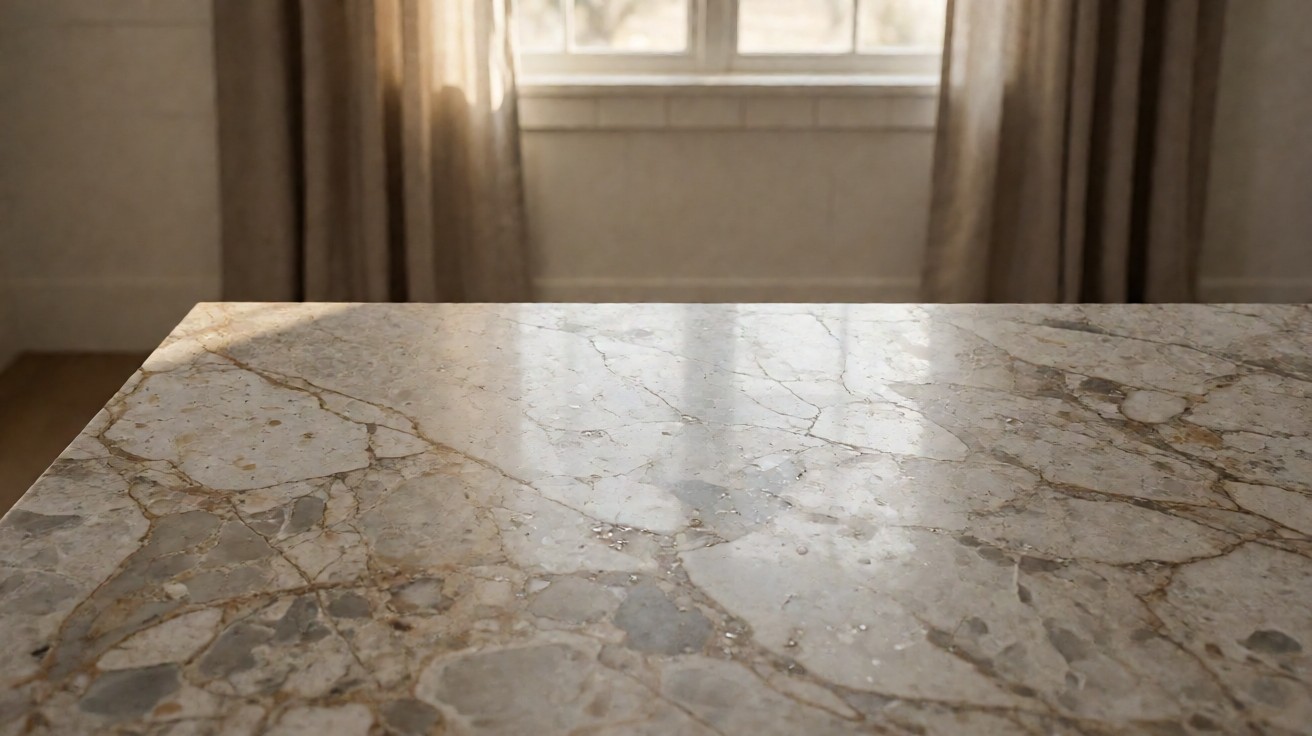
Both materials are dimensionally stable, which rules out the failure that plagues hardwood and some laminate. They fail differently. Stone fails by etching, by chipping at an edge, by cracking along a natural fissure under a point load, and by staining where a sealer has worn away.
Those failures are gradual and they are cosmetic before they are structural. Porcelain fails by chipping on an edge during installation, by cracking if the substrate moves enough to defeat the bond, and by grout discolouration in traffic lanes. A broken porcelain tile is replaceable; a broken stone slab is a scar.
Traffic is worth treating separately from durability because the two materials age in traffic differently. Stone develops a burnished sheen along the walked path and a matte finish at the edges, and for many owners that reads as a floor that improves with use.
Porcelain in the same lane shows the same dulling, but because porcelain is a uniform manufactured product the contrast with the unwalked areas is more visible and reads as wear rather than as patina. Neither is wrong, but the stone version tends to be received better.
Repair, Replacement, and the Long Term
This is the practical core of the decision. A cracked porcelain tile is a solved problem: the manufacturer often supplies replacements for years, a replacement from the same batch is invisible, and a single tile can be lifted and re-bedded without disturbing the rest of the floor. A cracked or stained stone slab is a permanent feature.
Stone that has been down for a decade has usually faded, been re-sealed, or developed a patina, and a new slab will not match it. The realistic options are to live with it, to patch it with a repair compound that is visibly different, or to replace a much larger area.
The same logic applies to colour change over time. Stone develops a patina that many owners come to value and many try to reverse with a wet grinder, which removes the surface and leaves a repair nobody can hide.
Porcelain does not patina; it holds its colour, and when it does change it changes uniformly through UV exposure rather than unevenly. For a household that expects to move within a decade, porcelain is the better asset.
For a house that will be held for a century and where the floor is meant to age with the building, stone is the better choice and the only one that ages.
| Scenario | Better Choice | Reason |
|---|---|---|
| Bathroom or laundry | Porcelain | No sealing, unaffected by water or acid |
| Kitchen with heavy cooking | Porcelain | Stain and acid resistance, easy replacement |
| Entryway with grit and moisture | Porcelain | Survives tracked water without treatment |
| Formal living or dining room | Stone | Slab variation is the visual point |
| House held long term | Stone | Patinas with the building, no match ever needed |
| Historic or period property | Stone | Material the building would have used originally |
| Rental or short tenancy | Porcelain | Uniform replacement, lowest call-backs |
Grout, Joints, and the Continuity Question
Both materials come with joints, and the joint is the one place where stone and porcelain behave identically: it is the weak point in the floor and it will stain or crack long before the surrounding tile does.
Stone joints tend to be wider because the slabs are calibrated less precisely, which suits the variation in the material, and a wider joint also forgives the small height differences that stone floors carry.
Porcelain can be laid with a very narrow joint, which is exactly what makes large-format porcelain read as continuous, and the mosaic tile guide covers the opposite end of the format range where the joint is the design.
The waterproofing argument turns on this detail. A porcelain floor over a waterproof membrane is only as waterproof as its grout and its edges, and most of the failures people attribute to porcelain are grout or sealant failures.
A stone floor has more joint area and a greater need for a penetrating sealer, which is the practical reason stone is treated as a wet-room risk rather than the material itself.
Cold and Warm Underfoot
Both materials conduct heat better than wood, vinyl, or cork, and both feel cold to a bare foot in a winter morning.
There is a difference between them in how cold, because porcelain tile in a large format has more mass and more exposed surface than a honed stone floor of the same thickness, and polished stone is measurably warmer underfoot than polished porcelain.
If the floor is over a concrete slab in a northern climate and warmth matters, a textured or honed stone surface beats polished porcelain.
The same property cuts the other way for anyone choosing a floor for a room with radiant heating. Both are good conductors and both will move heat efficiently, which is an advantage, and both will feel cold to a foot that has been sitting still, which is a disadvantage.
Neither material is thermally insulating and neither should be specified on the basis of comfort without addressing the subfloor build-up or the room’s heating.
Installation, Subfloor, and Cost
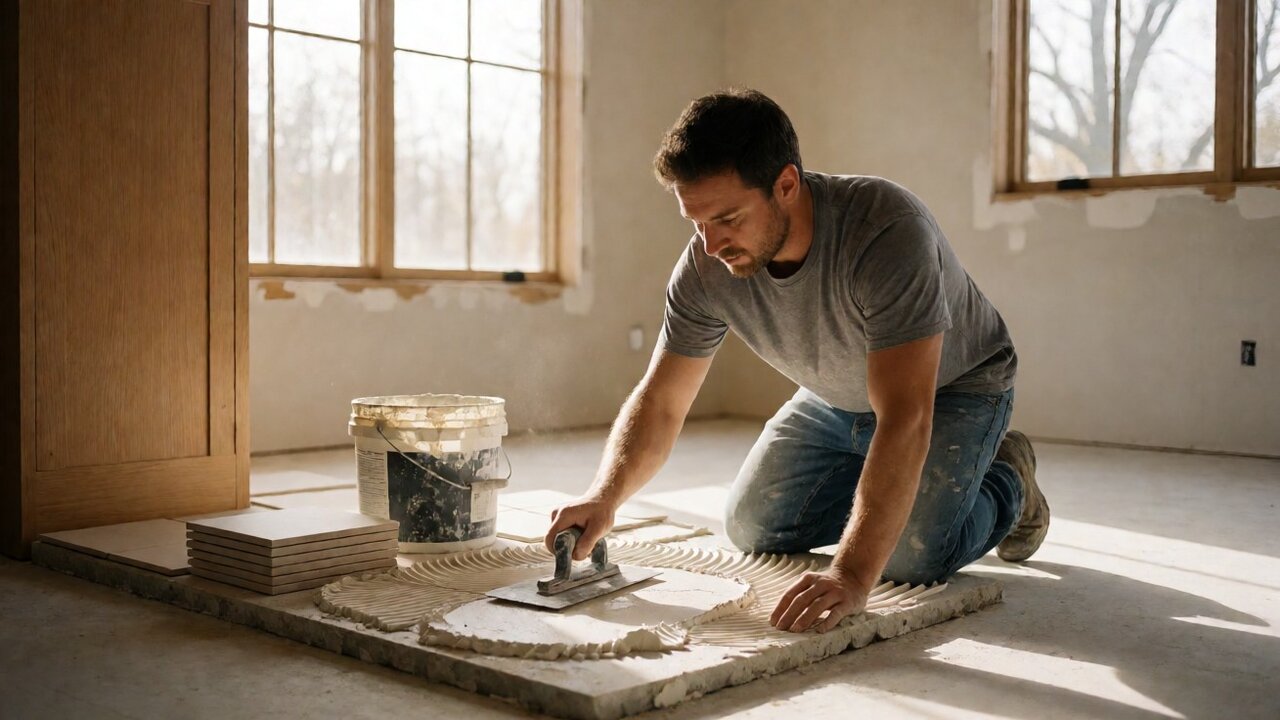
Stone is the harder installation of the two. Slabs are heavy, natural slabs are typically 3/4 inch and up, and unless they are calibrated for thickness they need a thick-bed mortar and careful lippage control, which is why stone floors sit higher than a tile floor and why the transition at a doorway is a real detail.
Porcelain, particularly in large format, is lighter and flatter but demands a flatter subfloor than its small-format cousin, and the large-format guide covers that preparation in detail.
Material cost runs in overlapping bands. Stone generally costs more per square foot than entry-level porcelain and similar to mid-range, with granite at the top of stone and marble and limestone in the middle. Porcelain spans a very wide range, and large-format porcelain has narrowed the gap.
Installed, stone often lands at $8 to $25 per square foot and porcelain at $4 to $18, and the difference is less about material than about the skill and the substrate preparation each one demands.
Making the Decision
The decision reduces to three questions in order. First, will the floor get wet? If yes, porcelain, with no serious counterargument. Second, how long will the house be held? If the answer is long and the floor is in a formal room, stone, because the inability to match a future repair stops being relevant.
Third, is the appeal of the material the variation or the consistency? That question is the one buyers most often skip, and answering it honestly resolves most of the ambiguity that a specification comparison leaves behind.
There is also a hybrid worth considering, which is porcelain tile made to imitate stone in a large format. It gives the visual of stone with the maintenance profile of porcelain, and the tile finish page covers how the surface texture changes both the look and the way the floor behaves underfoot.
The honest limitation is that the variation is printed rather than geological, so a homeowner who is specifically drawn to genuine stone for that reason should buy stone.
Resale and What Each Signals
Real estate professionals consistently report that natural stone reads as a premium material in a way porcelain does not, and buyers interpret it as permanence and as an investment. Porcelain is read as a high-quality practical choice rather than a premium one.
The gap is real in the appraisal conversation even though it is not a material fact, and it is worth factoring in for anyone selling within ten years.
The counterweight is that a stone floor that has been badly chosen for the room actively detracts. Stone in a low-traffic formal room adds; the same stone in a family kitchen with heavy traffic and acidic cooking invites the criticism that it is impractical. Porcelain in the right room never has that problem.
The question is not which material is better received in the abstract, it is which one is correctly matched to the room it is actually going to be in.