
How to repair cracked floor tiles: diagnose the cause, fill hairline cracks with epoxy, or replace a broken tile for a lasting fix in your home.
Repairing one cracked tile costs $130 to $500 with a pro, or under $50 in materials if the crack is hairline and the tile is soundly bonded. The right method depends on crack width, tile type, and whether the substrate moved.
How to Tell a Tile Crack from a Grout Crack
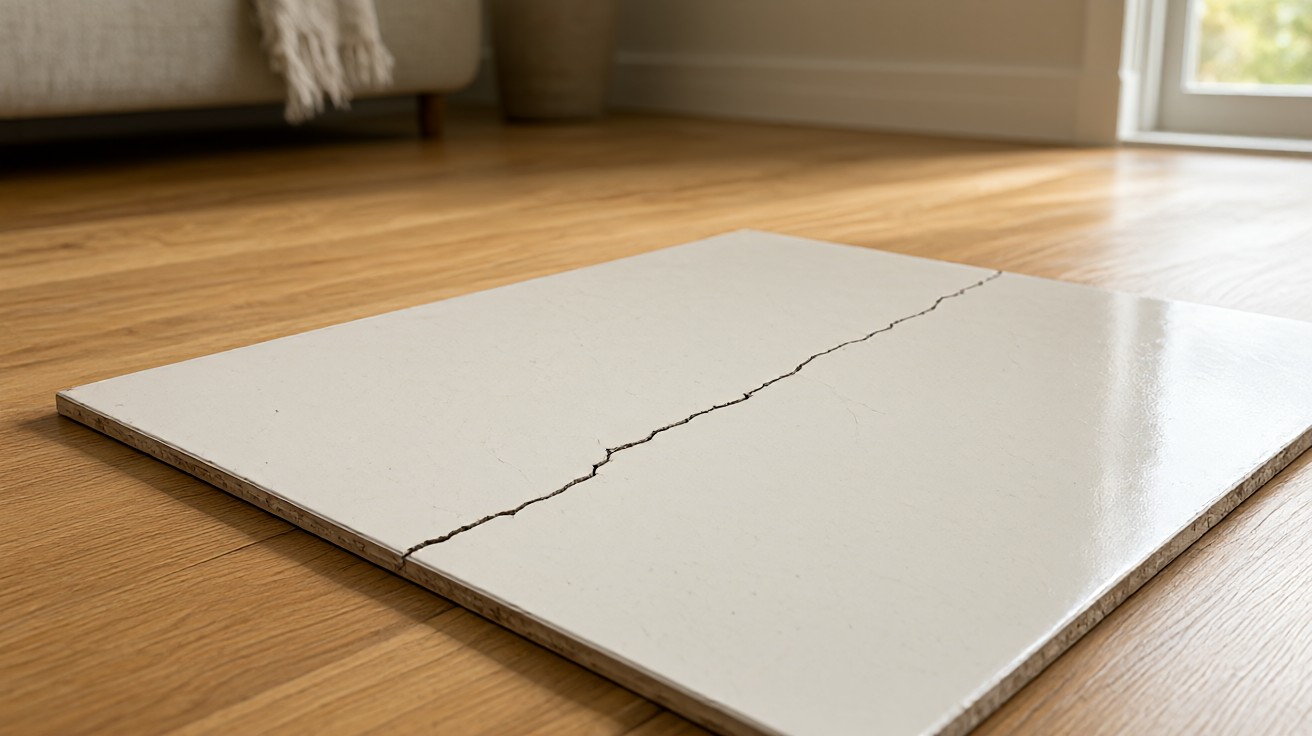
Run a fingernail across the line. A grout crack is soft, sandy, and sits in the joint. A tile crack is hard, sharp, and continues through the glazed face into the body. Tap the tile with a coin. A solid tile rings; a hollow tile sounds dull and signals a debonded mortar bed.
Moisture can mimic a crack. Efflorescence leaves white powder along a hairline and wipes off. A real crack stays. Photograph the line with a ruler in frame so you can track whether it grows over 30 days.
Grout cracks are repaired by raking out the old grout and repacking. Tile cracks need either epoxy injection or full replacement. Misdiagnosing one as the other wastes a weekend and leaves the real failure untouched. If haze remains after a repair, see how to remove grout haze from tile.
Use a grout saw or oscillating tool with a carbide blade. Work slowly to avoid scratching the tile edge. Vacuum dust before mixing new grout.
Common Causes of Cracked Floor Tiles
Tile is strong in compression but weak in tension. Any flex beneath it transfers stress into the tile body until something gives. The four causes below account for nearly every cracked tile on a residential floor.
Age and poor original installation compound. A 15 year old floor with no membrane and a wood subfloor in a humid climate is a candidate for widespread cracking once humidity swings.
Why Does the Substrate Move?
Wood subfloors deflect under load. The Tile Council of North America (TCNA) Handbook requires a maximum deflection of L/360 for ceramic tile and L/720 for natural stone under total load. A floor that flexes more than that cracks tile even with perfect installation.
Check deflection by loading the floor. A 200 pound person jumping in the center should not move a glass of water on a table nearby. If it does, add blocking or a second layer of plywood before re-tiling.
How Does Thermal Expansion Crack Tile?
Tile and grout expand and contract with temperature. TCNA Handbook section EJ171 calls for movement joints at all perimeters, penetrations, and changes of plane, plus field joints every 20 to 25 feet in each direction. A floor tiled wall to wall with no perimeter gap builds stress that cracks the weakest tile.
South-facing rooms with large windows see the biggest swings. Keep furniture and rugs from covering expansion joints so they can move freely.
What Causes Poor Thinset Coverage?
ANSI A108.5 requires a minimum 80 percent mortar coverage for dry interior areas and 95 percent for wet areas. Voids under the tile act as hinges. A point load on an unsupported section snaps the tile at the void edge.
Back-butter large format tiles over 15 inches to push coverage past 95 percent. Comb the mortar in one direction and slide the tile perpendicular to the ridges.
Can a Heavy Impact Crack Any Tile?
A dropped cast-iron pan or a refrigerator leg concentrates force on a small area. Porcelain resists this better than ceramic, but no tile is impact-proof. ASTM C627 Robinson-type floor tester rates installation systems for residential, light commercial, and heavy commercial traffic.
Place felt pads under appliance feet and use a plywood sheet when moving heavy items. A $5 sheet prevents a $400 tile repair.
When to Repair vs. Replace the Tile
Epoxy repair suits hairline cracks under 1/16 inch (1.6 mm) on a firmly bonded tile. The crack remains visible but sealed against moisture and dirt. Full replacement suits cracks wider than 1/16 inch, loose tiles, or any crack that runs to an edge.
Before repairing, check tile availability. If the original tile is discontinued, repair the crack with epoxy and plan a full re-tile when the floor ages. HomeAdvisor lists cracked tile repair at $130 to $500 per project and full tile floor replacement starting near $1,240.
Color matching is the hard part. Store a spare box of tile from the original lot. If none exists, pull a tile from a closet or pantry to use as the replacement and fill the hidden spot with a close match.
Tools and Materials for Tile Crack Repair
Gather everything before starting. Stopping mid-repair to fetch a tool lets epoxy set in the mixing cup.
Lay out a drop cloth and knee pads. Tile work is hard on joints. Good lighting at floor level reveals cracks and high spots you would miss from standing.
| Task | Tools | Materials |
|---|---|---|
| Epoxy fill | Utility knife, cotton swabs, razor blade | Clear two-part epoxy, matching grout colorant |
| Tile replacement | Grout saw, hammer, cold chisel, notched trowel | Replacement tile, thinset mortar, grout, sealer |
| Substrate check | Level, coin, moisture meter | Patch compound, crack isolation membrane |
How to Repair a Hairline Crack with Epoxy
Clean the crack with a vacuum and a damp cloth. Let it dry fully. Mix clear two-part epoxy per the package ratio, usually 1:1. Use a toothpick to work epoxy into the crack until it is slightly proud of the surface.
Wipe the tile face with mineral spirits before the epoxy skins over. A clean surface keeps the repair from staining the glaze. Use painter’s tape along the crack to keep epoxy off adjacent tile.
After 10 minutes, scrape excess epoxy with a razor blade held flat. Wait 24 hours before walking on it. Epoxy cures harder than grout but will not match the glaze. For a better color match, tint the epoxy with a drop of acrylic paint before mixing.
Temperature affects cure time. Below 60 degrees Fahrenheit, allow 48 hours. Keep pets and traffic off the repair until fully hard.
How to Replace a Cracked Floor Tile
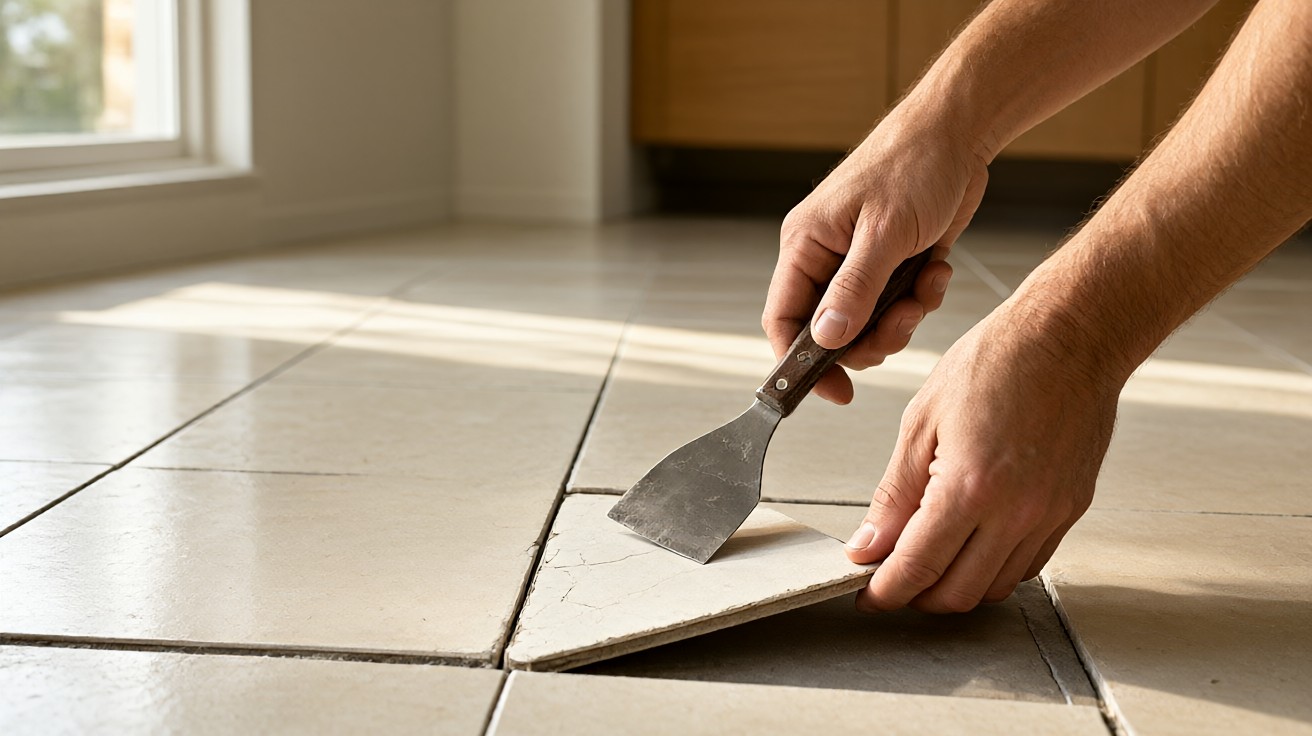
Score the grout around the cracked tile with a grout saw or oscillating tool. Break the tile center with a hammer and cold chisel, working from the middle outward. Remove fragments carefully to avoid chipping neighbors.
Wear safety glasses and gloves. Tile shards are sharp. Work in small sections and pry fragments upward, not sideways, to protect adjacent tiles.
Scrape the old thinset down to the substrate. Vacuum the cavity. Apply fresh thinset with a notched trowel, set the replacement tile, and tap level with a rubber mallet. Allow 24 hours before grouting. Grout the joint, wipe clean, and seal after 72 hours.
If the old thinset will not release, the tile may be bonded to a membrane. Stop and reassess rather than gouging the substrate. The guide on how to install ceramic tile covers thinset application in detail.
Crack Isolation Membranes: Preventing the Next Crack
When the cause is substrate movement, replacing the tile alone repeats the failure. An uncoupling or crack isolation membrane, such as those tested under ANSI A118.12, decouples the tile from subfloor movement. Install the membrane over the clean substrate, then tile over it.
Cost adds $2 to $4 per square foot but prevents repeat cracks. For a 200 square foot floor, that is $400 to $800 well spent against a repeat repair.
ANSI A118.12 requires the membrane to withstand 1/8 inch (3.2 mm) of in-plane movement without tile cracking. For slabs with structural cracks, use a membrane rated for 3/8 inch (9.5 mm) or pair it with a repair of the crack itself.
Cost of Repairing Cracked Floor Tiles
Costs vary by damage extent and tile type. Angi reports cracked or broken tile repair at $130 to $500 per project nationally, with severe water damage running $1,590 to $2,110. HomeAdvisor lists floor tile repair between $50 and $700 depending on square footage and access. For porcelain floors, see how to install porcelain tile for substrate notes.
Get two quotes. Compare material line items, not just totals. A low bid that skips the membrane is not a bargain.
| Repair Type | Typical Cost (USD) | Time |
|---|---|---|
| Epoxy fill, one tile | $0 to $50 DIY, $130 to $250 pro | 1 hour plus 24 hour cure |
| Single tile replacement | $150 to $400 | Half day plus 24 hour cure |
| Multiple tiles plus membrane | $400 to $900 | 1 to 2 days |
| Full floor re-tile | $1,240 and up | 3 to 5 days |
When to Call a Professional
Call a tile contractor when more than three tiles are cracked, when cracks form a pattern, or when the floor sounds hollow across a wide area. A pattern of cracks points to a structural or moisture issue that epoxy cannot fix. Moisture testing per ASTM F2170 relative humidity or ASTM F1869 calcium chloride is warranted before any re-tile over concrete.
If the original tile is discontinued and the floor is large, a pro can blend a new field tile with a border or feature strip. That costs more than patching but less than a full replacement.
Ask for a written scope that names the membrane, thinset, and grout. Vague bids hide material substitutions that shorten the repair life.
Preventing Future Tile Cracks
Use a crack isolation membrane on any tile over a wood subfloor or a slab with hairline cracks. Keep expansion joints open and filled with flexible sealant, not grout. Verify thinset coverage by lifting a tile during installation; 80 percent minimum in dry areas, 95 percent in wet areas.
Re-check grout joints every spring. Hairline grout cracks are early warnings of movement. Repack them before water reaches the substrate.
In humid climates, run a dehumidifier in summer. Moisture swells wood subfloors and triggers cracks months later.
Match the tile to the load. A porcelain tile rated for residential traffic under ASTM C627 holds up better than a wall-rated ceramic. The guides on tile mortar and thinset basics and grout and tile installation basics cover substrate and bonding details.
How to Inspect After Repair
After the repair cures, walk the floor in soft shoes and listen. A hollow sound means the tile is not bonded and will crack again. Check the crack line for epoxy shrinkage or grout color mismatch. Re-seal grout joints within 72 hours to keep moisture out.
Keep a photo log with dates. If a new crack appears in the same area, the cause is structural and needs a pro.
Save receipts and product labels. They simplify warranty claims and future matching.
Document the repair with photos and the tile lot number. That record helps if a warranty claim arises or if matching tile is needed later. The article on how to clean ceramic and porcelain tile covers routine care that extends tile life.