
Cloudy smears on a freshly grouted floor are grout haze, and what removes them depends on the grout type, the age of the film, and the tile underneath.
The answer is to identify the grout first, then match the cleaner to it: acid dissolves cementitious grout haze, a neutral abrasive lifts epoxy haze, and marble needs a non-acidic method.
What Grout Haze Actually Is
Haze is the residue of the grouting process that dries on the face of the tile instead of staying inside the joint, and it shows up as a white powder, dull smears, glossy patches, swirls, streaks, or any combination of those.
It is most common on textured tile surfaces, but it also appears on smooth and polished tile.
Three different films get called haze, and each one behaves differently once a cleaner touches it.
Cementitious grout haze is mostly the cement portion of the mixture, which is composed of calcium-based materials that rinse off during cleanup and then dry on the tile face.
A latex additive film stays behind when a cement grout is modified with latex for strength, because the pigments and the latex can attach and become embedded in the tile surface.
Mortar residue is the third, and it comes from the setting bed or the mortar that was not cleaned off before grouting.
Cleaning the joint and removing the film are different jobs, and a sponge float cleans the joint while the haze sits on the tile face beside it.
That is why a floor can look clean at every grout line and still read milky across the whole surface.
Why Haze Removal Is Timed By Cure Age
Cure time sets the window, and it is the fact that decides how hard you can work on a fresh floor.
The grout manufacturer sets that timing, and the product data sheet is the document that governs it, not a rule of thumb.
LATICRETE 1500 Sanded Grout allows foot traffic after 12 hours and heavy traffic after 24 hours.
The same product needs 14 days of cure at 70 degrees Fahrenheit before it is immersed in water.
How Long Should You Wait Before Cleaning?
Let the grout reach its own stated timing first, because cleaning a joint before it has hardened means scrubbing out your own grout.
Water exposure is the harder test, and a joint that is walked on at 12 hours is not the same as a joint that is soaked at 14 days.
Does Epoxy Grout Follow The Same Clock?
No, and the difference matters, because where the cement rule is measured in days, the epoxy window is measured in weeks.
MAPEI technical guidance states that residential-grade epoxy grout is considered cured after about 7 days, and that industrial epoxy grouts can cure in as few as 4 days.
The same document says Kerapoxy and Kerapoxy CQ epoxy grouts fully cure in 14 days.
Epoxy haze should be addressed as soon after installation as the grout manufacturer allows, and MAPEI recommends using its epoxy haze remover after the grout has dried at least 12 hours but within the first 24 hours.
| Grout Type | Cure Reference | Approach | Dwell Time |
|---|---|---|---|
| Cement-based, foot traffic allowed | 12 hours | mild cleaner, then acid if residue remains | 10 to 15 minutes |
| Cement-based, fully cured | 14 days at 70 degrees Fahrenheit before immersion | acid cleaner on acid-resistant surfaces | 2 to 5 minutes |
| Ready-mixed acrylic or urethane | manufacturer cure schedule | alkaline cleaner plus abrasive | several minutes |
| Epoxy, residential grade | about 7 days | epoxy haze remover, 12 to 24 hours after install | under 20 minutes |
Cement Grout Versus Epoxy Grout
ANSI A118.6 is the standard for cement-based grout, and it explains why cement joints behave the way they do under water and under a sponge.
LATICRETE 1500 Sanded Grout reports water absorption of 8 to 10 percent under ANSI A118.6 section 4.4, compressive strength of 3,500 to 4,500 psi under section 4.5, and linear shrinkage under 0.2 percent under section 4.3.
A joint that absorbs that much water and still sheds calcium onto the tile face will haze, and sealing it later will not remove the film.
ANSI A118.3 is the epoxy and chemical-resistant grout standard, and it is where the difference shows.
SPECTRALOCK 2000 IG epoxy grout exceeds ANSI 118.3 with compressive strength of 8,300 psi against a 3,500 psi minimum, tensile strength of 3,000 psi against a 1,000 psi minimum, and linear shrinkage of 0.07 percent against a 0.25 percent limit.
Epoxy grout does not release calcium, so it does not haze the way cement does, and acid on epoxy grout is the wrong tool because a cleaner meant for cement residue can attack the epoxy itself.
The Acid Choice And Why pH Matters
Acid works on cement haze because acids work by attacking calcium, breaking it down and dissolving it from the surface, and the obvious sizzling you see on contact is the sign of that reaction.
The joint itself is not what dissolves here, the calcium deposit the joint left behind is.
The pH of the cleaner tells you how fast it works and how much you must dilute it before it ever touches the tile.
The MAPEI UltraCare Acid Cleaner technical data sheet lists a pH of 1, a density of 1.10 grams per cubic centimeter, and an application range of 0 to 40 degrees Celsius.
It recommends dilution between 1:10 and 1:5 depending on the level of residue and the type of surface, with a 5 minute contact time before rinsing.
Phosphoric Acid Or Sulfamic Acid?
Both are sold for cement grout haze, and both appear in manufacturer documentation, so the choice matters less than the pH and the dwell time you respect.
The MAPEI UltraCare Acid Cleaner health disclosure lists both sulfamic acid and phosphoric acid among its components.
MAPEI also warns that if a mild acid wash does not remove the residue, using more acid may not do the trick and can damage the surface.
Is A Higher pH Cleaner Safer?
Neutral and alkaline cleaners work by breaking down the latex and pigment rather than dissolving calcium, which makes them the right tool for ready-mixed acrylic and urethane grout where acid does nothing useful.
Pairing a heavy-duty stone, tile and grout cleaner with an abrasive surface cleaner is the published answer for pigment and latex residues that survived an acid wash.
Step By Step Haze Removal
Test The Surface First
Always test first in several inconspicuous areas, and pick a spot where the haze shows clearly.
If the test area comes back lighter after a rinse, the chemistry is right and the dwell time was long enough.
Sweep, Vacuum And Pre-Wet
Sweep or vacuum all surfaces to remove loose debris, then pre-wet the surface with water.
Pre-wetting slows the reaction on the tile face and keeps the cleaner from drying where you applied it, and that drying is what leaves a dull ring behind.
Work A Manageable Area
Keep the work area small enough to finish before the product dries, and the MAPEI UltraCare Cement Grout Haze Remover is applied to about 15 square feet at a time.
Its coverage runs 20 to 50 square feet from a single quart, depending on density, porosity, texture, and how long the solution sits on the surface.
Give It The Dwell Time
This is where most failures happen, because scrubbing before the dwell time is up only moves the film around.
The MAPEI cement grout haze remover stands for 10 to 15 minutes, and the MAPEI UltraCare Acidic Tile and Grout Cleaner stands for 2 to 5 minutes.
Never let either product dry on the surface, because keeping it wet by adding more product is what lets the acid finish its work.
Agitate With A Nylon Brush
A nylon brush or a white nylon scrub pad is the right tool, because a wire brush can scratch a glossy glaze and a metal pad can cut a polished surface.
For larger areas, a low-rpm floor machine from 150 to 300 rpm spreads the work evenly, and MAPEI allows it on larger commercial installations.
LATICRETE finishes a joint with a coarse nylon pad and minimal water, which is the same mechanical principle applied by hand.
Rinse Thoroughly And Repeat
Rinse thoroughly with clean water, and agitate again as you rinse, so no cleaner is left sitting in the joint where it keeps working after you walk away.
Heavy residue often needs a second pass rather than a stronger solution, because more acid can damage the surface without lifting what a second pass would have lifted.
Let It Dry Before You Seal
Any grout sealer goes on after the area has dried for 24 hours, and the joint needs its own cure time before sealing is even relevant.
A sealer will not remove haze, and it will only lock in whatever film is still on the tile face.
Haze On Natural Stone And Marble
Acid is the hazard on stone, and the MAPEI UltraCare Acid Cleaner data sheet warns that the product etches polished marble, limestone, and concrete.
It says never use it on polished marble, calcareous stone in general, limestone-based materials, or cementitious terrazzo tiles.
MAPEI also limits its acidic tile and grout cleaner to acid-resistant natural stone such as granite and slate, plus ceramic, porcelain, quarry, sealed Saltillo, and terra cotta tile.
What Do You Use On Polished Marble?
You use a neutral abrasive and mechanical action instead of acid, and you work the surface with a nylon brush or a white nylon scrub pad rather than an acid gel.
The published method uses hand agitation for small sections and a low-rpm scrub machine for larger ones, and it starts with a small test area.
Mechanical action removes the film without dissolving calcium carbonate, which is what an acid does to marble.
And On Limestone, Travertine And Slate?
Limestone and travertine are calcium-based, so they etch the way marble does.
Slate is different, because it is not calcium carbonate, but a penetrating sealer can still change the look of the stone, so test first on any sealed slate.
Fired ceramic and porcelain tile are glass, and they are the safest surfaces under an acid cleaner.
Haze Removal In A Wet Room
A shower or any room over a waterproofing membrane is a different job, because the membrane under the tile has its own rules and its own cure clock.
ASTM D5957 guides flood testing of horizontal waterproofing installations with a hydrostatic head of no more than 4 inches and a slope of no greater than 2 percent.
The guide states that no testing should happen during the first 24 hours after the membrane is installed, or 48 hours minimum if the materials were installed at temperatures below 50 degrees Fahrenheit.
The practical rule is that you clean the surface, not the membrane, because flooding an area before the membrane has cured can push water past a lap or seam that the design assumed would stay dry.
A hazy shower floor is a small problem next to a failed membrane, and if the area is still inside the cure window there is no safe way to test it at all.
Troubleshooting Haze That Will Not Come Off
Why Does The Haze Come Back After Every Mopping?
If the film returns after a plain mop, the film was never removed, because a damp mop moves residue around and dries it in place.
A film of pigment and latex needs enough dwell time and mechanical action to lift it off the face of the tile.
Is The White Deposit Haze Or Efflorescence?
They look alike, and they are not the same, because efflorescence is salt carried out through the joint and the setting bed while haze is grout residue left on the tile face.
Acid dissolves haze and the calcium in it, while an alkaline cleaner with an abrasive removes efflorescence along with lime deposits.
What If The Joint Is The Problem, Not The Tile?
Check the joint before you keep cleaning the face, because a joint that is soft, powdery, or recessed is a grout failure that no cleaner fixes.
Scrubbing a weak joint only widens it, and if the grout itself has failed then it has to be cut out and redone.
Should You Call A Tile Professional?
Call one when the tile is polished natural stone, when the floor sits over a membrane that has already been flood tested, or when the haze is on epoxy grout that has cured more than 24 hours.
Those three cases carry a real risk of etching, membrane damage, or permanent epoxy damage that a rental machine will not fix.
How Much Cleaner Do You Need
Coverage numbers are a starting point, not a promise, because density, porosity, texture, and dwell time all move the real figure.
The MAPEI UltraCare Acidic Tile and Grout Cleaner covers 150 to 750 square feet per quart, and 600 to 3,000 square feet per gallon in its larger container.
The MAPEI UltraCare Cement Grout Haze Remover covers 20 to 50 square feet per quart, and its shelf life is up to 3 years when stored at 73 degrees Fahrenheit.
| Product Type | Coverage | Dwell Time | Safe Surface |
|---|---|---|---|
| Acid cleaner, diluted 10 to 1 for light duty | 150 to 750 square feet per quart | 2 to 5 minutes | ceramic, porcelain, granite, slate |
| Acid cleaner, diluted 2 to 1 for heavy duty | 150 to 750 square feet per quart | 2 to 5 minutes | acid-resistant stone only |
| Cement grout haze remover, undiluted | 20 to 50 square feet per quart | 10 to 15 minutes | ceramic, porcelain, acid-resistant stone |
| Neutral abrasive on polished marble | test area first, then work in sections | mechanical, no acid | polished marble and limestone |
Prevention During The Next Grout Job
Most haze is set during grouting, not after, and the sponge work during cleanup does more for the finish than any cleaner applied later.
Remove the excess grout with the edge of the grout float, hold the float at a 90 degree angle and pull it at a 45 degree angle across the joints and tile.
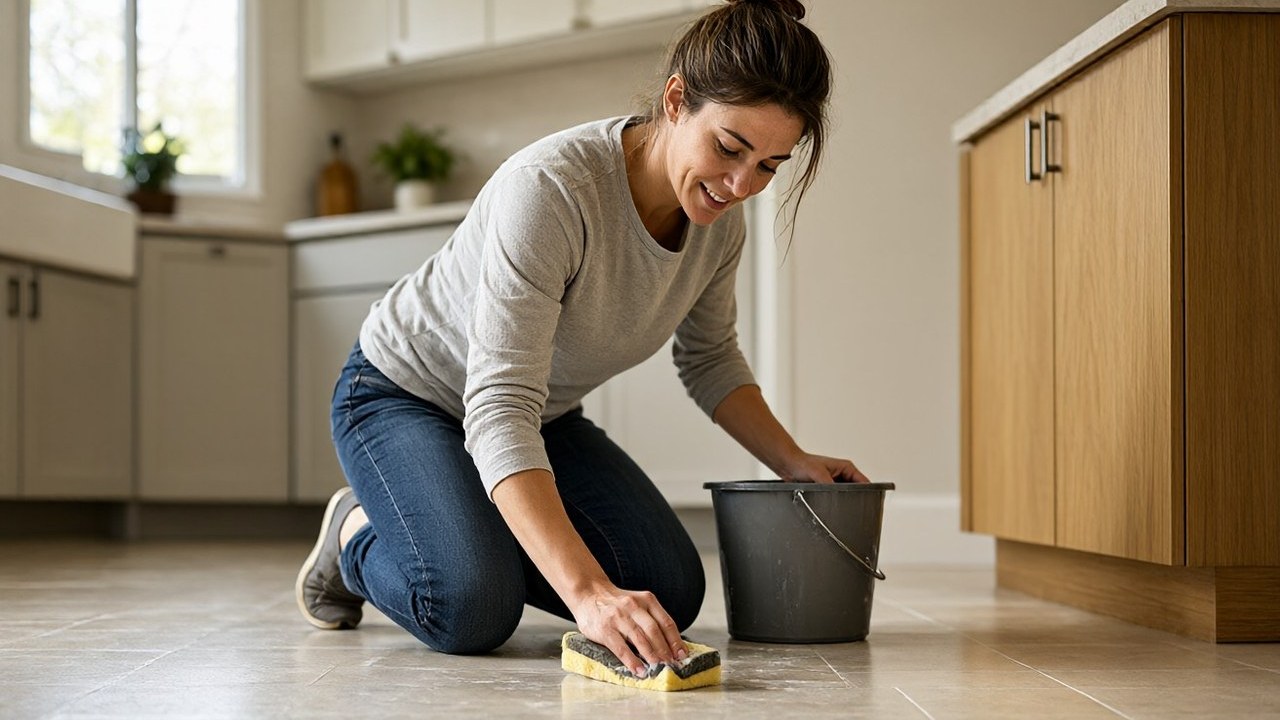
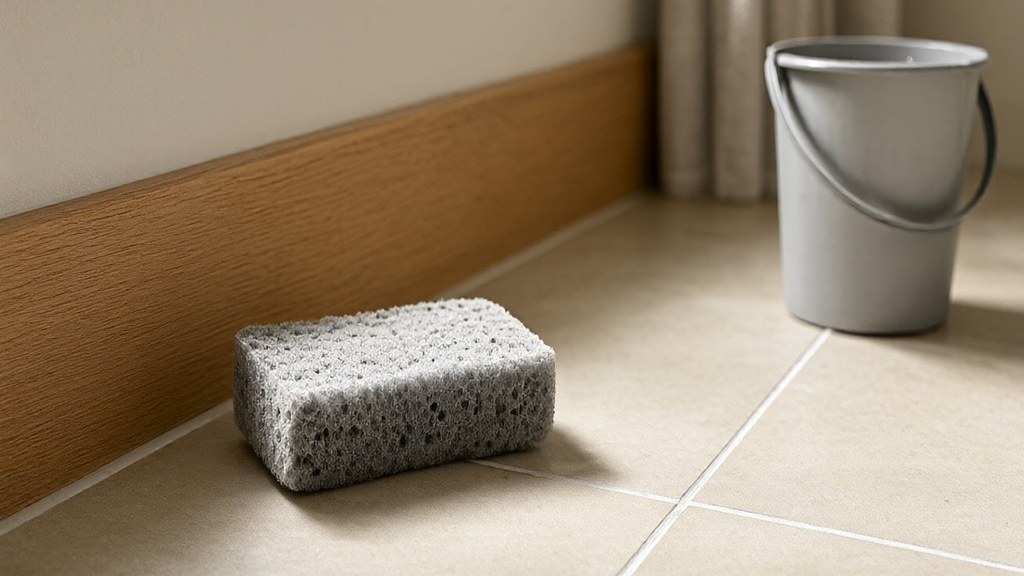
Then remove the remaining grout with a damp sponge, not a wet one, and change the water in the bucket often because dirty water redeposits the cement you just lifted.
The joint cleaning sequence and the tools that matter are covered in our grout and tile installation basics.
Then let the floor cure before anyone mops it, and seal only when the grout manufacturer says the joint is ready.
Routine care of a sealed floor is a separate topic, and our guide to maintaining floor grout and sealers covers the sealing schedule and what a sealer actually does.
For the routine mopping and scrubbing that follows, the method depends on whether the floor is ceramic or porcelain, and our ceramic and porcelain tile cleaning guide separates those.
If you are still choosing the tile itself, the tile flooring guide covers the material choices that change how forgiving a surface is to clean.
For more on this topic, see How to Clean Flooring After Renovation