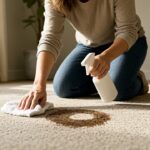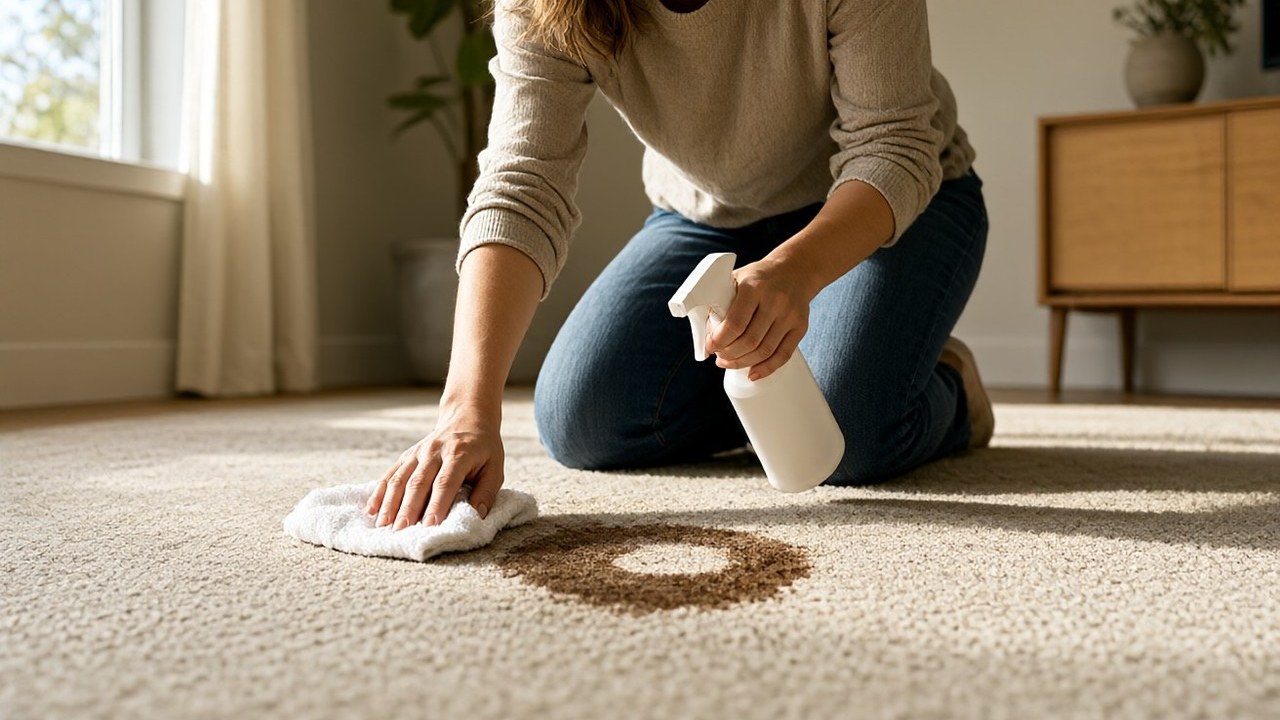

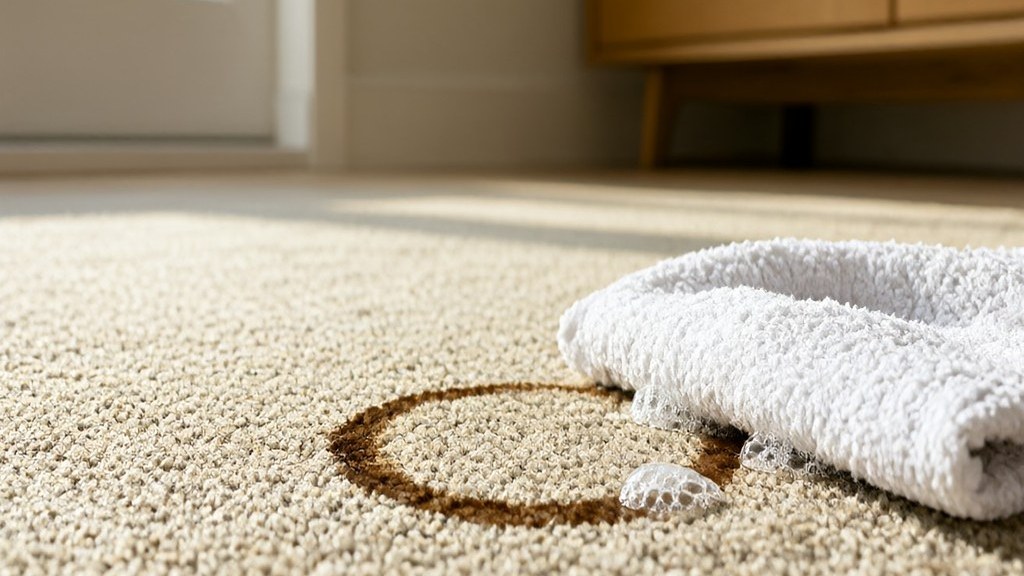
A coffee ring dries on the hallway carpet, and by the time you notice it the mark has a hard edge and a darker halo where the liquid kept moving.
The answer is a fixed sequence: blot the spill with a dry white cloth first, then treat what is left with a spot remover matched to the stain type, the carpet fiber, and the time that has passed.
Why Carpet Stains Become Permanent
The CRI 205 Residential Carpet Standard for Maintenance and Cleaning separates carpet mishaps into three categories, and the difference between them decides how much work the job ahead of you actually takes.
A spill is a liquid or dry substance deposited by accident on the carpet surface that can migrate to the base of the carpet, which means a quicker response often means complete removal.
A spot sits on top of the face fibers, often an oily, tacky or sticky deposit, and those usually come out with water-based or solvent-based cleaning solutions.
Staining is a local, more permanent discoloration that standard cleaning methods do not easily remove. It can sometimes be reversed, but permanent staining can occur if the work is not done properly.
Delay is what turns a spill into a stain. One widely used residential carpet warranty puts it plainly: the more time that elapses before removal, the more difficult a stain will be to remove, and some stains may not be removable at all.
The same warranty is careful with the phrase stain resistant, and it states that no carpet is absolutely stain proof. Stain resistance describes a fiber and dye treatment that slows absorption, not a surface that refuses a spill.
The practical consequence is simple. Act inside the first few minutes and you are cleaning a spot. Come back the next morning and you are trying to reverse staining, which is a different job with a different cost.
Identifying The Stain Type
Before you touch anything, decide what the substance is. The single most useful question is whether the mark is water-based or oil-based, because those two need opposite chemistry.
How Do You Tell A Water-Based Stain From An Oil-Based One?
Water-based means coffee, tea, juice, milk, wine, and most plain food spills. Oil-based means grease, butter, makeup, and wax, and those need a solvent rather than a detergent solution.
The CRI 204 Commercial Carpet Standard removal sequence starts with identification of the carpet manufacturer, the type of carpet fiber, and the backing, and then identifies the spill, the spot, or the stain as wet, dry, water-based, or oil-based.
If you cannot tell, look at the edge of the mark. Water spreads outward into a soft halo and keeps traveling. Oil holds a sharp boundary and stays where it landed.
Does The Fiber Type Change How A Stain Behaves?
It does, and it changes how far the liquid travels before it reaches the backing.
Nylon and polyester make up most residential carpet, with olefin and wool filling specific roles. Wool is valued in part for how it handles soil, and nylon is the fiber most often chosen when a carpet has to take a strong bleach treatment.
Fiber matters most when you pick a treatment. A product that is safe on a nylon loop pile can discolor a wool loop, and a solvent that works on an oil-based mark can dull an olefin face.
Does The Age Of A Stain Change The Method?
Yes, and it changes the odds more than the product does.
Fresh liquid is still moving. Every minute it sits, more of it migrates from the face fiber toward the backing, which is the condition the CRI 204 standard calls wicking.
A dried mark also changes the color chemistry. A dye that has oxidized inside the pile is harder to lift than the same dye still suspended in a wet spill.
The Blot And Treat Sequence
The CRI 205 residential standard gives three steps, and the order is not negotiable. Absorb the spill, treat the spot, and call a professional if the first two do not work.
Step One: Absorb The Spill
Blot liquids with a dry white absorbent cloth or plain white paper towels with no prints or colors, because printed material can transfer ink or dye onto damp carpet.
Keep blotting until the area is barely damp. Semi-solids such as food spills can be scooped up with a spoon, and solid dried bits can be vacuumed away.
Do not scrub and do not use a brush. The standard is blunt about the consequence, because bristle agitation frays the carpet and changes its texture permanently.
Step Two: Pretest And Treat
Before any cleaner touches the carpet, test it where nobody will see it, or on a scrap of the same material.
The CRI 204 commercial standard gives a specific test. Apply the liquid to the test area, hold a white cloth on the wet area for 10 seconds, then examine the carpet and the cloth for color transfer, color change, or damage.
That test is the colorfastness check. If color moves, the dye is not stable with that solution, so you select a different one.
Then apply a small amount of the chosen cleaner to a white cloth and work it in gently from the edges toward the center. Blot rather than scrub, and repeat if the spot is not gone.
Finish by blotting the area with clear water once or more, which pulls the remaining cleaning product out of the fiber instead of leaving it to attract soil.
One rule is worth memorizing. Layering several spot, spill, or stain removal products on top of each other without rinsing between them can set a stain and make it permanent.
Work from the outside inward. For a spill the size of a baseball, work an area the size of a basketball, because the liquid you cannot see is still spreading under the fibers.
Stain By Stain Removal Methods
The sequence never changes. What changes between categories is the cleaner you apply and how thoroughly you rinse it out afterward.
Water-Based Stains
Coffee, tea, juice, wine, and soda are the easiest category, because the dye is dissolved in water that has not yet bonded to the fiber.
Blot first, work a small amount of spot remover in from the edges, and finish with a clear water blot. Repeat the cycle rather than escalating to a harsher product.
Protein Stains
Blood, milk, and dairy leave protein behind, and protein binds to wool and to protein-dyed yarns in ways plain water will not release.
Use cold water first and blot, then apply an enzymatic cleaner that breaks the protein down. Never use hot water on blood, because heat sets the protein into the fiber.
An enzymatic cleaner needs time and a damp carpet to work, so follow the dwell time on the label instead of blotting early and cutting the reaction short.
Dye And Ink Stains
Ink, dye, and some food coloring are the hardest of the water-reachable stains, because the color is engineered to bond.
Isopropyl alcohol is the usual first move for ink, since it dissolves the dye carrier without adding water to the pile.
Test colorfastness first and work from the outside in, because alcohol spreads the dye as readily as water does.
Grease And Oil Stains
Grease and oil belong to a different procedure, and our guide to removing grease stains from floors walks through that solvent-based method step by step.
What matters for identification is knowing they are not water stains. A detergent solution will spread the oil and leave a sticky residue that attracts soil faster than it did before.
Pet And Urine Accidents
Pet accidents are delegated as well, and our pet stains guide covers the urine and feces procedure in full.
For identification purposes, note that a pet stain usually reads as a darker halo with a lighter center, and that odor is a separate problem from the visible mark, so a stain that looks gone can still need odor treatment.
| Stain Category | How It Behaves | First Treatment | Common Failure |
|---|---|---|---|
| Water-based, such as coffee or juice | Bleeds outward and keeps moving | Blot, then spot remover, then a clear water rinse | Scrubbing or hot water |
| Protein, such as blood or milk | Binds to wool and protein-dyed yarn | Cold water blot, then an enzymatic cleaner | Hot water |
| Dye and ink | Designed to bond to the fiber | Isopropyl alcohol, pretested | Letting alcohol spread the dye |
| Grease and oil | Holds a sharp boundary | Solvent-based spot treatment | Using a detergent solution |
| Pet accident | Dark halo with a lighter center | See the pet stains guide | Waiting, which drives odor deeper |
Wicking And Why Stains Come Back
Wicking is the movement of liquid, soil, and residual contaminant from the carpet backing to the tip of the fiber during the drying process.
That definition explains the brown ring that reappears a day after a stain looked gone. The center is dry, and the edge keeps pulling dye upward as the carpet finishes drying.
Air movement during drying reduces wicking, which is why the standard tells you to ventilate cleaned areas and to work without delay.
A dry absorbent compound is also useful against wicking, because it draws liquid out of the pile as it dries instead of letting it travel back up toward the tips.
Overwetting makes all of this worse. Prolonged dampness can cause discoloration, and it can cause separation of the backing from the face yarn.
How Fiber And Pile Change The Result
Pile is the yarn you see and touch, and it decides how far a liquid travels before it reaches the backing.
Low pile of 1/4 inch or less is a tight construction. Stains sit near the surface, so they are easier to reach and easier to rinse out completely.
Plush pile of 1/2 inch or more hides soil and hides stains, and it also traps them deeper. A treatment that lifts a mark on low pile can leave a visible ring on plush.
Two ASTM test methods describe the numbers on a carpet spec sheet. ASTM D5823 determines tuft height, which is the length of the pile measured in inches, and ASTM D5848 determines mass per unit area, which is the weight of the yarn in ounces per square yard.
Those two numbers together produce carpet density, and a third test method, ASTM D6859, sets the pile thickness in inches that the calculation uses. A typical residential carpet falls between 1500 and 4000 on the density scale, and where a carpet sits in that range tells you how deep a stain can set before you reach it.
Pull tuft bind into the same picture and you can see why a carpet that crushes underfoot also traps stains. A loose tuft lets soil and dye work down between the yarns instead of staying on the surface where a blot can lift it.
Our carpet flooring guide explains how density, pile height, and twist work together, and why a denser carpet holds its shape in a traffic lane while a loose one crushes.
Fiber changes the chemistry of the fix as well. Wool generally hides soil rather than standing out from it, nylon accepts most household dyes and tolerates bleach, polyester holds color well but resists aggressive solvents, and olefin is solution-dyed, so the color runs all the way through the fiber.
DIY Methods That Work And Methods To Avoid
Which Home Remedies Work On Carpet?
A solution of one cup white vinegar, which is a 5 percent acetic acid solution, mixed with one cup water is the standard answer for heavy detergent residue left behind by spot cleaning.
Baking soda is useful on a fresh spill that is still wet, because it absorbs liquid before it reaches the pile. It is a first-response absorbent rather than a remover.
A dry absorbent compound works the same way, with the added benefit that it also pulls residue out of the pile as the carpet dries.
Blotting with plain white paper towels, a plastic spoon for semi-solids, and a small portable extractor for rinsing are the tools that produce the most reliable results.
Which Home Remedies Make The Problem Worse?
Scrubbing is the first one to drop. It frays the pile, distorts the texture, and drives the stain deeper into the yarn.
Pouring a volatile cleaning solvent directly onto carpet is the second. The standard is explicit that volatile solvents destroy the latex that holds the carpet components together, so a nonflammable spot remover is preferred.
Using any solution stronger than the label recommends is the third. Extra detergent does not clean more, and it leaves a residue that holds soil and causes rapid resoiling.
Hot water is the fourth, because heat sets protein and drives dyes deeper into wool and into protein-dyed yarn.
And never layer products without rinsing between them, because that specific combination can set a stain permanently.
Tools And Products
The kit for carpet stain removal is short, and every item has one specific job.
What Is A Spot Remover, And When Do You Use One?
A spot remover is a cleaning solution built for one area rather than a whole carpet, and it comes as a spray or as a concentrate you apply to a cloth.
Use one after blotting, never before. Spraying a remover onto an unblotted wet spill spreads the mark and pushes it deeper into the pile.
Match the product to the category of stain. A detergent solution handles water-based marks, a solvent-based product handles grease and oil, and an enzymatic cleaner handles protein.
Look for a product that carries the Carpet and Rug Institute Seal of Approval, the industry test program for cleaning efficacy, which covers vacuums, extractors, cleaning systems, and cleaning products.
If a product does not carry that seal, treat its label as unverified and pretest it every time.
What Else Belongs In The Kit?
White absorbent cloths, plain white paper towels, a plastic spoon or a spotting spatula, a small portable extractor for rinsing, a dry absorbent compound, baking soda, white vinegar, an enzymatic cleaner, and a spot remover matched to the stain.
Add a flashlight. A dark mark shows its true extent under raking light, and raking light also reveals the halo edges that tell you whether a stain is still spreading.
For the larger program that keeps spots from becoming a recurring problem, our guide to cleaning carpet covers the routine that surrounds any single stain.
When To Call A Professional
The residential standard makes professional help the third step, and that is not a failure. It is the point where further home treatment starts costing more than it saves.
What Does A Professional Carpet Cleaner Actually Do?
The most common method is hot water extraction, where heated water and a cleaning solution are injected into the pile and then pulled back out with vacuum recovery.
Hot water extraction works because it flushes the fiber rather than treating the surface, and it is the practical way to reach a stain that has wicked all the way down to the backing.
A professional job also brings air movers and controlled drying, and those are what reduce wicking. Ask whether the company works to ANSI/IICRC S100-2021, the American National Standard for Professional Cleaning of Textile Floor Coverings, which covers 13 areas of practice and includes a dedicated spot and stain removal section.
How Long Should Carpet Take To Dry After Treatment?
Expect 6 to 12 hours for a wet-cleaned carpet to dry, and the standard says the carpet should be dry within 12 hours. If it is still wet past 12 hours, contact a professional.
Ventilate while it dries. Open windows when the outdoor weather allows it, because sunny and low-humidity conditions speed the process.
Drying also matters for air quality. Carpet is one of the lowest emitters of volatile organic compounds in the indoor environment, and the low-level emissions from new carpet normally dissipate within 48 to 72 hours after installation when the space is ventilated.
Drying also matters for the air in the room. The US EPA reports that concentrations of many volatile organic compounds are consistently higher indoors, up to ten times higher than outdoors, and that EPA studies found levels of about a dozen common organic pollutants 2 to 5 times higher inside homes than outside.
Carpet that stays wet for days is not a carpet problem alone. It becomes a moisture problem that can lead to odor and to mildew in the padding and the subfloor.
What Stain Resistance Warranties Cover
Stain resistance is a warranty term, and reading it precisely tells you what a manufacturer will actually do when a mark shows up.
One widely used residential carpet warranty covers quality assurance for 15 years, provides limited lifetime staining coverage for most household food and beverage stains, and covers abrasion for 15 years on the condition that the carpet will lose no more than 10 percent of the pile face fiber by weight.
The same warranty states that no carpet is absolutely stain proof, that removal of a given stain may require repeated cleanings, and that some stains may not be removable.
So the warranty responds to a stain by replacing the carpet or by paying for cleaning. It does not promise that the mark will disappear completely on the first attempt.
| Warranty Term | What It Covers | What It Does Not Cover |
|---|---|---|
| Quality assurance, 15 years | Material or workmanship defects | Staining |
| Limited lifetime staining | Stain resistance to most household food and beverage | Every stain, since some may not be removable |
| Abrasion, 15 years | No more than 10 percent of pile face fiber loss by weight | Appearance change from crushing or matting |
| Bleach and fade resist, 15 years | Resistance to listed stains such as coffee, mustard, cola, and bleach | Stain types outside the listed list |
| Zipper warranty, 10 years | Loop carpets that will not zipper | Any carpet other than a loop construction |
Preventing The Next Stain
Most of the work of stain removal happens before the spill does.
Entrance mats are the first layer of defense, and the CRI 204 commercial standard recommends mats that extend 9 to 15 feet inside the entrance to catch tracked moisture and soil before either reaches the pile.
Treat spills while they are still wet, because the CRI 204 standard is clear that the longer the delay, the higher the probability of a permanent stain.
Keep a spot remover, an enzymatic cleaner, white vinegar, baking soda, and a dry absorbent compound on hand, so the response takes a minute rather than an afternoon.
A topical stain and soil protectant can be added as part of a maintenance program, and it gives the pile a better chance against the next spill.