
Laminate flooring swells when moisture reaches the HDF core, and the right fix depends on whether the water came from above, below, or the air around it.
The swelling is not a surface stain. It is the wood-based core absorbing water and expanding, which pushes the seams up and locks the planks out of level.
The answer is to find the moisture path first. Once the core swells past the joint tolerance the damage is permanent, so the real job is finding the moisture path and stopping it before more planks take on water.
What Laminate Swelling Looks Like
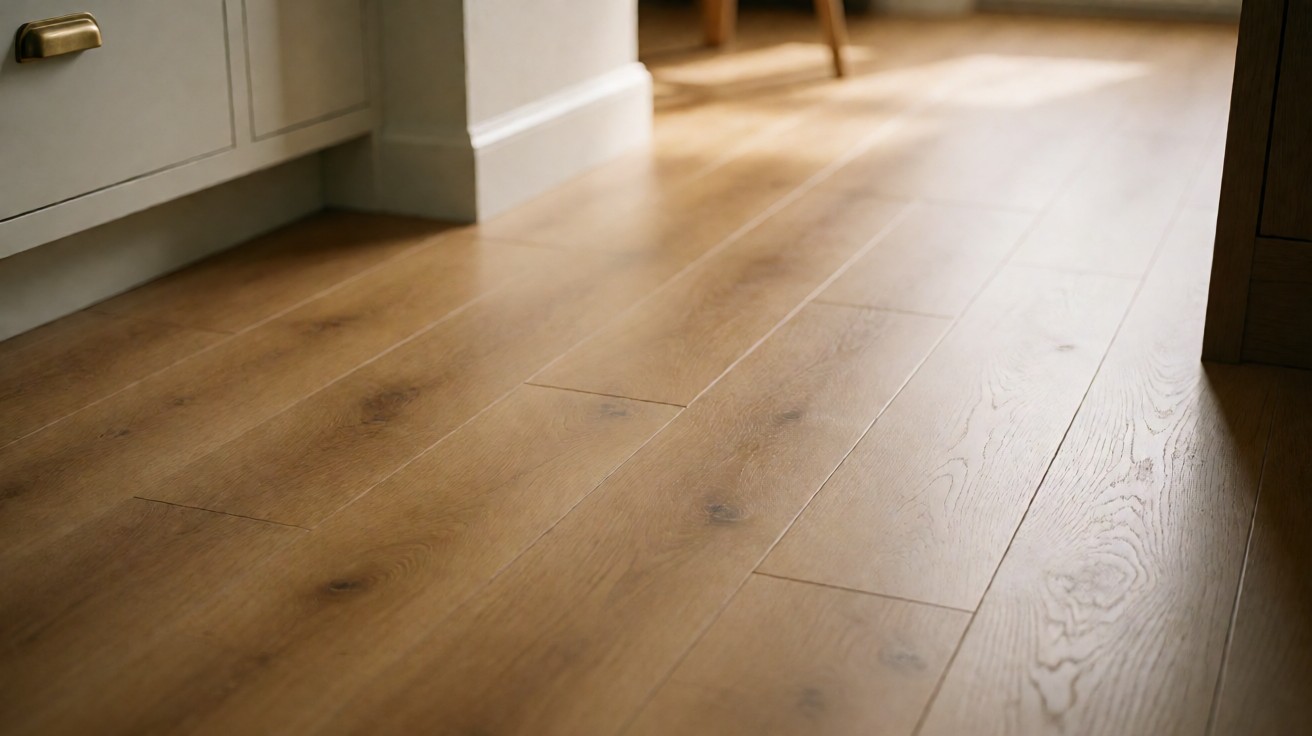
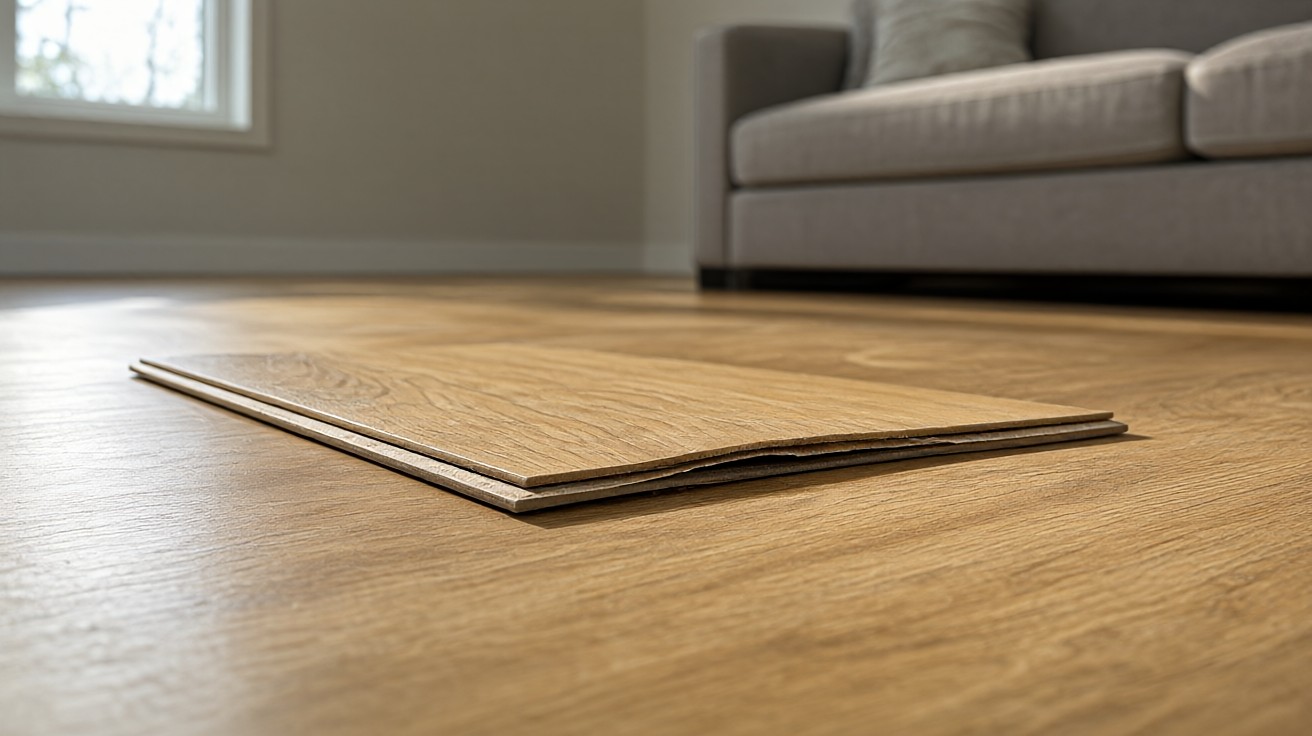
Swelling usually shows first at the long edges and short ends of planks, where the joint is thinnest. The seam rises into a ridge you can feel with a fingertip, and the plank edge may look slightly darker than the face. In bad cases the plank cups across its width and the floor feels uneven underfoot.
Act early. Small ridges grow.
It is easy to confuse swelling with buckling. Buckling is the whole floor lifting in a hump because expansion gaps were too small or the floor was pinned. Swelling is local, raised seams or plank edges, and it traces back to water rather than to temperature or gap size.
Is the Swelling at the Seam or Across the Plank?
Seam ridges point to water entering the joint, either from cleaning water, spills, or humidity cycling. Cupping across the plank points to moisture coming up through the subfloor or condensing under the plank. The two paths need different fixes, so identifying the location saves time and money.
Why the Core Swells: The Hygroscopic Problem
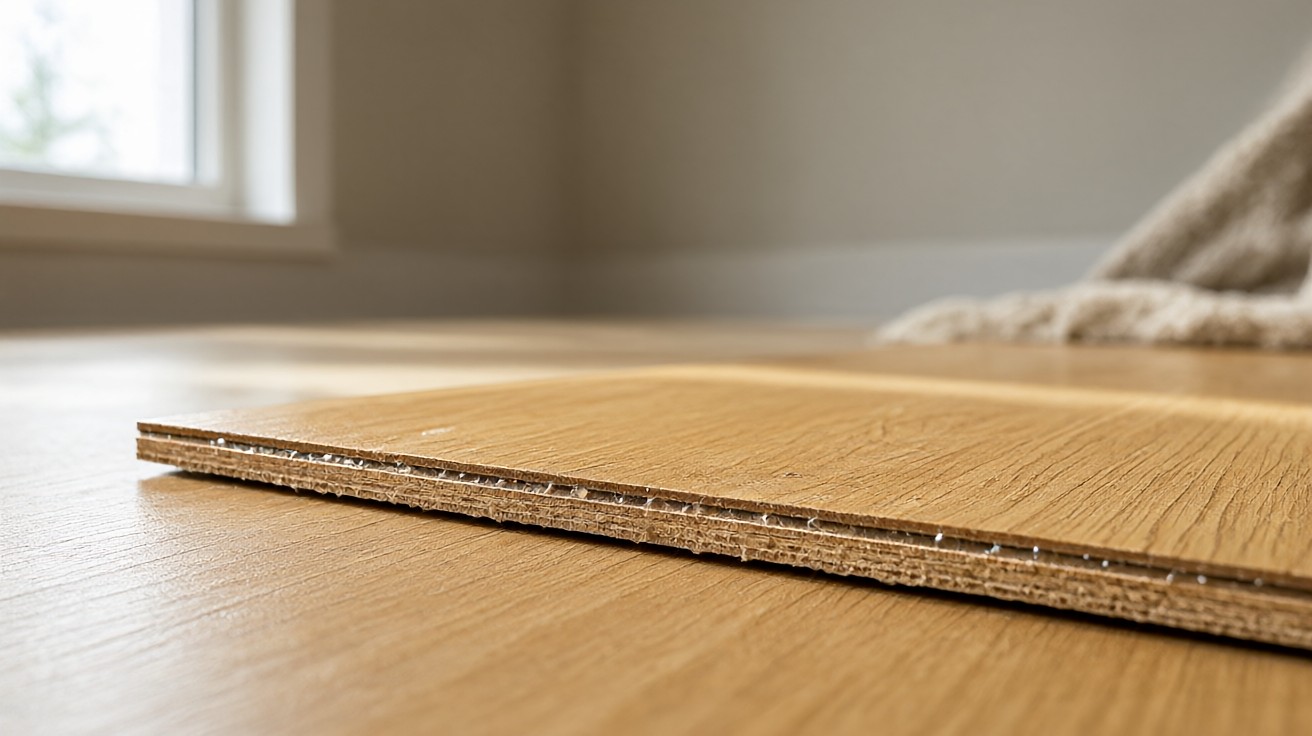
Laminate is a layered product. The decorative surface is a melamine-impregnated paper, the backing is a balancing layer, and the middle is a wood-based core, usually high-density fibreboard (HDF). HDF is made from wood fibres pressed with resin, and wood is hygroscopic: it absorbs and releases moisture with the surrounding air.
When the core takes on water it expands. Because the top and bottom layers are sealed and stiff, the expansion has nowhere to go but sideways and upward, which is why joints lift.
The EPLF technical bulletin on laminate installation notes that expansion and contraction of the core material caused by changes in moisture content is a property typical and intrinsic to the product, and that in persistent extreme humidity, below 30 percent or above 90 percent relative humidity, dimensional changes and distortion follow.
This is also why the core density matters. A denser HDF absorbs water more slowly but still absorbs it, and once saturated the swelling is the same order of magnitude regardless of brand.
Moisture Sources From Above
Surface water is the most common trigger. Wet mopping with a soaked mop, spills that sit for an hour, pet accidents, and plant pots without saucers all put free water on the floor. Water finds the joint, wicks into the core, and the seam swells within 24 to 48 hours.
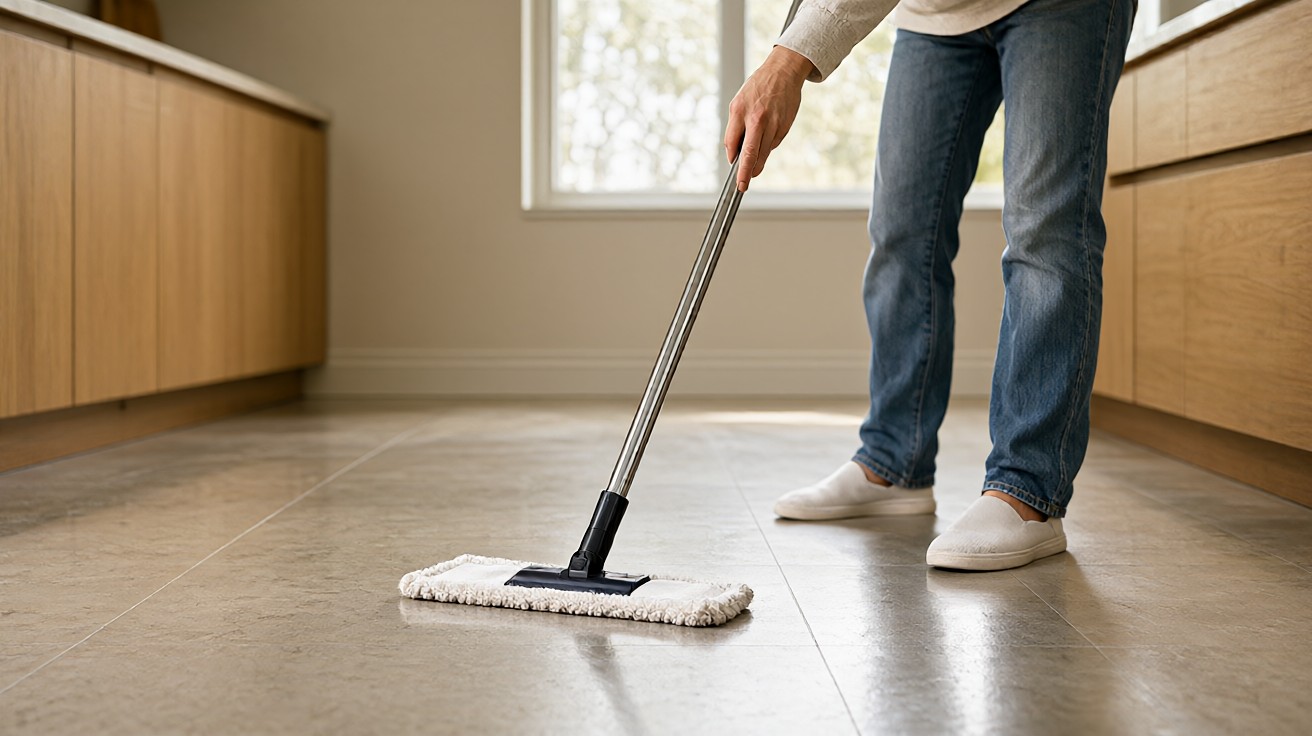
The EPLF cleaning bulletin is explicit: wipe with a very slightly damp cloth, wring it out thoroughly first, and take care that no water penetrates the joints, because the core layer is made of wood and water causes unsightly swelling of the joints. It also advises against film-forming polishes and waxes, which can trap moisture and make the problem worse.
Which Cleaning Habits Cause Swelling?
Steam mops are the worst offender because they force hot water and vapour directly into the joints. String mops that are not wrung out, and leaving standing water after a spill, are the next most common. A microfibre mop that is only damp, plus immediate drying of spills, keeps surface moisture out of the core.
| Moisture source | Typical path into core | Time to visible swelling | First sign |
|---|---|---|---|
| Wet mopping or steam mop | Joint wicking from surface | 24 to 48 hours | Raised seam ridges |
| Spill left sitting | Joint wicking from surface | 12 to 36 hours | Darkened plank edge |
| Pet accident | Joint plus surface penetration | 24 to 72 hours | Localised ridge |
| Plant pot without saucer | Continuous drip at one spot | 1 to 2 weeks | Cupped plank |
Moisture Sources From Below
Water from below is harder to spot because the surface can look dry while the core absorbs moisture from underneath. Concrete slabs that were not moisture-tested, crawl spaces without vapour barriers, and plumbing leaks under the floor all push water vapour up into the plank.
The EPLF installation bulletin sets a vapour barrier requirement for screed floors and limits relative humidity in mineral sub-floors to 75 percent RH measured to EN 17668. It also recommends a water vapour control layer to protect against rising damp. If those steps were skipped, the floor is taking on ground moisture every day.
A slab that tests above the limit needs mitigation before flooring goes down, not after. Once the core has swollen from below, drying the room will not reverse it because the fibres have already expanded and the resin bonds have broken.
Ambient Humidity and Seasonal Movement
Even without a spill or a leak, air humidity drives movement. The EPLF cleaning bulletin states that a room temperature of 18 to 25 degrees Celsius with relative humidity of 50 to 70 percent creates optimal conditions, and that with higher humidity the wood material panels tend to swell, while low humidity coupled with high temperatures causes shrinkage.
This seasonal cycling is normal and is exactly why expansion gaps exist. The problem starts when the gap is too small, when the floor is installed tight to a wall or pipe, or when humidity swings are extreme and prolonged. A winter with the heating on and no humidifier can shrink the floor and open gaps; a wet summer can swell it and close them.
When gaps close completely the floor has nowhere to expand, and the pressure transfers into the joints, which then swell and ridge. That is why a floor can swell in summer even with no water on it.
Watch the seasons. Gaps tell the story.
AC Rating and Water Resistance Limits
The AC rating on a laminate box describes abrasion resistance, not water resistance. AC3, AC4, and AC5 tell you how many abrasion cycles the surface survives; they say nothing about how the core handles water. A high-AC laminate with an untreated HDF core will swell just as fast as a low-AC one.
Water resistance is a separate specification. Manufacturers test it with thickness swelling after 24 hours of immersion to ISO 24336, and with joint water resistance to ISO 4760.
The EGGER NatureSense data sheet, for example, lists thickness swelling of 6 percent plus or minus 1 percent after 24 hours, and 24-hour water resistance with a qualitative rating after re-drying of less than 3 and a quantitative rating of 0.3 millimetres with no water leakage.
Mohawk Vitality lists thickness swelling of no more than 18 percent after 24 hours at 20 degrees. FINline lists no more than 10 percent swelling after 24 hours of total board immersion.
Those numbers are the honest comparison point. A product rated at 6 percent swell is more moisture-tolerant than one rated at 18 percent, but neither is waterproof. Water-resistant laminate delays swelling; it does not prevent it.
What Does Water-Resistant Laminate Actually Resist?
It resists short, surface contact. Spills wiped within the manufacturer window, usually 24 to 72 hours, bead on the surface and do not reach the core. Standing water, steam, and subfloor vapour still get through. The NALFA Surface Swell Test exists precisely to measure how an assembled joint handles prolonged water exposure, and it is an add-on certification to LF-01, not a default.
| Spec | What it measures | Typical value | Reader takeaway |
|---|---|---|---|
| AC rating (AC3/AC4/AC5) | Surface abrasion cycles | AC4 = 4000+ cycles | Durability, not water tolerance |
| Thickness swelling, ISO 24336 | Core expansion after 24h immersion | 6% to 18% | Lower is better for moisture |
| 24h water resistance, ISO 4760 | Joint leakage and swell after soaking | <0.3 mm swell, no leakage | Delays swelling, does not stop it |
| Use class, EN 13329 | Traffic and moisture class | 23/32 or 23/33 | Higher class, stricter moisture test |
Core Types and Swell Performance
Standard HDF cores swell the most. Moisture-resistant HDF, often called aqua or aquaReject core, is treated with wax or resin and swells less, but it is still wood and still absorbs water. Some products add an impregnated joint or a waxed tongue and groove to slow wicking.
The HARO TRITTY 200 Aqua system uses a highly swellable aquaReject core board plus an aquaTec impregnation and is approved for damp rooms when glued over the entire surface, withstanding standing water for up to 24 hours. That is a system solution, not a property of the core alone, and it requires the full glue-down installation to achieve the rating.
A core density above 850 kilograms per cubic metre, as listed on the FINline spec sheet, slows water uptake but does not change the end state. Density is a rate, not a guarantee.
Manufacturer Moisture Limits
Every laminate warranty carries moisture conditions. The EPLF installation bulletin specifies a mean moisture content at 50 percent relative ambient humidity and 23 degrees Celsius of 6 plus or minus 2 weight percent for MDF cores and 5 plus or minus 2 weight percent for HDF cores. Subfloors must be dry enough that the installed floor does not exceed those values.
Manufacturers also set acclimation and environmental limits. Most require the flooring to sit in the room for 48 hours at 18 to 24 degrees Celsius and 35 to 65 percent relative humidity before installation. Installing outside those limits, or over a slab that has not been tested, voids the moisture warranty even if the product itself is rated water-resistant.
Read the warranty document, not the box. The box sells features; the warranty lists the conditions under which swelling is covered, and those conditions almost always include a moisture test result and an expansion gap measurement.
Measure first. Then install.
Installation Gaps and Subfloor Prep
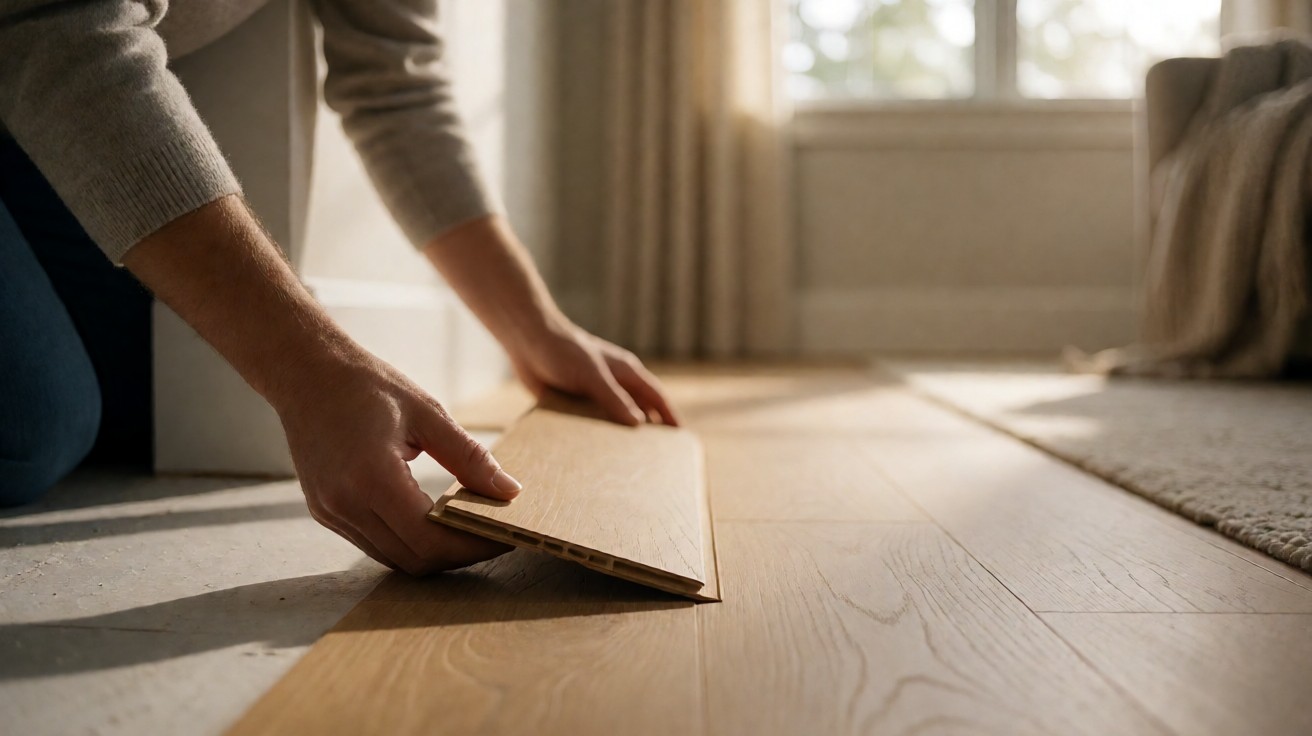
Expansion gaps are the mechanical defence against swelling. A floating laminate floor needs a gap of 8 to 10 millimetres around the perimeter and around pipes and thresholds, and the gap must stay open.
If baseboards or quarter-round are nailed through the plank, or if the floor is installed tight to a door frame, the expansion has nowhere to go and the joints swell under pressure.
Subfloor flatness matters as much as moisture. A dip or hump flexes the plank at the joint, opens a hairline gap, and that gap becomes a water path. The EPLF bulletin requires the subfloor to be even and sufficiently dry, with a vapour barrier over screed, before laying.
For a deeper look at gap sizing and the mechanics of movement, see the flooring expansion gaps explained guide, and for installation steps see how to install laminate flooring.
How to Tell Swelling From Other Problems
Not every raised seam is moisture damage. Click-lock joints can separate if the locking profile was not fully engaged, and planks can peak if the floor was installed over an uneven subfloor. The difference shows in pattern and behaviour.
Moisture swelling is local, often near a water source, and the plank edge feels soft or fibrous. A mechanical peak from an uneven subfloor is linear, follows a hump, and the plank stays hard. Seasonal cupping is uniform across a room and reverses when humidity normalises.
If the swelling is uniform and seasonal, do not replace planks. Add a humidifier in winter and ventilation in summer, and check that the expansion gaps are open. If it is local and soft, moisture has entered the core and that plank needs replacing.
Repair or Replace: The Decision
Once HDF has swollen, it does not return to its original dimensions. Drying the room may flatten the surface slightly but the fibres stay expanded and the joint stays weak. The decision is whether the damage is local or widespread.
For one or two planks, replace them. Laminate is designed for plank replacement, and the guide to repairing chipped laminate flooring covers the removal and replacement process.
For gaps that opened after swelling, see how to fix gaps in laminate flooring. If more than a third of the floor is affected, or the subfloor is the moisture source, the whole floor comes up and the subfloor is fixed first.
Repair cost for a small area is typically 200 to 600 US dollars for materials and labour, while full replacement runs 4 to 8 US dollars per square foot installed. Those figures are consistent with Angi and HomeAdvisor ranges for laminate repair and replacement.
How to Prevent Swelling
Prevention is cheaper than repair. Keep relative humidity between 35 and 65 percent, use a damp not wet mop, wipe spills immediately, and put saucers under plant pots. Test the subfloor moisture before installation and install a vapour barrier over concrete and crawl spaces.
Choose a product with a low thickness swelling rating and a water-resistant joint if the room is a kitchen or a hallway. Even then, treat the floor as water-resistant, not waterproof, and follow the manufacturer cleaning instructions. Note that waterproof laminate products still rely on sealed joints and are not immune to subfloor moisture.
For routine care that keeps water out of the joints, see how to clean laminate floors. If you are weighing a switch to a more moisture-tolerant material, how to install LVP flooring covers a fully waterproof alternative, and flooring transitions, trim, and finishing costs helps budget the changeover.