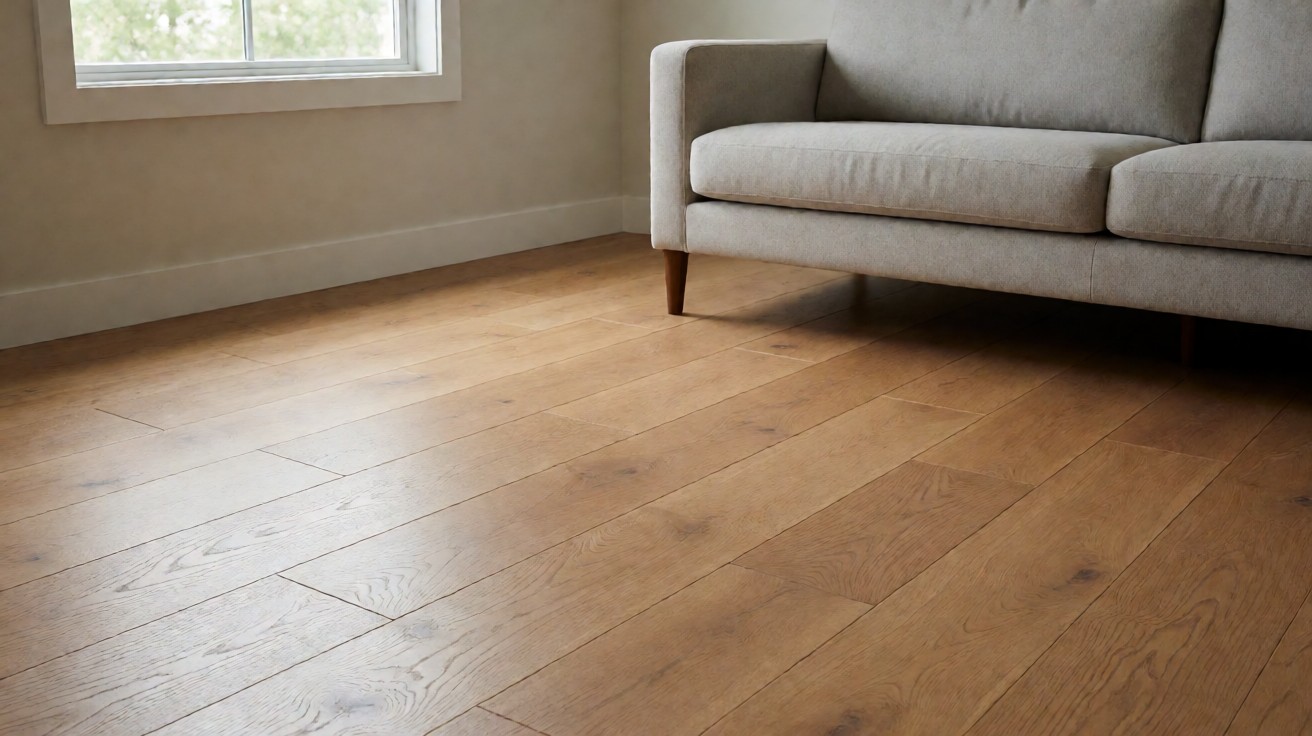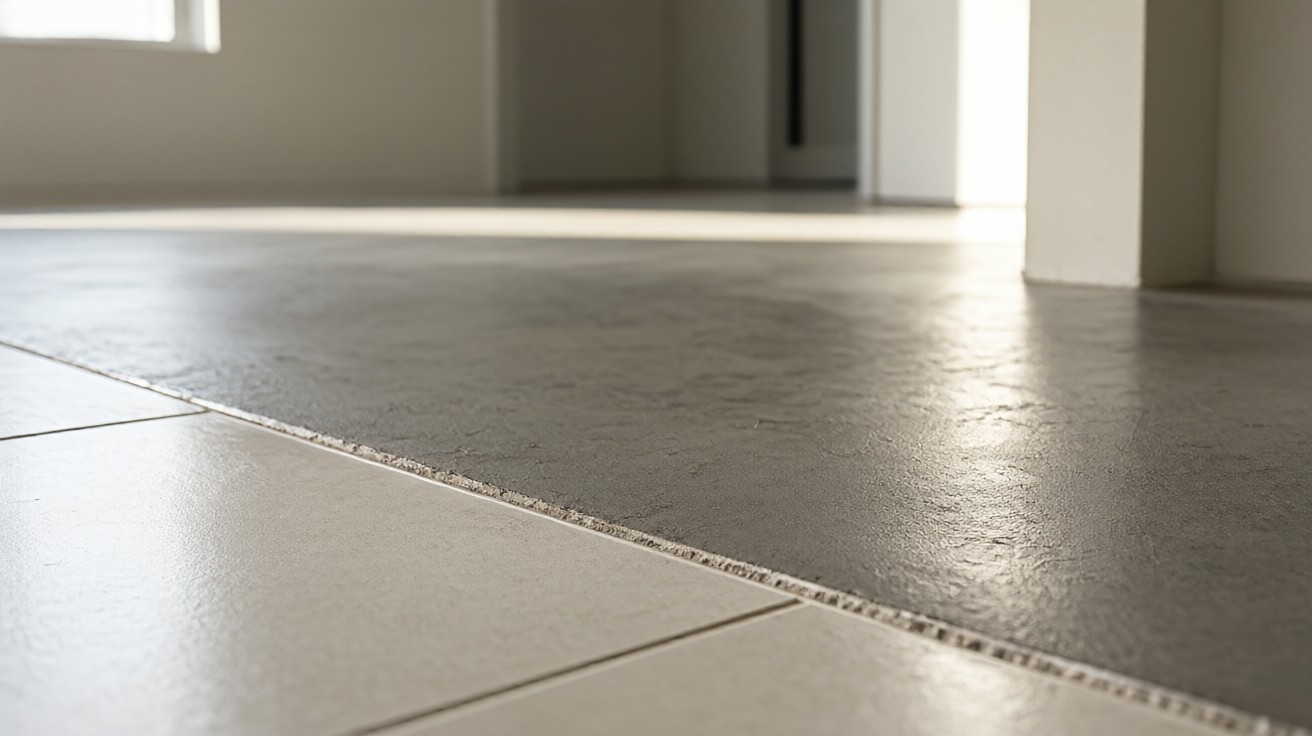

Living room echo comes from hard floors and flat walls, so the fix is a soft rug over half the floor plus an acoustical underlayment, not a quieter floor.
Hardwood, tile, and polished concrete bounce sound back instead of absorbing it, and that returned energy is what you hear as echo. A living room with a large rug is halfway to quiet.
Quick Answer: Where the Echo Comes From and What Fixes It
The answer is usually not a quieter flooring material. It is a floor assembly that absorbs and breaks up reflection: a rug with a dense backing, an acoustical underlayment under a floating floor, and soft furniture.
Start with the rug. If your floor is bare hardwood, tile, or laminate over a wood subfloor, cover at least half the floor with a rug whose NRC is 0.30 or better, running it within 12 inches of the walls on two sides.
That one change removes more echo than any underlayment you can buy. The underlayment matters for what you hear downstairs, not for what you hear in the room.
What IIC rating is good enough for a living room?
An IIC rating of 45 is the practical floor for a home interior, 50 is comfortable, and 60 or above means the assembly is doing real work. Homes are judged on comfort, not code.
If you already know your floor’s rating and it is low, the best flooring for living rooms guide covers which materials you can overlay to raise it without a full tear-out.
How STC, IIC, and NRC Describe Three Different Problems
Three ratings get mixed up constantly, and each measures something different. STC is airborne transmission, IIC is structure-borne impact transmission, and NRC is how much a surface absorbs.
Put another way, an NRC of 0.30 absorbs roughly 30 percent of the sound energy hitting a surface, and the rest returns as reflection. In decibel terms, a hard surface can hold a conversation 5 dB louder than a soft-lined room.
Confusing them is why people buy a high-NRC product and then wonder why the thump from the room below is unchanged. Absorption and isolation are separate jobs, and a floor needs both to work.
ASTM E90 is the lab test method producing a Sound Transmission Class and an Impact Insulation Class for a floor assembly. ASTM E413 converts a measured transmission loss curve into a single STC number.
ASTM E492 does the same job for impact sound, producing the IIC rating. Both standards report results in the same frequency Hz bands, which is why the two numbers can be compared side by side.
The Carpet and Rug Institute (CRI) publishes carpet and pad NRC data on the same 0.00 to 1.00 scale, which is handy when comparing a rug against a hardwood floor.
Typical assemblies land between 45 and 60 IIC, wide enough that the difference between bare 3/4 inch plywood and the same plywood with resilient underlayment can be 15 IIC points, a gap larger than most homeowners expect.
NRC is really a sound absorption coefficient averaged over four bands, and a 0.10 difference sounds trivial on paper until you hear it in a 320 sq ft room with a hard ceiling above it.
NRC runs from 0.00 to 1.00 and says how much sound hitting a surface is absorbed rather than reflected, measured across 250 Hz, 500 Hz, 1000 Hz, and 2000 Hz. Hardwood scores near 0.10, thick carpet on a dense pad near 0.50, and acoustic ceiling tile near 0.85.
Does a higher NRC rating mean a quieter room?
Only for sound that hits the surface directly. A rug with an NRC of 0.40 does nothing about footsteps travelling down a staircase, and a ceiling at NRC 0.85 does nothing about sound bouncing off bare hardwood.
You need absorption at the surface and isolation at the floor to fix both halves of the problem. One without the other leaves you listening to an echo that no product can reach.
Where Reflectivity Comes From: Hardwood Versus Carpet
Hardwood is the most reflective common living room floor because a sealed wood surface returns roughly 60 to 75 percent of the sound that hits it, and carpet absorbs most of what reaches the pile. That is why a room that echoes in bare wood often stops echoing the week a rug goes down.
The hardwood vs carpet reflectivity gap is the largest acoustic difference between the two dominant living room floors, and it is worth more than most people expect.
The finish matters more than most people expect. A high-gloss polyurethane reflects more than a matte oil finish, and polished concrete or porcelain tile reflects more than either. If your floor already has a low-sheen finish, replacing it is rarely worth the money.
Carpet wins the absorption contest outright. The carpet versus hardwood living room comparison walks through the full trade, and sound is the strongest argument for carpet even though it is only one argument.
| Surface | Typical NRC | Reflected sound | What it does for a living room |
|---|---|---|---|
| Hardwood with satin finish | 0.10 | High, roughly 60 to 75 percent | Reflects speech and music back into the room |
| Matte or oiled hardwood | 0.15 | Moderate | Small improvement, not a solution |
| Porcelain or ceramic tile | 0.05 to 0.10 | Very high | Worst common case for echo |
| Laminate | 0.10 | High | Behaves like hardwood acoustically |
| Thin felt pad alone | 0.10 | No change | Isolates impact but absorbs almost nothing |
| Carpet, 6 to 8 lb pile | 0.30 to 0.40 | Low | Meaningful reduction in reflection |
| Carpet over 8 mm pad | 0.50 to 0.60 | Very low | Best common floor assembly for echo |
Read that table with one caveat: an NRC difference only shows up if the rug is large enough and dense enough to matter in the first place. A 2 by 3 ft rug at NRC 0.35 sitting on bare hardwood changes almost nothing at all.
Size first, then density, in that order.
Underlayment, Acoustical Felt, and the Floating Floor
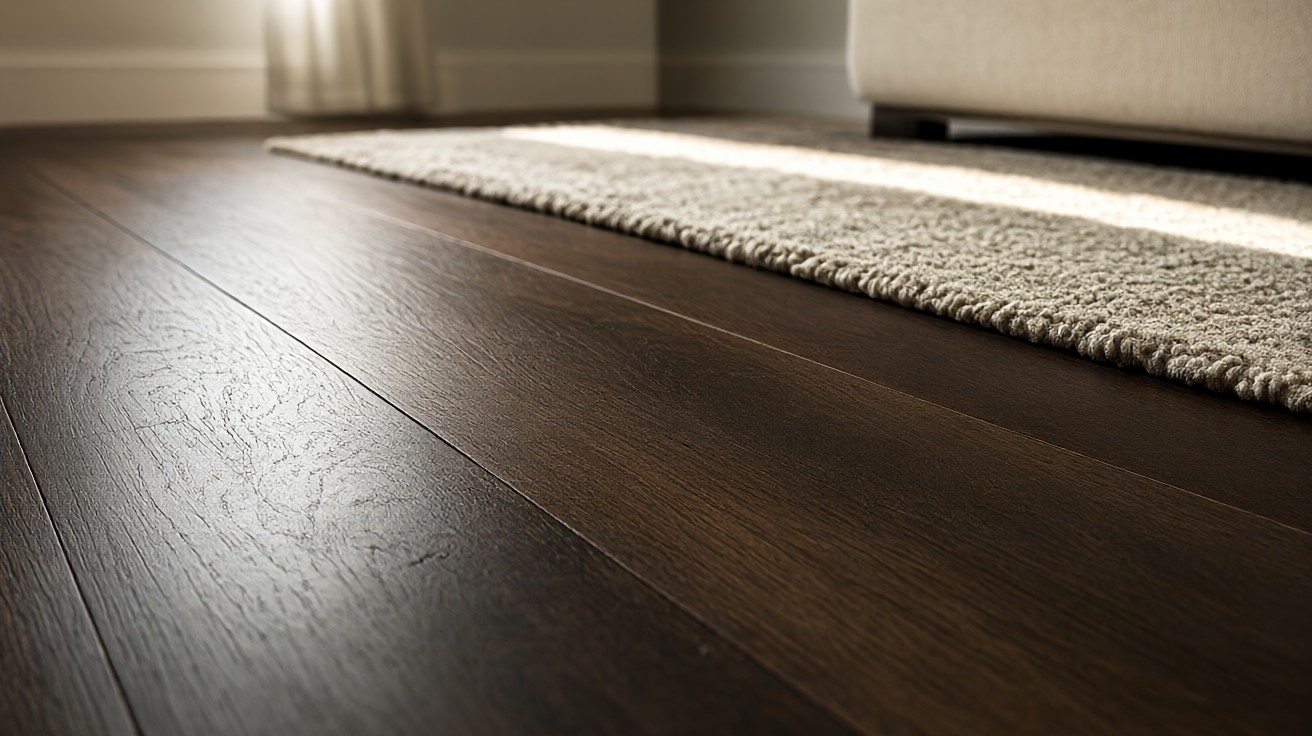
A floating floor is a layer of resilient material between the finish floor and the subfloor, and that layer does the acoustic work. When the floor moves independently of the structure, impact energy is dissipated in the material instead of being driven straight into the joists.
The result is typically 10 to 15 IIC points of improvement over a nailed-down floor of the same thickness, and that is the single biggest measurable gain you can get in the structure itself.
Three underlayment families do this. Acoustical felt is a dense fibre material, usually 3 mm to 5 mm thick, that gives almost no footstep feel but adds real isolation.
Rubber or cork underlayment is thicker, usually 6 mm to 10 mm, and adds both isolation and some absorption. Foam underlayment, the cheapest at 1.5 mm to 3 mm, mostly handles moisture protection, so it is a poor choice when echo is the problem.
The underlayment must be the product the flooring manufacturer approved for that floor. A floating floor over the wrong underlayment voids the warranty, and a warranty voided over a 5 mm saving is a bad trade.
Choosing the padding inside the living room flooring ideas and layouts guide is the same acoustic decision in a different order. Specify the underlayment at install time, because it cannot be added later under a nailed finish.
Subfloor Resonance and the Squeak You Can Feel
Subfloor resonance happens when the subfloor and the joists form a springy panel that vibrates at a low frequency when something lands on it. Because that panel runs across several joists, one footfall can set the whole area ringing.
You hear resonance as a hollow boom rather than a sharp tap. Tap the floor with a knuckle and listen for a drum, and if the surface feels springy near a wall, the joist or blocking underneath is the weak point.
If footsteps carry downstairs as a thump rather than a tap, you have impact transmission instead of resonance. Resonance is fixed structurally, transmission by the floor assembly.
Both problems share one remedy, which is inserting a resilient layer between the walking surface and the structural panel. Bridging joists with blocking at 16 inches on center also stiffens the assembly and pushes the resonant frequency where it dissipates faster.
How Big a Rug Actually Needs to Be
A rug floating in the middle of the floor with hardwood showing around it will not fix the echo, because reflection still comes off the exposed floor. The rug must cover enough of that surface, with edges overlapping the hard floor.
The practical rule for a living room is a rug covering at least 50 percent of the floor area, plus a second smaller rug on top if the floor is large. Layering two rugs raises the effective absorption.
The classic 9 by 12 ft over a 5 by 8 ft combination is not a decorator trick. It is an acoustic one, because the second rug fills the gap where the first ends.
Padding under the rug matters as much as the rug itself. A wool rug on a 1/4 inch felt pad with an NRC near 0.15 does not perform like the same rug on a 3/8 inch dense pad at 0.30.
If the rug is thin, a separate dense pad is the cheapest acoustic upgrade available to a renter, and it costs a fraction of what an underlayment upgrade does during a floor replacement.
What pile height should an acoustic rug have?
Look for a pile of 1/2 inch or more if you want real absorption, and check the published NRC rather than guessing from texture. Dense wool at 1/2 inch pile commonly reaches an NRC of 0.50 or higher, while low-pile flatweave rugs sit at 0.10 to 0.20.
The Ceiling and the Furniture Are Half the Room
A hard floor is only one of six surfaces in a room, and echo comes from all of them working together. A flat drywall ceiling reflects roughly 85 to 90 percent of the sound that hits it.
That is why a hard floor and a hard ceiling send the same conversation back at you from two directions at once. The floor reflects upward, the ceiling reflects downward, and they meet where you are sitting.
Curtains, upholstered furniture, and bookshelves matter acoustically even though nobody buys them for that reason. A fabric sofa absorbs mid-frequency energy, and a bookcase full of books does the same.
A large rug and a full sofa in the same room make a bigger difference than two rugs alone, which is why an empty room with good flooring still sounds worse than the same room furnished.
Furniture is free sound treatment.
Vaulted ceilings make the problem worse because reflected sound has further to travel before returning, and hard floors are common in exactly those rooms. If you have a vaulted living room, treat the ceiling before you touch the floor.
Acoustic Performance by Flooring Material
No material on its own hits a target IIC of 50 in a typical wood-framed house, but the range is wide and the ranking is stable. The table below shows typical lab figures for a 3/4 inch plywood subfloor with a floating finish floor over resilient underlayment.
| Assembly | Typical IIC | Typical STC | Weak point |
|---|---|---|---|
| Solid hardwood, nailed to plywood | 42 to 45 | 48 to 52 | Almost no isolation from impact |
| Engineered hardwood, floated on 2 mm foam | 45 to 48 | 50 to 53 | Thin foam gives little isolation |
| Engineered hardwood on 5 mm felt | 50 to 53 | 52 to 55 | Needs a moisture-rated felt |
| Laminate on 8 mm cork or rubber | 52 to 56 | 53 to 56 | Moisture sensitivity of the core |
| Rigid core vinyl on 1.5 mm pad | 48 to 51 | 52 to 55 | Factory pad is usually thin |
| Carpet over 8 mm pad | 55 to 60 | 48 to 52 | Highest material cost per sq ft |
Carpet wins the impact test because it decouples the walking surface from the subfloor and absorbs the strike instead of transmitting it. Hardwood wins on style and durability, so the practical answer is hardwood with an acoustical layer.
That is the trade in one line.
Notice that STC barely moves across that table. Airborne sound through the assembly is already handled by the walls and the mass of the subfloor, so the STC column is the one you rarely have to optimise for.
What the Living Room Demands That Other Rooms Do Not
Imagine a 16 by 20 ft living room with a vaulted ceiling, a wall of glass, and hardwood from the entry to the fireplace. The floor area alone is 320 sq ft, and the ceiling height pushes the first reflection past where a rug reaches.
In that room, echo has two separate sources. Hardwood reflects the mid-frequency energy of speech and television back across the empty floor, and the vaulted ceiling and glass wall return it again.
The second source is footsteps. Without an isolation layer, every step drives the 3/4 inch plywood and the joists below, and in a room that size the low-frequency boom arrives late enough to sound like a separate event rather than part of the step.
The fix follows the size of the room. A rug covering 160 sq ft or more handles the reflection, an acoustical felt or cork layer of 5 mm or thicker handles impact, and curtains on the glass wall cut the second reflection.
The same three steps in a 10 by 12 ft room would be overkill on the ceiling and undersized on the rug. Room dimensions decide how much of each treatment you need.
Decision Rules for Fixing Echo in Your Living Room
Work down this list and stop when the echo is gone. Each step costs less than the one below it, and most rooms never reach the bottom.
If you can cover 50 percent or more of the floor with a rug that has an NRC of 0.30 or better, start there. If the echo persists, add a second rug on top of the first. If it is still there, treat the walls: hang lined curtains, add an upholstered sofa, and fill the shelving.
Only after those three steps do you look under the floor. If you are replacing the flooring, specify a floating installation with acoustical underlayment of 3 mm or thicker and target an IIC of 50 or better above another occupied space.
Underlayment first, always, before the rug.
If the room is on the ground floor or on a concrete slab, the echo is a room-surface problem rather than a transmission problem, so spend the money on rug and fabric instead of underlayment. A concrete slab with no basement underneath cannot transmit much anyway.
Two thresholds are worth memorising. Below an IIC of 45, footsteps are clearly audible in the room below. Below an NRC of 0.20, a rug will not move the needle on its own.
The National Wood Flooring Association (NWFA) publishes guidance on flooring types and their acoustic behaviour that is worth reading before you specify anything, especially when you are balancing a hardwood look against noise.
Common Mistakes That Keep Rooms Echoing
The most common mistake is a rug that is too small. It looks intentional, it sits under the coffee table, and it changes almost nothing about the reflection off the surrounding floor.
The second most common is choosing a rug with no pad, which gives up the cheapest improvement in the whole room. The third is specifying a finish floor without specifying the underlayment and accepting whatever the installer has in the truck.
The third is specifying a finish floor without specifying the underlayment and accepting whatever the installer has in the truck. A 1.5 mm foam pad under hardwood is a moisture barrier doing an acoustic job it cannot do.
The fourth mistake is chasing sound through the floor structure while the television in the same room is the actual source. Nothing in the joists will help you there.
The fifth mistake is assuming paint and drywall can be made acoustic. A suspended ceiling tile with an NRC of 0.80 or higher works because it is fibrous with a cavity behind it, and painted drywall has an NRC of about 0.15.
One last note on what this article cannot tell you. A lab IIC number describes a specific assembly in a specific laboratory, and your room will sit near it rather than exactly on it.
If the echo bothers you daily, an on-site measurement by an acoustical consultant is worth more than any spec sheet, because it measures your joist spacing, floor build-up, and actual ceiling height rather than a laboratory approximation.
Both angles matter here, and both are covered in Why Your Living Room Floor Sounds Hollow or Squeaks.
Last updated: November 2026