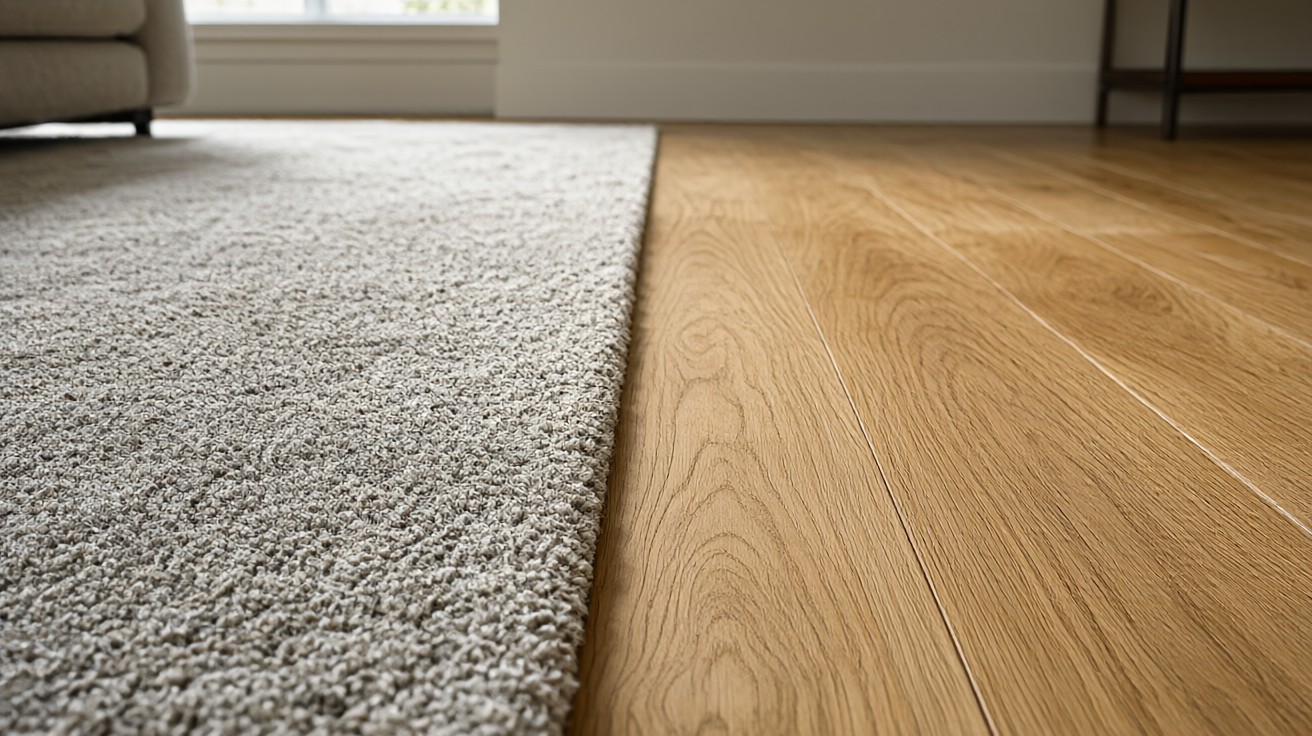

Quick Answer: In a living room, carpet wins on comfort and acoustics, hardwood wins on resale and pet claws; choose by traffic and who lives there now.
This space is the one where both materials are genuinely good and genuinely wrong at the same time, because it holds the sofa, the television, the bookcase and the people, and each of those asks the floor for something different.
Why the Living Room Is the Hardest Room to Call
A living room pulls in opposite directions. It wants the durability of a hallway, the comfort of a bedroom and the look of a dining room, and no single material delivers all three, so the decision is really about which gap you will live with.
The mistake is choosing one material and asking it to do every job. Hardwood takes the scratch marks. Carpet takes the quiet and the warmth. If you write down what your floor actually absorbs on a normal Tuesday, the right family becomes obvious and the wrong ones drop out on their own.
This page is the living-room application of the two materials. The general material comparison lives at carpet vs. hardwood flooring, and the broader ranking of living-room materials lives at best flooring for living rooms. Read those first if you have not yet settled the material family.
Carpet in a Living Room: Where It Wins and Where It Frays
Carpet is the only soft floor in mainstream residential use, and in a living room that single fact decides more than any specification sheet. It is warmer underfoot in January, quieter underfoot at every hour, and materially more forgiving to a child or an older adult walking on it.
Where it frays is traffic and furniture. A living room concentrates weight in a few spots: the sofa feet, the armchair, the coffee table. Carpet compresses there and does not fully recover, so after five to eight years the traffic lane between the door and the television reads as a visible path even when the rest of the room looks new.
Carpet also holds everything the room produces. Crumbs, pet hair, the fine dust that settles on a television stand, and the occasional spill all stay in the pile until they are extracted. A good vacuum twice a week handles the surface; a professional hot-water extraction once a year handles the rest.
The carpet standard that matters here is the IICRC S100 textile floor covering standard, which governs cleaning frequency and method rather than construction. Under it, a living room with daily use needs extraction at least annually, and more often with pets.
If you are weighing wall-to-wall against an area rug over hardwood, that is a different decision with a different cost curve, and the open plan discussion at best flooring for open plan spaces covers the transition question.
What Kind of Carpet Survives a Living Room?
Low, dense pile. A cut pile of 0.375 to 0.5 inch with a face weight above 40 ounces per square yard resists crushing under furniture legs better than a plush saxony. Loop pile hides traffic even better but snags on pet claws, so a household with a dog should stay with cut pile.
Subfloor preparation for carpet follows ASTM F710, which requires a flat, dry, clean surface; a deviation beyond 3/16 inch in 10 feet telegraphs through the pile.
Hardwood in a Living Room: Where It Wins and Where It Dents
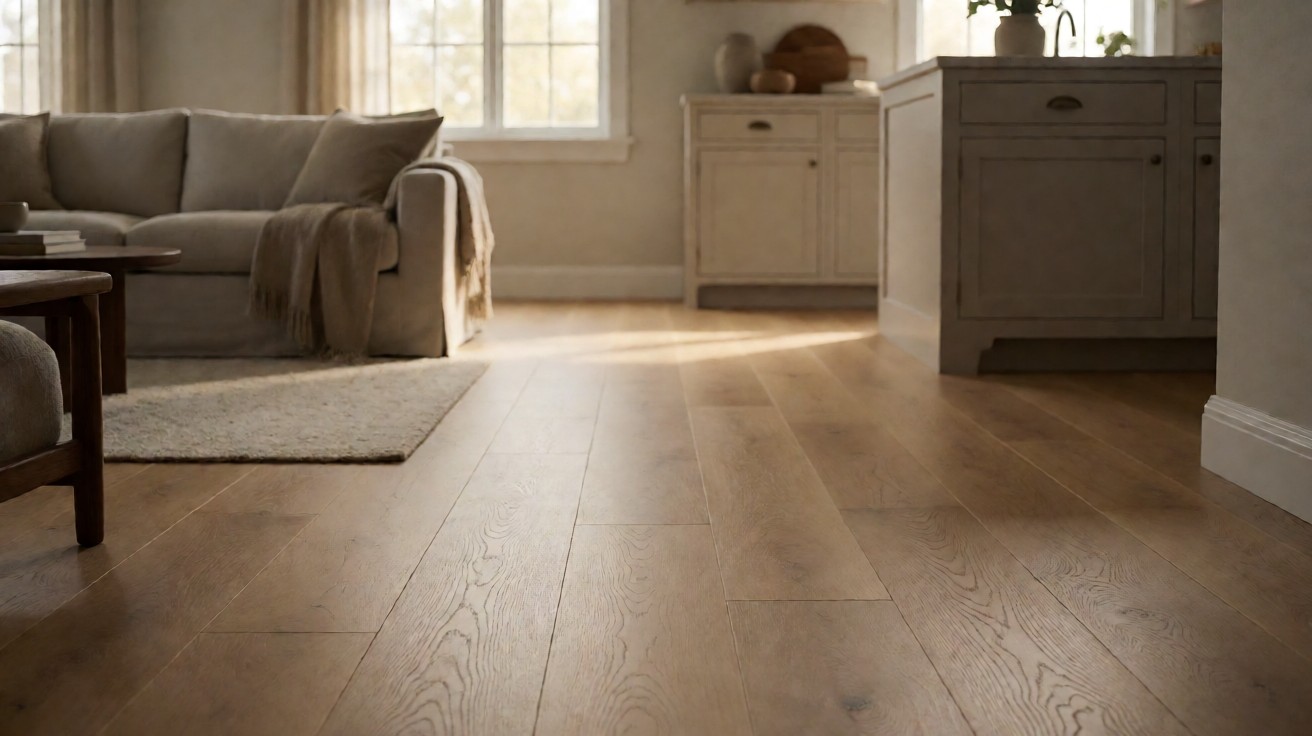
Hardwood is the floor that reads as permanent, and in a living room that perception does most of the selling. It photographs well, it takes a rug without complaint, and it is the surface most buyers expect to see in the main living space.
What it does not take is the living room’s daily abuse. Chair legs dragged across it leave crescents. A dropped remote leaves a dent. A dog’s nails leave a fan of scratches that are only visible in raking light until the day they are visible in all light.
Red oak, at roughly 1,290 lbf on the Janka scale, is the common baseline; harder species like hickory at 1,820 lbf buy time but not immunity.
Water is the other enemy, and the living room has more of it than people admit: a spilled drink during a film, a plant saucer that seeps overnight, a humidifier left running. Hardwood does not forgive any of those, and the damage shows as cupping or dark staining at the seams.
The National Wood Flooring Association (NWFA) guidelines that govern this material put acclimation at three to five days in the room before installation, and they set the moisture content target within two percentage points of the subfloor. Skip either and the floor moves after it is down.
Hardwood’s real advantage is time. A solid or engineered hardwood floor lasts 25 to 50 years and can be refinished every 10 to 15 years, so the cost per year is lower than carpet’s even though the invoice at checkout is higher.
Does Engineered Hardwood Change the Living Room Answer?
Engineered hardwood changes the moisture tolerance and the refinishing count, not the scratch story. The wear layer is real wood, so a dog’s nails mark it the same way. What improves is stability over a concrete slab and resistance to the humidity swings that cup a solid plank.
That distinction matters most on a slab.
Furniture Legs: The Test Neither Material Loves
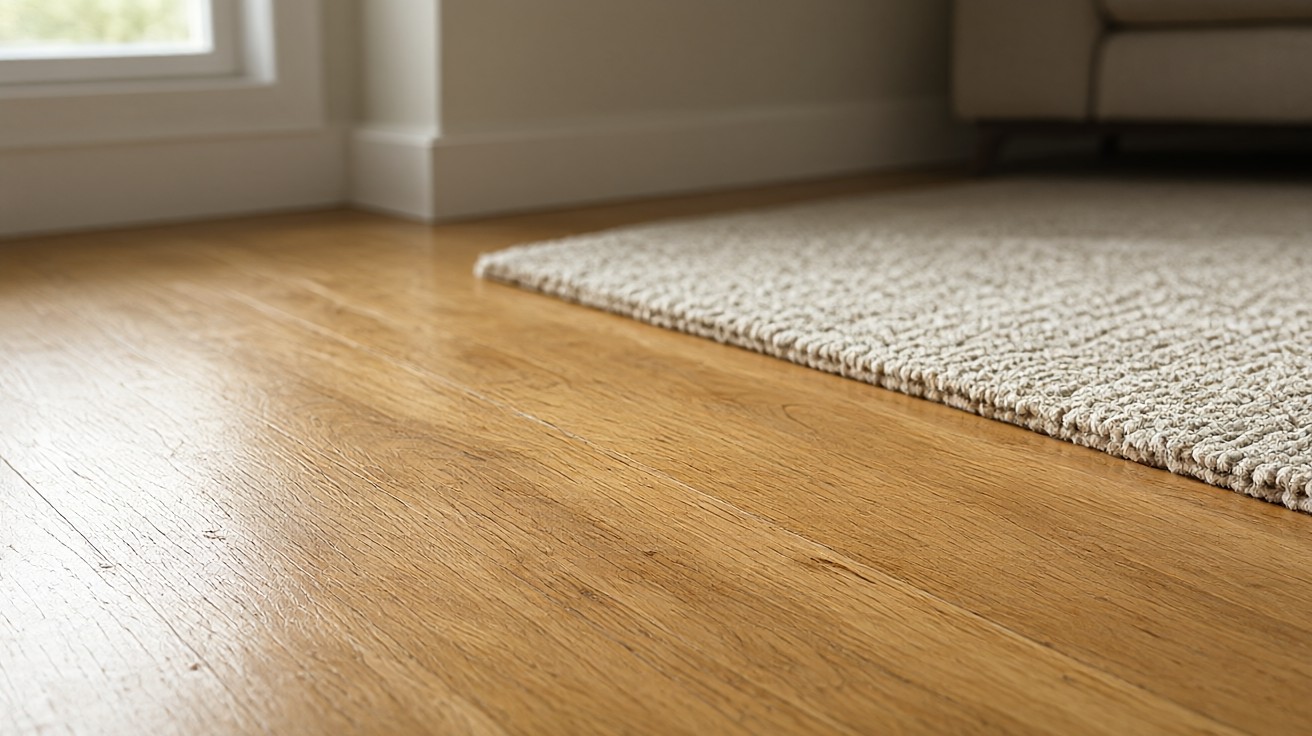
Furniture is the living room’s quiet destroyer, and both materials handle it badly in different ways. On carpet, heavy pieces compress the pile and leave permanent divots; on hardwood, the same pieces leave dents and, worse, trap grit under the feet that scratches the finish when the furniture shifts.
The fix is the same for both and costs almost nothing: put a felt pad under every leg that touches hardwood, and a hard coaster or caster cup under every leg that sits on carpet. Replace felt pads every six months, because they load with grit and become sandpaper.
A 2 inch caster cup under a sofa spreads the load across roughly four times the area of a bare leg.
On hardwood, lift rather than drag when you move a piece, even with pads. On carpet, rotate the furniture a few inches twice a year so the compression marks do not become permanent lanes. Neither habit takes more than ten minutes and both add years to the floor.
Pet and Kid Traffic: What Actually Happens to Each Surface
Pets and children are the real deciders in this comparison, and they split the verdict cleanly. Carpet hides the daily chaos: a knocked-over cup disappears into the pile, a toddler’s fall lands on something soft, and the room sounds quieter with a dog running across it.
Hardwood shows everything. Pet urine that is not caught within minutes stains and can require board replacement. A child’s toy dragged across the floor leaves a track. The payoff is that hardwood cleans in seconds with a damp cloth, where carpet needs extraction.
The honest split is this. A household with a young dog and a toddler usually does better on carpet for the next five years, then switches. A household with older children and no pets usually does better on hardwood from day one, because the maintenance load drops and the resale value follows.
If pets are the deciding factor, the pet guide at best flooring for homes with dogs and cats ranks the families by claw and accident tolerance, and hardwood lands mid-pack there, not first.
How Fast Does a Living Room Floor Show Wear?
Carpet shows a traffic lane in five to eight years and needs replacement in eight to twelve. Hardwood shows scratches in the first year but does not need replacement for 25 to 50 years; it needs refinishing at 10 to 15 years. The cost per year favours hardwood, the comfort per day favours carpet.
That trade is the whole decision.
Acoustics and Comfort: The Reason People Still Choose Carpet
Acoustics is the argument carpet wins outright, and it is the one that survives every other comparison. A living room with hardwood and a television sounds like a room with a television. The same room with carpet and a pad absorbs the mid and high frequencies, and the difference is audible the moment you walk in.
Imagine a film at 9 p.m. with a toddler asleep upstairs: on hardwood every footstep lands in the bedroom, while carpet with a pad cuts the Impact Insulation Class (IIC) transmission enough that the room below stops hearing each step.
Comfort underfoot follows the same line. Carpet with a quality pad at 8 to 10 pounds per cubic foot density is warmer in winter by a measurable margin and softer for the whole evening. Hardwood is cold and hard, and no rug fully fixes the cold because the rug covers only part of the floor.
If the living room is above a bedroom, carpet is not a style choice, it is a neighbourly one. Footfall on hardwood transmits through the structure; carpet with a pad cuts that transmission enough that the room below stops hearing every step.
Indoor air quality matters here too: look for Carpet and Rug Institute (CRI) Green Label Plus certification, which limits volatile organic compounds (VOC) in the carpet and pad, and air the room for 48 to 72 hours after installation.
Resale and the Living Room Floor
Hardwood carries a resale advantage that carpet does not, and in the living room that advantage is at its largest because the living room is the room every buyer walks through first. Published buyer surveys consistently rank hardwood above carpet in the main living spaces, and the gap is widest in the living room specifically.
Carpet’s resale problem is not that buyers dislike it, it is that a buyer cannot tell how old it is. A five-year-old carpet reads as used; a five-year-old hardwood reads as maintained. That asymmetry costs carpet at sale even when it is in good condition.
The practical reading: if you plan to sell within five years, hardwood is the safer investment in the living room. If you plan to stay for ten or more, the comfort advantage of carpet is yours to enjoy and the resale question belongs to whoever buys later.
Cost Over Ten Years, Not at Checkout
| Line item | Carpet | Hardwood |
|---|---|---|
| Installed cost per square foot | 3 to 7 dollars | 8 to 15 dollars |
| Lifespan in a living room | 8 to 12 years | 25 to 50 years |
| Maintenance per year | Annual extraction plus vacuuming | Occasional refinish every 10 to 15 years |
| Cost per year over 10 years | Higher, because replacement lands inside the window | Lower, because no replacement lands inside the window |
The checkout price favours carpet by a wide margin. The ten-year price favours hardwood, because carpet replacement lands inside that window and hardwood’s does not. Neither number is the whole story: carpet’s pad and installation are cheap to redo, and hardwood’s refinishing is a disruption that costs a week of living room.
A useful rule of thumb: if the budget is tight today and the stay is short, carpet is the rational buy. If the budget allows and the stay is long, hardwood pays back.
The Verdict by Household Type
| Household | Better fit | Why |
|---|---|---|
| Young family with toddlers and a dog | Carpet | Soft landings, quiet, hides daily mess |
| Older children, no pets, long stay | Hardwood | Low maintenance, long life, resale |
| Selling within five years | Hardwood | Buyer preference in the main living space |
| Living room above a bedroom | Carpet | Footfall transmission drops sharply |
| Tight budget, short stay | Carpet | Lower checkout cost, acceptable lifespan |
The verdict is not a material, it is a household. Carpet survives a living room full of young children and pets better than hardwood does. Hardwood survives a living room full of teenagers and dinner parties better than carpet does. Match the floor to the people, not to the photograph.
How to Decide in One Afternoon
Stand in the room at the time of day you use it most. Note where the light falls, where the sofa will sit, and where the path from the door to the television runs. Those three observations answer most of the question without a single sample board.
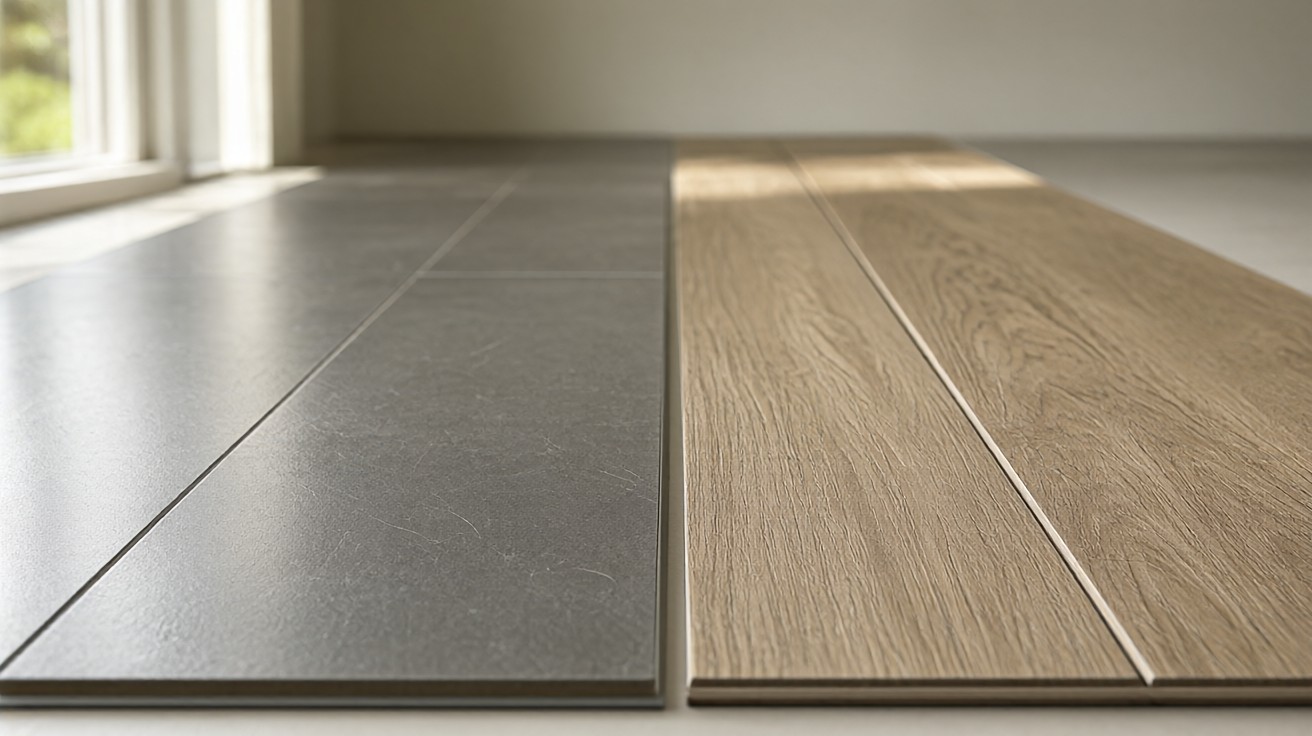
Then take home one carpet sample and one hardwood sample and live with them on the floor for a week. Walk on them in socks at seven in the morning. Spill a glass of water on each and time how long you have before it matters. Sit on the floor and listen to the room. The floor you stop noticing is the right one.
If you are still undecided after that week, the default is hardwood in a living room you will sell and carpet in a living room you will live in. That default has survived more remodels than any single material recommendation.
Where This Page Sits Next to the General Comparison
This page owns the living-room application: furniture legs, pet and kid traffic, acoustics, comfort and resale in one specific room. The general material comparison owns the material-level trade across every room. If your question is about the materials, read that one. If your question is about this room, you are in the right place.
The broader ranking of living-room materials, including vinyl, laminate and tile, lives at best flooring for living rooms. And if the living room is part of an open plan, the single-material question is covered at best flooring for open plan spaces.
Both angles matter here, and both are covered in Living Room Flooring Ideas and Layouts, and Living Room Flooring Acoustics.
Last updated: November 2026