
A coastal house gets three separate attacks on the floor at once, and only one of them is the salt in the air that the rest of the country never deals with.
What the Salt Actually Does, and How Fast
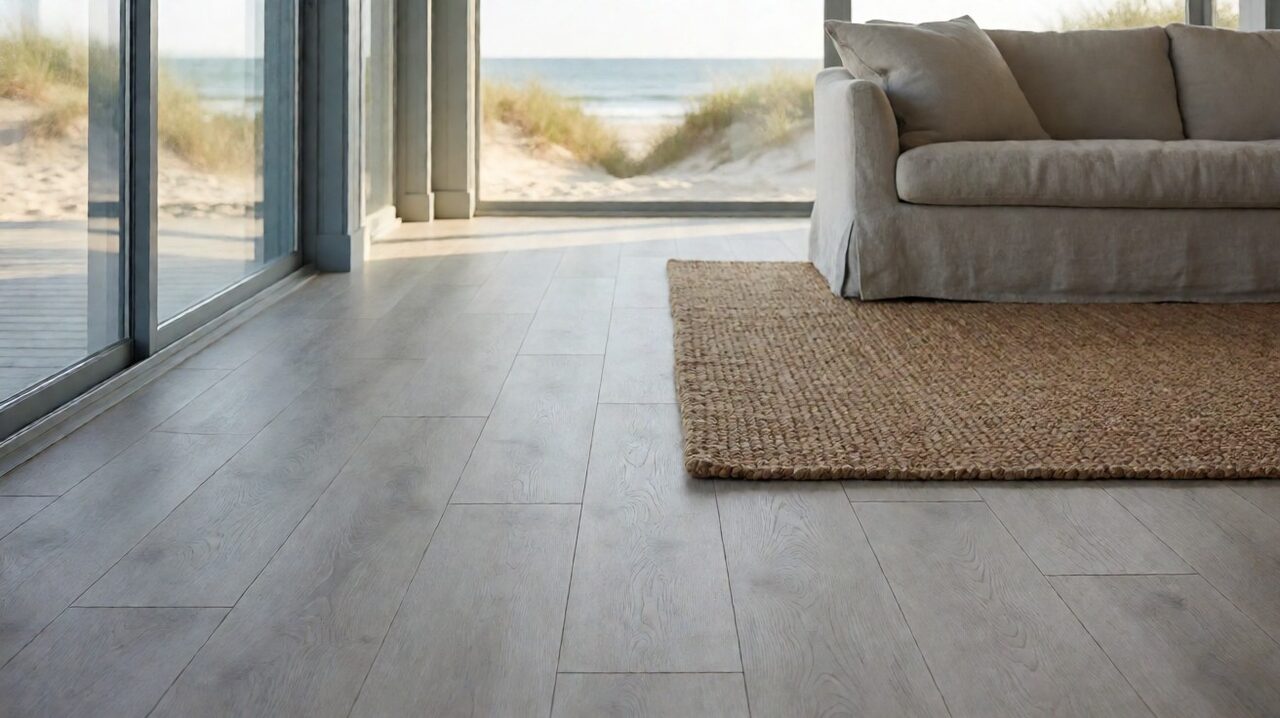
Rigid core vinyl with a 20 mil or heavier wear layer is the right answer for an enclosed coastal living room, and porcelain tile is the right answer for any surface the wind reaches. Wood is the one family to keep out of both unless it stays well away from the opening.
Salt in sea air is hygroscopic, so it pulls moisture out of the air and holds it against whatever it lands on.
That combination is what makes it corrosive rather than merely dirty. A film of salt on a steel bracket stays damp even on a dry day, and the corrosion underneath it is invisible until the bracket fails.
If your house is more than a mile or two inland, the effect on the interior floor is small. If you can smell the air through a closed window, it is not.
Sand Is the More Immediate Problem Indoors
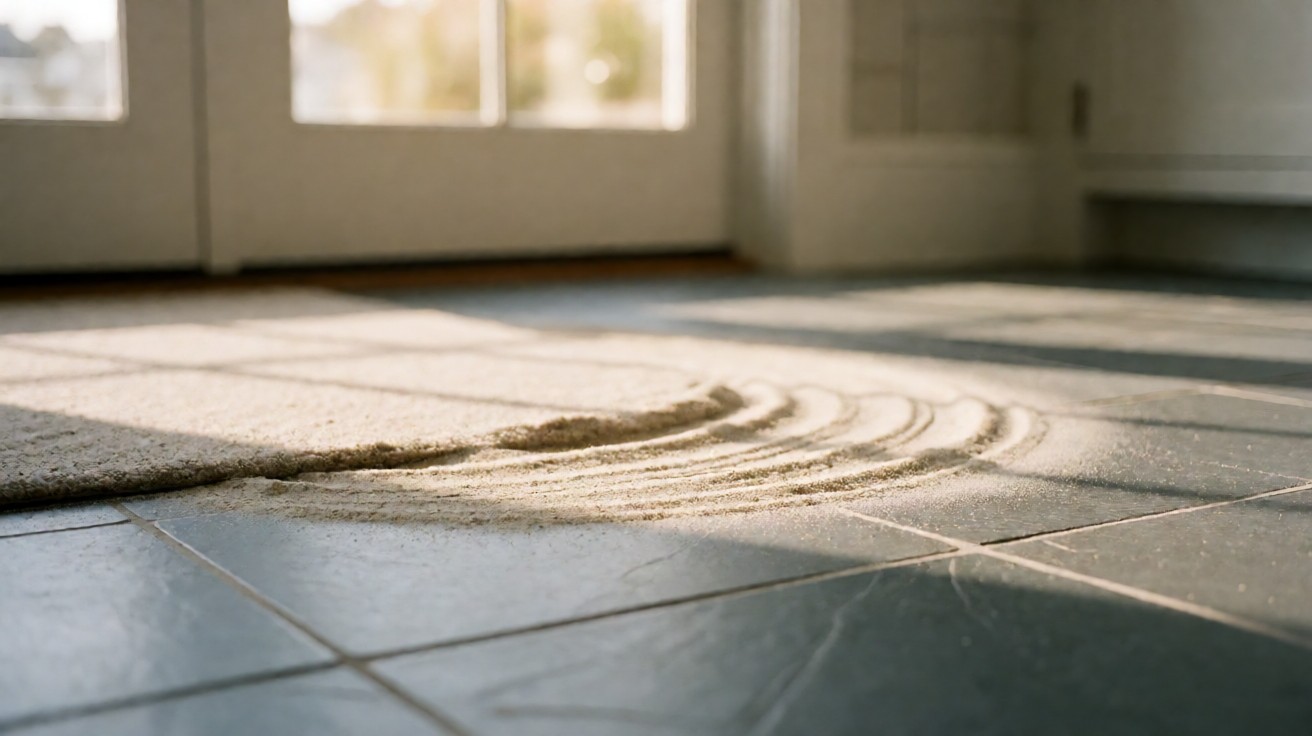
Beach sand is quartz, and quartz is harder than most residential floor finishes. It gets carried in on feet, on towels, and on everything else that came off the beach.
It dulls a polished floor first and scratches it later, and it does both in a swept arc that starts at the door.
A mat that stays down catches the coarse fraction before it reaches the floor. What passes it is the fine fraction, and only the floor specification handles that.
The flooring for mudrooms page covers the same grit problem in a mudroom, where grit arrives from soil rather than from sand.
| What the coast adds | How it shows up | The signature | When it applies |
|---|---|---|---|
| Hygroscopic salt film | Corrosion of fixings and metal in contact | Invisible until the fixing fails | Metres from open salt water |
| Quartz sand carried indoors | Dulls a polish, then scratches the finish | A swept arc starting at the door | Any house used from the beach |
| Reflected UV off water-facing glass | Fades colour, flattens texture | Seen first in a matte finish | Any south- or west-facing room at the water |
| Outdoor humidity entering indoors | Moves a wood floor at the threshold | Cupping and gaps at the opening | Any door left open to the wind |
| Groundwater under the slab | Vapour through the floor | Lifted edges and failed seams | Any slab within tidal reach |
Rigid Core Is the Default Answer, and Here Is Why
In a house within sight of salt water, rigid core wins on three specific counts.
The surface does not absorb, so salt film and damp tracked in on a towel is a wipe. The core is inert stone or mineral, so salt has nothing to attack. And because the plank lifts, one damaged board is one board rather than a whole room.
The rigid core vinyl covers the two core types and the vinyl construction guide is where the wear layer figure is worth reading, because sand is the abrasive here rather than grit.
Porcelain Tile, Where the House Is Open to the Elements
If the floor is on a porch, a sunroom, or an area open to wind-blown spray, porcelain is the material rather than a preference.
Vitrified porcelain absorbs under 0.5 percent, which means it neither takes on water nor moves with frost. The standard the whole ceramic family is written against is ANSI A137.1, and the absorption class on the box is the figure to read.
The trade-off is the one porcelain always carries: it is cold, hard, and unforgiving of a poor installation.
If the room is enclosed, that coldness is a real daily cost for no benefit, which is why the answer changes at the threshold.
Where Wood Is a Mistake, and Where It Is Not
Wood fails near salt water for a reason that is not really about salt at all.
A door left open near the beach exposes the floor to outdoor humidity that the interior of the house does not have. That swing is the same movement problem as any other humid climate, and wood is the material that moves most in it.
Enclosed, away from the opening, and kept at an interior moisture content between 6 and 9 percent, engineered hardwood is defensible. The solid versus engineered hardwood comparison covers why the layered core is the one that tolerates it.
The flooring for humid climates page covers the same moisture mechanism in a general humid climate.
The Deck, the Screed, and the Outdoor-Indoor Joint
The line between an indoor floor and an outdoor deck is where most coastal flooring projects fail.
If both sides use the same material and the same expansion allowance, the joint moves as one. If the outdoor side is tile and the indoor side is resilient, the two move differently and the joint needs a profile that accommodates both.
The flooring transitions guide page covers those profiles, and the flooring for sunrooms page covers the room where the outdoor temperature swing is widest.
UV, Wind, and the Finish That Fades
UV degradation and salt are often described as if they were the same problem, and ANSI A137.1 classifies a tile by water absorption rather than by how it fades, which is why a coastal tile specification still starts with the absorption group, and they are not. Salt is chemical and needs moisture to act; UV is photonic and happens in dry air. A floor at the water fails both, and a floor thirty metres inland fails only the second.
Because the UV dose comes through glass rather than from the air, a room facing the water can receive more damaging light through a west-facing window than an unshaded room in a hot inland climate receives all summer. That is why the light-exposure rating on the product matters more in a coastal living room than anywhere else on the coast.
Concrete and Slabs Near the Water
A slab within reach of salt water is a different substrate problem from a slab inland, and the moisture test still decides it.
ASTM F2170 measures the relative humidity in the slab rather than testing for surface water, and 75 percent is where a membrane becomes required. Above 85 percent the groundwater or the drainage is wrong, and no floor product fixes that.
The flooring over concrete slabs page covers the substrate side and the flooring for basements page covers the below-grade case.
UV, Wind, and the Finish That Fades
South-facing and west-facing glass is a different degradation path from salt, and it arrives first.
If your windows face the water, the floor gets a reflected UV dose in addition to everything else. A matte or textured surface shows that fade as a change in texture long before a polished one shows it as a change in colour.
If your flooring carries an AC rating for light exposure, that is the figure to ask a supplier for, and a supplier who does not know it is telling you something.
| Material | What it survives here | The figure to specify | How it fails | Where it fits |
|---|---|---|---|---|
| Rigid core vinyl | Salt, sand, damp | 20 mil wear layer or heavier | Repairable plank by plank | The default for an enclosed coastal room |
| Porcelain tile | Salt, sand, spray, UV | Water absorption under 0.5 percent | Chip is permanent; dulls before it scratches | The only answer for wind-exposed or outdoor |
| Sheet vinyl | Salt and damp, not sand | Homogeneous or felt-back | Hard to repair in place | When seams are the problem and the room is small |
| Engineered hardwood | Humidity swing, not salt | 6-9 percent interior moisture content | Sandable once the finish goes | Only well away from an open door or window |
| Solid hardwood | Humidity swing | Same content, but moves more | Sandable, with more movement to manage | Hard to justify within sight of open water |
Specifying for the Room Rather Than for the House
A coastal property almost always has three different zones, and specifying one floor for all of them is the mistake that shows up three years later.
The enclosed interior takes the same specification as anywhere else, with a wear layer chosen for grit rather than for water, and a wear layer of 20 mil or above is the figure to hold a floor to in a house where everything comes in through the door sanded.
The wind-exposed zone needs a material that does not move, which is why porcelain or an exterior-rated tile is the answer and resilient is not. A tile specified for exterior use carries a water absorption under 0.5 percent and a freeze-thaw rating, and ANSI A137.1 is where those classes are written.
The third zone is the one nobody specifies, which is the transition between them, and it is where the two different movement rates meet. A transition profile that flexes on one side and is rigid on the other is the standard detail for that junction.
Where the flooring is glued rather than floated, the adhesive choice is a fourth specification rather than a detail. A click-lock plank and a glue-down sheet in the same property are two different products sharing a look, and the “+GL+” page is where the difference between the two installation methods is set out.
What Timeframes Actually Mean Here
A coastal specification is judged over a decade rather than a season, and the useful question is not how long a floor looks new but when it becomes unserviceable.
An interior rigid core floor specified at 20 mil or above in a sand-tracked house is normally specified for a 15 to 25 year life in ordinary residential use, and the failure mode is gradual dulling in the traffic path rather than a single event.
Porcelain outdoors is a different calculation again, because the exposure is unconditioned. A tile rated for exterior use carries both an absorption figure and a coefficient of thermal expansion, and the second one is what decides whether it survives ten thousand freeze cycles rather than three.
Engineered hardwood within an interior coastal envelope is the case where the answer is genuinely uncertain, because the number of freeze-thaw cycles at the threshold rather than in the room is what drives it, and that is a measurement worth taking at the door.
If the property is within a storm-surge reach, none of the above matters, because the floor will be under salt water for hours rather than for air-borne salt for years. In that case the question is a flood question and the “+FR+” page answers it rather than this one.
How to Choose, and Where to Look Next
One last practical note. If a house has a covered porch that is technically enclosed but open on three sides, it is the wind-exposed zone rather than the interior one, and specifying it as interior is the single most common coastal specification error.
Ask two questions before choosing anything: how far is the nearest wall of the house from open salt water, and which rooms are open to the wind.
If nothing is open to the wind, this is an ordinary specification with extra grit protection. If something is, it is a different specification entirely.
The rigid core vinyl covers the default answer, the porcelain tile page covers the open case, and the flooring types compared page has every family in one table. The flooring for cold climates page covers the other weather, and the flooring for high traffic areas and the flooring for homes with children page cover the other.