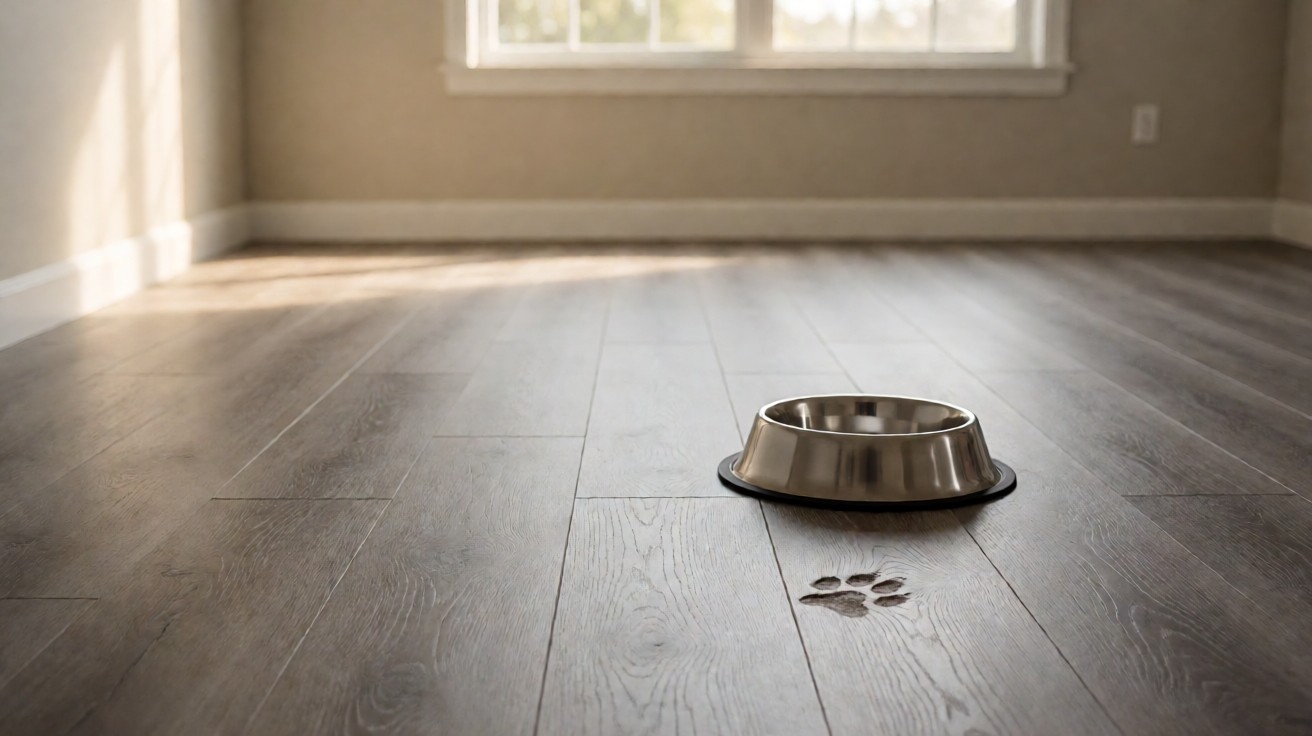

A dog and a cat damage a floor in completely different ways, and a floor that survives what one of them does is not automatically right for the other.
Dogs and Cats Fail Floors in Different Ways
The useful distinction is not how hard a pet is on a floor. It is what kind of damage each one does, because those need different answers.
Dogs typically cause more wear and tear through heavy foot traffic, muddy paws, and skidding, and the damage is spread across the room in a general way. Cats pose a higher risk of localised scratching and targeted messes. One is a traffic problem and the other is a concentrated-surface problem, which is why a floor that shrugs off a dog’s daily traffic can still be ruined by a cat scratching one spot by the skirting board.
| What is happening | What it asks of the floor | Why it matters |
|---|---|---|
| A dog: spread damage, daily | A non-porous surface and a tough finish | Water, grit, and claws across a wide area |
| A cat: concentrated scratching | A tough wear layer and a tough backing | One point, repeated, at skirting height |
| A spill or a tipped bowl | A surface that does not absorb at all | The most common cause of both failures |
| Furniture legs and dragged toys | Felt pads under every leg | The point load that marks any finish |
What a Dog Actually Does to a Floor
There is a fourth one that people forget and that is worth naming separately: claws. A dog crossing a hard surface drags its claws rather than lifting them, and it does that several times a day for the life of the dog. On a surface with a texture it grips and marks less; on a polished one it skids and marks more.
Three things, in rough order of how often they cause a problem.
Water is the first: a bowl that tips, a muddy track, a wet dog after a walk. Every one of those is an absorption question and it is why the surface has to be non-porous rather than merely tough. Grit is the second: dirt off a paw carries abrasive grit, and grit is what dulls a finish and scratches a glaze over months rather than days. Weight is the third: claws on a hard floor, furniture legs, and a dog that slides across a polished surface when it turns. The best flooring for mudrooms page covers the same grit-and-water problem in the room where it is concentrated.
What a Cat Actually Does to a Floor
There is one further cat behaviour that matters for flooring specifically, which is urine. On a sealed non-porous surface it sits on top and lifts with a wipe. On any porous or absorbent material it goes in, and it is one of the harder things to remove from a fibre core or a pile.
A cat’s damage is narrower and much harder to design around, because it is concentrated and repetitive in the same place.
Scratching is the whole problem. A cat scratches at a vertical surface next to a doorway, at a consistent height, in the same spot, and it does it with a claw rather than a heel. That is a different mechanism from a dog crossing a floor: it is a point load repeated at one location rather than a load spread over an area, and point load repeated in one place is what beats a surface faster than uniform traffic does.
Rigid Core and Vinyl, the Practical Answer
The limitation of that answer is the appearance one. A good wood look plank is convincing at a distance and repetitive at close range, and in a small room where the floor is a large part of the view that repetition reads faster than it does in a large open space. Sheet vinyl and large format tile are the two that do not repeat visibly.
Rigid core and quality vinyl are where most houses with both end up, and the reasons are specific to pets rather than general.
The surface does not absorb, so a tipped bowl or a muddy track is a wipe rather than a permanent mark. The wear layer takes a claw mark without splitting the board. And the whole plank can be lifted rather than demolished, which matters in a room where the accident will happen again. The rigid core vinyl page covers the stone core and the vinyl construction guide is how to read a specification sheet for the wear layer before buying.
The Wear Layer Is the Whole Argument
A wear layer is also the difference between a floor that can be recoated and one that has to be replaced, which depends on the construction rather than on the number. It is worth asking which of the two a product is before the number, because a thicker layer on a product that cannot be recoated still eventually means replacement.
In a pet household the number that decides the purchase is the wear layer, and it is measured in mils, or thousandths of an inch.
A thin wear layer in a house with a dog is sanded off by grit in a few years, because the grit does not care what the surface looks like. A thicker layer survives that and can be spot repaired or recoated depending on the construction. This is the same figure that comes up in the accessibility specification for wheelchair traffic, for exactly the same reason, and it is the one number worth asking a shop for rather than the price per square foot.
Wood and Laminate, Honestly
There is also the question of what happens underneath. A pet household is where a fitted carpet and a floating floor are often specified in the same building, and the underlay under the floating floor is what decides how the room sounds and how warm it is.
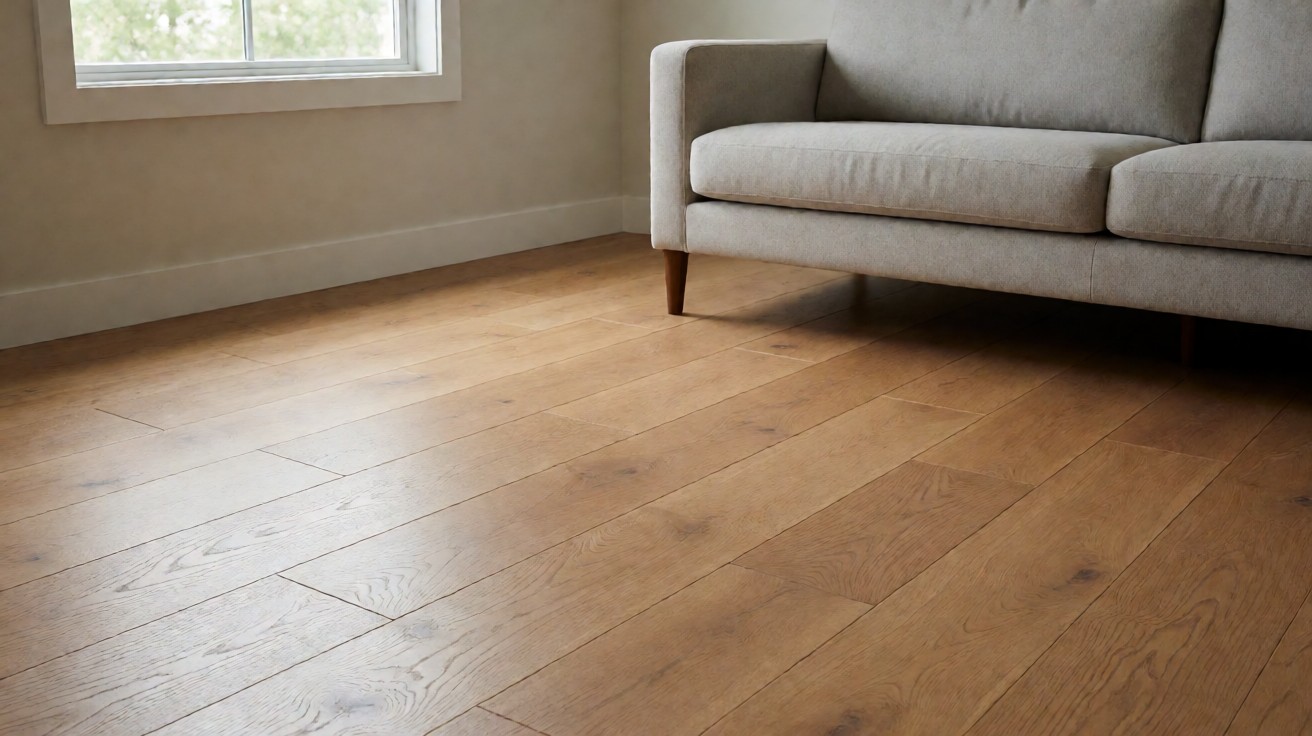
Wood is the family most people want in a room with a dog, and it is defensible where the dog is calm and the room is dry.
The failure is grit: a finish that is scratched through can be sanded and refinished, which is why wood is more forgiving than it looks. Laminated board is less forgiving, because the decorative layer is thin and once it is through there is nothing to sand back to. The solid versus engineered hardwood comparison page covers the two wood constructions and the laminate flooring guide covers the wear layer and core in the laminated board.
Carpet and the Honest Case Against It
Carpet tile changes part of that answer rather than all of it. A single damaged tile can be lifted and replaced instead of cutting a patch out of a broadloom sheet, which is the one genuine advantage carpet has in a pet household and the reason it is worth a separate comparison rather than a single mention.
Carpet is the quietest and the softest option and it is the one most people rule out in a house with pets for reasons that are real.
A spill sits in the pile. A tipped bowl has to be lifted out rather than wiped up, and if it is not lifted out promptly the odour stays. Grit and hair work their way into the pile and do not come back up. The one situation where carpet is the right answer is a room with no accident risk and a lot of barefoot time, such as a bedroom with a cat on it and no food in the room.
The Problem With Scratching Posts and Placement
There is a mitigation that costs nothing and is worth more than any product choice in a cat household: where the scratching happens.
A cat scratches at a vertical surface at a consistent height beside a doorway. A post or pad at that height, placed beside the doorway rather than in a corner of the room, redirects the behaviour to something replaceable. Moving the damage from a floor to a cheap post is a better outcome than any wear layer, and it is the advice most often left out of this page by retailers who sell flooring.
Moisture and the Accident That Is Not the Floor’s Fault
There is a middle category between a wiped spill and a flood, and it is the one that catches people out: a puddle that sits for hours rather than minutes. The longer water sits on an absorbent or seamed surface, the further it travels, and the surface that recovers in thirty seconds is not the same surface as one that recovers in three days.
One thing worth separating out: the recurring small accident and the one-off large one are different problems with different fixes.
A weekly small spill on a sealed surface is a wipe. A standing flood from a burst pipe or a washing machine is a different category, and the flooring types compared comparison of the material families is worth reading alongside this page because the answer changes with the scale of the event. The point for a pet household is that a floor chosen for everyday accidents should not be evaluated as though it has to survive an insurance event.
| Material | What it survives here | The limitation to know about |
|---|---|---|
| Rigid core (SPC) | Water, grit, claws, and a thick wear layer | Repaired or replaced plank by plank, not demolished |
| Sheet vinyl | Water and accidents, not claws | The most forgiving surface, and the least forgiving to look at |
| Engineered hardwood | Grit and claws, in a dry room | Sandable once the finish goes; damaged under standing water |
| Laminated board | Grit, in a dry room | The thin decorative layer is what fails and there is nothing to sand |
| Porcelain tile | Water, grit, claws, everything | The hardest answer and the coldest underfoot |
How to Choose, and Where to Look Next
One last practical note. The finish and the cleaning regime matter more in this room than in a dry one, because a surface that has been cleaned a hundred times behaves differently from one that has been cleaned a dozen, and the wear layer and the cleaning product together are what decide that rather than the material name.
Write down which pet is the problem and what it actually does. A dog that walks through the kitchen twice a day and a cat that scratches one spot beside a door are different specifications, and only one of them needs a thick wear layer.
Then read the guide for the material that answered it. The rigid core vinyl page is the most common answer, the solid versus engineered hardwood comparison is the answer for a room where the look matters more than the traffic, and the flooring types compared page has every family in one table. The best flooring for mudrooms page covers the same grit and moisture problem in the room designed to receive it, and the best flooring for dining rooms page covers the one with concentrated furniture loads.