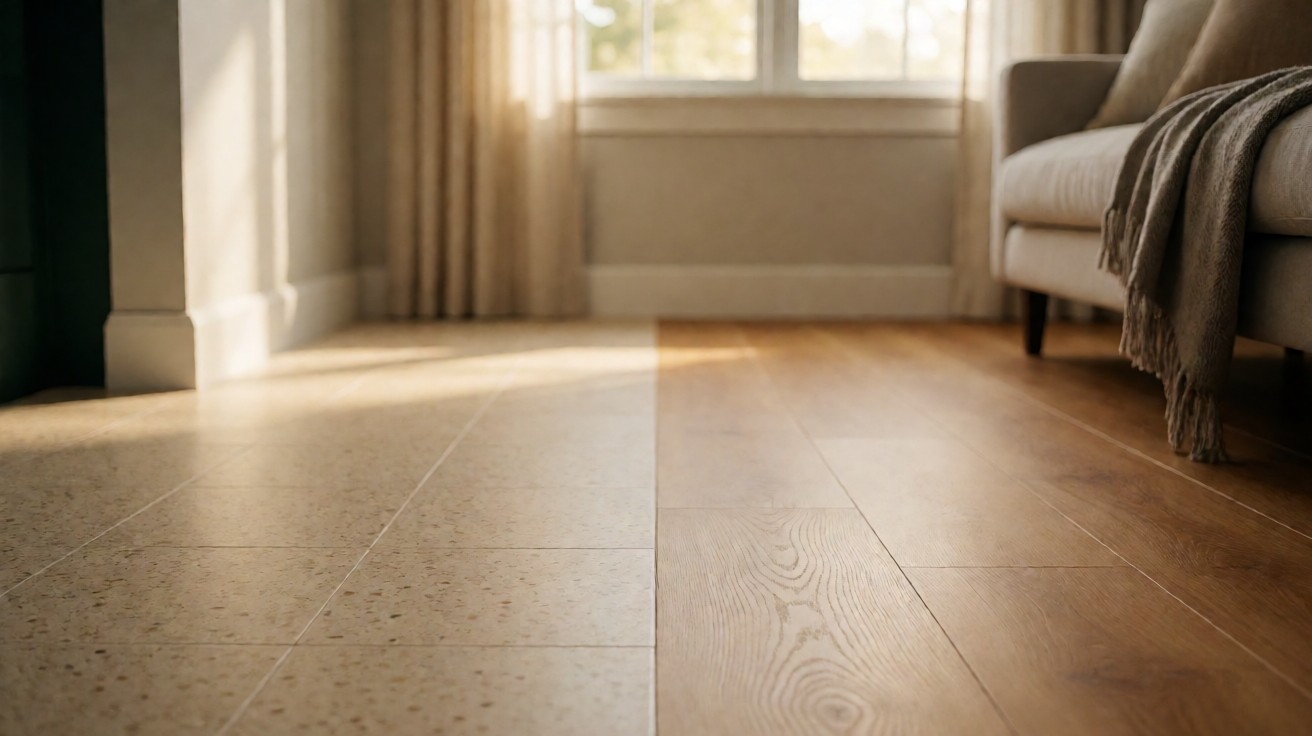

Most sheet flooring sold as linoleum today is really vinyl, a synthetic plastic. If you want the natural material, ask for cork, wood flour and linseed oil.
Choose vinyl for wet rooms, busy homes and any budget that matters. Choose genuine linoleum for a dry, gently used room where a renewable, antimicrobial material is worth the premium.
One is renewable and self-healing.
The other is waterproof and nearly indestructible.
The difference is not a matter of taste. Linoleum is a natural composite of linseed oil, wood flour, cork dust, pigment and mineral filler, pressed and cured until it becomes a dense sheet. Vinyl is a synthetic plastic: PVC, a printed film laid over it, and a polyurethane wear layer over that film.
This comparison covers water, wear, feel, cost and what a room actually needs from a floor. If you have not yet decided between carpet, hardwood and these two, the material comparison sets every option side by side.
If you are weighing vinyl against the other synthetic floors, the laminate guide and the vinyl flooring guide cover that side of the choice.
Linoleum vs. Vinyl: Quick Answer
If you want a natural, renewable, antimicrobial floor that is gentle underfoot, and you accept a smaller colour range and a surface that can scratch and yellow in strong sun, choose linoleum.
If you want a floor that shrugs off water, resists abrasion, costs less and comes in an enormous range of wood and stone looks, choose vinyl. Vinyl is the practical default for most busy households and most wet rooms.
The names confuse almost everyone.
The roll of patterned sheet flooring in a hardware store is called linoleum, and in most cases it is not linoleum at all. Real linoleum was invented in the 1860s from linseed oil, wood flour and cork. The material on the shelf today is polyvinyl chloride, printed and coated.
They are opposite choices, not two names for the same floor.
Linoleum and Vinyl Are Not the Same Thing
A vinyl sheet and a linoleum sheet look similar in the aisle and behave nothing alike once they are on the floor.
Vinyl is a plastic that does not absorb water, does not soften with heat, and carries a sacrificial wear layer that protects a printed image. Linoleum is a filled natural rubber and cork composite that absorbs, breathes and quietly springs back underfoot.
That difference in composition is why a single answer does not fit every room, and why the material question comes before the price question.
What Linoleum Actually Is
Genuine linoleum starts as a liquid and ends as a solid sheet. Linseed oil binds everything together, wood flour gives it body, and cork dust is the filler that does the real work.
The cork granule content is the number that separates a good sheet from a cheap one. Better grade linoleum runs roughly 55% cork granules by weight in the wearing surface, where bargain grades drop toward 40% and lose their spring.
Thickness runs from 2.0 mm at the entry level to 2.5 mm and 3.0 mm in heavier commercial sheet. The thicker the material, the more forgiving it is of an imperfect subfloor.
Underneath sits a woven jute backing of roughly 350 g/m2, which is why the sheet is heavy in the hand and why a damaged edge can be lifted and repaired instead of scrapped. In density terms that is about 0.35 kg per m2 of floor.
Sheets normally come 6 ft wide and 13 ft long, and they are installed wet, bonded with a full spread of adhesive under ASTM E1743, the standard practice for evaluating resilient floor covering adhesives.
Because every ingredient is plant or mineral based, the material is naturally antimicrobial and it is the only truly renewable option of the two.
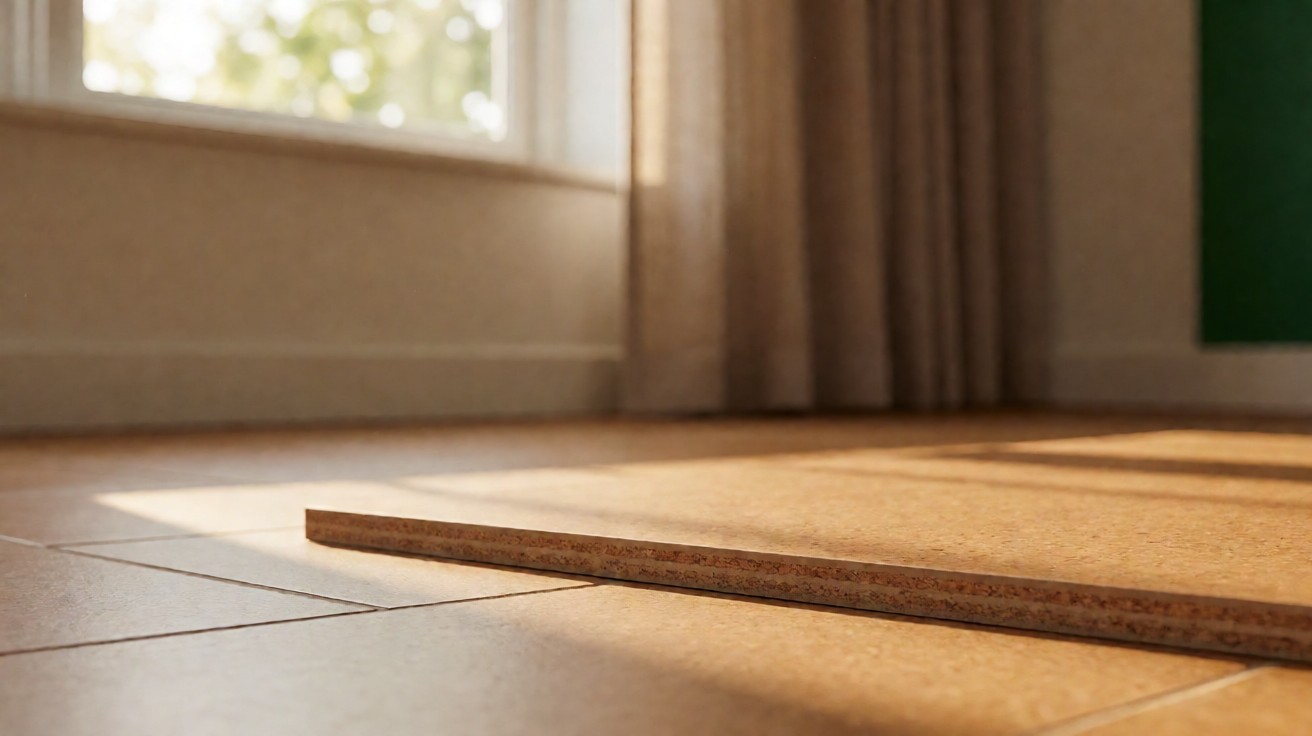
It also has a memory.
Pressed cork and oil underfoot recover from a scuff rather than staying creased, and the sheet keeps its grip long after it has been walked on for 25 years.
What Vinyl Actually Is
Vinyl flooring is polyvinyl chloride, a plastic, built in layers. A foam or fibre core carries the sheet, a photographic print supplies the pattern, and a clear polyurethane layer takes the wear.
That wear layer is quoted in mils, where one mil is one thousandth of an inch. Residential sheet usually carries a 12 mil wear layer, mid range sheet runs 20 mil, and commercial or entry plank products start at 28 mil and go to 40 mil.
Total sheet thickness runs 2.0 mm to 3.0 mm for the common grades, while rigid luxury vinyl plank is a different animal at 4.0 mm to 5.5 mm because it carries a rigid core.
Construction is where plank and tile differ from sheet. Rigid products use a layered core, usually 5 layers, that locks together with a tongue and groove, and the LVT and LVP comparison breaks down how those layers differ.
The printed film is the reason vinyl wins on looks. Wood grain, marble veining and concrete texture are images printed at high resolution, so the range is effectively unlimited.
It is also the reason a scratch on vinyl shows the plastic underneath rather than a repaired grain.
Water Resistance
This is where the two materials separate most cleanly. Vinyl is a plastic, so water sits on the surface and can be wiped away. Linoleum is a natural fibre composite, and water goes into it.
Sheet vinyl absorbs less than 1% of its weight in water over a standard test cycle, while linoleum takes on around 10% and swells with it. A swollen linoleum sheet buckles at the seams and stays buckled.
So a kitchen, a bathroom, a laundry or a basement is a vinyl room. A bedroom, a study or a quiet hallway can go either way, and there is no argument for linoleum in a wet room.
Linoleum can still be specified in dry rooms that are washed occasionally. It simply cannot be mopped like vinyl, and a wet mop left on the surface will leave a mark.
Durability and How Each Wears
Vinyl wins on abrasion. The polyurethane wear layer is sacrificial, so the printed film underneath is protected and the floor keeps its look for 10 years to 25 years depending on traffic and layer thickness.
Linoleum wears differently. There is no sacrificial layer, so the material itself takes the scuff, but the cork structure compresses rather than tears and many marks can be steam cleaned out.
Neither floor can be refinished. A worn linoleum sheet is replaced, and a worn vinyl floor is replaced or overlaid, so the lifespan of the material matters more than the finish.
Impact sound is where the assembly, not the top layer, decides the outcome. ASTM E989 sets the IIC measurement, and a good vinyl floor over a resilient underlay can reach an IIC of 50 or better, where bare linoleum on concrete usually lands in the 30s.
In a building with heavy traffic and a lot of water, vinyl is the only sensible answer. The multi-occupancy flooring guide covers how that choice changes in corridors, lobbies and shared stairwells.
Feel Underfoot and in a Room
Linoleum is warmer and softer. It has a slight give, it absorbs sound better than a hard plastic sheet, and it quietens footsteps in a way vinyl cannot without an underlay.
Vinyl is harder and cooler to the touch, though a good underlay closes most of that gap. Vinyl does have one advantage here: it stays firm in cold rooms rather than turning brittle.
Colour matters more for linoleum than for vinyl. The palette runs to around 40 linoleum shades in muted, earthy tones, and the pigments shift toward yellow over 10 years in direct sunlight.
Emissions are the other thing a buyer asks about. FloorScore and GreenGuard certification cover indoor air quality for vinyl, and CARB Phase 2 plus TSCA Title VI set the formaldehyde limits a compliant product must meet, with the carbon protocol and green certification marks both working from 0.5 mg/m3 of formaldehyde in the test chamber.
Cost, Availability and How They Compare
Vinyl is cheaper. Material plus labour for sheet vinyl runs about 2.50 dollars per sq ft to 4.50 dollars per sq ft, while installed linoleum sits closer to 6.00 dollars per sq ft to 9.00 dollars per sq ft.
For a 140 sq ft kitchen that gap is roughly 500 dollars, and it is the number that pushes most buyers toward vinyl without much deliberation.
Availability runs the same way. Vinyl is stocked in every home centre and comes in thousands of patterns, while genuine linoleum is a specialist order with lead times of 3 weeks to 6 weeks.
Sheet vinyl also wins on repair. A damaged 6 ft x 13 ft sheet can be patched from a leftover offcut, while a matching piece of linoleum has to be colour matched across the whole room.
What You Actually Get in Each Material
The factor table below compares the two on paper. This one turns the choice into a room-level assignment, because a floor that is right for a bedroom is often wrong for a basement.
| Room | Material | Why it fits the room |
|---|---|---|
| Basement (damp) | Vinyl | Absorbs under 1%; linoleum swells at 10% |
| Kitchen (spills) | Vinyl | Wipes clean; a 20 mil wear layer takes the traffic |
| Bathroom or laundry | Vinyl | The only sensible choice of the two |
| Bedroom | Linoleum | Warmer at 2.5 mm; dry, gentle traffic |
| Craft or studio room | Linoleum | Soft underfoot for hours of standing |
| Sun-blasted south room | Vinyl | Linoleum pigments yellow; printed vinyl does not |
| Busy household | Vinyl | Wear layer protects the print for 15 years or more |
| Natural-material priority | Linoleum | Renewable, 55% cork, naturally antimicrobial |
The Comparison at a Glance
| Factor | Linoleum | Vinyl |
|---|---|---|
| Composition | Natural: linseed oil, wood flour, 55% cork | Synthetic: PVC core, printed film, wear layer |
| Thickness | 2.0 mm to 3.0 mm | 2.0 mm to 3.0 mm sheet, 4.0 mm rigid plank |
| Wear layer | None; the material itself wears | 12 mil to 40 mil polyurethane |
| Water absorption | About 10% by weight | Under 1% |
| Slip resistance | Meets 0.42 DCOF wet | Meets 0.42 DCOF wet |
| Sound | Quiet by nature; IIC in the 30s on concrete | IIC 50 or better with a resilient underlay |
| Sun yellowing | Yes, natural pigments shift over 10 years | Minimal, the printed film is stable |
| Antimicrobial | Natural | Only where certified |
| Renewable | Yes, plant and mineral base | No, petroleum based |
| Typical installed cost | 6.00 to 9.00 dollars per sq ft | 2.50 to 4.50 dollars per sq ft |
| Service life | 25 years or more | 10 years to 25 years by wear layer |
| Best in | Bedroom, study, craft room, dry quiet rooms | Kitchen, basement, wet room, high traffic |
How to Choose for Your Project
The material you need is usually decided by the room, and that should be the first question. If the floor will be in a damp or very wet place, linoleum is out and vinyl is the only sensible answer.
Imagine a 1930s kitchen with original linoleum that is 2.0 mm thick and cannot be removed, and the new sheet vinyl is 3.0 mm. Laid straight over the old floor, the finished surface sits 1.0 mm higher, so the doors need planing and the skirting loses its fit.
The same kitchen settles the argument on cost too. Vinyl at 3.50 dollars per sq ft against linoleum at 7.00 dollars per sq ft over 140 sq ft is a difference of about 490 dollars, before anyone counts the removal labour.
If the room is dry and the floor will be treated gently, think about what a natural material is worth to you. If it matters, linoleum is genuinely better than its price. If it does not, vinyl is cheaper and easier to source.
Before the sheet goes down, the subfloor decides as much as the room does. Concrete needs to be flat within 1/8 inch over 10 ft, and the room itself should sit under 75% relative humidity. If the slab is wet, use a moisture barrier and allow 3 days before the first coat of adhesive.
Adhesive then needs to cure before traffic. A typical sheet installation wants 72 hours with no foot traffic and 7 days before the floor is washed for the first time.
If you are weighing the installation method for the vinyl you have chosen, the glue-down against click-lock settles that question, and the kitchen flooring guide covers the room that produces the most moisture of all.
For the quiet end of the house, the living room buying checklist sets out what to check before you commit to a floor in a space that is mostly furniture and daylight.
Is linoleum really natural and antibacterial?
Genuine linoleum is both. The material is made from plant and mineral ingredients, and the natural mix has the same family as the material itself, which means bacteria have a harder time surviving on it than on a bare plastic.
If you are specifically shopping for a material that is both renewable and naturally antimicrobial, that is the reason to pick it. It is one of the few flooring options that is genuinely natural in both ingredients and behaviour.
Can I install linoleum over the floor in a wet basement?
You should not. Linoleum absorbs around 10% of its weight in water, and a damp or flooded basement is exactly where it will swell and stain. A vinyl plank or tile is the correct answer there. If the basement is dry and well sealed, linoleum can go over it, but it is not the material you would pick for that room.
How do I tell real linoleum from vinyl in a store?
Look at the edge and the weight. Real linoleum has a granular, matte surface with a visible jute backing underneath, and a 3.0 mm sheet feels dense in the hand. Vinyl has a printed, often glossier face, a clean cut edge and a foam or fibre core, and it is much lighter.
Standards, Labels and What They Decide
Four test standards do most of the deciding work here, and each one settles a different question a buyer is asking.
ASTM F1303 covers sheet vinyl flooring and sets what a sheet has to be called a floor covering: thickness, dimensional stability, wear layer and resistance to indentation. If a product sheet carries it, the numbers on that sheet are measured.
ASTM F2411 sets the accelerated wear testing procedure for vinyl sheet, tile and plank, so a 20 mil claim and a 28 mil claim mean something comparable across brands.
ASTM E989 is the standard test method for impact sound transmission under a floor, and it is where an IIC rating comes from. It decides whether the floor is quiet enough for the building above or the room below.
ANSI A326.3 is the American National Standard for dynamic coefficient of friction. It decides the slip resistance threshold, and 0.42 when wet is the number a specifier looks for on both of these materials.
ASTM E1743 covers resilient floor covering adhesives and their bond to a substrate. It decides whether the sheet will stay put, which matters in a kitchen where the floor gets wet regularly.
Europe works to ENF and ISO 10581 for linoleum, where ENF is the emission class and ISO 10581 sets the wear class and dimensional tolerance a European linoleum must meet. CRI, FloorScore and GreenGuard cover recycled content and indoor air quality certification for the vinyl side.
Read those marks as buyer decisions, not decoration. F1303 and F2411 tell you whether the product is properly made, E989 tells you how it sounds, A326.3 tells you whether it is safe underfoot, and E1743 tells you whether it will still be there in 15 years.
Where This Fits in the Rest of the Choice
Linoleum and vinyl are both sheet, tile or plank floors, and the material question between the two is settled here. The environmental side of the same comparison is a separate decision, with the renewable and off-gassing angles covered in their own detail.
From here the next decision is which type of vinyl you will install, if that is what you are choosing, and which construction suits a room and a subfloor. The vinyl flooring guide owns that part, and the room specific pages will tell you which material suits the space you are actually putting it in.
Last updated: November 2026