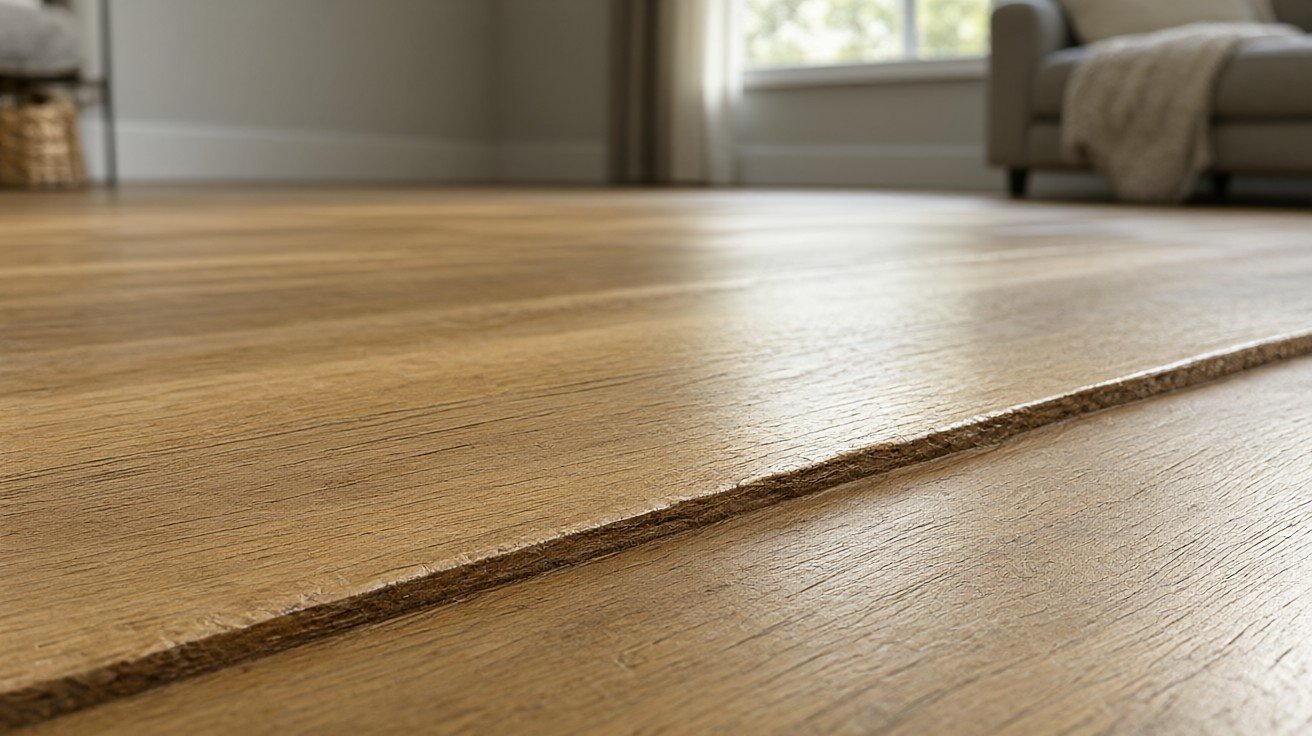

Moisture destroys flooring by swelling wood, lifting laminate edges, dissolving adhesives, and feeding mold. Here is the mechanism behind each failure.
You should use the fix-the-source rule: replacing the floor without that step only resets the clock. When water reaches wood, laminate, adhesive, or subfloor, failure follows a predictable path.
Why Moisture Is the Leading Cause of Flooring Failure
Flooring is a layered system. The visible layer sits on an adhesive or fastener, which sits on a subfloor, which sits on soil or a slab. Water enters from any of those layers and changes the dimensions or chemistry of the materials above it. Because wood, laminate core, and adhesive are all sensitive to water, a small moisture change can produce a large visible defect.
Most failures are not manufacturing defects. They are the predictable result of water reaching a material that was never meant to stay wet. The damage often shows up weeks or months after the water event, because moisture moves slowly through dense materials.
For example, a homeowner in a humid climate installs solid oak over a slab that tested at 85 percent relative humidity; within one season the boards cup at the edges.
Why Does the Damage Show Up Late?
Water moves through concrete at roughly a few millimeters per day. A slab that looks dry on the surface can still hold moisture deep inside. By the time the moisture reaches the bond line, the floor may already be installed and finished.
How Wood Absorbs Moisture and Moves
Wood is hygroscopic. It absorbs and releases water vapor until its moisture content balances with the surrounding air. This equilibrium moisture content rises in humid air and falls in dry air. Below the fiber saturation point of about 28 to 30 percent, wood swells as it gains moisture and shrinks as it loses it.
Wood is also anisotropic. It moves far more across the grain than along it. Tangential movement, across the face of a plainsawn board, is the largest. Radial movement, through the thickness, is smaller but still significant. Longitudinal movement along the grain is negligible. That directional behavior is why moisture changes produce cupping and gapping instead of uniform expansion.
What Is Equilibrium Moisture Content?
Equilibrium moisture content is the moisture level at which wood stops gaining or losing water for a given temperature and relative humidity.
In occupied homes, indoor relative humidity typically ranges from 30 to 60 percent, which puts wood equilibrium moisture content roughly between 6 and 9 percent.
The National Wood Flooring Association recommends installing solid hardwood at a moisture content between 6 and 9 percent in most regions.
Why Solid Wood Floors Cup and Crown
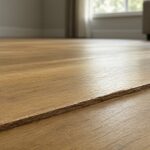
Cupping occurs when the underside of a board holds more moisture than the top. The bottom swells while the top stays the same, so the board curves upward at the edges and dips in the center. The driver is a moisture gradient through the thickness, not the total moisture alone.
Moisture usually enters from below. A damp subfloor, a wet slab, or humid crawl space air raises the moisture content of the board bottom.
The top, exposed to conditioned air, stays drier. The resulting gradient bends the board.
If the source is a plumbing leak or poor grading, the diagnosis is usually straightforward. If the source is water vapor from concrete, it can take weeks or months to appear.
Crowning is the reverse. The top of the board holds more moisture than the bottom, so the center rises above the edges. This happens when a cupped floor is sanded flat while still wet, or when a spill soaks the surface. Once the moisture equalizes, the sanded profile is locked in.
Can Cupping Be Reversed?
If the moisture gradient is removed early, the board can return to flat as the moisture content equalizes. If the board was constrained from swelling and acquired a compression set, it will not return to its original width and permanent gaps appear when the floor dries. Severe cases need board replacement.
| Failure | Moisture Pattern | Visible Symptom | Typical Source |
|---|---|---|---|
| Cupping | Bottom wetter than top | Edges higher than center | Damp subfloor, crawl space, slab vapor |
| Crowning | Top wetter than bottom | Center higher than edges | Surface spill, sanding a wet cupped floor |
| Gapping | Uniform drying after set | Gaps between boards | Compression set from constrained swelling |
Why Engineered Wood Reacts Differently
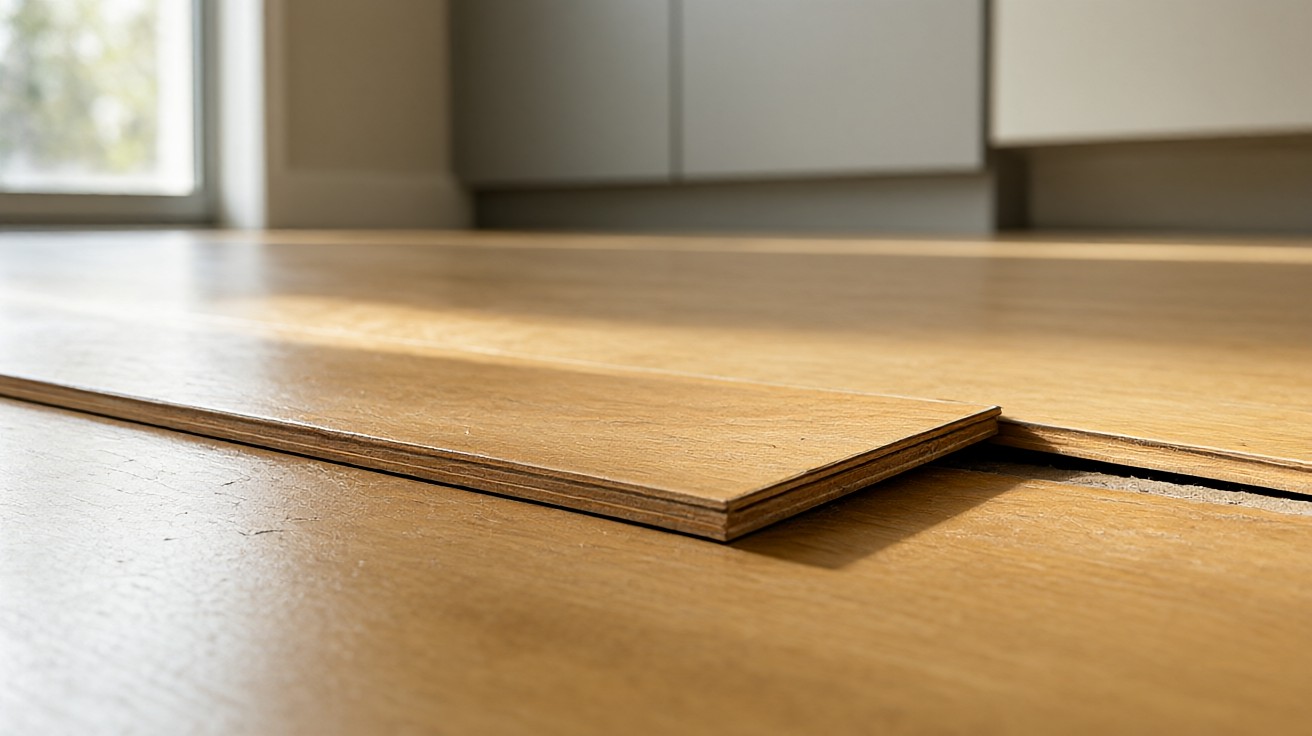
Engineered flooring bonds a thin hardwood face to a plywood or high-density fiberboard backer. The two layers respond to moisture at different rates. The face shrinks and swells roughly ten times faster than the backer. When moisture content drops below the level at manufacture, the face pulls across the width and the board cups with the edges rising.
This is the opposite of solid wood, which cups when the bottom gets wetter. Engineered wood can cup when it gets too dry. That is why engineered floors perform best near the moisture content they had at manufacture, and why HVAC changes after installation can trigger cupping in a floor that performed well for years.
Engineered floors also resist cupping from wet bottoms better than solid wood, because the backer stabilizes the face. But they are not immune. A persistent moisture source from below can still delaminate the layers or swell the core.
Why Laminate Swells at the Edges
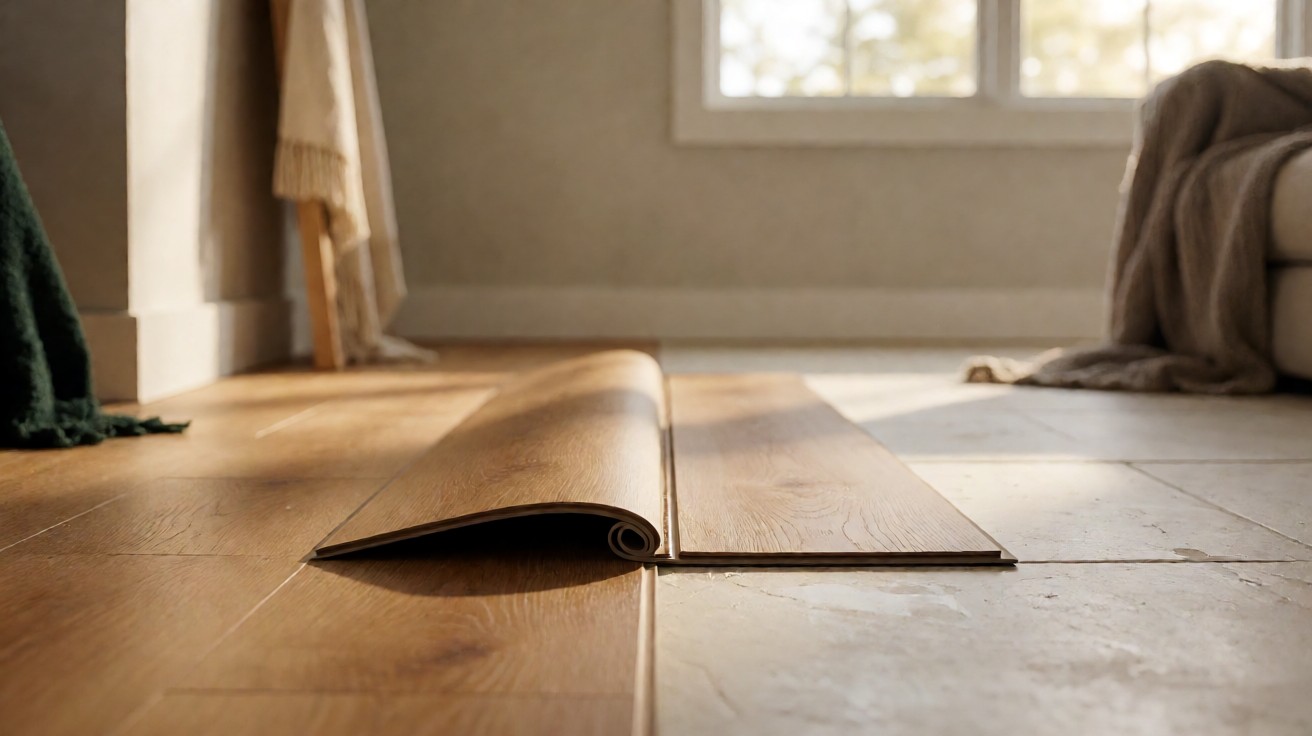
Laminate flooring has a high-density fiberboard core. That core is wood-based and highly absorbent. Water that reaches the core through seams, cut ends, or an unsealed edge causes the fibers to swell. The swelling concentrates at plank edges and joints, where the core is most exposed, producing raised edges, bubbling, and separation.
The wear layer and decorative print are thin and relatively waterproof, so the surface can look fine while the core expands underneath. Once the core swells, the dimensional change is permanent. Drying the floor does not restore the original thickness.
Expansion gaps at the perimeter exist precisely because laminate moves with humidity. If the gap is too small or blocked by baseboard, normal seasonal expansion has nowhere to go and the floor tents or buckles in the middle.
Is Mold Under Laminate Always Visible?
No. Mold grows on the underside of the plank and on the underlayment or subfloor where moisture is trapped. The top surface can look normal while the core and subfloor are affected. A musty smell or soft spots underfoot are often the first signs.
Why Adhesives Let Go on Wet Concrete
Adhesive failure on a slab is a chemical process, not just a mechanical one. Water vapor migrates through concrete from the soil or from residual mix water. When that vapor reaches the bond line and condenses, it re-emulsifies water-based adhesives and breaks the bond. The flooring blisters, cups, and releases.
There is a second mechanism. As relatively pure condensed water collects at the bond line, the alkaline moisture in the concrete migrates toward it by osmosis.
The pH at the bond line can rise to 11 to 13. That caustic solution attacks virtually all flooring adhesives.
This alkaline attack is why moisture and alkalinity together cause more flooring failures than all other causes combined, according to industry training materials.
Hydrostatic pressure is often blamed but is rare on slabs poured on grade, because the water table must be higher than the slab to exert that pressure. Most failures come from vapor diffusion and alkaline migration, not from water being forced through under pressure.
Why Efflorescence Appears on Slabs
Efflorescence is a white crystalline deposit that forms when moisture moves through concrete and evaporates at the surface. Water dissolves soluble salts in the concrete and carries them upward. When the water evaporates, the salts crystallize on the surface.
Efflorescence itself is cosmetic, but it signals an active moisture path through the slab. If that same path continues under an installed floor, the moisture condenses at the bond line and drives adhesive failure and mold. Treating the crystals without stopping the moisture source does not fix the problem.
Why Mold Grows Under Flooring
Mold needs moisture, a food source, and time. Wood-based flooring, underlayment, and dust provide food. Moisture trapped under an impermeable floor provides the water. The Environmental Protection Agency recommends drying water-damaged areas within 24 to 48 hours to prevent mold growth, and keeping indoor relative humidity below 60 percent.
Under a finished floor, mold is hidden and can spread across the subfloor before it is detected. By the time it is visible at a seam or smells musty, the affected area is usually larger than the visible stain. Removal and drying of the subfloor are required before any new flooring is installed.
Moisture Sources That Drive Each Failure
Identifying the source matters more than treating the symptom. The table below maps common sources to the failure they produce.
| Source | Failure It Produces | Where It Shows First |
|---|---|---|
| Residual mix water in new concrete | Adhesive blistering, cupping | Bond line, plank edges |
| Soil vapor through slab | Adhesive release, efflorescence | Low spots, seams |
| Humid crawl space air | Solid wood cupping | Bottom of boards |
| Spill or wet mopping | Laminate edge swell, crowning | Joints, surface |
| Plumbing or appliance leak | Localized cupping, mold | Near the leak |
| HVAC change or dry winter air | Engineered wood cupping, gapping | Across the field |
Testing Before You Install
Testing confirms whether the slab or subfloor is ready. Relative humidity probes per ASTM F2170 and calcium chloride tests per ASTM F1869 are the standard methods for concrete. For wood subfloors, moisture meters give the moisture content of the wood itself. Testing should happen after the building is enclosed and the HVAC is running.
See how to test concrete moisture before flooring, relative humidity testing for concrete slabs, and moisture meters for wood subfloors for the procedures. A vapor barrier or underlayment can reduce risk; see vapor barriers and flooring underlayment.
How to Decide: Repair or Replace
Some moisture damage is reversible and some is not. The decision depends on the material, the duration of exposure, and whether the moisture source is fixed.
| Condition | Repair Likely | Replace Likely |
|---|---|---|
| Solid wood cupping, source removed early | Yes, after drying | No |
| Solid wood with compression set | No | Yes |
| Laminate edge swell | No | Yes |
| Adhesive release on slab | Only if slab dried and re-bonded | Usually yes |
| Mold under flooring | No | Yes, plus subfloor remediation |
Key Standards and Limits to Know
Standards give the thresholds that separate a pass from a failure. ASTM F2170 measures in-slab relative humidity; many flooring products require 75 percent or lower.
ASTM F1869 measures moisture vapor emission rate; a common limit is 3 pounds per 1000 square feet per 24 hours.
The National Wood Flooring Association recommends a 6 to 9 percent moisture content for solid hardwood installation.
The Environmental Protection Agency recommends indoor relative humidity below 60 percent to prevent mold. Exceeding any of these limits shifts the risk from manageable to likely failure.