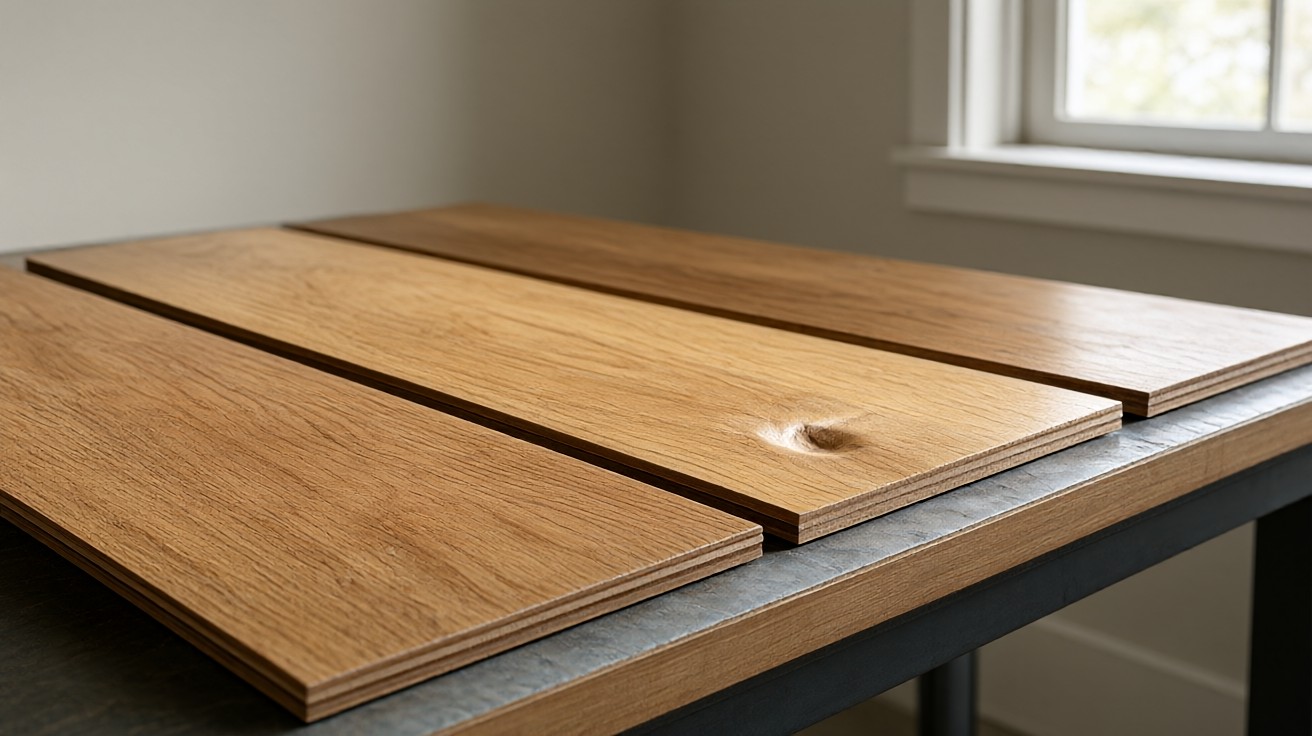

You hold three hardwood sample boards in the aisle, each stamped with a Janka number, and you cannot tell which one will actually hold up to everyday dents.
The Janka hardness rating is a dent resistance figure from the ASTM D143 ball test: the pounds-force needed to sink an 11.28 mm steel ball to half its diameter. White oak reads 1,360 lbf; hickory tops 2,140 lbf.
The Short Answer: What a Janka Rating Tells You
Janka hardness measures dent resistance, not wear. The number is the pounds-force it takes to sink a hardened steel ball halfway into the side of the wood. A higher figure means the surface resists everyday dents from furniture legs, dropped tools, and pet claws better.
The answer is simple: use the Janka number to rank dent risk, not to rank scratch or wear resistance. And a higher number is not automatically better for every room. For the full hardwood picture, start with the hardwood flooring guide.
Go with hickory or white oak when the room takes heavy traffic. Choose walnut or cherry for a softer look in a calmer room. Everything else on the scale is in service of those two decisions.
Read the number in bands. Below 1,000 pounds-force is a soft species. Between 1,000 and 1,500 is the mainstream domestic range, and above 1,800 puts you in hickory, pecan, and imported territory.
The Test Behind the Number
Modern Janka testing traces to a 1906 adaptation of the Brinell ball test by J. August Janka, an Austrian wood technologist. ASTM D143 is the current American method, and ISO 13061-12 is the international version that runs the same ball press and reports the load in newtons.
Section 13 of ASTM D143 covers hardness on small, clear, defect-free specimens. Clear means no knots and no visible defects, because both would change the load the ball takes. The standard sets the load rate at 0.25 inches per minute so the number is reproducible from lab to lab.
The ASTM D1037 hardness modulus test works on a larger 80×150 mm sample at least 6 mm thick, at a slower 0.05 inches per minute rate. That modulus measures stress at depth rather than the peak load of the ball test, and the slower rate keeps the two measurements separable when you compare across species.
For hardwood flooring, the value you will find in charts usually comes from those standard specimens, not from your finished board. If you want a parallel rating for a different floor type, read laminate AC ratings explained.
The Ball, the Depth, and the Units
The test presses a 11.28 mm (0.444 inch) hardened steel ball into the wood until it sits halfway in. That is 0.222 in, about 5.64 mm of depth, which equals the ball’s own radius. A dial gauge reads the total load, reported in pounds-force in US tables and in newtons in metric ones.
The ball diameter was chosen so its projected contact area works out to about 100 mm2. Divide the load by that area and you get a pressure at the contact point. A 1,360 lbf white oak works out to roughly 1,970 psi, and a 2,140 lbf pignut hickory to about 3,100 psi.
The pressure is the point.
The wood is tested at 12 percent moisture content, the dry basis the tables standardize on. The conversion between units is fixed at 1 pound-force equals 4.448 newtons, so 1,360 lbf is about 6,050 N and 2,140 lbf is about 9,520 N.
One Australian hardwood industry guide runs the same ball press in newtons with a slightly smaller 11.18 mm ball and calls the test irrelevant for veneers under 6 mm thick. That is a scope note, not a correction: the US and international numbers still follow the 11.28 mm ball.
Side Hardness vs End Hardness
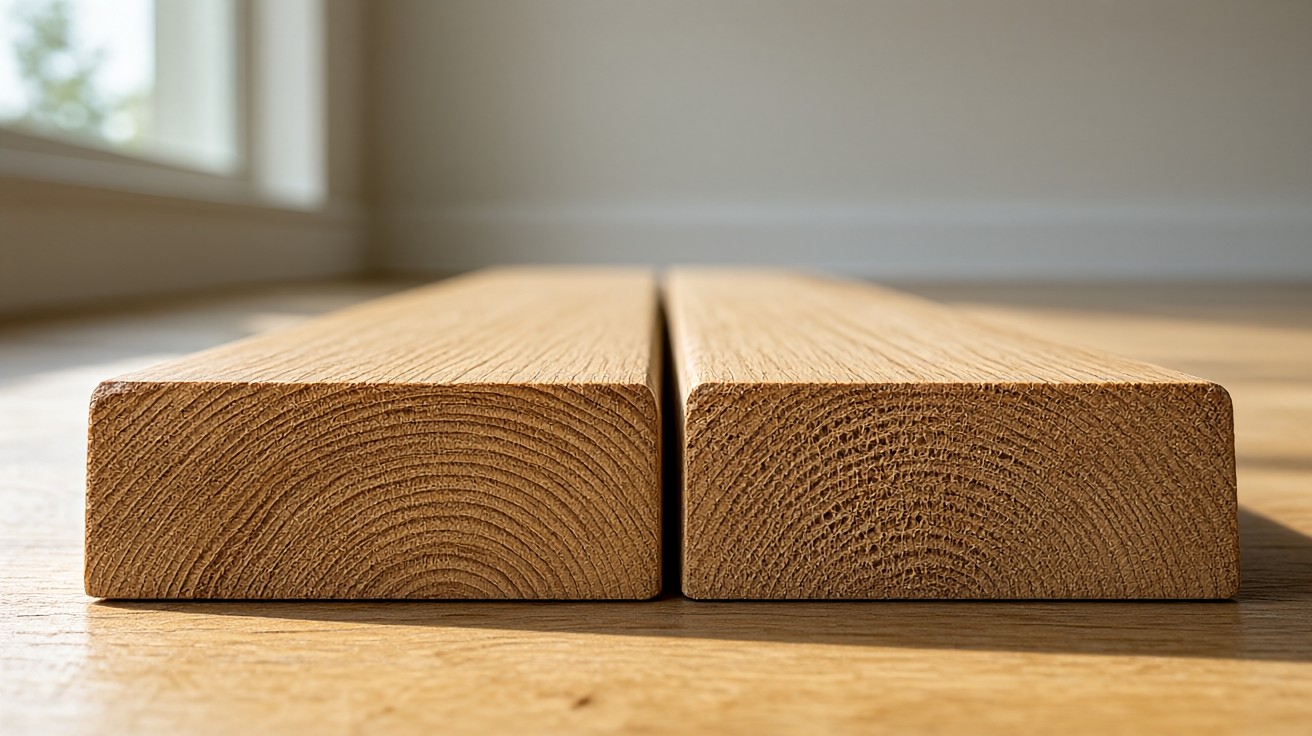
Load the ball perpendicular to the growth rings and you measure side hardness. Press it into the end grain and the ball has to push the fibers apart, so the end reads harder. Flooring is walked on from the side, which is why published Janka values quote the side hardness.
Even the side value is an average of the radial and tangential faces of the specimen. That averaging is one reason two sources can print different numbers for the same wood. A value taken on a single face can sit a few hundred pounds-force off the published average.
If you ever test a sample yourself, keep the faces separate. Compare one face against a published average and the ranking will mislead you.
End grain does have its place. Tool handles, turned spindles, and deck posts take loads along the grain, where the same species reads harder. For a floor, though, the side value is the one that matters, because that is the surface your foot, your furniture, and your pets actually press on.
The Species Rating Table
The table below is reference data: the species you will actually spec, in pounds-force at 12 percent moisture content, with the newton equivalent and the scope each value comes from. Where publishers disagree, both numbers stay visible with a scope label instead of an average.
| Species | Janka (pounds-force) | Janka (newtons) | Source / scope |
|---|---|---|---|
| Douglas-fir (Interior West) | 660 | 2,940 | USDA 5-3b |
| Black cherry | 950 | 4,230 | USDA 5-3b |
| American black walnut | 1,010 | 4,490 | USDA 5-3b; NWFA |
| Red oak, southern | 1,060 | 4,710 | USDA 5-3b |
| Yellow birch | 1,260 | 5,600 | USDA 5-3b; NWFA |
| Red oak, northern (benchmark) | 1,290 | 5,740 | USDA 5-3b; NWFA |
| White ash | 1,320 | 5,870 | USDA 5-3b; NWFA |
| White oak | 1,360 | 6,050 | USDA 5-3b; NWFA; Wood Database 1,350 |
| Hard maple | 1,450 | 6,450 | USDA 5-3b; NWFA |
| Hickory/pecan (group) | 1,820 | 8,090 | NWFA group; USDA pecan |
| True hickories (range) | 1,810 to 2,140 | 8,050 to 9,520 | USDA: shellbark 1,810; shagbark 1,880; mockernut 1,970; pignut 2,140 |
| Jarrah | 1,910 | 8,490 | USDA 5-5b; NWFA |
| Ipe (Brazilian walnut) | 3,680 | 16,370 | USDA 5-5b; Flooring Artists 3,684 |
| Lignum vitae | 4,500 | 20,020 | USDA 5-5b; Wood Database 4,390 |
Use red oak at 1,290 lbf as your benchmark. It sits in the middle of the domestic range, which makes it the natural reference point when you compare a softer walnut or a harder hickory.
The newton column is just the fixed conversion of the pound-force column, at 4.448 newtons per pound-force. Read either column, not both, and keep the source label with the value.
For the full species choice, which of these to put in a given room, see the compare hardwood species guide.
What Hardness Predicts: Dents and Compression
A higher Janka number means more force is needed to embed the ball, which comes from a denser, harder cell structure. In a home that shows up as resistance to point loads. A dropped tool, a heavy cabinet leg, or a dog jumping on a chair leg all concentrate weight into a small area.
Imagine a 40 lb coffee table with thin casters. Under a soft species, the casters leave shallow crescents along their path. Under a hickory or white oak floor, the same table leaves nothing. The denser the wood, the less the surface deforms under that load.
The correlation with specific gravity is why the densest species top the table. White oak’s 1,360 lbf is a meaningful step up from walnut’s 1,010 lbf for a hallway that takes real traffic.
Wide, flat feet spread the load and dent less. Narrow legs and casters concentrate it.
That is where the Janka number earns its keep. When a dent does form, the repair is a separate decision. Our guide to repair dents in wood floors covers filling and sanding them out.
What Hardness Does NOT Predict
Does Janka hardness measure scratch resistance?
No. A scratch is the finish being cut, not the wood giving way. The wear layer on top governs whether a key, a spoon, or a high heel shows through. A harder species resists the dent that would expose the grain, but the scratch visibility is a finishing question.
Wear works the same way. A 2022 study in the Forest Products Journal ran a 500-cycle abrasion test on five US hardwoods. The result broke the usual ranking.
White oak out-wore hickory, even though hickory carried the higher hardness. Hickory measured 2,030 lbf at the surface against white oak’s 1,363 lbf, yet it lost 0.212 mm of thickness against white oak’s 0.147 mm. The denser, closed-grain white oak wore less despite the lower ball-test number.
Wear depends on grain, extractives, and density, not indentation force alone. If a scratch does show, our guide to repair scratched hardwood floors covers the fix, and the finish choice is the first lever: see prefinished vs unfinished hardwood.
| What the Janka number predicts | What it does not predict |
|---|---|
| Dent and cup resistance under point loads | Scratch resistance, which the finish governs |
| Species versus species dent ranking | Slow surface abrasion and long-term wear |
| How hard a floor is to dent | Dimensional stability or seasonal movement |
| Side-grain hardness value | End-grain or vertical hardness |
| Whether a floor will take a heavy point load | How fast it will look worn over years of traffic |
Why Published Janka Values Disagree
Why do red oak and white oak have different Janka values?
Because red oak is not one number. USDA splits it: northern red oak is 1,290 lbf and southern red oak is 1,060 lbf, while white oak runs 1,360 lbf. The gaps between published values come from four sources of scope, and the table below keeps each one visible instead of averaging them away.
The first is moisture. Green values run far lower than the 12 percent standard, so a green white oak reads 1,060 lbf against 1,360 dry. The second is species group versus individual species. The NWFA hickory/pecan figure of 1,820 lbf averages a group, while USDA lists each true hickory from 1,810 to 2,140 lbf.
The third is radial and tangential averaging, and the fourth is simply which source published the chart. When you see two numbers for the same species, check the scope before you trust either one.
Pick one source and stay inside it.
The USDA tables are the reference set for domestic species, the NWFA scale is the trade standard for flooring, and the commercial charts sit somewhere in between. Mixing sources is how a 1,350 white oak ends up looking different from a 1,360 white oak.
| Species | Value A (scope) | Value B (scope) | Why they differ |
|---|---|---|---|
| White oak | 1,360 (USDA, NWFA) | 1,350 (Wood Database) | rounding and ball-size assumption |
| Red oak | 1,220 (Wood Database) | 1,290 northern / 1,060 southern (USDA) | red oak is a group; northern vs southern differ |
| Hickory/pecan | 1,820 (group average) | 1,810 to 2,140 (USDA true hickories) | group average vs individual species |
| Lignum vitae | 4,500 (USDA) | 4,390 (Wood Database) | different sample set and test basis |
| Purpleheart | 2,890 (NWFA) | 1,860 (Flooring Artists) | common-name confusion: Peltogyne vs Pterocarpus |
| Jatoba | 2,820 (NWFA) | 2,350 (USDA, Flooring Artists) | group figure vs single species |
| Teak | 1,078 (NWFA, Thai/Burmese) | 1,000 (Flooring Artists) | origin variant |
| Ipe | 3,680 (USDA) | 3,684 (Flooring Artists) | rounding |
Solid vs Engineered: Where the Number Applies
The National Wood Flooring Association is explicit: its Janka scale does not apply to engineered wood flooring. The ASTM D143 specimen is a solid piece, and an engineered plank is a thin solid species face over a layered core, so the ball test as written is not the right instrument for the whole plank.
There is a reasonable counter-argument, made in a retailer’s engineering test note: if the wear face is solid white oak, the dents land in that same white oak, so the species number transfers to the face. The core changes how the plank moves with moisture, not how it dents.
In practice, use the species value as a dent resistance proxy for a matching wear face, and treat the engineered caveat as a scope boundary, not a zero. A 6 mm solid face still dents the way its species dents.
The core, typically a cross-layered plywood or hardwood ply, is what gives the plank stability across temperature and humidity swings. That stability is the real reason engineered floors get specified over solid in some climates, and none of it shows up in the Janka number.
How to Use the Number Without Over-Buying Hardness
Is a higher Janka rating always better?
No, and over-buying hardness is a real cost. A very hard species dents less, but it is harder to cut, sand, and stain, and it pairs with a more expensive finishing job. In a bedroom with area rugs and light traffic, a 1,000 lbf walnut is plenty and reads warmer.
Choose hickory or white oak over maple when the room takes real traffic or heavy furniture. Match the number to your traffic and dent risk, not to scratch anxiety.
What Janka rating does a home with dogs need?
Claws are point loads, so a 1,300 to 1,800 lbf floor keeps the surface intact under them. For high-traffic kitchens and hallways, a 1,300 to 1,450 lbf white oak or hard maple is the sweet spot. For a rental with pets, push toward hickory or pecan, above 1,800 lbf.
Run the rooms through that lens. A formal dining room with runners needs no more than walnut. A kitchen where the family lives wants white oak or maple. A hallway between bedrooms and a home office wants hickory or pecan.
The number follows the traffic, not the other way around.
Hardness is a floor decision, not a finish decision. Buy the hardness your traffic needs, and spend the rest of your budget where the surface actually lives.
How This Fits the Rest of the Hardwood Choice
Janka is one input, not the decision. It ranks dent resistance, so it matters most in high-traffic rooms, with pets, and under heavy furniture. It does not decide color, grain, stability, or budget.
When you pair it with the finish you plan to use and the species you actually like, it becomes a real filter instead of a tie-breaker. Start with the hardwood flooring guide for the full picture, and let the Janka number settle the dent question, not the whole floor.
Keep the scope label in your head as you shop: 12 percent moisture content, side hardness, in pounds-force. Strip one of those three and a comparison stops being a comparison.
If the room’s traffic is light and the look you want is warm and soft, the dent question is nearly a non-issue. The number loses its grip.