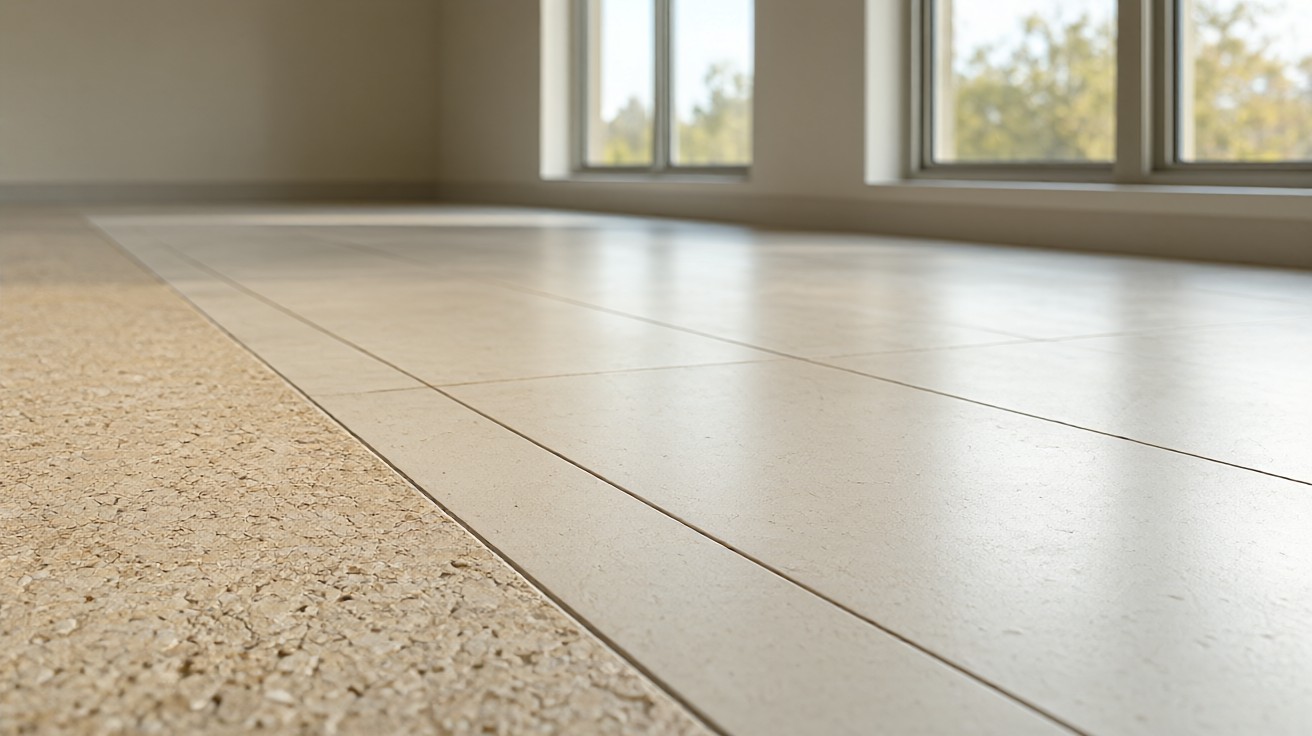

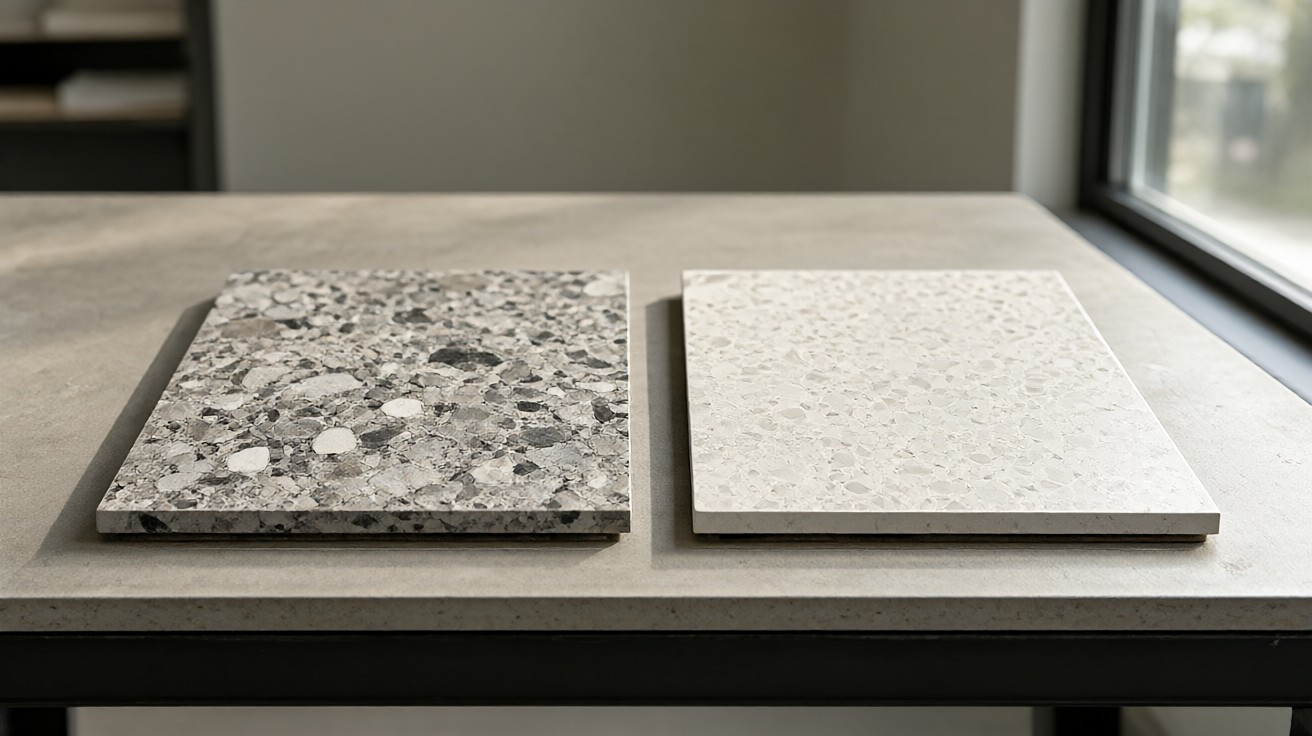
Terrazzo and terrazzo-look porcelain can share the same showroom photo, yet one is stone chip through the body and the other is a printed face on fired clay.
Porcelain wins for most US homes on cost, water resistance, and upkeep. The real aggregate floor wins where a re-grindable surface and a custom chip field matter more than the higher installed cost, and where the substrate can carry the system. The choice is condition-based, not a blanket ranking.
The Short Answer: Terrazzo or Porcelain Tile?
For most US homes, terrazzo-look porcelain is the practical winner. It costs less installed, its body is impervious at 0.5% water absorption or below, and it never needs a sealer. Real terrazzo, poured or precast tile, is the winner when you want a floor that can be re-ground rather than replaced.
That verdict flips on three conditions. Choose porcelain if the room is wet, the budget is fixed, or the install is DIY. Choose real terrazzo if a custom aggregate field and a monolithic look outrank first cost, and if the substrate can carry the system.
That is the whole decision in one line: porcelain for friction-free living, terrazzo for a floor you can restore.
One correction up front: terrazzo is not automatically heavier or more absorptive than porcelain. A thin-set epoxy terrazzo topping at 3/8 inch runs 5 to 6 pounds per square foot, lighter than many porcelain floors. The system and the construction decide, not the material name.
What You Are Actually Comparing
Real terrazzo is aggregate, marble, granite, glass, or shell, bound in cement or epoxy and ground flat. It arrives in two formats: poured-in-place and precast terrazzo tile. Both are full-body. Our terrazzo flooring guide covers the material itself.
Those two real formats are a separate decision from the printed lookalike, and the poured terrazzo versus terrazzo tile comparison covers joints, depth and weight.
Terrazzo-look porcelain is a different product. A chip pattern is inkjet digitally printed onto a porcelain body, usually under a glaze. The body is fired clay, quartz, and feldspar, not aggregate. The porcelain tile guide covers that body.
There is a third construction the headline hides: through-body porcelain. Unglazed, its color runs the full thickness, so a chip shows the same color rather than a bare clay body. It is still fired ceramic, not stone, and it cannot be re-ground to a new finish.
So this is a three-way comparison, not two. Real terrazzo, printed terrazzo-look porcelain, and through-body porcelain wear differently, repair differently, and carry different water classes. The tile flooring guide covers formats and edges.
Full-Body Aggregate vs a Printed Surface
The decisive difference is depth. In real terrazzo the chips you see at the surface continue through the body. The wear layer and the depth are the same material, so grinding a worn surface exposes fresh aggregate. That is what re-grinding and refinishing actually do.
In printed terrazzo-look porcelain the pattern is a surface wear layer, microns of ink and glaze over a dense body. Wear through that layer and the body shows. No amount of polishing brings the pattern back, because the pattern was never in the body.
Through-body porcelain sits between the two. Color runs through, so chips and scratches hide better than on a glazed or printed face. But the body is uniform fired ceramic, not aggregate, and it cannot be honed back to a fresh stone-like finish.
The cross-section is the honest witness here. The face can be printed, but the body cannot.
| Property | Real terrazzo (poured or precast tile) | Terrazzo-look porcelain (printed/glazed) | Through-body porcelain |
|---|---|---|---|
| Body | Aggregate in cement or epoxy binder, full-body | Fired clay body, inkjet pattern under glaze | Fired clay body, color through thickness |
| Surface wear layer | Same material as depth; re-grindable | Microns of ink/glaze; replace-only | Through-body color; chip-hiding, not re-grindable |
| Water absorption class | Cement tile semi-vitreous (ASTM C373); epoxy matrix low permeability | Impervious, 0.5% or less (ANSI A137.1) | Impervious, 0.5% or less (ANSI A137.1) |
| Sealing | Cement terrazzo needs a penetrating sealer | Body needs none; grout may | Body needs none; grout may |
| Repair path | Hone, polish, color-matched filler, re-grind | Replace tile; attic stock from original batch | Replace tile; chips less visible |
| Pattern depth | Random aggregate through body | Printed repeat at surface | Uniform or through-body color |
How Each Floor Wears, Chips, and Repairs
Real terrazzo is restorable. A tile installer’s comparison describes honing and polishing out scratches, color-matched filler for deep chips, and repair of cracked tile, the same processes used on natural stone. The thickness makes cracking unlikely, and the body makes refinishing possible.
Printed porcelain is replace-only. The pattern resists fading, but a chip through the glaze cannot be reground. A designer’s high-traffic guide stresses attic stock from the original shade and caliber batch, because a later run will not match. Routine care is covered in our terrazzo care guide.
Through-body porcelain hides wear better than a printed face, since the color continues through. It is still replace-only if a tile cracks. If matching stock is unavailable, a single damaged tile can force a larger replacement than the damage itself.
One caution for terrazzo with marble aggregate: acids etch it. A UK tiler’s guide is explicit that a sealer will not stop acid etching on the cement binder or the marble chip. Porcelain’s glazed face resists household acids. If the room sees vinegar, citrus, or acidic cleaners, that difference matters.
Water Absorption, Porosity, and Sealing
Porcelain is defined by absorption, not by looks. ANSI A137.1 and ISO 13006 set the impervious class at 0.5% water absorption or less, measured by ASTM C373. The Porcelain Tile Certification Agency tests to that limit. Firing between 1200 and 1400 degrees Celsius produces the dense, virtually non-permeable body.
Absorption is the spec that separates them. Everything about sealing follows from that one number.
Cement terrazzo tile is not impervious. A published cement terrazzo tile specification gives ASTM C373 absorption as semi-vitreous, the class above impervious. That is the honest answer to porosity: cement terrazzo tile absorbs more water than porcelain and needs a penetrating sealer.
Epoxy terrazzo is a separate case. The NTMA describes the resin matrix as low permeability, which is why epoxy suits sanitary areas. But precast epoxy terrazzo tile in the same published spec also carries a semi-vitreous C373 result. Scope matters: the matrix chemistry and the precast tile test are not the same claim.
Sealing follows from absorption. Cement terrazzo needs a sealer and a reseal cadence: one terrazzo contractor’s commercial guide gives every 2 to 3 years, a UK tiler’s guide every 12 to 18 months in busy rooms. Porcelain’s body needs none. The grout is the shared water path, covered in our grout and sealer guide.
So the myth that terrazzo is waterproof fails for cement terrazzo, and the myth that porcelain is maintenance-free fails at the grout. In a wet room, porcelain wins on the body. Real terrazzo can work if sealed and maintained, but the sealer and the joints are the weak points.
Grout Joints, Edges, and the Monolithic Look
Both tile formats have grout joints. Poured terrazzo does not: it uses divider strips, placed per ACI 302.1 and NTMA guidance, over cracks and joints in the slab. If a seamless field is the goal, poured terrazzo is the format that delivers it, while tile always reads as a grid.
A published cement terrazzo tile specification sets the install envelope: minimum 1/8 inch grout joint, at least 95% thin-set coverage on the back with no voids, L/360 deflection, and substrate flatness within 1/8 inch in 10 feet and 1/16 inch in 24 inches. ANSI A118.4 mortar is the setting material.
Edges change how the grid reads. In a tile installer’s comparison, terrazzo-look porcelain does not have a completely flat edge, so its grout lines are more noticeable than authentic terrazzo tile. Honed zinc or brass strips between real terrazzo tiles can be polished flush for a monolithic look.
Rectified porcelain can run tighter joints, and large format means fewer of them. The same installer flags that there is no ANSI standard dedicated to terrazzo tile installation; crews reference TCNA Handbook stone methods instead. Treat that as an installer’s observation, not a published standard.
Grout is the shared maintenance burden. Cement grout stains and needs sealing; epoxy grout costs more but resists staining. If the goal is the fewest, least visible joints, the decision is about format and edge, not about terrazzo versus porcelain alone.
Slip Resistance: DCOF and Finish
Slip is measured, not guessed. ANSI A326.3 (2021) tests dynamic coefficient of friction for hard surface flooring, not just tile. The TCNA FAQ lists five product use classes: interior dry and interior wet at 0.42 or greater, with interior wet+, exterior wet, and oils/grease classes manufacturer-declared.
Finish drives the number. A published cement terrazzo tile specification gives wet DCOF averages of 0.46 polished and 0.54 honed under ANSI A137.1 section 9.6.1. One retailer’s large-format matte porcelain lists 0.63. Honed terrazzo tile and matte porcelain both clear the interior wet threshold; a glass-like polish is the risk.
A326.3 sets no normative limit for exterior floors, ramps, or shower floors, and coatings qualify only for dry areas unless the manufacturer declares otherwise. DCOF also changes with wear, contaminants, and maintenance. A new test value is not a lifetime guarantee.
A UK tiler’s guide gives a different test: sealed honed cement terrazzo at wet PTV 42, where 36 or above is low slip potential. That is a pendulum value, not DCOF, and it is UK scope. If the area is wet and barefoot, specify the finish and the use class, not the material name.
Weight, Thickness, and Substrate by System
The shorthand that terrazzo is always heavier than porcelain is wrong. The NTMA system table scopes weight by construction, and a thin-set epoxy topping is lighter than many porcelain floors. The table below keeps each figure attached to its system.
Weight is a system property, not a material one. Read the table by row, not by name.
| System / product | Thickness | Weight (lb per sq ft) | Source scope |
|---|---|---|---|
| Epoxy thin-set terrazzo | 3/8 inch | 5 to 6 | NTMA system table |
| Monolithic cement terrazzo | 1/2 inch | 5 to 7 | NTMA system table |
| Polyacrylate terrazzo | 3/8 inch | 4.5 | NTMA system table |
| Bonded cement terrazzo | 2-1/4 inch total | 18 to 22 | NTMA system table |
| Sand cushion cement terrazzo | 3 inch total | 25 to 30 | NTMA system table |
| Precast cement terrazzo tile | 1/2 inch US / 20 mm UK | about 11 (55 kg/m2) before adhesive | Published spec / UK tiler |
| Porcelain tile | 3/8 to 1/2 inch | 4.3 to 8 | Retailer product page / contractor guide |
Read the table by system. Epoxy at 5 to 6 psf and polyacrylate at 4.5 psf are lighter than or comparable to porcelain at 4.3 to 8 psf. Precast cement tile at roughly 11 psf, bonded at 18 to 22, and sand cushion at 25 to 30 are heavier. The material name alone tells you nothing.
Two vendor figures need scope flags. A terrazzo contractor’s commercial guide gives poured terrazzo at 2 to 3 inches and 15 to 20 psf, which is a poured-system figure, not tile. A terrazzo manufacturer’s blog calls terrazzo tile 50% lighter than ceramic or stone, an unscoped claim. Neither overrides the NTMA system table.
Substrate is the gate. The published spec’s L/360 deflection and flatness limits apply to tile; poured systems depend on slab quality. On wood or upper-story framing, check dead load and deflection before choosing a heavy system. Binder and system selection is covered in our epoxy vs cement terrazzo guide.
Acoustics belongs here too, because the lever is the underlayment. The NTMA is explicit that terrazzo’s dense surface reflects rather than absorbs sound; impact-noise control comes from a resilient layer, as at Northrop Auditorium’s 3/8 inch recycled rubber pad. A contractor’s table calling terrazzo a good sound absorber contradicts that.
Both terrazzo and porcelain are hard, reflective surfaces. Neither absorbs sound in the way a carpet or a resilient pad does. If quiet underfoot is the goal, the underlayment is the decision, not the finish material. Do not buy terrazzo expecting it to absorb sound.
Cost: Material, Installed, and Lifecycle
Cost bands disagree across publishers, so each figure below keeps its source and scope. Never average them. The spread is the information: it tells you how much the answer depends on region, format, and labor assumptions.
| Item | Cost band (US, per sq ft) | Source and scope |
|---|---|---|
| Terrazzo tile, material | $4 to $12 (Angi); $7 to $15 (HomeGuide) | Homeowner project data vs contractor materials |
| Terrazzo tile, installed | $9 to $22 (Angi); $15 to $35 (HomeGuide) | Installed total vs materials plus labor $8 to $20 |
| Poured terrazzo, installed | $15 to $35 (Angi); $20 to $70 (HomeGuide) | Poured-in-place, both publishers |
| Porcelain tile, installed | $8 to $20 | Stone-cost index, US 2026 |
| Porcelain, material example | $13 | One retailer, 24x48x3/8 inch matte porcelain |
| Ceramic tile, material | as low as $1 | Terrazzo manufacturer blog, vendor flag, ceramic not porcelain |
| UK real terrazzo tile | £100+ per m2 before fitting | UK tiler guide |
| UK poured terrazzo | £250 to £300+ per m2 installed | UK tiler guide |
The terrazzo tile installed spread, $9 to $22 from Angi against $15 to $35 from HomeGuide, is a baseline difference, not a contradiction to resolve. Angi reflects homeowner project data; HomeGuide builds up materials plus contractor labor. Both are labeled; neither is an average.
Lifecycle baselines differ too. A terrazzo contractor’s commercial guide gives terrazzo 30-plus years against porcelain at 15 to 20, with terrazzo reseal every 2 to 3 years and porcelain grout reseal every 3 to 5. Detailed terrazzo pricing is in our terrazzo floor cost guide.
A stone-cost index runs a 30-year model the other way: porcelain near $14 per square foot against marble near $41, with porcelain needing no care beyond cleaning and replacement when worn. That model assumes porcelain is not restored; the contractor model assumes grout degradation and terrazzo restoration. Different baselines, different winners.
A terrazzo manufacturer’s blog calls terrazzo one of the lowest lifecycle cost floors, a vendor claim. The honest reading: porcelain wins first cost and care cost; terrazzo can amortize its higher first cost over decades if restoration is funded. The lifecycle winner depends on which baseline you accept.
Where Each Floor Wins
The decision is condition-based. Porcelain wins if the room is wet, the budget is the binding constraint, the install is DIY, or the property is a rental where turnover cost matters. Its impervious body and no-sealer care are the lowest-friction path for most US homes.
Real terrazzo wins if a custom aggregate field, a monolithic seamless look, or a re-grindable multi-decade horizon is the priority, and if the substrate and the maintenance budget can carry it. Historic restoration and commercial spaces with funded upkeep are its strongest cases.
Through-body porcelain wins if you want chip-hiding durability without terrazzo’s sealing and restoration. It is the commercial-corridor compromise: harder to show wear than a printed face, cheaper to maintain than real terrazzo, still replace-only if a tile cracks.
If you’re installing over a wood subfloor, the deflection limit decides before the pattern does.
Three gates decide. Substrate: if deflection or dead load is marginal, epoxy thin-set is the lightest real-terrazzo path, or choose porcelain. Maintenance: if you will not seal and reseal, do not install cement terrazzo in a wet or stain-prone room. Budget: if first cost binds, porcelain.
Both materials work over radiant heat, and both can be specified to an interior wet slip class. The winner is not the material with the better brochure; it is the one whose conditions your room, your substrate, and your maintenance habits actually meet.
How to Tell Real Terrazzo from Terrazzo-Look Porcelain
Look at the edge. A UK tiler’s guide and a tile installer both give the same test: real terrazzo shows chips through the body, while terrazzo-look porcelain shows a uniform clay body with a printed face. The cross-section does not lie, even when the surface photo does.
Lay six to eight tiles dry. A printed pattern repeats across tiles; real aggregate is random. If the same chip cluster appears in the same place on multiple tiles, it is inkjet printing, not stone. This is the fastest showroom test.
Other tells: a water drop beads on an impervious porcelain body but darkens unsealed cement terrazzo. Precast cement tile at 1/2 inch or 20 mm feels heavier per area than 3/8 inch porcelain. Pressed-edge porcelain shows wider, more visible grout lines than rectified or honed-strip terrazzo.
Do not rely on sound. Both are hard, dense, reflective surfaces; tapping tells you little. Ask for the spec sheet instead: ASTM C373 absorption class (impervious at 0.5% or less versus semi-vitreous), ANSI A326.3 DCOF and use class, and PTCA certification for porcelain.
Terrazzo vs Porcelain Tile FAQs
Is terrazzo or porcelain tile better for a bathroom?
Porcelain, in most cases. Its body is impervious at 0.5% absorption or less and needs no sealer, while cement terrazzo tile is semi-vitreous and depends on a maintained sealer and grout. Real terrazzo can work in a bathroom if sealed and reseal is funded, but porcelain is the lower-risk choice.
Does terrazzo-look porcelain tile need sealing?
The body does not. Porcelain is impervious, and a printed or glazed face needs no penetrating sealer. The grout joints may, especially cement grout in a wet or stain-prone area. Real cement terrazzo tile is the opposite: the body needs a sealer, and a UK tiler’s guide seals before grouting as a grout release.
Can you repair a chipped terrazzo-look porcelain tile?
Not by refinishing. The pattern is a surface wear layer, so a chip through the glaze cannot be reground; the tile is replaced, ideally from attic stock of the original shade and caliber batch. Real terrazzo is the repairable one: honing, polishing, and color-matched filler restore the body.