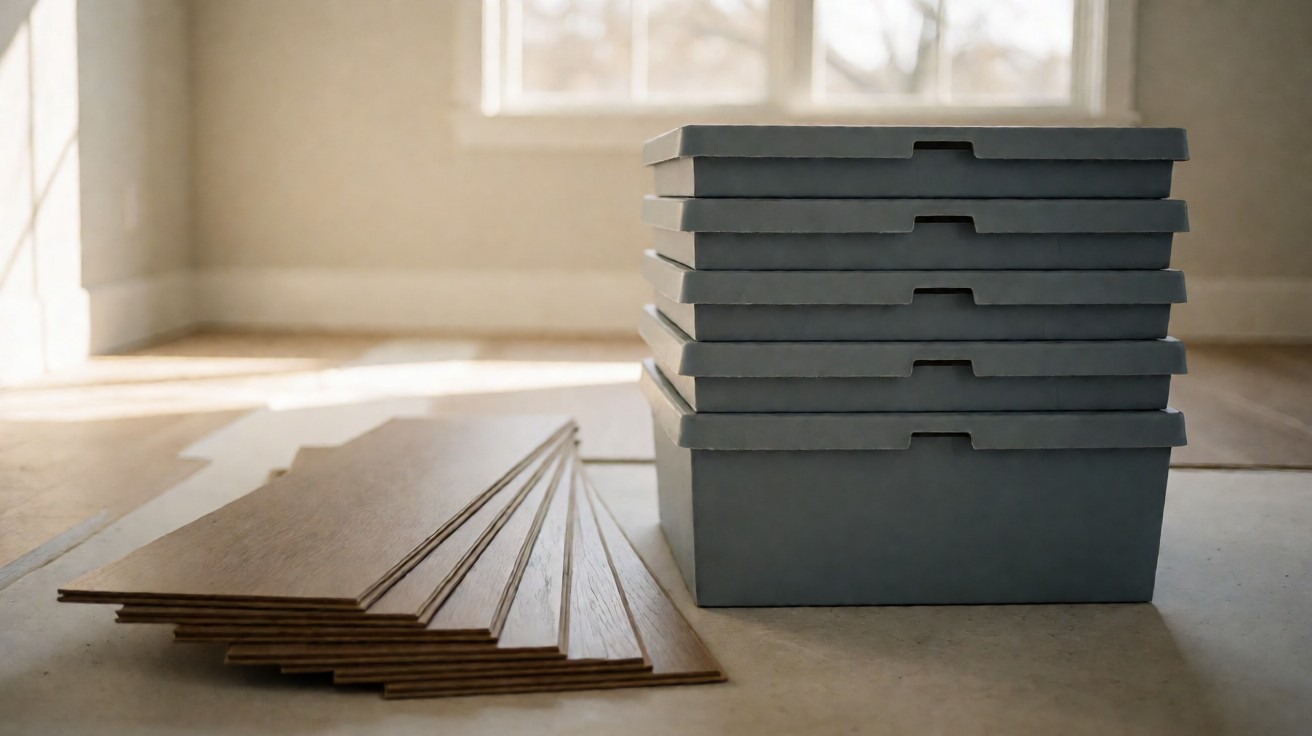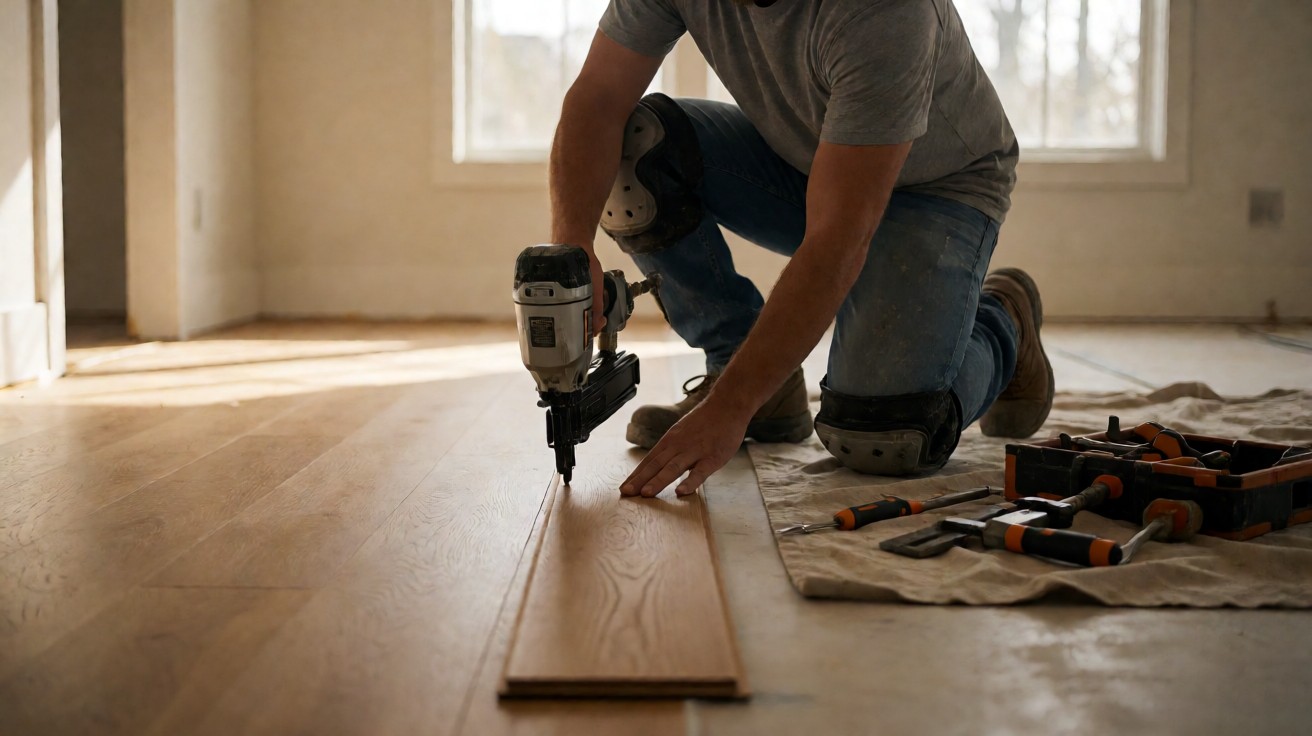

The flooring arrived and the installer comes Friday. The cartons have to sit in the room until they match its heat and humidity before a plank is laid.
The answer is a minimum of 48 to 72 hours in the room itself, with 7 to 10 days the better target when the manufacturer asks for it, and the boxes kept sealed, in the room they will be installed in, and off bare concrete the whole time.
How Long Flooring Should Acclimate Before Installation
Acclimatization is a conditioning period, and the number attached to it depends on who you ask. The NWFA 2025 Installation Guidelines set the floor: the interior environment of the jobsite should be 65 to 85 degrees F and 40 to 60% relative humidity for at least 48 hours before any moisture testing or installation takes place.
That 48-hour rule is about the room, not the boards. It says the building has to be stable before you start measuring it. If the jobsite is cold in January or hot and damp in July, the acclimatization clock has not started no matter what day the delivery showed up.
Manufacturer instructions on the cartons are the other half of the answer. BHW Floors sets a minimum acclimatization time of 72 hours and recommends 7 to 10 days for optimization, and Preverco calls 48 to 72 hours for engineered wood, and ideally 48 to 72 hours for solid wood, good practice rather than an optional step.
Choose the longest period that any instruction in your project demands. If the manufacturer says 7 to 10 days and the trade body says 48 hours, the 7 to 10 days is what you are held to, and installing early against the carton sheet is the thing that comes back as a complaint later.
Acclimatization is also a delivery date problem, not just a waiting problem.
BHW Floors asks that flooring be delivered approximately 48 hours before installation. That number assumes a normal room and a normal schedule. When the delivery lands early, the cartons sit in the room until the install date rather than sitting in a garage, which is why the delivery date and the install date have to be booked together.
| Source | Stated period | What the period covers |
|---|---|---|
| NWFA 2025 Installation Guidelines | At least 48 hours before testing or installation | 65 to 85 degrees F and 40 to 60% relative humidity in the jobsite |
| NWFA for spaces receiving wood flooring | At least 7 days before installation | 65 to 75 degrees F and the humidity planned for occupants |
| Preverco | 48 to 72 hours for engineered wood, ideally 48 to 72 hours for solid wood | Target 70 degrees F plus or minus 10 degrees F and 37 to 50% relative humidity |
| BHW Floors | Minimum 72 hours, 7 to 10 days recommended for optimization | HVAC on and maintained, 60 to 80 degrees F, 35 to 55% relative humidity, 5 days minimum |
| BHW Floors delivery guidance | Approximately 48 hours before installation | Booking the delivery so the conditioning period starts on arrival |
Where The Flooring Should Sit While It Acclimates
Preverco is direct about it: store the flooring in the room where it will be installed, and do not place it in basements, garages, or areas with fluctuating conditions. A garage stack conditions to the garage, and the garage is not where the floor is going.
BHW Floors adds the placement details that decide whether the boxes are doing any good at all. Do not store the product directly on concrete, and do not store it near outside walls. Concrete stays cold and damp underneath a stack, and an outside wall is the coldest surface in the room.
Leave the cartons closed. BHW Floors says plainly that you should not open or remove the product from its cartons during acclimatization, which makes the carton the unit that conditions, not the board inside it. Carton walls and pallet wrap slow down how fast the stack takes on the humidity of the room.
Leaks, dampness, and improper ventilation get fixed before the flooring arrives, not after. Preverco says to address them before starting. An acclimatization period in a room with a sweating pipe or a jammed return vent produces conditioned flooring in the wrong conditions.
Keep the room itself in the state you want the floor to live in. If the heating goes off overnight and the temperature swings hard between midnight and dawn, the boxes are chasing a moving target and the 48-hour count means much less than it does in a stable house.
If the flooring has to sit somewhere else, that somewhere has to be the room it is going into.
The Temperature And Humidity Your Room Needs
Three sources, three sets of numbers, and they overlap more than they differ. The NWFA range is 65 to 85 degrees F and 40 to 60% relative humidity. Preverco targets 70 degrees F plus or minus 10 degrees F with relative humidity at approximately 37 to 50%, and calls that step critical and not to be skipped.
BHW Floors frames the same requirement as an operating condition rather than a target. The heating and cooling system should be on, operational, and maintained, between 60 to 80 degrees F with relative humidity at 35 to 55%, for a minimum of 5 days.
The NWFA numbers shift once wood is involved. In spaces that will receive wood flooring, the recommendation is to hold the temperature between 65 to 75 degrees F and the relative humidity planned for the building’s occupants for at least 7 days before installation.
Humidity is the figure most people get wrong, because they measure the room on a wet day in a closed house. The target is not today’s reading, it is the average the house will hold once it is lived in normally. Measure the same room twice a week apart, and if the two numbers are far apart, the house is not ready to condition anything.
Choose the target that matches your climate and stay with it. A house in a humid coastal climate holds a different number than a house in a dry inland one, and the manufacturer sheet on your cartons is where that number comes from.
Wood tells you when it has arrived. Preverco puts the target at 6 to 9% moisture content for wood acclimatized to normal living conditions, and that is the figure to check against once the boxes have had their time.
Why The Numbers Range From 48 Hours To 10 Days
Same word, three different questions.
The spread comes from the sources measuring different things. The NWFA 48 hours is a jobsite conditioning rule: the room has to be stable before you start testing it, and it says nothing about how long the boards themselves sit.
A manufacturer’s 72 hours is a minimum acclimatization time for the product, while a 7 to 10 day recommendation is an optimization window, extra time for the flooring to reach the moisture content of normal living conditions.
The 7-day figure sits in between and applies to wood specifically. Hold 65 to 75 degrees F and the occupant humidity in the room for at least seven days before installation, and the flooring arrives at the job with wood already close to the moisture content of the house.
When the periods conflict, follow the longest and the most specific. A 48-hour jobsite rule from a trade body and a 72-hour minimum on the cartons are not in conflict, they measure different things, so you do both. A 48-hour rule and a 7 to 10 day manufacturer recommendation are in conflict, and the manufacturer wins.
Specify the period you are working to before the crew arrives, and put it in the order. It costs one line in a purchase order and it removes the argument on the morning of installation, when the flooring has already been sitting in the room for a day and a half.
If the room cannot hold the numbers, you have a different project. No acclimatization period fixes a building that cannot hold a temperature, and adding days to a schedule in an unheated garage does not move the material any closer to the finished room.
How To Tell When The Flooring Has Equilibrated
Time is a proxy. The wood itself is the instrument. Preverco states the target plainly: 6 to 9% moisture content for wood acclimatized to normal living conditions, which is the number a moisture meter reads in the field.
Read the boards, not the room. Take readings from boards taken from the middle of the pallet and from the outside, and compare them. When boards stored in different positions land within a couple of points of each other and inside the 6 to 9% range, the stack has stopped arguing with the room.
Weight is the check most people skip. Weigh a small sample of boards before the acclimatization period and again at the end of it, and the change in weight tells you how much moisture the stack took on or gave up. A pallet that lost weight was dry when it arrived, and it is now closer to the room.
Look at the ends of the boards and the edges of the panels. Boards that are still adjusting show end checking, and the ends show it first because that is where moisture moves fastest.
If the readings still move week to week, the stack has not settled.
A reading taken in the hallway is not a reading of the stack.
Check the readings again on install day, not just on delivery day. The numbers that matter are the ones taken in the room, on the morning the floor goes down, with the heating running the way it has been running for the whole period.
Moisture Testing The Subfloor Before Installation
Acclimatization conditions the flooring. Moisture testing measures the floor it goes on top of, and the two happen at the same time, not one after the other.
The standard test for a concrete slab is ASTM F2170, the in-situ relative humidity probe test. The probe goes into a drilled hole in the slab, and NWFA requires 72 hours for moisture to reach equilibrium inside that hole before any reading is taken.
That 72-hour wait is why slab conditioning comes first. NWFA wants the concrete slab at the same temperature and humidity expected during service conditions for at least 48 hours before the test is placed, so the reading describes the floor the finished room will actually have.
The limit that matters for wood is 75% relative humidity measured in situ. Above that, the slab is still giving off moisture, and the answer is a moisture mitigation system or more waiting, not a better acclimatization schedule for the boards on top.
Testing frequency is set too. Perform three tests for the first 1,000 sq ft and one test for every additional 1,000 sq ft, so a 2,000 sq ft slab takes four probes rather than one.
A phenolphthalein test that indicates excessive moisture sends the job back to formal testing. NWFA requires further testing using ASTM F2170, calcium chloride testing under ASTM F1869, or a moisture meter, to establish the baseline for required acclimatization.
That baseline is the number the acclimatization period is calculated from. It decides whether the material sits in the room for the 48 hours the jobsite rule allows or for the 7 to 10 days the manufacturer asks for, and it cannot be argued with on install day.
| Test or requirement | Threshold | What it decides |
|---|---|---|
| ASTM F2170 in-situ relative humidity probe | 72 hours of equilibrium inside the hole before the reading | Whether the slab reading is valid at all |
| Slab conditioning before the test | At least 48 hours at service temperature and humidity | Whether the reading describes the finished room |
| In-situ relative humidity limit for wood and wood-based products | 75% relative humidity | Whether mitigation is required before installation |
| Test count for a slab | 3 tests for the first 1,000 sq ft and 1 test for every additional 1,000 sq ft | How many probes a slab needs to be trusted |
| Phenolphthalein test indicating excessive moisture | Further testing under ASTM F2170, ASTM F1869 calcium chloride, or a moisture meter, then 48 to 72 hours of conditioning minimum | The baseline for required acclimatization |
Flatness is a separate test with a separate tolerance, and it is checked before the same crew starts laying. The guide on how to check subfloor flatness covers the straightedge method, the numbers that matter, and what to do when a high spot turns up.
What To Do When The Room Is Not Ready
Sometimes the room fails and the flooring is already on site. Leaks, dampness, and improper ventilation are the three conditions Preverco says to resolve before starting, and they are also the three that make a waiting period pointless.
Where the problem is the slab rather than the boards, the fix is a mitigation system, and that is a bigger job than acclimatization. Where the problem is the room, running the heating and cooling earlier is usually the cheapest fix available.
If the delay crosses into a season change, recalculate. A stack that started acclimatizing in January is conditioning toward a winter number, and installing it in July against a 40% target is a different problem than the one you scheduled.
Where the flooring has already been sitting in a garage or a cold room, it is not conditioned yet, whatever the delivery date says. Move it into the room it is going into and restart the count, and do not shorten the count because the crew is booked.
If the subfloor itself needs work, that is a different budget line, and subfloor repair cost is worth pricing before the delivery rather than after the delivery lands and the install date is already booked.
The Acclimatization Checklist
This is the sequence to work through before the install date, and every line on it is something you can confirm for yourself rather than take on trust.
Book the delivery so the flooring arrives about 48 hours before installation, which is the window BHW Floors builds into its own instructions and the one most crews plan around.
Get the flooring into the room it will be installed in, and keep it off concrete and away from outside walls for the whole period, not just for the first day.
Turn the heating and cooling on and leave it running, between 60 to 80 degrees F and 35 to 55% relative humidity, for at least 5 days.
Hold the room at 65 to 85 degrees F and 40 to 60% relative humidity for at least 48 hours before anything gets tested, and for 7 days when wood is going down.
Keep the cartons sealed. Do not open them or remove the product during acclimatization, and do not cut a box open to look at a board.
Fix leaks, dampness, and poor ventilation before the period starts, because conditioned flooring sitting in a damp room is still damp flooring when the crew opens the cartons.
Take a moisture reading in the middle of the stack and at the edge of it, and look for the 6 to 9% moisture content range before the first carton is opened.
Have the slab tested under ASTM F2170, allowing 72 hours of equilibrium inside the hole before the reading, and stay under the 75% in-situ limit.
Check the flatness of the subfloor before the crew arrives, so a problem under the floor does not turn into a problem with the floor laid on top of it.
Record the dates, the moisture readings, and the room conditions you held, and hand that record to the installer on the morning of the job.
What Goes Wrong When Acclimatization Gets Skipped
Wood flooring installed straight out of a cold truck or a damp warehouse does not stay still. It moves with the room after installation, and that movement shows up as gaps, cupping, and boards that sound hollow underfoot.
Cupping and crowning are the two failure shapes you see. Boards that swell in the middle of a panel and dip at the edges have taken on moisture in an unstable room, and boards that shrink at the edges have given moisture up too fast.
The gaps that open later along a wall are the expensive version of the same mistake. The sizing and movement math behind that is covered in flooring expansion gaps explained, but the gap only works if the flooring on both sides of it was conditioned to the room it is living in.
A floor that moves after installation is also a warranty problem. Manufacturers write the acclimatization period into their installation instructions, and a floor installed outside those instructions is the one that gets argued about.
The cheapest fix is scheduling, not money. Two extra days before the install date costs nothing but a phone call, while a floor that has to be lifted, dried, and relaid costs the material twice.
Acclimatization Is Not The Same As The Post-Install Wait
Two different clocks run in the same job, and they get confused constantly. Acclimatization is the period before installation, when the flooring is being conditioned to the room. The post-install wait is the period after installation, when the adhesive, the finish, and the floor itself are given time to set.
The post-install clock belongs to the material and the finish, not to the acclimatization period. The guide to when you can walk on new flooring covers the wait times by material, and that is the page to read for furniture placement and traffic.
Keep them separate when you schedule. Book the install date at the end of the acclimatization period, and then add the post-install wait on top of it before the furniture comes back.
If the acclimatization period was short, the post-install wait does not absorb the difference. A floor that was installed out of condition is still out of condition while it cures, and no amount of waiting on top fixes it.
Questions To Ask Your Flooring Supplier
Ask what period the manufacturer specifies for your product, in writing, and ask what they mean by the period. Most sheets use the word days where the trade guidance uses hours, and the difference matters when you are booking a crew.
Ask whether the manufacturer requires the cartons to stay sealed during the period. Some do, and opening a box early is how a pallet gets conditioned unevenly, with the boards in the middle of the stack lagging the ones on the outside.
Ask what relative humidity the manufacturer wants the room held at, and what they mean by the target. If the answer is a range, you want to know which end you are aiming at when the numbers are 37 to 50% or 35 to 55%.
Ask what the installer wants to see before starting. A moisture reading, a room temperature, a date. If the answer is nothing, you are the only check in the process.
Ask who is responsible if the floor moves later. Manufacturers point at the installer for installation instructions, and installers point at the schedule. The answer tells you who to call when the floor opens a gap in February.
Where This Step Sits In The Whole Install
Acclimatization is one stage of a longer process, and it runs in parallel with the subfloor work rather than after it. The rooms get cleared, the slab gets conditioned and tested, the flooring sits in the room being conditioned, and installation starts when both are ready.
All of that runs after the work of preparing a room for new flooring, and it is worth doing properly, because a room that cannot be held at temperature is a room that cannot condition flooring.
The full sequence, from delivery through the last row, is set out in the flooring installation guide. It is worth reading once before the delivery date so you know which steps the crew expects to have done and which ones they expect to handle.
The order that matters most: fix the subfloor, condition the room, test the slab, acclimatize the flooring, then install. Reversing the first two is what produces the failures described above, and no schedule recovers it.
Plan backwards from the install date. If the manufacturer says 7 to 10 days, the room needs 48 hours of stable conditions before testing, and the slab needs 72 hours of equilibrium in its test hole, the delivery lands earlier than most people expect.
That is the whole job, and it is mostly a planning job: put the flooring in the room early enough, keep the room stable, and let the clock run before the crew arrives.