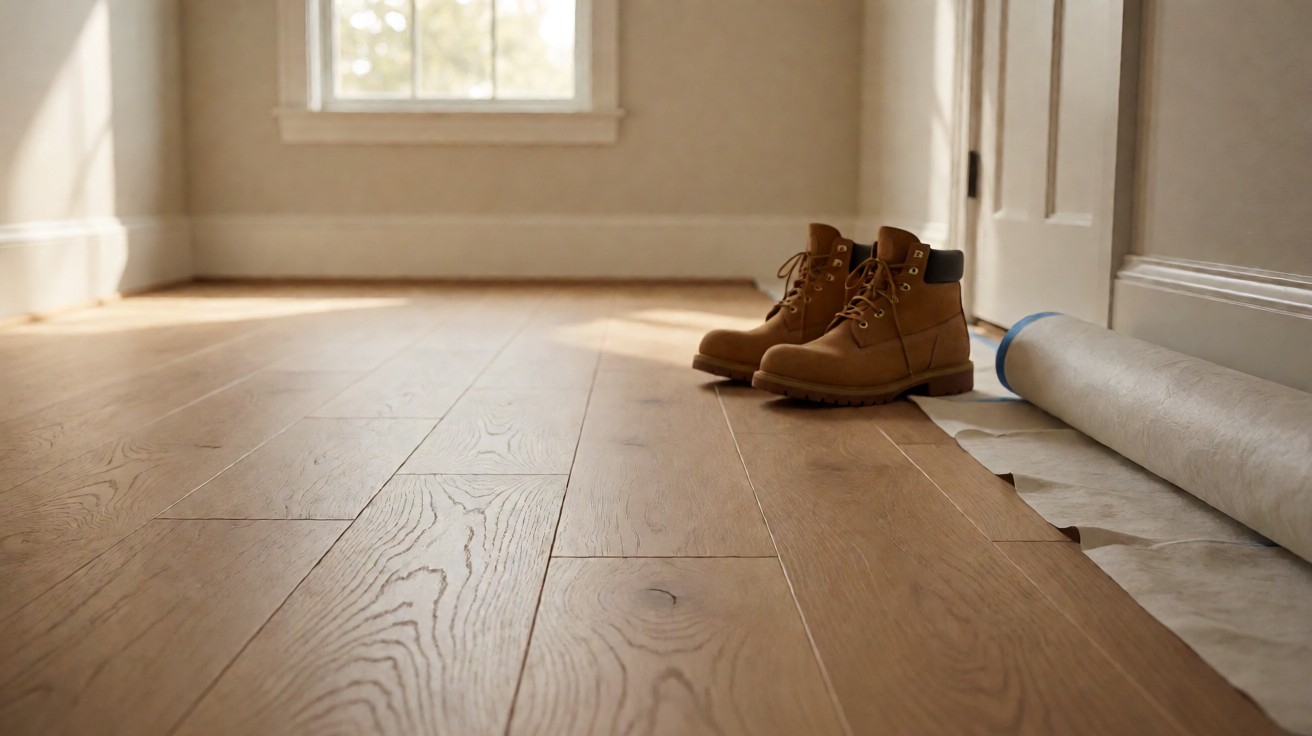

The installer finished the floor on Thursday, the sofa is still on the truck, and you want to know when you can walk on it without ruining the work.
The answer is that most floors take light foot traffic within 24 hours of installation, but the real number comes from the product’s own data sheet. Tile waits on the grout, hardwood on the finish, glued vinyl on the adhesive, and a click-lock floor waits on nothing at all.
Three Different Clocks: Dry, Light Traffic, And Full Cure
A floor that is dry to the touch is not the same as a floor that is ready for furniture, and manufacturers publish three separate milestones that do not overlap.
The first is dry to the touch, when the surface no longer marks from a fingerprint. The second is light foot traffic, meaning a person walking across in socks.
The third is full cure, when the material has hardened to its rated strength. That is what a manufacturer means by safe for furniture.
If a data sheet says 24 hours and never says which milestone it means, the number is doing no work at all.
The gap between those milestones is often wide. A waterborne polyurethane coating from Bona reports light foot traffic at 8 hours, 80 percent cure at 24 hours, and full cure at about 5 days.
The same company puts cure for waterborne finishes at 3 to 7 days against 14 to 30 days for oil-modified ones. A separate Bona page on Swedish oil finishes notes they can take 30 to 90 days.
That spread is why a floor can look finished, take light foot traffic, and still be marked by a sofa leg put on it the same evening.
Dry is a surface condition. Cure is a chemical one, and it keeps going long after the surface feels fine.
Three clocks can also be running at once on a single job: the adhesive underneath, the grout or finish on top of it, and the substrate below that, still giving up moisture.
Each has its own figure, and the floor is only as ready as the slowest of the three. If an installer quotes one number for the whole job, ask which layer it belongs to.
The Wait Times, Material By Material
The table below collects the figures manufacturers publish for the milestones that matter.
Read the second column as the point where you can walk across the room, and the third as the point where furniture, trolleys, and pets belong.
| Material | First light foot traffic | Furniture and heavy traffic | What sets the clock |
|---|---|---|---|
| Hardwood, site finished | 8 to 24 hours | 3 to 7 days, longer for oil finishes | The finish coat |
| Engineered wood, glue down | 12 hours | 24 hours | The adhesive bond |
| Ceramic and porcelain tile | 24 hours | 72 hours, longer before sealing grout | Grout cure |
| Glue down vinyl plank and LVT | 24 hours | 48 hours | The adhesive bond |
| SPC and rigid core, click lock | Immediately | 72 hours for rolling loads | Nothing to cure, joints settle |
| Click lock laminate and cork | Immediately | 24 to 48 hours for furniture | Nothing to cure |
| Carpet tile | Immediately | 24 hours for seams to dry | Seam sealer and adhesive |
| Glue down broadloom carpet | 24 to 48 hours | 24 to 48 hours | The adhesive bond |
| Sheet vinyl, linoleum, rubber | 24 hours | 72 hours | The adhesive bond |
| Epoxy or sealed concrete | 12 to 16 hours | 3 days to full cure | The coating |
Two things are worth noticing in that table. The first is that click-lock products have no adhesive underneath, which is why they can be walked on the same afternoon.
The second is that every adhesive-backed floor lands in the same band: 24 hours for light traffic and 48 to 72 hours for furniture, because that is how long a water-based or acrylic adhesive needs to reach a bond.
The order of operations around the install is covered in the flooring installation guide. This clock starts when the last plank or tile is set.
Check the finish data sheet for your own product, because the numbers in trade tables and the numbers on the box are not always the same figure.
Hardwood, Engineered Wood, And Bamboo: The Finish Sets The Clock
Site-finished hardwood is the slowest of the common residential floors, and the reason is the finish rather than the boards.
A floor is sanded, filled, and coated, and each coat has to cure before the next goes down.
Typical published figures for a waterborne polyurethane are light foot traffic at 8 to 24 hours, 3 to 7 days to full cure, and 14 to 30 days for oil-modified finishes.
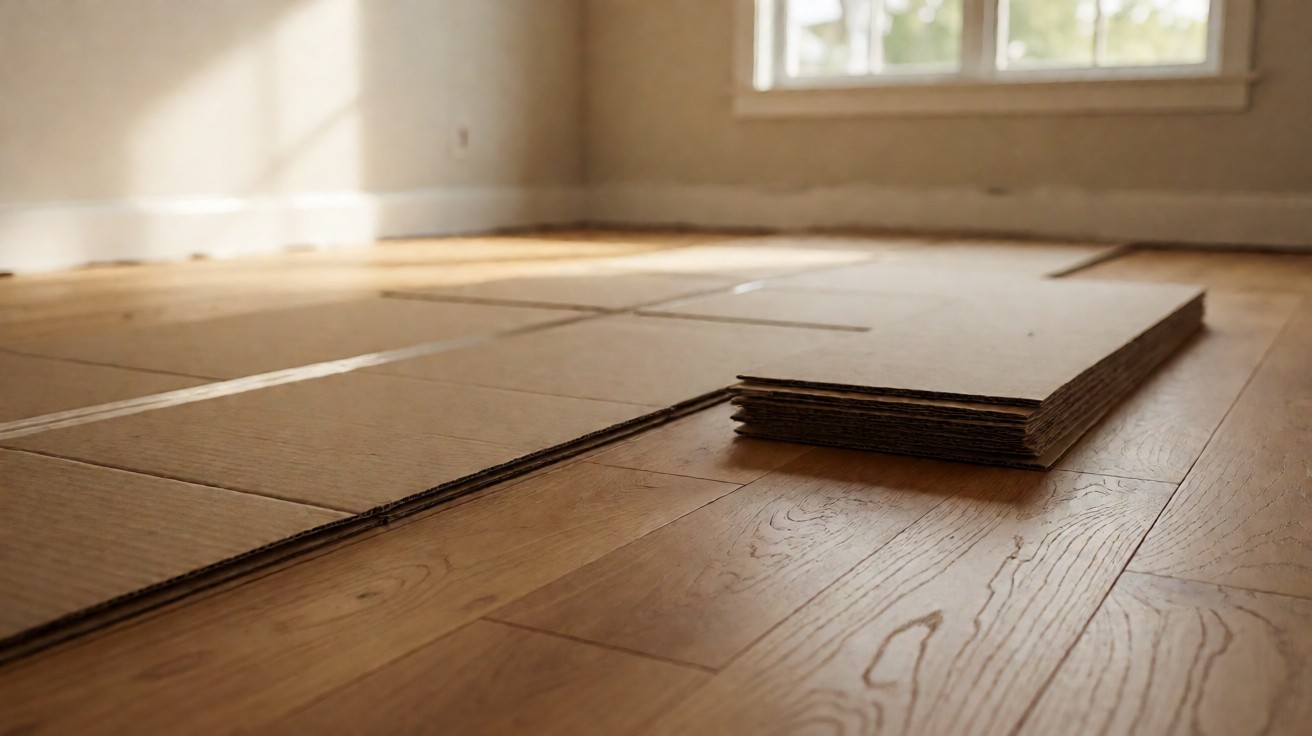
A newly coated floor should be covered with cardboard or hardboard sheeting, taped at the seams, whenever people have to cross it.
Prefinished engineered wood and bamboo behave differently, because the finish is already cured when the plank arrives and the only clock is the adhesive.
Mohawk’s glue-down instructions for its engineered Uniclic product ask installers to avoid light or regular foot traffic for at least 12 hours and heavy foot traffic for at least 24 hours.
Mannington’s hardwood guidance puts first foot traffic at 12 hours in typical climates, and warns that arid, dry climates need longer.
The National Wood Flooring Association sets the environment as well as the wait, asking for 30 to 50 percent relative humidity and 60 to 80 degrees F.
The same guidelines recommend that wood flooring be one of the last jobs completed on a project, and that foot traffic on finished wood be limited.
Acclimating the wood before site finishing adds a further 5 to 7 days before the first coat goes on.
One practical note for anybody living on the floor while it cures: if the house is heated in winter, the finish runs slower than the data sheet assumes.
Rugs stay off the floor until the finish is fully cured. A water-based finish also clears the smell long before the floor is ready, so a floor can pass the smell test months before it passes the cure test.
Ceramic And Porcelain Tile: Grout Sets The Clock
Tile on a mortar bed or a thin set is a two-stage wait, and the stages get confused. The first is the setting of the mortar or thin set underneath, and the second is the cure of the grout on top.
Custom Building Products publishes a typical figure for its LFT thin set mortar of 24 hours before grouting and light traffic, and 7 to 10 days before heavy or vehicular traffic.
The same guidance asks that the assembly stay above 50 degrees F or below 100 degrees F for 72 hours to achieve a proper bond.
Their rapid cure product shows how much the ordinary case depends on chemistry: groutable in 2 to 4 hours, light foot traffic at 4 to 6 hours, and heavy commercial traffic 24 hours after grouting.
Cement-based grout then needs its own time. Laticrete advises a minimum of 72 hours at 70 degrees F before a sealer goes on.
Mapei puts the sealer window at 24 to 72 hours depending on the manufacturer, and epoxy grout cures faster than cementitious grout, so the bag matters more than the habit.
The tile itself is not the limiting factor, and this is where product standards and install standards get run together.
ANSI A137.1 is the tile specification, and it sets the water absorption ceiling that defines porcelain at 0.5 percent or less, tested to ASTM C373.
The same specification carries a wet-area threshold of 0.42 wet DCOF for level interior tile walked on wet.
ANSI A326.3 is the test method for measuring dynamic coefficient of friction, and it carries no threshold of its own.
That wet DCOF figure matters when you are choosing a tile for a bathroom or an entry, and it does not tell you when to walk on a new floor. It is a product performance test performed on a wet tile.
A tile that clears 0.42 can still be sitting under grout that has not cured. The same logic applies to how soon the installer starts grouting.
If a rapid mortar was used, grouting at 4 hours is right. If an ordinary one was used, the same 4 hours is too early and the tile can shift under the pressure of the grout.
Grout walked on too soon crumbles at the joints and leaves a permanently gritty surface.
Glue-Down Vinyl, LVT, And SPC: The Adhesive Decides
Glue-down vinyl plank and LVT behave like any other adhesive-backed floor, with the published figures clustered where you would expect.
The Lions Floor glue-down LVP guide allows light foot traffic only for 24 hours after installation, restricts heavy traffic, rolling loads, and furniture placement for 48 hours, and asks for at least 5 days before any wet cleaning.
SPC and rigid core vinyl splits by installation method. A click-lock plank is walked on immediately, because the only thing holding the floor together is the tongue and groove, and the panels arrive already finished.
The same guide asks that the floor not be exposed to heavy rolling load traffic for 72 hours after installation.
On a glue-down SPC install the adhesive is the clock, so that guide asks for 24 hours before the adhesive has set and 24 hours before traffic on stairs.
One more SPC detail catches people out: the heating system goes to its preferred level only after 48 hours, because a fast heat-up drives off the moisture the adhesive is still working with.
If the floor goes down over a non-porous substrate, the same guide warns that additional time may be necessary.
Laminate, Cork, And Other Floating Floors
Click-lock laminate and floating cork are the fastest floors in the house, because nothing has to cure. There is no adhesive under the planks and no wet film on the surface.
They can be walked on during installation if nobody catches a joint. What needs a wait is water, and what needs care is furniture.
The floor still has to acclimate before it goes down rather than after. CALI asks for 24 hours of acclimation in normal living conditions, and the Floor Warehouse guide gives 24 to 48 hours.
The method for putting it down is in how to install laminate flooring.
Where the wait matters is under furniture. A floating floor expands and contracts with the room, so a rigid sofa leg sitting on a lifted joint can hold one plank off its neighbour and the floor stays uneven for good.
Let the floor settle first, and put a felt pad under every leg.
Carpet And Carpet Tile
Carpet is the easiest floor in the house to walk on and the easiest one to ruin.
A stretch-in installation is walked on the same afternoon, because the carpet is held by tack strip and tension rather than by glue.
The limit is furniture. Heavy furniture needs blocks or a pad under its legs, and those should stay in place for at least 24 hours so the legs do not imprint the pile.
Glue-down carpet is a different animal. CRI 105, the residential carpet installation standard, and Standard Carpets’ broadloom manual say the same thing about restricting traffic.
Traffic over field-applied adhesive installations should be limited to installation personnel only for a minimum of 24 to 48 hours so adhesives can cure properly, and premature traffic will cause installation failure.
Both also ask you to keep water from cleaning or other sources off the carpet for 30 days, and to keep the room at or above 50 degrees F.
Flagship goes further and asks for no traffic at all for a minimum of 48 hours after installation.
Carpet tile is quicker than glue-down broadloom, but it is not instant. Interface asks that seams be allowed to fully dry for 24 hours before allowing traffic.
Godfrey Hirst’s tile instructions ask for 24 hours of on-site conditioning at 15 to 35 degrees Celsius, and warn against moving heavy objects within 24 hours of the installation.
If you are installing carpet tile over a ramped area, Interface recommends a pressure sensitive adhesive rather than a hard set, because a hard set is what allows peaking and buckling to show up later.
Sheet Vinyl, Linoleum, And Rubber
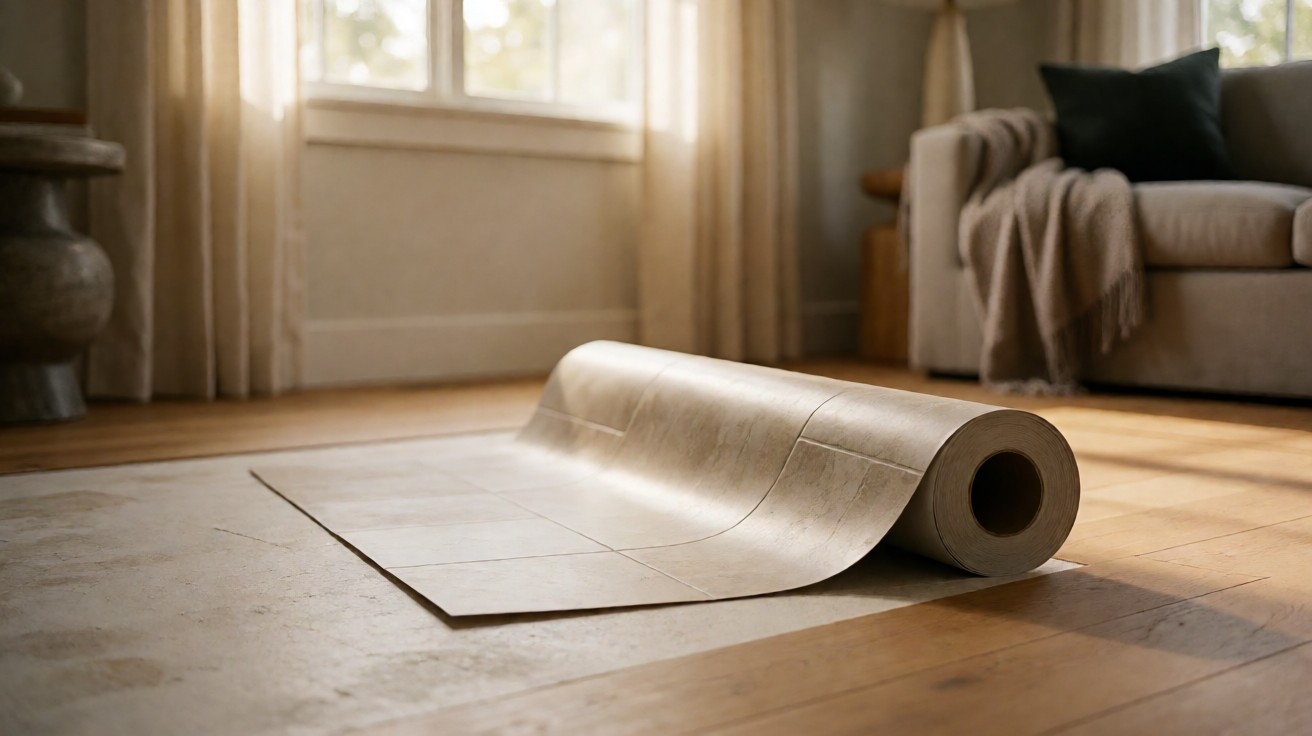
Sheet vinyl is one big glued sheet, and the adhesive underneath needs time to grab.
Godfrey Hirst’s installation procedure says heavy traffic or wet cleaning should not be allowed on the installation for a minimum of 72 hours, so the adhesive reaches its full bond strength.
That bond forms at a temperature between 15 and 26 degrees Celsius, and the rolls must condition on site for a minimum of 48 hours at an air temperature between 18 and 38 degrees Celsius before they are cut.
Linoleum and rubber sheet follow the same pattern, because they are the same kind of construction: a heavy sheet, a wet adhesive, and a bond that develops over a day or two.
The figure to use is the one on the adhesive’s own data sheet, because rubber and linoleum adhesives are not the same product as vinyl adhesives.
A seam that lifts later is the usual tell that the adhesive had not reached bond strength when the floor was put into service.
What Else Is Curing: Self-Leveling Compound, Epoxy, And Sealers
Two jobs sit behind the floor and add to the clock before it even starts.
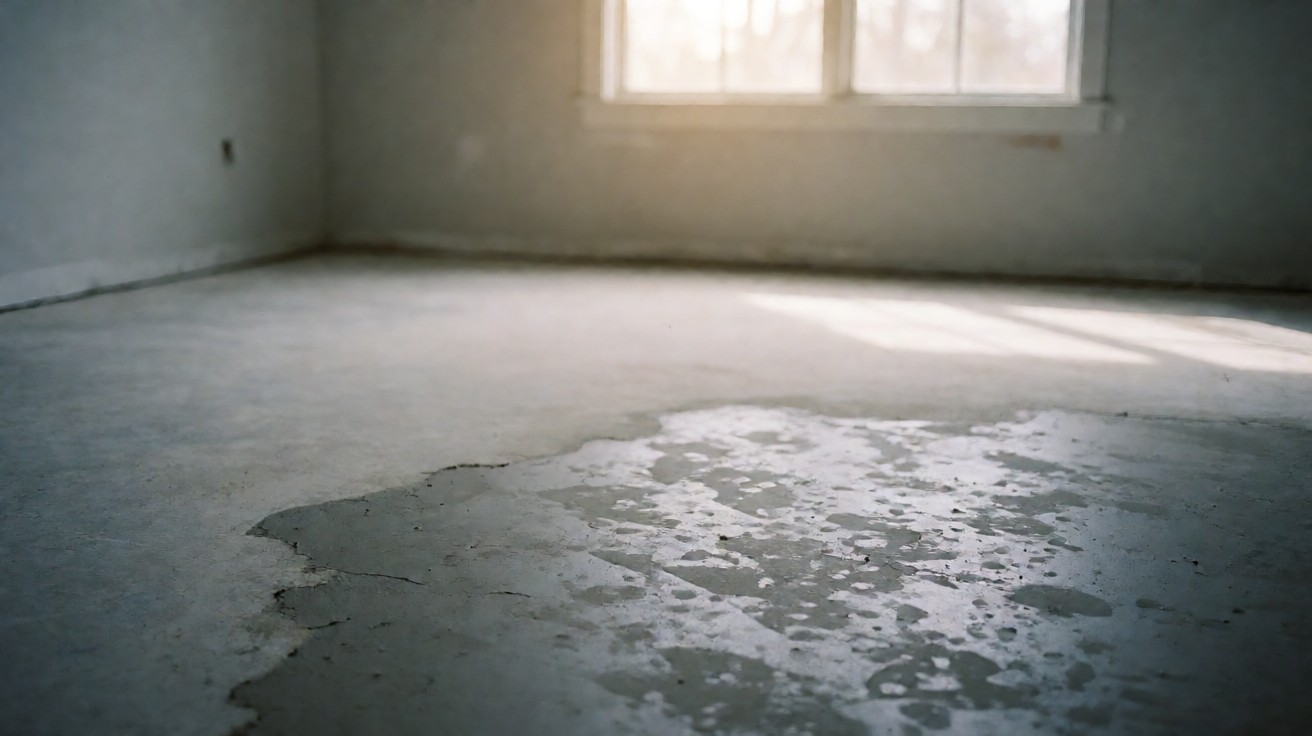
A concrete slab that needs to be levelled gets a self-levelling compound poured over it, and that compound has to cure before a single plank is laid.
ARDEX K 15, a rapid drying compound, is walkable after 2 hours and takes floor coverings in as little as 4 hours. The Americas version of the same product gives 2 to 3 hours to walk, 6 hours for moisture-insensitive tile and stone, and 16 hours for all other floor coverings.
That gap between 6 and 16 hours is a good reason to read the sheet for the product in the room rather than the product in the advert.
The second job is the coating. A water-based epoxy floor coating reaches light foot traffic in 12 to 16 hours, normal foot traffic and heavy items in 24 to 48 hours, and full cure and vehicle traffic in 3 days.
A concrete sealer such as PROSOCO PolishGuard is dry to the touch in 30 to 60 minutes, takes light foot traffic at 4 hours and normal traffic overnight, and reaches its full stain repellency in 7 days.
PROSOCO LSGuard, used on ground and polished concrete, is ready for traffic within an hour of the final burnishing, needs protection from water for 24 hours, and takes more than 7 days to reach maximum water resistance.
| Product | Light foot traffic | Heavy traffic or full cure |
|---|---|---|
| Waterborne epoxy floor coating | 12 to 16 hours | 24 to 48 hours, 3 days full cure |
| Concrete sealer, polished floor | 4 hours, or 1 hour after burnishing | Overnight for normal traffic, 7 days full |
| Waterborne polyurethane floor finish | 8 to 24 hours | 3 to 7 days |
| Oil-modified polyurethane floor finish | 24 hours | 14 to 30 days |
| Self-leveling compound, rapid | 2 to 3 hours | 4 to 16 hours before floor coverings |
The money side of a levelling layer is worth understanding before you accept a quote, and the cost side is set out in flooring underlayment cost.
If a floor is being coated rather than covered, ask for the coating’s data sheet before the job starts. Without it there is no agreed number for the day you move the fridge back.
What Changes The Wait: Temperature, Humidity, And Thickness
Every published cure figure assumes a room. The usual assumption is 70 to 80 degrees F and 40 percent relative humidity.
When the room is not that, the number on the data sheet no longer describes what is happening on your floor. A cold room holds the solvent in the coating, a damp room slows the water escaping, and both stretch the wait.
The floors with the least tolerance for a bad environment are wood and resilient sheet.
The National Wood Flooring Association sets 30 to 50 percent relative humidity and 60 to 80 degrees F for wood, and Custom Building Products asks that tile assemblies stay above 50 degrees F or below 100 degrees F for 72 hours.
Moisture in the slab is the version of this that delays a job by weeks rather than days.
ASTM F710 is the standard practice for preparing a concrete floor to receive resilient flooring, and it sets out moisture testing for the slab rather than a cure clock.
ASTM F2170, the in-situ relative humidity probe test, carries the ceiling most resilient flooring specifications set at 75 percent RH.
ASTM F1869, the calcium chloride test, is the companion check, and 3 pounds per 1000 square feet in 24 hours is the limit most resilient specifications call for.
Above that, resilient flooring does not go down at all.
F710 also sets out how long a slab needs, with a minimum drying time of 60 to 90 days. Newly poured concrete floors generally take 90 to 120 days to cure before they are even tested.
Thickness works the same way. A thicker grout bed, a deeper pour of levelling compound, or a heavier build of coating all hold more water and give it more to escape.
| Situation on site | Effect on the published figure | What to do |
|---|---|---|
| Room below 70 degrees F | Every cure time stretches | Heat the space, keep the HVAC running |
| Warm room, high humidity | Surface dries, the cure does not | Lower the humidity, use the longer figure |
| Slab above 75 percent RH | Resilient flooring cannot be bonded | Test it, then wait or add a moisture barrier |
| New concrete under 90 days old | Moisture is still moving | Wait, then test before covering |
| Thick grout bed or levelling pour | More water to drive off | Add days rather than hours |
| Garage or unheated porch | Cure nearly stops | Bring the space into range first |
If the job was priced and scheduled in a warm month and the floor is going down in January, the schedule should say so in writing.
Getting The Real Number: Manufacturer Sheet, Not Installer Guess
The number that governs your floor is in that floor’s Technical Data Sheet or Installation Instructions, under a heading like traffic, curing, or return to service.
It is not in a rule of thumb, and it is not the same as the number an installer will remember a year later.
So ask for the document. If an installer says 24 hours, ask which product and which milestone, and ask to see the line it comes from.
Any legitimate figure can be traced back to a page. A good answer names the product, the temperature and humidity the figure assumes, and whether it covers light foot traffic or furniture.
A vague answer is usually a figure borrowed from a different material.
If the floor is covered by a warranty, the installation instructions are the document that warranty is written against, and the traffic restrictions inside them are the ones that matter.
A final walkthrough once the floor has had its wait is covered in how to inspect a completed flooring project.
Protecting The Floor While You Wait
Cover the floor. Cardboard sheets or hardboard over the finished surface, taped at the seams, costs less than one damaged board or one scuffed finish.
If there is a route people must take across the room, lay a runner of plywood or hardboard along it.
Furniture waits for the heavy traffic figure rather than the walking figure, and it waits longer than the manufacturer number suggests if the room is cold.
Every leg gets a felt pad, and no caster sits directly on the floor.
Keep the heating and air conditioning running. A floor that cures in a stable environment cures predictably, and a floor that cures in a swing between 55 degrees F at night and 75 degrees F by day cures in the time you would guess rather than the time it needs.
If you are moving in stages, or if you have pets, or if a delivery is booked for the day after the install, tell the installer which day the traffic will happen.
A wait can be planned around a known date, and it cannot be planned around a surprise.
Rugs and mats are the last thing down, after the finish has fully cured, and they never go down on a floor that is still curing underneath them.