
Your quote has an underlayment line you cannot price, sitting beside a carpet pad line you recognise, and neither one names the product it is buying.
Choose by the job, not by the label. Foam over wood runs 0.25 to 0.60 dollars per square foot. A rated moisture membrane over a slab runs 0.75 to 1.50 dollars for material and more installed. A backer board is a third product entirely, at 3 to 7 dollars installed.
What Underlayment Is Actually For
Underlayment sits between the subfloor and the finish. It is not decoration, and it is not a comfort layer by default. It does up to three jobs, and a product that does one of them properly usually costs less than a product that does all three badly.
The first job is smoothing. A concrete slab can be flat enough to walk on and nowhere near flat enough to glue a sheet of vinyl to. Underlayment bridges small hollows and feather edges so the finish above does not print the shape of the slab.
The second job is cushioning and sound control. Foam and fibre compress underfoot, which takes the sharp edge off impact noise moving through the structure. A denser product trades some of that comfort for a surface that resists furniture indentations.
The third job is moisture control. A film or a treated layer slows water vapour rising through concrete so the floor above stays dry. This is the only job that costs real money, because it is the only one that needs a tested rating.
If the floor above is glued down, the underlayment is doing smoothing and moisture work only. Cushioning earns its cost on a floating floor and in a room where somebody walks barefoot.
Types of flooring split into glued, nailed and floating, and the specification changes with each. A floating floor needs compression resistance and room to expand. A glued floor needs a surface that does not move.
Underlayment, Carpet Pad And Moisture Barrier Are Three Products
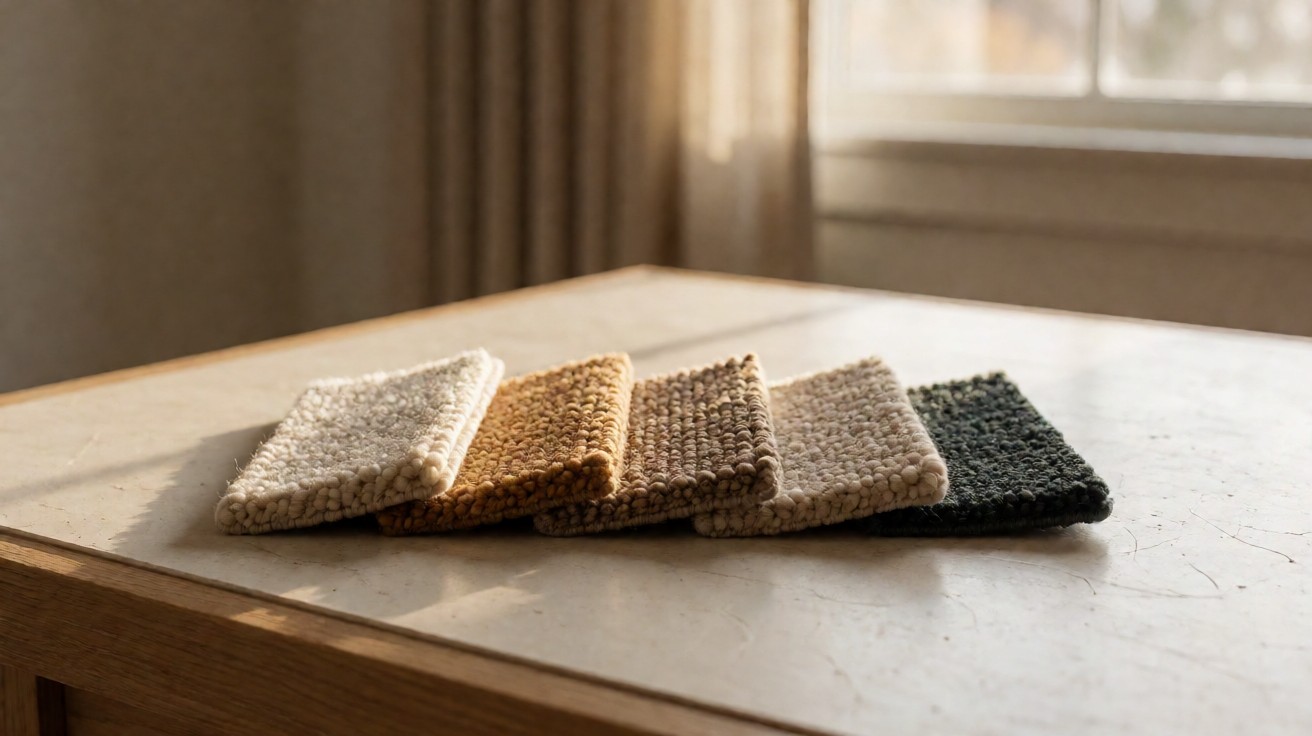
A carpet pad is a cushion, sold by the roll or the square yard, dimensioned in thickness and density. It goes under carpet, and it has no perm rating and no vapour test behind it.
Pad is also the thing most often sold as underlayment, because the two words have been interchangeable in the trade for decades. When a quote carries a pad line next to an underlayment line, read the square footage and the unit price separately.
A moisture barrier is a sheet film with a measured resistance to water vapour. It has no cushioning value and no acoustic value. Its entire job is to slow vapour, and paying cushioning prices for a film means paying for the wrong property.
The three blur when one roll does two jobs at once. Fibre underlayment with a factory-applied plastic film handles smoothing, cushioning and a limited amount of vapour control in a single product, which is exactly why it costs more than plain foam.
Where the words are used loosely, ask two questions. Is the layer compressible, and is it rated for water vapour? Compressible but unrated means cushioning. Rated but not compressible means a barrier. Neither answer is underlayment in the general sense.
Pad pricing and material selection are worked through in the carpet flooring guide, which covers the cushion side of this argument properly.
Foam, Fibreboard, Felt, Rubber And Backer Board
Five material families cover almost every underlayment line on a residential quote, and none of them is a variation on the others.
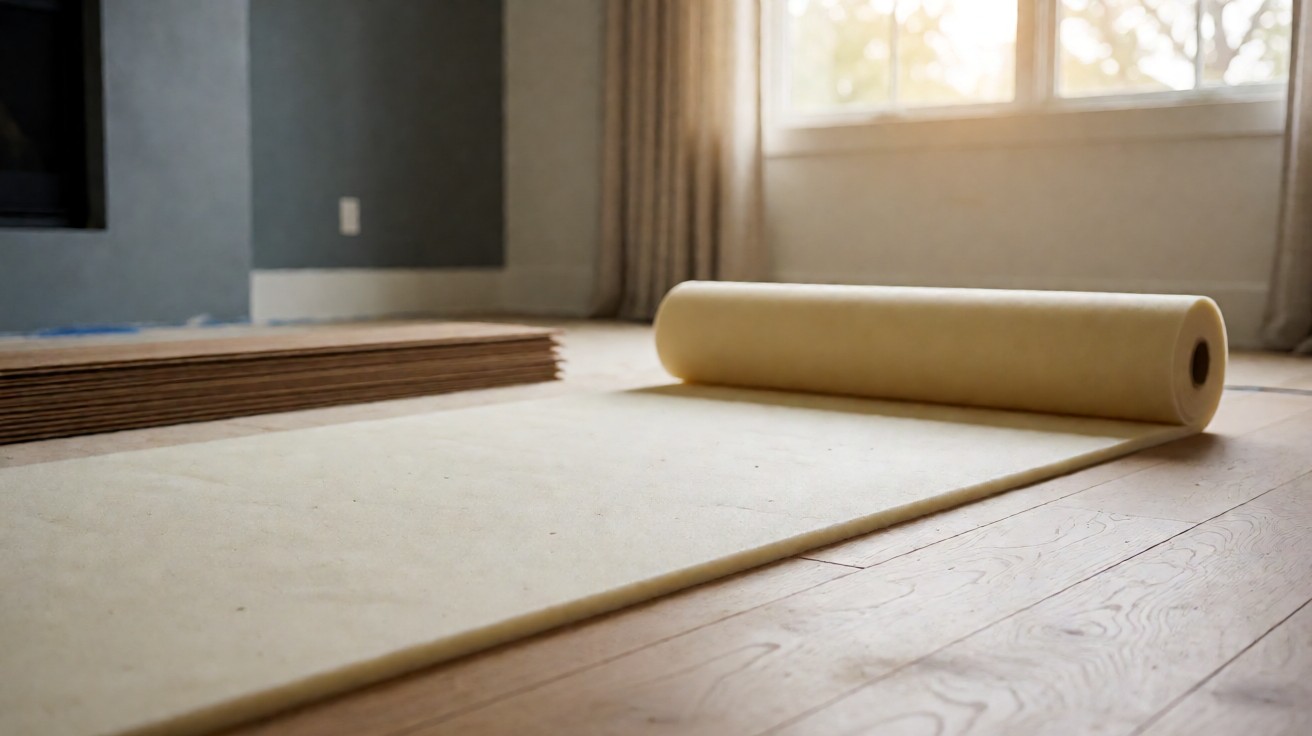
Foam is polyethylene, normally in rolls 3 feet wide at 1.5 mm to 3 mm thick. It smooths and cushions and does very little about vapour. It is the cheapest option and the correct one for a floating floor over a dry wood subfloor.
Fibre underlayment is wood or recycled fibre with a binder, at 2 mm to 4 mm. It spans hollows better than foam, carries more load and holds more sound down. It is heavier to roll out and it costs more per square foot.
Felt, including asphalt saturated felt, is the traditional sheet good. It is smooth and dimensionally stable, with no vapour rating and no cushion at all. It has largely left residential work and is still common under nail-down wood on a slab.
Rubber underlayment is crumb rubber or a synthetic rubber sheet at 3 mm to 6 mm. Dense, quiet and expensive, it is specified mostly where impact sound matters more than the budget line.
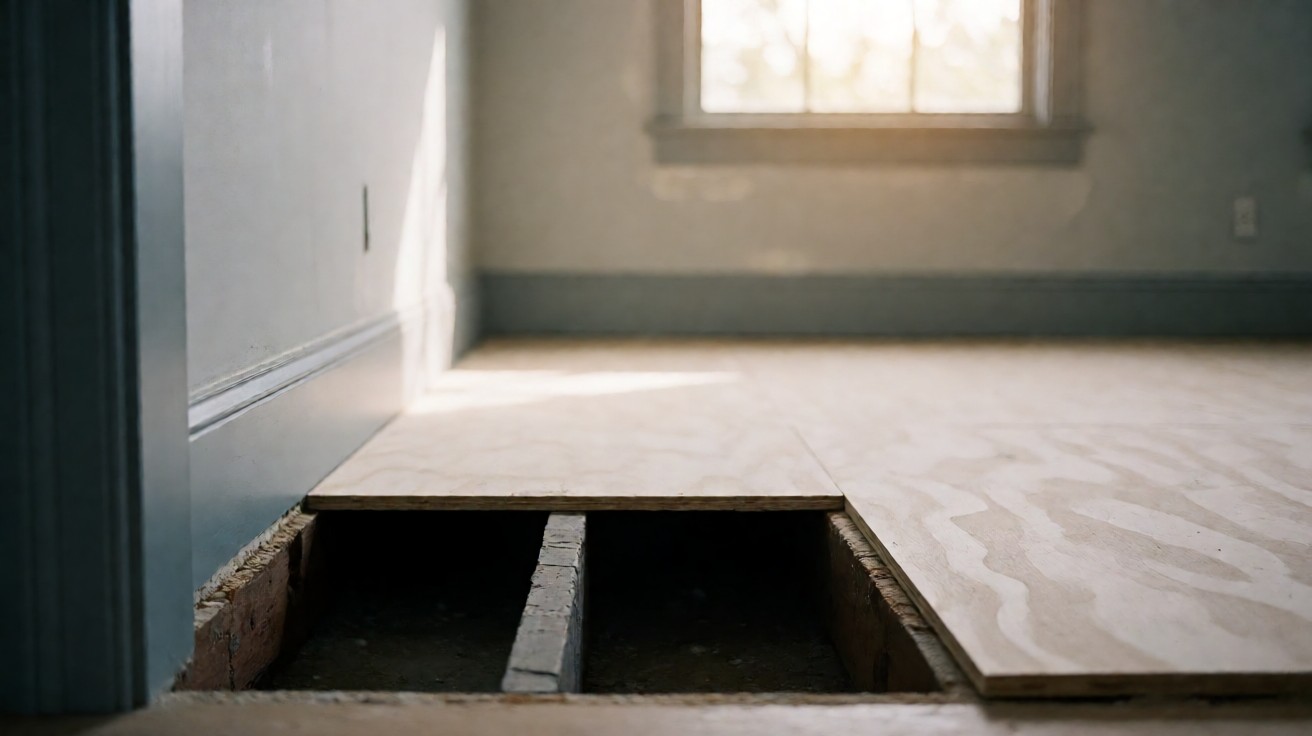
Backer board is not underlayment in the roll sense. Cement board at 1/4 inch or 1/2 inch, or plywood at 3/4 inch, is a substrate, and it is the answer when the finish above is thin enough that the slab would print through it.
Price tracks thickness and density here, not comfort.
Here is the same information sorted by what each material is for rather than by price.
| Material | Typical Thickness | Primary Job | Where It Belongs |
|---|---|---|---|
| Polyethylene foam | 1.5 mm to 3 mm | Smoothing and cushioning | Floating floor over dry wood |
| Fibre and recycled fibre | 2 mm to 4 mm | Smoothing plus sound control | Floating wood and laminate |
| Fibre with attached film | 2 mm to 3 mm | Smoothing plus limited vapour control | Slab that already tested dry |
| Polyethylene vapour membrane | 6 mil | Moisture control only | On or below grade concrete |
| Rubber sheet | 3 mm to 6 mm | Acoustic and load control | Multi-unit sound requirements |
| Cement backer board | 1/4 inch or 1/2 inch | Flat, stable substrate | Tile and thin resilient over a slab |
Nothing in that table is interchangeable. A roll that smooths well and a film that blocks vapour are answering different questions, and a quote that prices both at 0.50 dollars per square foot has priced neither honestly.
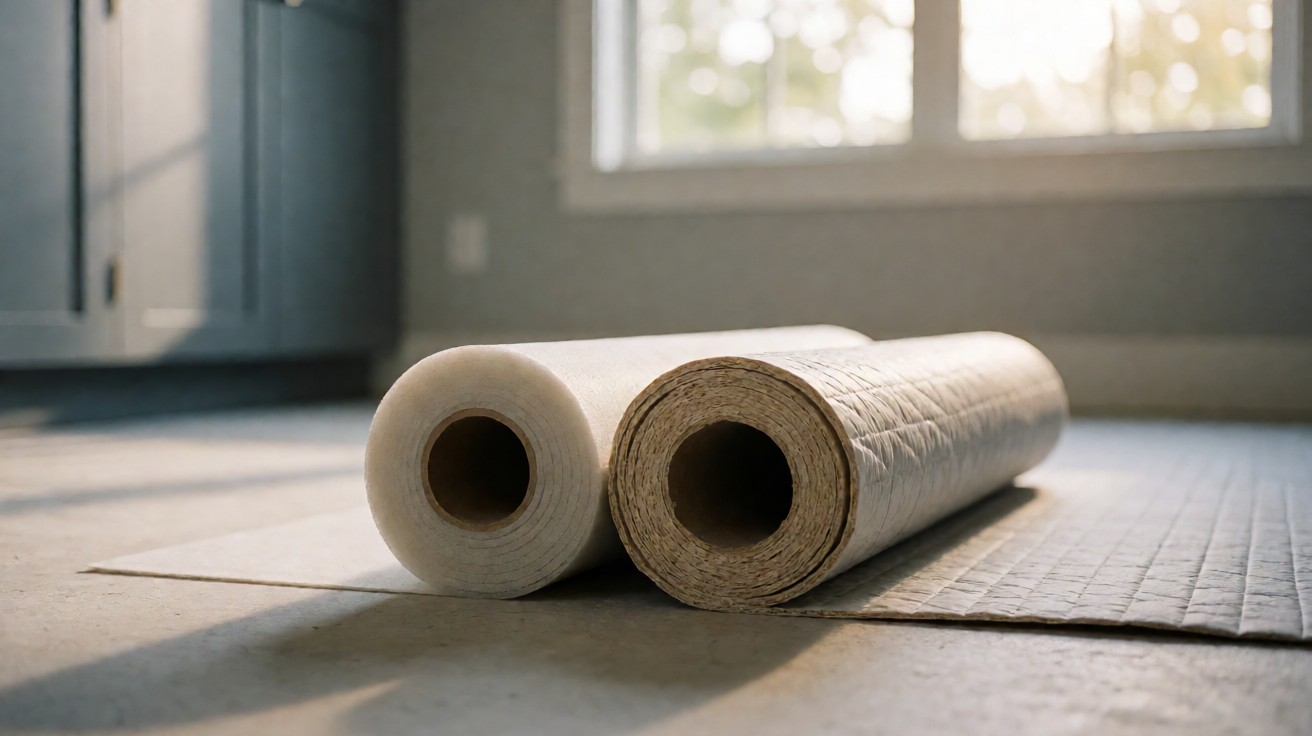
What Underlayment Costs Per Square Foot
Material prices are the easy half to quote and the easier half to compare. Labour is where a residential estimate hides most of its assumption.
| Product | Material Per Square Foot | Installed Per Square Foot | Main Note |
|---|---|---|---|
| Basic foam sheet | 0.25 to 0.60 dollars | 0.75 to 1.60 dollars | No vapour protection at all |
| Fibre underlayment | 0.45 to 1.10 dollars | 1.10 to 2.40 dollars | Heavier to handle |
| Fibre with attached film | 0.90 to 1.60 dollars | 1.60 to 3.10 dollars | Check the film rating |
| Rubber underlayment | 1.20 to 2.40 dollars | 2.00 to 4.20 dollars | Specified for acoustics |
| Polyethylene vapour membrane | 0.15 to 0.40 dollars | 0.40 to 0.90 dollars | Labour is taping, not rolling |
| Cement backer board | 1.50 to 3.50 dollars | 3 to 7 dollars | Counts as substrate work |
| Carpet pad | 0.25 to 0.75 dollars | 0.50 to 1.20 dollars | Comfort and wear, not vapour |
Rolling, cutting and taping underlayment runs 0.50 to 1.50 dollars per square foot installed on a straightforward rectangular room. It is quick per hour and slow per square foot, so a 60 square foot bathroom costs proportionally more than a 600 square foot open plan.
Where the substrate is concrete and a separate membrane is needed, the film and the taping labour add 0.25 to 0.75 dollars per square foot on top of whatever else is going down.
Backer board installed runs 3 to 7 dollars per square foot and plywood nailing base runs higher again. Quote those as a separate line from underlayment, because they are a different trade on site.
For a 400 square foot room at 0.85 dollars per square foot, the underlayment material is 340 dollars. Add 15 percent for cuts and a second pass and it is 391 dollars before anyone is paid to lay it.
The arithmetic in the material versus installed price breakdown separates the two halves of that number.
Where The Underlayment Line Appears On A Quote
Underlayment surfaces on an estimate in three forms, and only one of them uses the word underlayment.
Sometimes it is a named line item in square feet with a product and a unit price. That is the clearest form and the only one you can compare against another quote.
Sometimes it is folded into the flooring price as a floating floor system installed. The product is then unnamed, and an unnamed product cannot be checked against the floor manufacturer installation requirements.
Sometimes it sits inside a preparation charge reading level and prepare subfloor. That single line can cover grinding, patching, or underlayment, and it should be broken into items before the crew starts cutting.
Three forms, and only one of them is honest.
| What The Quote Says | What It Might Be | The Question To Ask |
|---|---|---|
| Underlayment, 400 square feet at 0.85 dollars | A named roll at a known price | Which manufacturer and which thickness |
| Floating floor system installed | Floor plus underlayment plus labour | Which underlayment is in the system |
| Level and prepare subfloor | Grinding, patching, or a roll | Square feet for each activity |
| Moisture barrier | A 6 mil film taped at the seams | What is the permeance rating |
| Carpet pad included | Cushion at 0.25 to 0.75 dollars | Thickness and density in pounds |
If the quote gives a square footage but no product name, ask what the product is before you compare anything. A 2 mm fibre roll at 1.10 dollars and a 2 mm film at 0.40 dollars are both printed as underlayment on the same day.
What Moves The Price Up Or Down
Four numbers decide most of the variance between two quotes, and only one of the four is the product name.
The first is thickness, in millimeters. Anything under 1.5 mm on a floating floor compresses under a furniture leg and stays compressed. NALFA LF-03 sets 1 mm as the floor for a certified laminate underlayment, which tells you how little is acceptable.
The second is vapour rating, written as an sd value in meters in Europe and Canada, and as a perm rating or a pounds per 1,000 square feet per 24 hours figure in the United States. A number you cannot trace back to a test method is a marketing claim.
The third is compression resistance, in psi. NALFA LF-03 requires 2.5 psi at 0.5 mm of deflection for a laminate underlayment. Below that the locking system carries the load instead of the pad, and the failure appears as cracked seams eighteen months later.
The fourth is density or fibre content, in pounds per cubic foot. On carpet pad this predicts how long the cushion survives traffic, and the same reasoning applies to a fibre underlayment.
Room size moves the unit price on its own. A crew carries a minimum charge, so 120 square feet and 1,200 square feet can land at nearly the same total and make the small room look expensive.
Whether the floor floats or glues changes the specification rather than the price. A glued floor gets no credit for cushioning performance, because nothing about it compresses.
Four numbers settle it before any brand name does.
Over A Concrete Slab You Need A Different Product
A slab is the reason most underlayment arguments happen in the first place. Concrete is mineral, porous, and still releasing water vapour years after it was nominally cured.
ASTM F1869 measures moisture vapour emission with a calcium chloride test, and the widely used acceptance figure for resilient flooring is 3 pounds per 1,000 square feet per 24 hours. Above that, the adhesive bond gives up and the floor lifts.
ASTM F2170 measures relative humidity inside the slab with an in-situ probe, and the common acceptance figure is 75 percent. Above that figure no underlayment helps, because the slab itself has to dry or be sealed first.
A reading above either figure is not a negotiation.
ASTM F710 also requires a permanent moisture vapour retarder under every on-grade and below-grade slab, at a minimum thickness of 0.010 inch and a permeance of 0.1 perms under ASTM E1745. Without one, the floor above it is on a countdown.
In Europe and Canada the same requirement is written as an sd value. EPLF and MMFA guidance puts the minimum at 75 m, which a 150 micron polyethylene film or a 10 micron metalised film both reach comfortably.
Where the floor above is floating wood or laminate, one sheet that combines a rated film with the underlayment usually beats two separate layers on material and labour. Where the finish is glued, separate layers are easier to inspect and easier to replace.
If the slab is also out of tolerance, underlayment is the wrong repair, and the numbers live in the floor levelling cost breakdown instead.
Choosing the floor itself over a slab is a separate decision, and flooring for concrete slabs covers which of them tolerate a damp substrate.
Perimeter And Seam Tape Are The Hidden Line Items
Underlayment is bought by the roll, sealed at the seam and cut at the perimeter. Only the roll price reaches most quotes.
Seams in a floating underlayment are butted, not overlapped, and every end cut gets taped. The tape is the cheapest material on the job and the first thing dropped when a crew is running behind.
Perimeter expansion gaps matter more than the tape. Floating floors need 1/4 inch at the walls below 2,500 square feet and 1/2 inch above that, and trimming the underlayment tight to the skirting fights the movement the floor needs.
A 6 mil film over a slab goes down with a 6 inch overlap and tape at every seam. Where the specification calls for 3 mil tape and the crew uses the roll edge instead, the vapour path is open exactly where it matters.
If a quote shows no tape line and no perimeter allowance, ask whether the seams are meant to be left bare. On a slab, an open seam is the whole failure in one joint.
VOC And Emissions Are A Real Selection Criterion
Underlayment is one of the few materials in a house that keeps off-gassing after the floor is walked on and the windows stay shut.
SCAQMD Rule 1168 sets the volatile organic compound limit for carpet pad adhesive at 50 grams per liter, wood flooring adhesive at 100 grams per liter, and rubber floor adhesive at 60 grams per liter. Where a crew uses an adhesive above its limit, the product is not compliant inside the South Coast air district.
Emission testing is a separate measurement from adhesive VOC. CA Section 01350 and the FloorScore programme both use a chamber test for total volatile organic compounds, with 0.5 milligrams per cubic meter published on FloorScore certified products.
The practical way to buy a low-emitting product is to ask whether it is certified rather than whether it is described as low VOC. A certification carries a test report behind it, and a description does not.
If somebody in the house has asthma, specify the certified sheet and leave the room ventilated for 48 hours after installation before the furniture goes back.
DIY Versus Professional
Rolling underlayment is one of the few flooring tasks a competent homeowner finishes in an afternoon. Taping a vapour membrane is a separate job, not the same job with a longer roll.
The professional case is the seam. A butt joint that opens 1/8 inch under a floating floor becomes a sound bridge, and it is the place the floor will rock under a chair.
The professional case is also the moisture test. Nobody rents a calcium chloride kit for a small room, and a reading taken in one corner of the slab is worse than no reading at all.
The professional case is the warranty. Most flooring manufacturers require their own specified underlayment and installation method, and a substitution by a subcontractor voids the floor warranty along with it.
Where a quote already includes a crew, the underlayment labour is a small share of the floor price and the product is set by the floor manufacturer. DIY earns its place when the room is rectangular and the floor is floating.
Rolling the sheet is the easy half.
Where Underlayment Is Optional, And Where Cutting It Is A False Economy
There are installations where a full underlayment is genuinely not needed. Solid or engineered wood nailed to a plywood subfloor is one, provided the board reads dry and measures flat.
A second underlayment under a resilient plank that already carries an attached pad is often unnecessary too, and several manufacturers cap any added layer at 3 mm for exactly that reason. The LVP flooring cost breakdown covers the attached-pad question in detail.
Carpet pad is the exception in the other direction. Carpet is designed to flex over a cushion, and carpet laid straight onto a subfloor wears through its own backing in a few years.
Removing underlayment from a floating floor over a slab is a false economy, because the same sheet is carrying the vapour path and the surface flatness as well as any cushioning value.
Where a quote omits underlayment entirely, ask whether the floor is floating. If it is, the omission is a change of system rather than a saving.
How To Compare Two Underlayment Lines On One Quote
Lay the two lines side by side and compare four numbers before you read a single product name. The names are marketing; the numbers are the specification.
Thickness in millimeters first, because a 2 mm fibre roll against a 3 mm foam roll is not a comparison of quality. It is a comparison of two products in the same family.
Vapour rating second, written as an sd value in meters or as pounds per 1,000 square feet per 24 hours. If one line carries no rating at all, the two lines are not competing on the same property.
Compression resistance in psi, or density in pounds per cubic foot where the product is a fibre or a cushion. This is the number that predicts whether a seam is still locked in year five.
Then check what is inside the unit price. A line at 1.20 dollars per square foot with no tape and no perimeter allowance is more expensive than a line at 0.95 dollars with both included.
Finally, confirm that both lines serve the same floor. A membrane rated for a slab and a foam rated for a wood subfloor are not competing quotes, they are two different systems sharing an invoice.
Where The Money Is Not Worth Spending
Premium acoustic underlayment on a ground floor bedroom with nothing below it is the most common place money does nothing. There is no room underneath to hear.
A thicker cushion on carpet in a low traffic bedroom is the second. CRI guidance puts residential cushion at no more than 7/16 inch, and past that the extra thickness buys a trip hazard at the doorways and a shorter life in the carpet backing.
A second moisture membrane over a dry, ventilated wood subfloor is the third. Sealing a wood floor under a floating finish traps the moisture the wood is holding, and that shows up as edge swelling a year later.
What is worth paying for is the rated product on a slab, the tested compression resistance on a floating floor, and tape at every seam. Those three items buy out the failure modes that actually appear.
Underlayment is usually the smallest line on a flooring quote, and that is exactly why it gets skimped on. Getting it wrong costs the entire floor above it.
Smallest line, largest consequence.