
A humid climate is what punishes the wrong flooring choice quietly, and the damage usually appears weeks after the season that caused it has passed and gone.
What Humidity Does to a Floor, and When
The damage is swelling in gaps, cupping at the edges, a door that no longer closes, and it appears after the season that caused it. That lag is the whole reason people think it is unrelated to the weather.
The mechanism is straightforward. Wood moves: it takes up moisture in the wet season and lets it go in the dry one, and a floor that is not designed to tolerate that movement will buckle, gap, or cup in sequence. A rigid material that is installed incorrectly will fail in a different sequence: the plank lifts at the edges rather than the whole floor, because the moisture is getting under the floor rather than into the material.
The Two Real Questions, in Order
Two questions decide the choice, and they are worth separating because the answers do not always match.
The first is what the floor material does in the wet: does it absorb, swell, move, or sit still, and what is the limit before it fails. The second is what is underneath, and whether the moisture is getting under the floor at all, because a non-porous surface will survive any amount of humidity above it but will fail in a different way if the moisture is underneath. The flooring types compared page has the materials in one table and the underfloor is the half that the table does not cover.
| What the floor does in the wet | The material family | The half that is usually skipped |
|---|---|---|
| A floor that moves with the humidity | Engineered hardwood, flexible vinyl | The material tolerates the movement, not the installation |
| A floor that does not move at all | Rigid core, porcelain tile | The material must be installed over a dry, sealed base |
| A floor that absorbs | Laminated board, any fibre | The single worst answer in a humid location |
| A floor that moves, on a cold subfloor | Sheet vinyl over a moisture membrane | The membrane is the half that is skipped |
Wood, and Why It Is the Worst Fit Here
Wood is the material that moves the most in a humid climate, and in the wrong humidity range it moves too much for the floor to cope.
Solid hardwood is the worst case because it is one piece of timber that moves in every direction. Engineered hardwood moves less because the core is layered and it is the veneer that carries the cup, and that is the honest answer for a room with a lot of humidity. Laminate is a worse fit than the wood: the fibre core inside is exactly the material that a humidity day will expand, and there is no way around that except a very good moisture barrier under the floor.
Vinyl and the Two Different Answers It Gives
Vinyl is the material that most houses with humidity problems end up on, and it does so for two different reasons depending on the product.
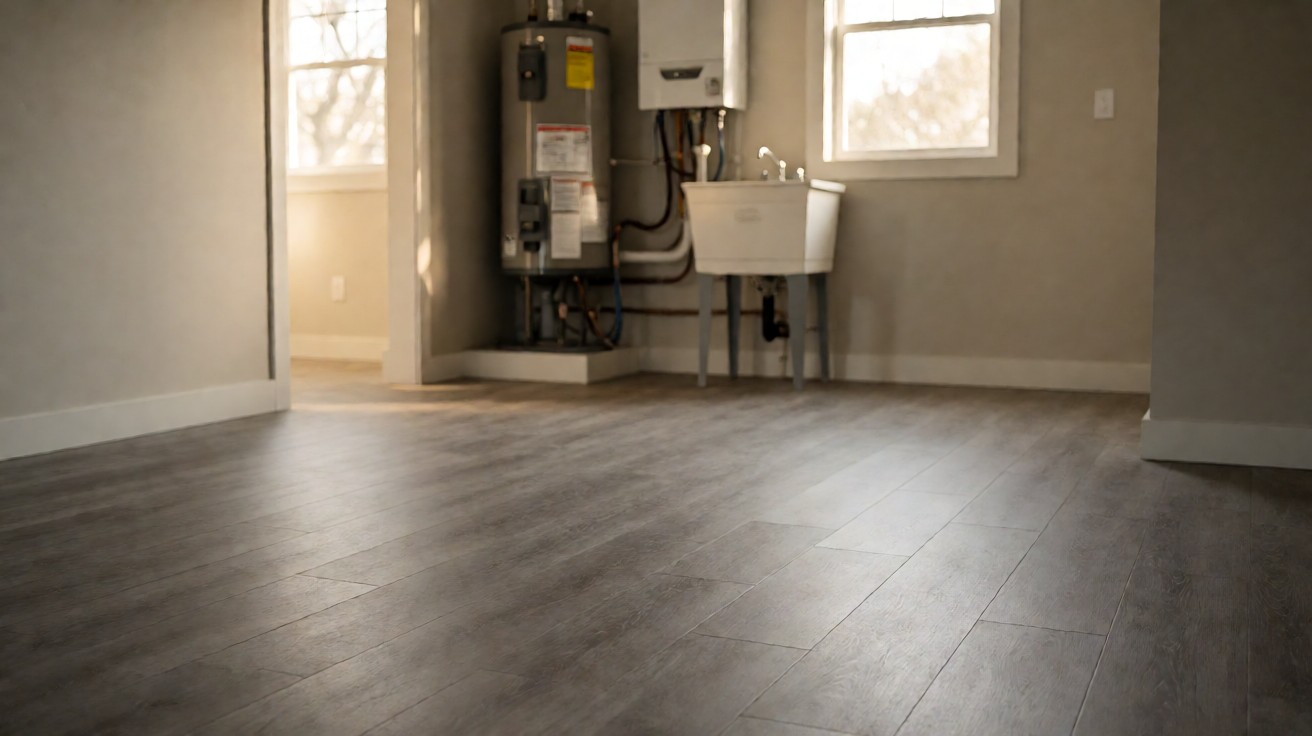
Rigid core with a stone or mineral core is genuinely non-porous and will not swell, so the failure that remains is not the material but the installation: moisture that gets under the floor, a gap that did not allow for movement, or an adhesive that was not the right one for the location. The flexible sheet and plank variants move with the humidity rather than resisting it, which makes them better over an unlevel or damp subfloor but worse at keeping a straight line in a room with a lot of movement. The {R} covers the stone core and the {CR} is where to read the specification for the version that will survive the location.
Tile, and Why It Is the Easy Answer With a Real Cost
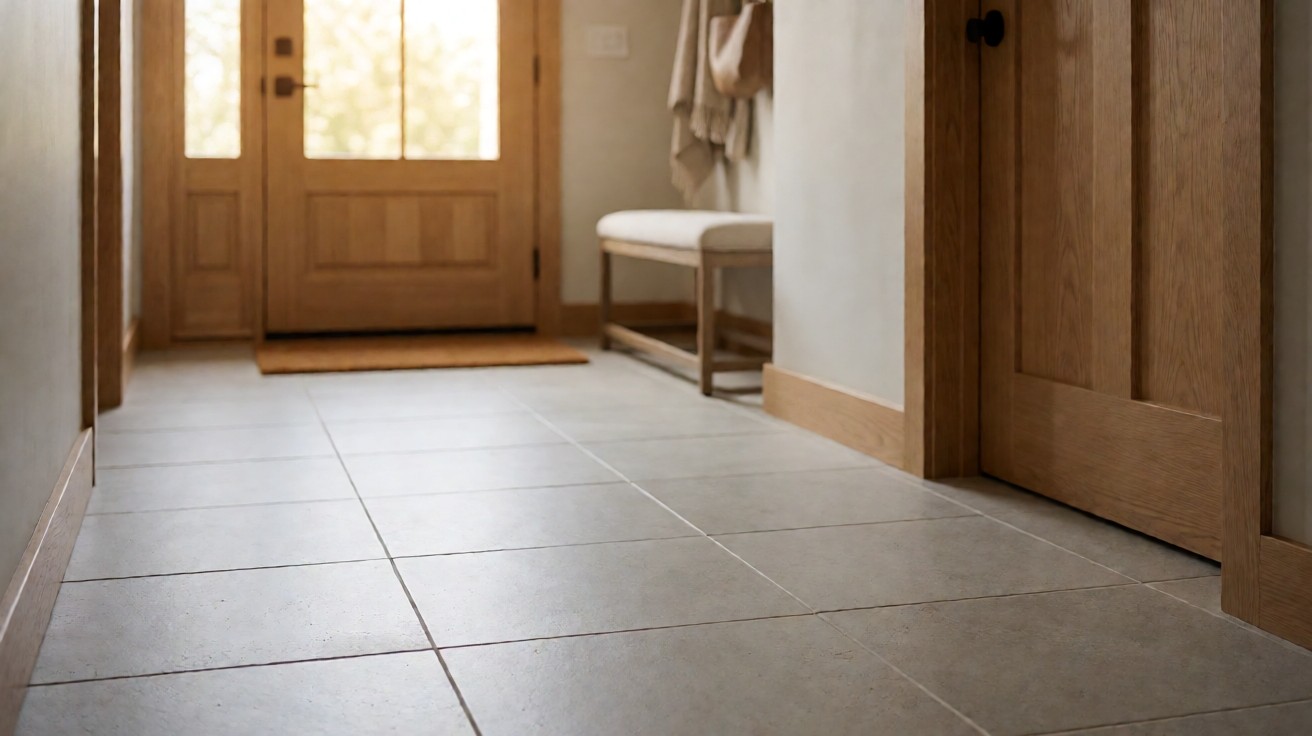
There is one version of the tile answer that is worth being specific about: the grout. A tile floor in a humid house will hold the water on the surface for a long time, and the water that reaches the grout rather than the tile will sit there, and it is the grout that stains and lifts the edge of the tile in a location that is wet for days. The grout line is a specification on this page rather than a finishing detail.
Tile is the material that does not absorb, and in a house where the moisture problem is the material rather than the location it is the correct answer without discussion.
The cost is the one that catches people. Porcelain is the hardest and the least absorbent of any floor material, and it will take a humid summer and a flooded winter without moving a millimetre. The price is that it is cold underfoot, that it does not forgive a poor installation, and that the moisture underneath it will move out of the joints and the grout. The {PT} covers the two tile families and the {TG} covers the grout and the finishing question.
What the Season Does, and Why the Lag Matters
One more thing worth being specific about is the lag between the season and the visible damage, because it is the reason the two failures look unrelated to the weather. A floor that has moved over a winter will not be seen to have moved until the summer when it closes up, and a floor that has absorbed moisture over a spring will not be seen to have absorbed it until the summer when it dries out. The lag is what makes people attribute the damage to the season it appears in rather than the season that caused it, and it is also why the floor that looks fine in the summer is not the one that will be fine next winter.
Carpet, and the One Place It Is Right Here
Carpet is the wrong answer in a humid climate and it is worth saying that directly, because it is what most humidity rooms are specified with for no good reason.
The fibre takes up the moisture that a sealed surface would shed, and the pad underneath is the one that moulds. That is the one exception on this page, and it is worth stating: in a room used barefoot for hours, a carpet pad that breathes is the right answer even in a humid house, provided the fibre is a low-absorbency one and the pad is the one that dries rather than the one that holds. Everything else on this page is the opposite. The {CG} covers the fibre and the pad and the {CT} comparison is worth reading if a tiled section and a carpeted section are in the same house.
The Two Different Failure Sequences, and How to Tell Which One You Have
The same material installed in two different houses will fail in two different sequences, and the difference is not the material. The sequence that starts with the gaps opening in the dry season and closing in the wet is a movement problem in the material, and it asks for a different material. The sequence that starts with the edges lifting in the wet and sitting flat in the dry is a moisture problem under the floor, and it asks for a membrane rather than a new material. Reading which sequence you have is the half of the specification that is cheap to get right and very expensive to get wrong.
The Moisture Barrier Is Half the Specification
There is a number that is worth asking for, and it is the moisture content of the material at the point of installation. A hardwood floor installed wet, even with the right kind of membrane underneath, has moved more than it will move later, and the gaps will be in the wrong places for the rest of the life of the floor. It is the one measurement that separates a floor that is installed for the location from one that is installed for the showroom.
Half of every humidity room is not the floor, and the people who get it wrong get it wrong in the half they skipped.
The membrane or the damp-proof course underneath the floor is what stops the moisture from arriving at it at all, and it is specified in millimetres, not in the showroom brochure. It is also the reason that the same material is right for a basement and wrong for the first floor of the same house. The flooring types compared page has the families together and the membrane is the line that decides which half of the table the room falls into.
| The symptom you can see | What it tells you | The half of the specification to fix |
|---|---|---|
| The failure starts with gaps opening in the dry season | A movement problem in the material | A different material rather than a new installation |
| The failure starts with edges lifting in the wet | A moisture problem under the floor | A membrane, not a new floor |
| The skirting board has opened up from the floor | The wood has moved more than it should | A different construction rather than the same one |
| The grout line is stained or the edge is lifting | Water reached the grout rather than the tile | A sealed grout or a different material |
The Door, and the One Symptom People Miss
There is a second version of this symptom that is easier to see and easier to fix, and it is the skirting board gap. If the skirting board has opened up from the floor by the time the summer is well advanced, the floor has moved under it and the material is the problem rather than the installation. The skirting board is the tell that a hardwood floor has moved more than it should.
The door that no longer closes is the one symptom of a humidity problem that is visible without opening the floor, and it is the one that is worth checking before buying anything.
If the door that fits in the winter does not fit in the summer, the floor has moved and the room is the location of the problem, not the material. That is the one test that tells you which of the two questions on this page you have to answer first.
How to Choose, and Where to Look Next
One more practical note. In a house where the humidity problem is the material and not the location, the room to test is the one with the most barefoot time and the most time, not the hall, because that is where a failure will show first and the most, and where a good choice will do the most quiet work.
Write down the humidity problem in one line: is the material the problem, or is the location the problem, and is the moisture coming in from outside or moving through the house.
The two questions are what the next pages answer. The rigid core vinyl page is the most common answer and the vinyl construction guide is the specification that tells you if that answer will hold. The porcelain tile page is the answer when the location is the problem rather than the material. The flooring types compared page has the two families together and the solid versus engineered hardwood comparison covers the two wood constructions if the look is what matters more than the traffic.