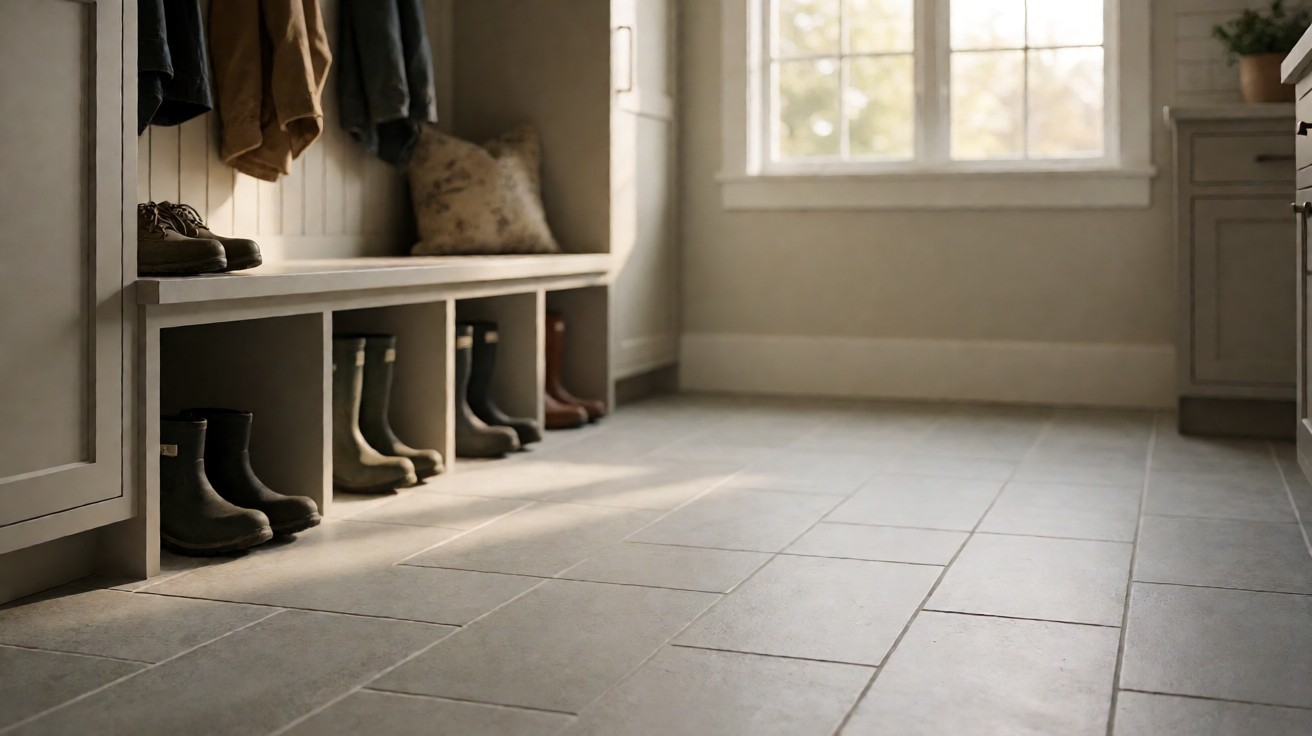

The best mudroom floor takes grit, wet boots, and salt off a pair of shoes before it reaches anywhere else in the house, and it is allowed to look ugly.
A Mudroom Is a Working Surface, Not a Hallway With a Coat Rack
A mudroom is the only room in a house whose floor is meant to be dirty. Everything it does is about containing what comes in from outside: the grit, the wet, the salt, the grass, the mud, and the snow that turns to water on a warm day and then dries on the floor.
That is a different job from a hallway, which is a route, and a different job from an entryway, which is a transition. A mudroom is a container. It needs a floor that can be left dirty for a week without looking neglected, and that can be scrubbed in five minutes when it has to be.
What Comes Off a Boot, and What It Does to a Floor
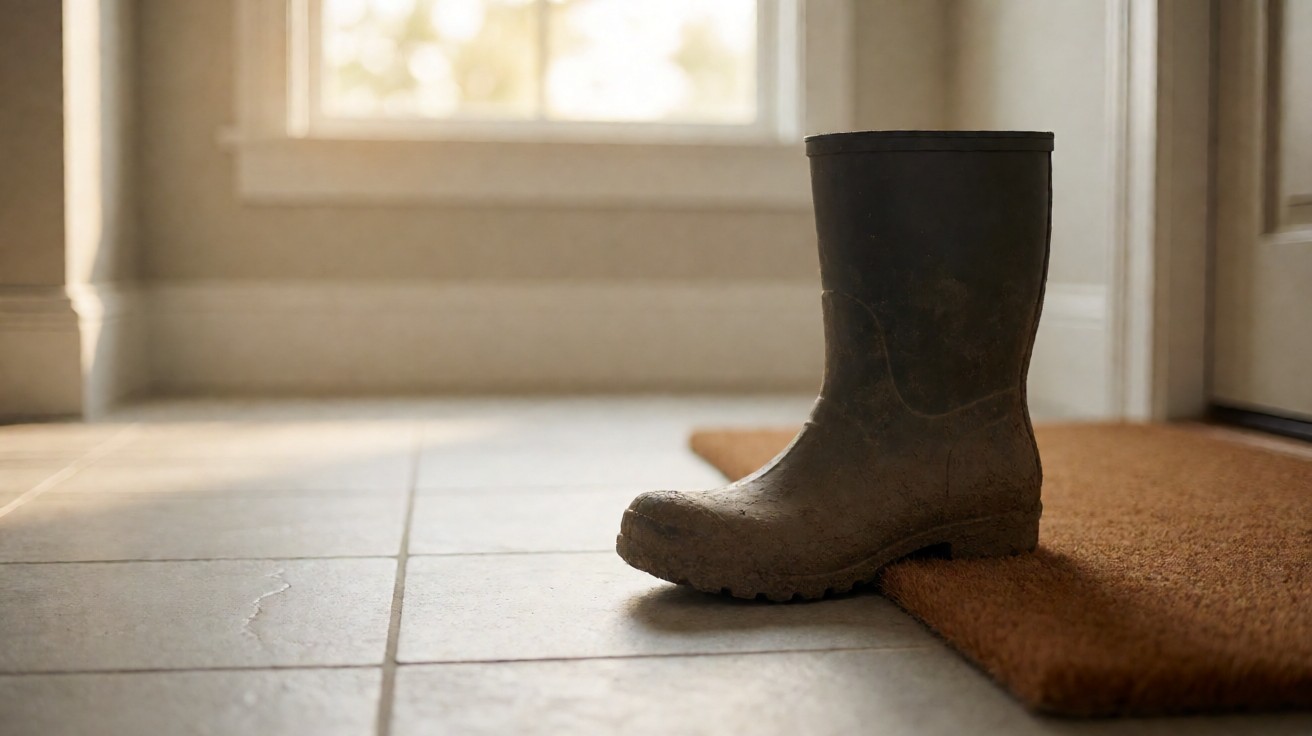
A boot carries four things indoors, None of them is dirt on its own. Each one behaves differently on a floor, and a material that handles three of them can still be the wrong answer if it cannot handle the fourth. and they are different problems rather than one dirty problem.
Water is the swelling one, and it sits in the joints and the low spots. Grit is the abrasive one, and it is what dulls a finish and scratches a glaze. Organic material is the staining one: grass, mud, pet hair, and the chlorophyll that leaves a green mark. And salt is the fourth, which is the one people forget: salt dissolves in the moisture on the floor and attacks the surface itself over a winter rather than sitting on top of it.
The Three Families That Belong Here
Few materials are genuinely right in this room, and the reason is that the floor has to take all four of those things at once and be cleanable in the time it takes to get the children out of the door.
Tile is the traditional answer and it remains the best one for grit and water. It has been the answer in this room for as long as houses have had a place to leave the coats, and the reason it has survived is that nothing else does those two jobs for the same money. Porcelain is the version to prefer because it absorbs less and it is the one that survives a salt-laden winter without the surface going dull. Rigid core is the modern answer and it is the right one where the mudroom connects straight to a kitchen or a garage, because it takes the water that comes with it.
| The mudroom’s actual job | The family that answers it | Why it survives there |
|---|---|---|
| The wettest climate, the most grit | Large format porcelain | Does not absorb, and fewer joints is fewer lines to hold water |
| Mudroom opening onto a kitchen or garage | Rigid core, SPC | Takes tracked water and lays over a slab without demolition |
| A warm dry climate, a bare floor wanted | Cork or rubber | Soft underfoot, quiet, and they never show a scuff |
| A mudroom that is really a corridor | Anything washable | The room is a route, so the rule is the hallway rule |
Tile and Porcelain, and Why the Joint Decides It
The tile surface never absorbs and the line between the tiles does, which means the grout is what this room actually tests. A sealed grout can be washed and dried; an unsealed one holds water and grit in the line and goes grey.
Large format porcelain is the version to prefer here for the same reason it is preferred in a bathroom: fewer joints is fewer places for that to happen. A mudroom in a wet climate with a hundred square feet of twelve inch ceramic tile is a hundred lines of grout to keep clean. One large tile across the same floor is one line. The porcelain tile page covers the two tile families and the tile flooring guide covers the sizes and the joint work.
Rigid Core Where the Mudroom Meets the House
Rigid core is the correct answer where the mudroom opens directly onto a kitchen or a garage, because it is the family that takes the water that arrives with the grit, and because it lays as a floating floor over a slab or a damp subfloor that a tile would require you to fix first.
It is comfortable enough to stand on and it is easy to scrub, and it is the material that gets chosen most often in new builds for exactly those reasons. The one thing it cannot do is be glued down over a damp slab without a membrane, and the rigid core vinyl page covers the build that decides whether it stays flat over a wet winter.
Cork and Rubber, the Softer Answers
Cork is the material that comes up most often in this room It is also the one that surprises people, because cork is associated with wine cellars and kitchens and not with a corridor, and the same properties that make it good in a cellar make it good here: it is soft, it does not scratch easily, and it does not take a scuff from a boot heel. and it is a genuinely good answer in a way that is not true in most rooms. It is soft underfoot, it takes grit without scratching, and it takes a boot without clicking.
Rubber is the other one worth knowing about in this room, and it is the most forgiving surface available: it is warm, it is quiet, it never shows a scuff, and it survives salt better than almost anything else. Neither is a budget material in a household line, and both are worth quoting next to a tile when the mudroom is a space the family actually uses.
The Bench, the Cubbies, and the Floor Under Them
The built-in furniture is what a mudroom is actually for, It is also the reason a mudroom floor is often specified after the cabinetry rather than before it, because the cabinetry constrains where the floor can be laid and what the traffic line will look like when it is installed. and it decides the floor in a way people forget. A bench has feet that carry load onto the floor at four points. Cubbies have a base that either sits on the floor or on a kick.
That matters because the floor under a bench is the part of a mudroom nobody cleans, and it is where the grit ends up and stays. A floor with a good pad under a floating installation handles it better than a tile with a hard grout line nobody can reach. It is also the reason a mudroom floor should be laid so the traffic line does not run along the front of the bench.
Cleaning and the Five-Minute Rule
The design decision that matters more than the material is how fast the floor can be cleaned, because in this room the floor gets dirty daily and the cleaning has to happen daily and nobody wants it to take twenty minutes.
Tile and sealed porcelain can be swept and mopped in a few minutes because everything sits on the surface. Sheet vinyl is the same. A loose lay vinyl plank is close behind, though the seams collect a little. Anything with a pile collects grit into itself and does not come back up, and in a room where the dirt arrives from outside that difference compounds quickly.
| The cleaning question | The answer | Why it matters daily |
|---|---|---|
| Everything sits on the surface | Tile or sheet vinyl | Swept and mopped in minutes, because nothing goes in |
| Close behind, seams collect a little | Loose lay vinyl plank | Scrubbed easily, the seam line holds a little grit |
| Grrit goes into the surface | Carpet or a pile finish | Does not come back up, and compounds in a wet room |
Slip, Water, and the Safety Question
A mudroom floor is often the wettest surface in the house It is also the surface people walk across at speed, carrying a bag in one hand and looking for the other keys, which is the least attentive way anyone moves through a house all day. outside the actual bathroom, and it is a room where people move quickly and carry things. That makes the slip question real rather than theoretical, particularly where a puddle from a wet coat lands.
This is the one room on this site where tile has to be specified on the slip rating rather than on the colour, and where a matte or a textured finish is worth more than a polished one. A wet coat dripping on a polished floor is how most mudroom falls happen. The tile flooring guide covers the finish families and what they do wet.
Cost, and Where the Money Should Go in a Mudroom
The families sit where they sit everywhere, and this is a room where the difference between the right and the wrong answer is larger than the price difference is.
A tile floor with a properly sealed grout and a large format is a durable answer for the cost of a mid range floor. Rigid core costs a similar amount and installs faster. Carpet and engineered wood are both wrong in this room for the same reason, which is that water and grit together are what they cannot take, and paying for either one here is paying for the second replacement.
Where the Mudroom Stops and the House Starts
The transition is the point of this room, and the floor at that line is where the decision either pays off or does not. Whatever is walked in from outside stops at the mudroom floor and never reaches the finished floors beyond it, which is the entire reason a mudroom exists in a house that has one.
In a house with no mudroom, that same job happens at the front door, and it happens on whatever the hallway floor is. That is why the entryway and mudroom questions overlap so much, and why a house that solves it in one room does not have to think about it again.
How to Choose, and Where to Look Next
Start from the four things that come off a boot, because that list eliminates most of the options immediately. Whatever survives water, grit, and a wet coat, and whatever can be scrubbed in five minutes, is the shortlist.
Then read the material guide for the two that make it. The porcelain tile page and the rigid core vinyl page are the two that back the top picks, and the cork flooring page is worth reading if the budget stretches, because cork is the answer that suits a warm climate better than a tile does. The flooring types compared page has the full comparison, and the best flooring for hallways page covers the hallway next door where the floor has to be chosen on a different set of rules.