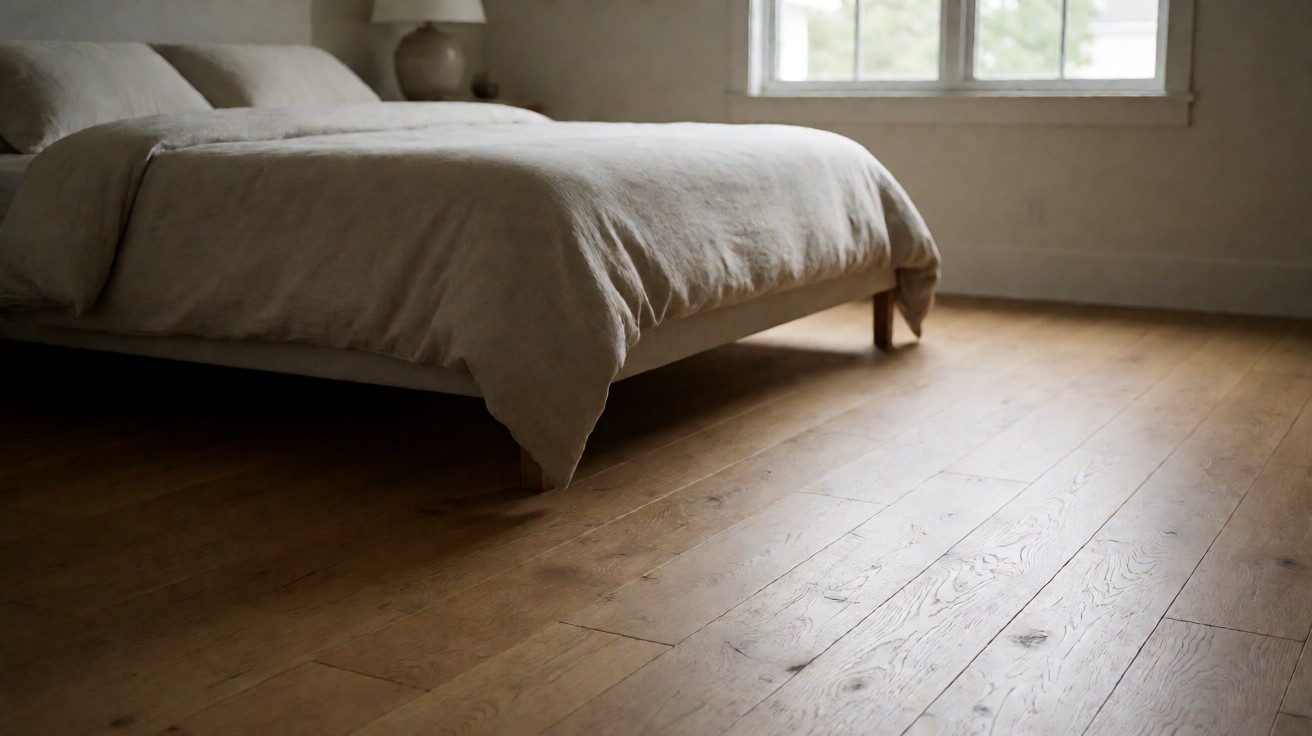

The best bedroom floor is warm under bare feet at six in the morning and quiet for whoever sleeps past it, and those two jobs decide almost everything.
A Bedroom Is the Quietest Room, Not the Toughest
A bedroom is the room where a hard floor is felt most and damaged least. Nobody drags a sofa across it every night, nobody runs a chair back and forth, and the wear on a bedroom floor is mostly a rug and a traffic path from the door to the dresser.
That makes this room different from every other on the site, because here warmth and quiet are worth more than durability. The floor you feel on a cold morning with bare feet is the floor you will notice every day of your life in that room, and the person asleep on the other side of the wall is affected by it too. This is the one room where a family often wants two different materials.
Why a Bedroom Floor Is a Feeling Decision
The word that decides a bedroom floor is not durable, it is warm. Stone, tile, and sealed concrete are the most durable and the coldest, and a cold bedroom floor at six in the morning is a real complaint people actually have. Warmth under bare feet is a material property you can feel in the first ten seconds of getting out of bed.
Quiet is the second property. A hard floor bounces the noise of a dropped book, a drawer, or a person getting up at night, and that noise carries through a joist system into the next room more easily than most people expect. That is why the second-most-common reason to choose a bedroom material is that somebody on the other side of the wall can hear you get up.
The Five Families and How a Bedroom Judges Them
Five families work in a bedroom and they divide by warmth and by quiet rather than by toughness, which is a different ranking from every other room on this site.
Hardwood and engineered wood are warm underfoot and quiet, and they are the right answer when the room is dry and the budget is there. Cork is the warmest and the quietest of everything sold as a floor. Carpet wins on quiet and loses on warmth in a way people do not expect. Rigid core is comfortable but only as warm as its finish. Tile is the wrong answer in a bedroom unless the only reason is the budget.
| The bedroom’s actual need | The family that answers it | Why it wins in this room |
|---|---|---|
| Cold feet at six in the morning | Hardwood, cork, or carpet | The floor is felt every day before anything else is |
| A light sleeper next door | Carpet, or cork on a good pad | Absorbs the noise a hard floor sends through |
| Over a slab or a damp risk | Engineered wood, or cork | A dimensionally stable core over a slab |
| A child’s room or a room that changes | Rigid core | Takes a mark and comes out when the room does |
| A budget room that must stay cold | Tile, reluctantly | The most durable and the least warm option |
Hardwood and Engineered, the Default Answer
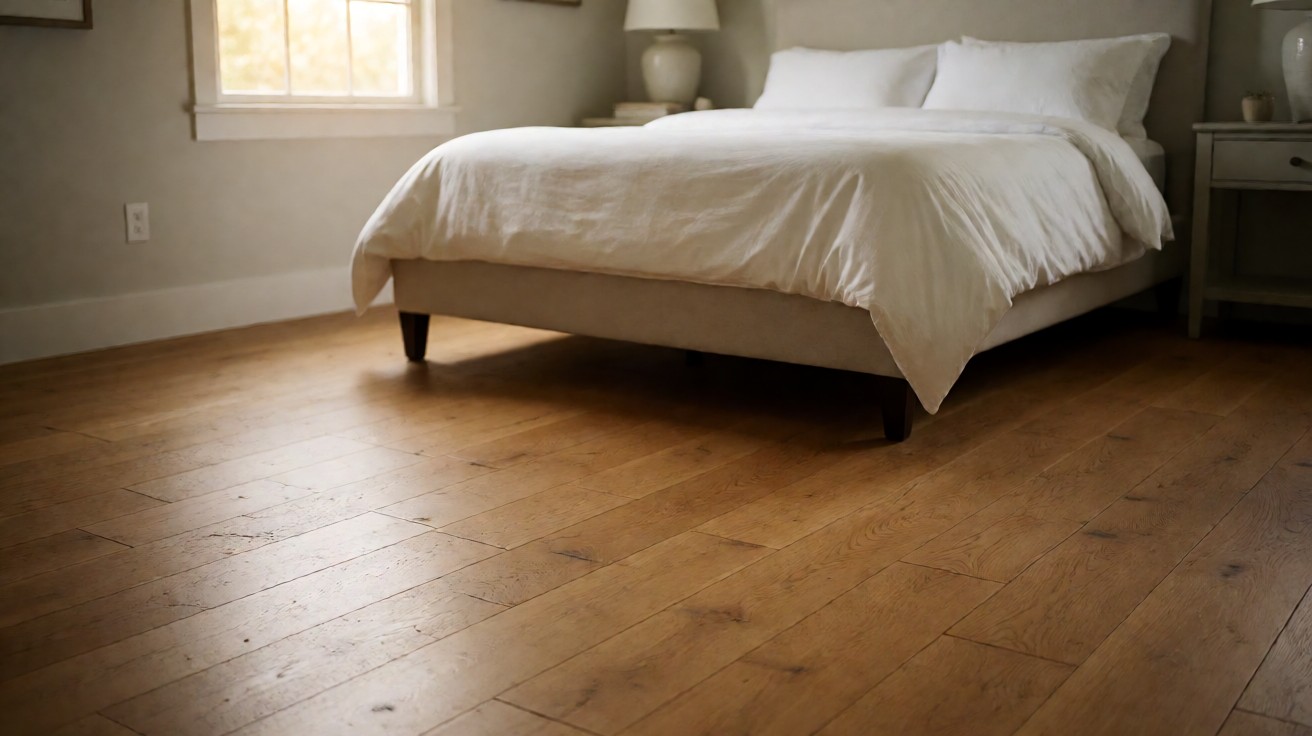
Hardwood is the family that most bedrooms end up with, and the reason is that it does two jobs at once: it is warm enough on bare feet and it is quiet enough for a shared wall.
Engineered hardwood is the version to pick over solid when the bedroom is over a slab, over a bathroom below, or in a house where the ground floor might get a damp patch. The layered construction is more dimensionally stable, and that matters more in this room than the sanding depth does, because nobody sands a bedroom twice. The hardwood flooring guide covers the two constructions and when each one earns its price.
Cork, the Warmest and the Quietest
Cork is the warmest floor sold and the quietest, and in a bedroom both of those are the whole argument. It has a soft surface underfoot, it does not ring when something is dropped, and it takes a scratch by compressing rather than by splitting.
It is also the one to choose when the bedroom is over a concrete slab or where a bare floor will be cold, because cork insulates where tile does not. The cost is the surface: cork dents under a furniture leg and it can be harder to keep looking new, which is why it is paired with a rug in most of the bedrooms that use it. The cork flooring page is where cork is covered in full.
Carpet, and the Quiet Answer
Carpet is the quietest material on this list and it is the correct pick for a bedroom when the person on the other side of the wall is a light sleeper. It absorbs almost everything, from footfalls to the scrape of a chair.
The trade is warmth, and it goes in an unexpected direction: carpet feels warm to someone walking on it in socks and cold to someone getting out of bed barefoot, because the pile collapses under a heel and the floor underneath never warms up. It is also the family most likely to need replacing in a bedroom, where the wear is a path from the door to the dresser. The carpet flooring guide covers the fibre and the pad, which is what decides how long it lasts.
Rigid Core, and the Honest Middle
Rigid core is the pick when the budget is the deciding factor and the bedroom is a child’s room or a room that will change use before the floor does. It takes a mark, it takes a spill, and it lays over almost anything including a slab.
It is comfortable and quiet enough for a bedroom, but it is only as warm as its surface finish, and a wood look vinyl plank is cooler to the touch than real wood. Where the room is above ground and dry, it is a reasonable answer; where it is over a cold slab, it is the wrong one. The rigid core vinyl page and the vinyl construction guide cover the construction details that decide which.
Tile, and When It Is the Honest Wrong Answer
Tile is the most durable and the least appropriate material in this list, It is also the one that most often gets chosen on price alone, and a cold tile bedroom in a house where somebody sleeps on the other side of that wall is two complaints about the same floor, not one. and the reason is not the durability, it is the temperature. A tiled bedroom is cold under bare feet at six in the morning and it sends every sound through the floor.
The two situations where it is right are a bedroom over a concrete slab where nothing else will stay down, and a bedroom in a hot climate where the floor itself is not the comfort problem. Otherwise it is a choice being made for the material rather than the room, and the tile flooring guide covers the tile families for the rooms where they do belong.
Padding, the Rug, and the Two Floors That Matter
There are really two surfaces in a bedroom and they are chosen separately: This is why a bedroom often ends up with a rug that covers most of the floor and a perimeter of exposed floor around it, and it means the rug choice can be made completely independently of the floor choice, which is a freedom the other rooms on this site do not give you. the floor, and the rug that covers most of it. The rug is the one most people touch first every morning, and it is what actually sits between bare feet and the floor for most of the day.
Under a floating floor, the pad is the third surface and it decides both the comfort and the sound. A good pad in a bedroom is the single cheapest way to make a hard floor feel softer underfoot and quieter to the room below, and it is also what stops a wood floor from sounding hollow. If the room is above somebody who sleeps, that pad is doing more than it costs.
Light, and the Finish That Flatters a Room You Sleep In
A bedroom is usually a low traffic, low light room compared to a kitchen, The exception is the room where two people get dressed in the morning, and that is a high traffic room in the morning and an empty room for the rest of the day, which is worth knowing before picking a finish that shows wear. and that changes the finish question. A finish that shows every scuff is the wrong choice here, and that is why the matte and wire brushed finishes that hide wear are the common bedroom picks in wood.
The colour question is different too. A bedroom reads best with a floor that is not the darkest thing in the room, because the floor occupies the largest uninterrupted surface and a very dark floor makes the whole space feel smaller. A mid tone hardwood or a warm cork does the work without that effect.
Cost, and Where a Bedroom Budget Goes
The families sit where they sit everywhere, but a bedroom is a small room and often the easiest place in a house to spend well without spending much, because there is little of it. A real hardwood bedroom floor can be a modest line item that carries the value of the whole room when you sell the house.
Rigid core and laminate are the value answers and cork sits between the value and the mid. Tile is the low material cost with the highest install cost, and in a bedroom that is usually money spent on the one material nobody wanted. The flooring types compared page has the full comparison if you want the numbers side by side.
| Family | Where it sits on cost | What that money buys you here |
|---|---|---|
| Cork | Middle of the five | The warmest and the quietest, and it dents under a leg |
| Hardwood, engineered or solid | Middle to higher | Warm, quiet, and the value at resale |
| Carpet | Middle of the five | The quietest, and the first to wear along the path |
| Rigid core, SPC | Lower of the five | Comfortable and tough, only as warm as its finish |
| Tile | Lower material, higher install | The most durable and the coldest, in the wrong room |
How to Choose, and Where to Look Next
Pick the family that is warm enough for the floor you get out of bed onto and quiet enough for the wall you share, then read the material guide for it. The flooring types compared page is the map that puts all of them in one table, and the hardwood flooring guide, the cork flooring page, and the carpet flooring guide are the three that back the top picks for a bedroom.
The decision is not the material that survives the most. It is the one that is still pleasant at six in the morning in year five, which in most bedrooms is either wood, cork, or a good carpet, and the difference between those three is a preference you cannot get from a specification sheet.