
The best basement floor is the one that survives below grade, and the family that does it is a porcelain tile over a tested slab, not the wood that will swell.
A basement is not an above grade room, and the floor has to take three things the rooms upstairs never take: water coming up through the slab, a lower ceiling that holds the damp, and a temperature that is the coldest in the house. Every material you are choosing is being asked to live in those three conditions, and most of them cannot.
This page ranks the families that tolerate a below grade room, walks through the slab work that has to come first, and points you to the guides for the two picks that survive the conditions.
A Basement Floor Is Not an Above-Grade Floor
The whole decision changes the moment the room is below grade, because the floor is no longer on a floor joist with air under it. It is on a slab, and the slab is in the ground, and the ground is where the water and the cold and the damp come from, and the material you choose has to live with all three for the years you have the room.
The mistake is to treat a basement like a bedroom and put down the same wood or the same standard laminate you would put in a dry room, and the mistake shows up in the first wet winter as a swollen edge and a cupped board. The pick has to start from the conditions, not from the look.
The Three Conditions That Decide Everything
There are three things the room does that decide the material, and none of them is the look. The first is moisture, the water that moves through the slab and the air that sits under the ceiling. The second is the height, the low ceiling that holds the damp and does not let it move. The third is the heat, the cold slab that the floor has to sit on and the temperature that a material over it has to take.
A material that fails any one of the three fails in the room, and the wood families and the standard laminate are the two that fail on the first and the third. The families that clear all three are the tile, the rigid core, and the concrete, and the rest of this page is about which of those is the right one for your slab.
What You Must Do to the Slab First
The material is not the first decision, the slab is, because every floor in the room sits on what you do to the concrete before you lay a single plank or tile. A slab that has water moving through it will fail any floor you put on it, wood or vinyl or tile, and the work has to happen before the pick is made.
The work is to test the slab for moisture, to install a vapor barrier or a moisture mitigating underlayment over it, and to fix the crack and the low spot that let the water in. A slab that has not been tested is the one that makes a good material still fail, and the polished concrete page is where the test and the prep for a slab are covered in detail.
The Materials That Tolerate a Below-Grade Room
Three families clear the three conditions, and they line up by how much they forgive the slab. Porcelain tile is the one that forgives the most, because it is dense, it is sealed, and it does not take up water from the slab. Rigid core is the one that forgives the least of the three but is the pick for the room that is not a wet room, because the stone core does not swell the way wood does. Polished concrete is the one that is the slab itself, and it is the pick when the room is a utility or a garage.
The table sets the three families against the three conditions, and it is the fastest way to see which one your slab can carry.
| The below grade room | The family that clears it | Why it survives the three conditions |
|---|---|---|
| The wettest below grade room | Porcelain tile | Dense, sealed, does not take up the slab’s water |
| A dry, not wet below grade room | Rigid core, loose lay | The stone core does not swell, lifts out easily |
| A utility or a garage space | Polished concrete | It is the slab, it takes the most, it lasts |
| The room that will be heated | Porcelain or rigid core | Both take the heat within their limits |
Porcelain Tile, the Most Forgiven Choice
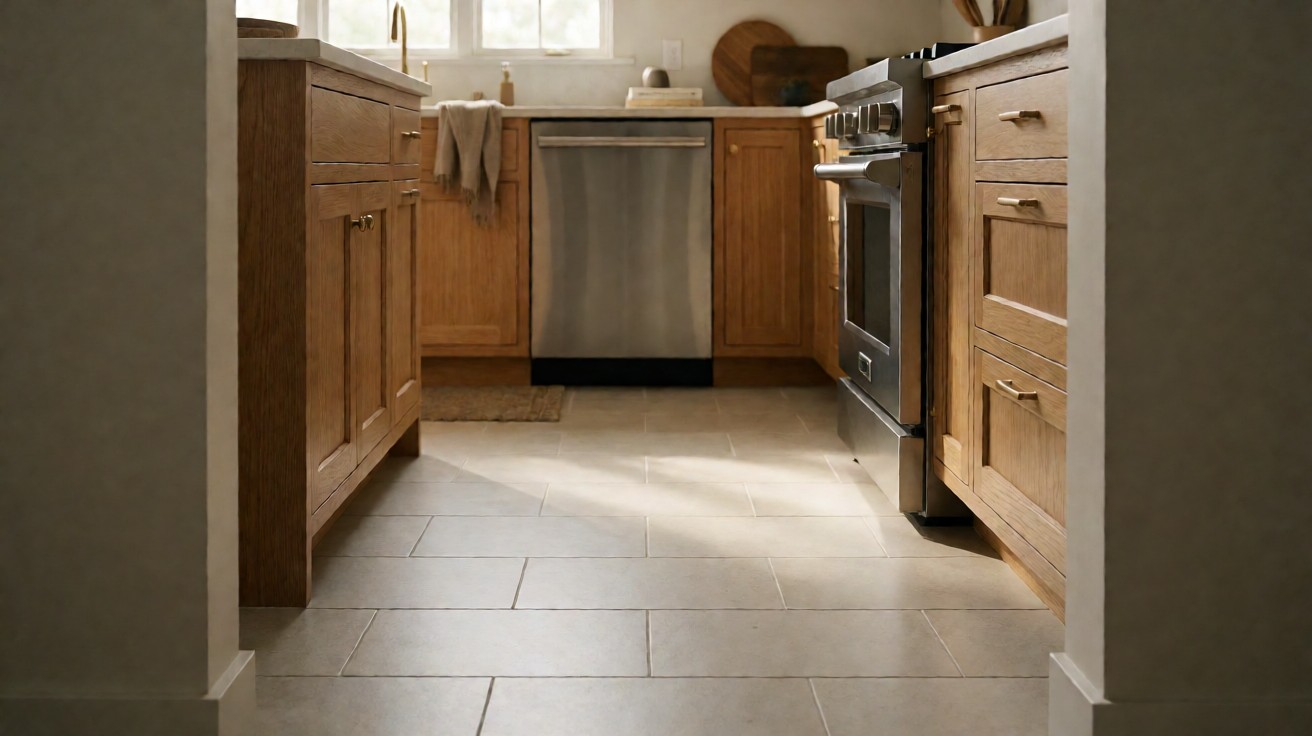
Porcelain is the pick that a below grade room forgives the most, because it is the densest of the three, it is sealed, and it does not take up the water that moves through the slab. It is the pick for the wettest room, and for the room that will be a bedroom or a bathroom that the water will find.
The size matters the way it does in a bathroom, because the fewest joints are the ones the water does not find, and a large format is the pick for the room that will be wet a lot. The tile flooring guide is where the size, the finish, and the grout plan are covered for a room that is not dry.
Rigid Core and Loose Lay Vinyl
Rigid core is the pick for the below grade room that is not going to be a wet room, because the stone core does not swell the way the wood does, and the loose lay version can be lifted out without a fight when the room changes its mind about what it is.
The version to use is the one with a real core, not the soft core that takes up water, and the install is the loose lay, not the glue, because the room will move a little over the years and the loose lay takes it. The rigid core vinyl page is where the two cores and the two install methods are walked through, and it is the guide to read before you spend the money on vinyl in a basement.
Why Solid Wood and Standard Laminate Lose Here
The two families that look right and fail fast are solid wood and the standard laminate, and they fail on the same two conditions. Wood takes up the water that moves through the slab and it swells, and it does not come back. Standard laminate is the same, because the core is a wood fibre board and it swells the same way, and the edge is the place the cupping starts.
The answer is not a different grade of the same family, it is a different family, and the hardwood flooring guide is where the two wood constructions and the rooms each one is right for are covered, and it is the page to read before you spend the money on wood in a room that is below grade.
Moisture Testing, and When to Stop
The test is not optional, and it is not the one a showroom will do for you. It is the one that tells you how much water is moving through your slab, and the number decides whether the room is one you floor at all this year, or one you leave and come back to.
The test that is worth doing is the one that measures the water in the slab over a week, not the one that wets the surface and waits, and the number that comes back is the one you floor against. If the slab is moving water, no floor you put on it will last, and the polished concrete page is where the test and the fix are covered.
Heating, Dehumidifying, and Vapour
The room that is not wet is the one that is heated and dehumidified, and the two upgrades together are the ones that change which floor you can put in, because a room that is dry and warm takes the wood that a room that is cold and damp does not.
The floor over heat has to move with the temperature and not crack with it, and the tile and the rigid core are the two that take it, and the flooring types compared page is where the heat limits for each family are laid out in one table, and it is the one to read if the room is going to be heated.
Underlayment and Glue Down in a Basement
The underlayment in a basement is not the same as the one upstairs, and it is the one that is a moisture barrier first and a comfort layer second, and the two jobs together are why the pick has to be the one rated for the below grade room.
The glue down is the one you use where the room is going to stay a bedroom and not move, and the loose lay is the one you use where it might, and the tile flooring guide is where the adhesive and the prep that a wet room needs are covered, and it is the page to read before the floor goes down.
| The below grade situation | The install that fits it | Why it survives there |
|---|---|---|
| A floor that must stay a bedroom | Glue down | The room is not moving, the seam is sealed |
| A floor that might change | Loose lay | Lifts out without a fight when the room does |
| The wettest part of the room | A moisture barrier underlayment | The job it does first is the one the slab needs |
Cost, and What a Failed Basement Floor Costs
The cost of a basement floor is not the floor, it is the slab work, and the slab work is where the money hides, and the material is the one that has to live with what the slab does for the years you have the room.
The number that matters is the floor, plus the barrier, plus the labour, on the time scale of the years the floor will last, and a floor that fails in the first wet winter costs more than the one that lasted, because you have to take it out and put another down, and the pick that lasts is the one that was chosen for the slab, not for the look.
How to Choose, and Where to Look Next
Pick the family that clears your three conditions, then read the two guides for the pick. The tile flooring guide and the polished concrete page are the two that back the default answer, and the rigid core vinyl page is the one for the room under budget, and the flooring types compared page is where you read the families against each other before you commit.
The decision is not the material that is prettiest. It is the one that survives below grade for the years you have the room, at a price you will not regret, and that is the whole basement floor, picked once.