
Moisture in a hardwood subfloor does not announce itself until the finished floor above it cups, gaps, or buckles months after installation is complete.
The answer is to test first: measure moisture content in both the hardwood subfloor and the flooring, confirm the gap stays within 4 percent for strip or 2 percent for plank, and hold installation until the numbers agree. That afternoon of testing is the cheapest insurance the floor will ever have.
What Moisture Testing for Wood Flooring Actually Answers
Moisture testing answers one question: will the wood stay the same size after it is installed? Wood swells when it gains water and shrinks when it loses it. A floor installed while the wood is wetter or drier than its long-term equilibrium will move, and movement shows up as cupping, crowning, gaps between boards, or buckling.
The test does not predict the future. It captures the moisture state of the subfloor and the flooring on the day of the test, under the conditions present that day. If the building is not yet conditioned, the test is meaningless, which is why the first step is always to bring the space to living conditions before any reading is taken.
Two separate materials get tested: the subfloor (usually plywood or OSB over joists, sometimes solid wood) and the flooring itself. Each has its own moisture content, and the relationship between them matters more than either number alone.
Wood Moisture Content vs Relative Humidity
Moisture content is the amount of water in the wood, expressed as a percentage of the oven-dry weight of the wood. Relative humidity is the amount of water in the air. A moisture meter for wood reports moisture content. A hygrometer reports relative humidity. Both are needed on a job site, but they answer different questions.
Wood is hygroscopic: it gains and loses water until it reaches equilibrium with the air around it. That equilibrium moisture content depends on temperature and relative humidity. In a conditioned home held at 30 to 50 percent relative humidity and 60 to 80 degrees Fahrenheit, wood settles at roughly 6 to 9 percent moisture content. In an unconditioned basement or crawl space it can sit well above that range.
Relative humidity in the room tells you where the wood is heading. Moisture content tells you where it is now. Test the air to judge whether the building is ready. Test the wood to judge whether the floor is ready.
How do you know the building is ready to test?
Hold the space at normal living conditions for at least 5 days before testing. That means heat or air conditioning running, windows closed, and no wet trades such as painting or drywall finishing active in the space. If the relative humidity swings more than a few points from day to day, the building is not stable and the readings will not repeat.
Pin Meters vs Pinless Meters
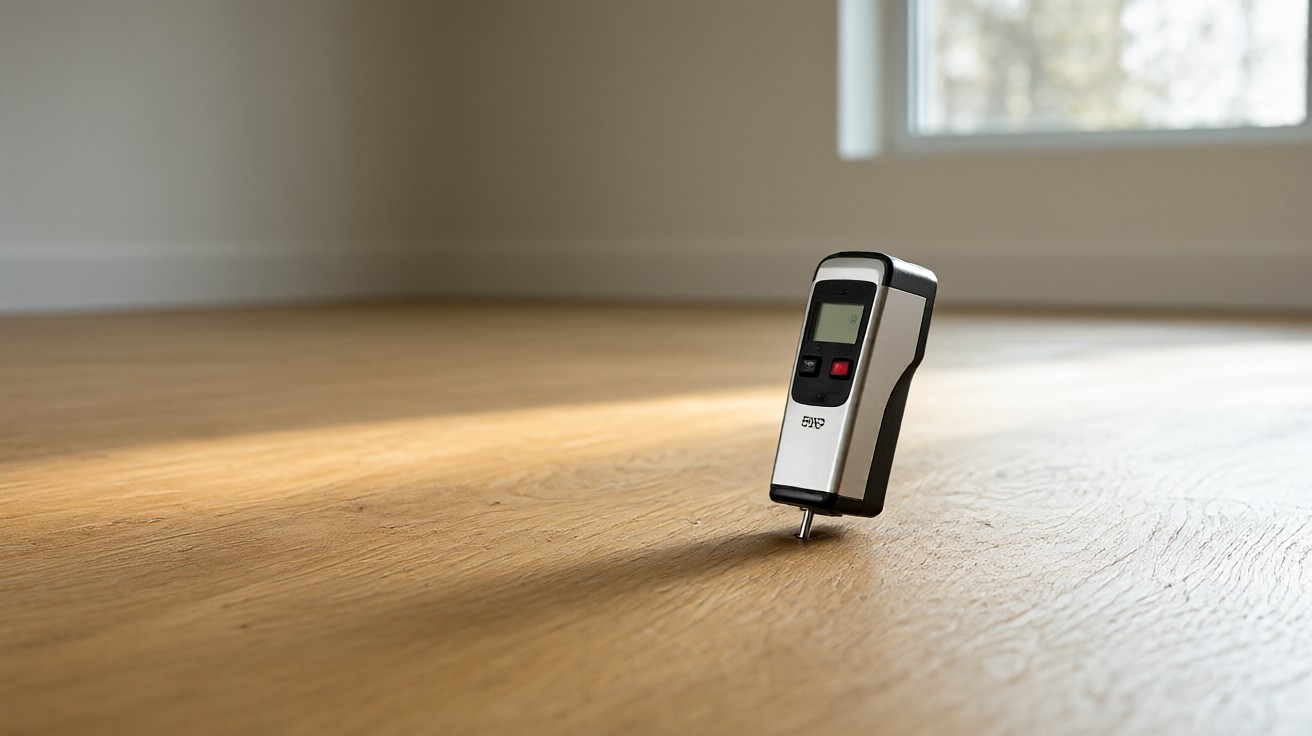
A pin meter drives two small electrodes into the wood and measures electrical resistance between them. A pinless meter presses a flat sensor against the surface and measures the dielectric constant of the wood beneath it. Both convert the electrical reading into moisture content, but they sample different volumes of wood.
| Feature | Pin meter | Pinless meter |
|---|---|---|
| How it reads | Electrical resistance between two pins | Dielectric constant through a surface sensor |
| Depth sampled | Between the pin tips, typically 1/4 to 3/4 inch | Surface to roughly 3/4 inch below the sensor |
| Damage to wood | Leaves two small pin holes | None |
| Speed on a large floor | Slow, one reading at a time | Fast, continuous scanning |
| Best use | Spot checks, depth profiles, verification | Screening large areas, finding wet spots |
| Species correction | Required for accurate numbers | Required for accurate numbers |
Most meters ship calibrated to Douglas fir. Test oak, maple, hickory, or pine and the meter applies a species correction factor to move the reading onto the correct scale. Skip the correction and the number is wrong even when the meter is working perfectly.
Pin meters are the verification tool. Drive the pins to different depths and you can profile moisture from the surface down, which matters on a thick subfloor. Pinless meters are the screening tool. Scan the whole floor first, mark the wet spots, then verify those spots with pins.
How deep does a pinless meter actually read?
Most pinless sensors read to about 3/4 inch below the surface. That is enough for plywood and OSB subfloors but not for a full 1-1/2 inch solid wood subfloor. On thick material, take pin readings at depth or split the material and test both faces.
How to Test a Wood Subfloor Step by Step
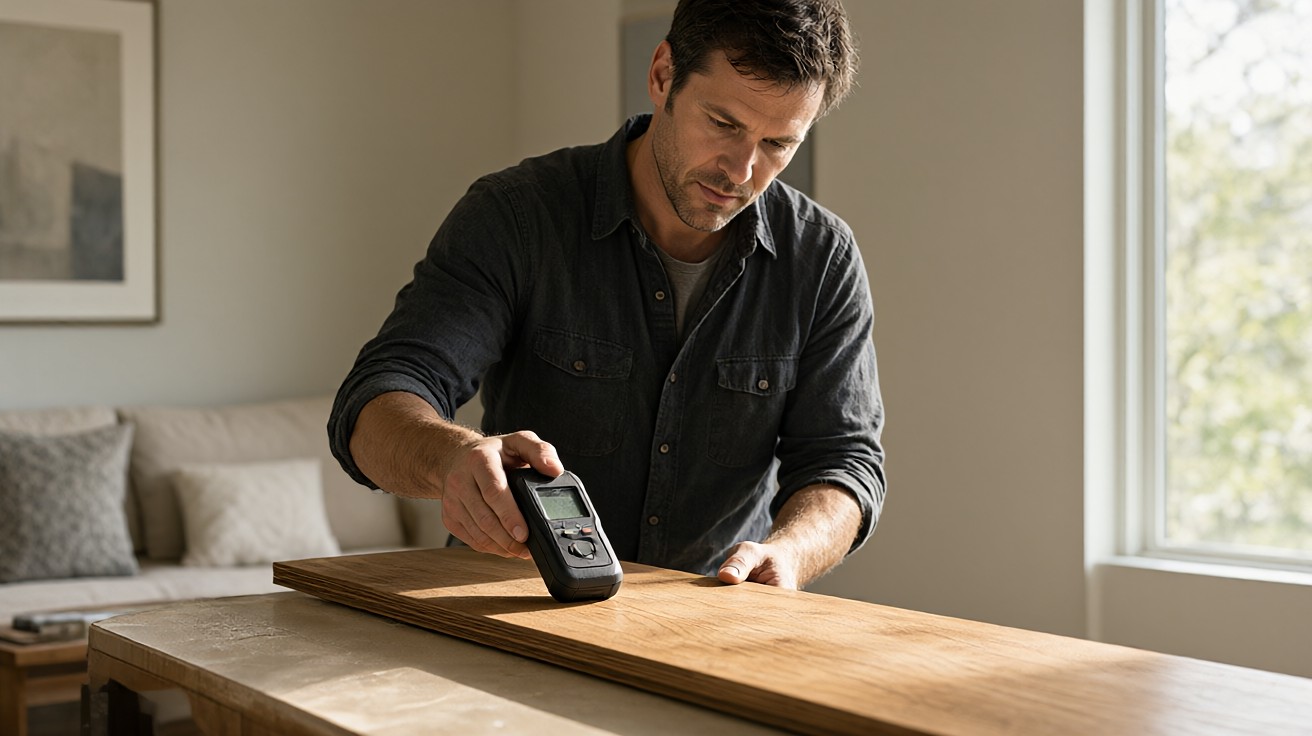
Bring the space to living conditions first, then work through the subfloor systematically. The NWFA recommends 20 readings per 1,000 square feet for wood subfloors, averaged and recorded. On a typical room that means a reading every few feet in a grid, plus extra readings near exterior walls, plumbing, and any spot that looks or feels damp.
- Condition the space for at least 5 days at 60 to 80 degrees Fahrenheit and 30 to 50 percent relative humidity.
- Check the subfloor visually and with a pinless scan to find wet or stained areas.
- Take pin readings at the marked spots and at regular grid points across the floor.
- Apply the species correction for the subfloor material.
- Average the readings and record them with the date, temperature, and relative humidity.
- Compare the average to the flooring moisture content and to the thresholds below.
Do not test directly over a joist or within 2 inches of a fastener, because metal skews the reading. Clean the surface first: dirt and adhesive residue both distort the contact a pinless sensor needs.
For subfloor preparation beyond moisture, see subfloor preparation for flooring, which covers flatness, fastening, and cleaning before the floor goes down.
Testing the Flooring Itself and Acclimation
Open three to five boxes from different parts of the delivery and test boards from each. Moisture varies within a shipment, especially if pallets sat in a damp warehouse. Test at least one board from the top, middle, and bottom of a stack.
Acclimation is the process of letting the flooring reach equilibrium with the job site before installation. The NWFA rule is to acclimate until the moisture content of the flooring is within 4 percent of the subfloor for strip flooring and within 2 percent for plank flooring, and until the flooring is within the manufacturer’s stated range. That often takes 3 to 5 days in a conditioned space, and longer in humid climates.
Acclimation only works if the building is conditioned. Stacking boxes in an unheated garage for a week does not acclimate the wood to the living room. Bring the flooring into the space where it will be installed, open the ends of the boxes, and let air circulate.
For concrete subfloors under wood, the moisture story is different and requires its own tests. See how to test concrete moisture before flooring and vapor barriers and flooring underlayment for that side of the job.
EMC and Indoor Conditions
Equilibrium moisture content is the moisture level wood reaches when it has fully adjusted to a given temperature and relative humidity. The table below shows approximate EMC values for wood at common indoor conditions. Use it to judge whether your readings are in the right neighborhood, not as a substitute for testing.
| Relative humidity | Temperature 60 F | Temperature 70 F | Temperature 80 F | Approx. EMC |
|---|---|---|---|---|
| 30% | 6.0% | 5.8% | 5.6% | 6% |
| 40% | 7.7% | 7.5% | 7.3% | 7.5% |
| 50% | 9.2% | 9.0% | 8.8% | 9% |
| 60% | 11.0% | 10.8% | 10.6% | 11% |
A home that holds 30 to 50 percent relative humidity year round keeps wood near 6 to 9 percent moisture content, which is the range most hardwood manufacturers target. Homes that swing from 20 percent in winter to 70 percent in summer will see the floor move with the seasons, no matter how well it was installed.
Acceptable Thresholds and the 4 Percent / 2 Percent Rule
The NWFA guideline sets the acceptable gap between subfloor and flooring moisture content. For solid strip flooring less than 3 inches wide, the subfloor may be up to 4 percentage points wetter than the flooring. For plank flooring 3 inches and wider, the limit is 2 percentage points. Parquet and end-grain have their own tighter limits, and engineered flooring follows the manufacturer’s specification.
These are maximum gaps, not targets. The closer the two numbers are, the less movement the floor will see. Many installers aim for a gap under 2 percent on any solid wood job.
Individual boards matter too. A subfloor average of 8 percent with one corner reading 14 percent is a problem even though the average passes. Always investigate outliers before covering them.
What reading forces you to stop?
Stop and do not install if the subfloor moisture content exceeds the manufacturer’s limit, if the gap between subfloor and flooring exceeds the 4 or 2 percent rule, or if any single reading is more than 4 points above the average. Fix the moisture source first, then retest.
Where Wood Floors Fail: Basements, Slabs, and Crawl Spaces
Moisture problems cluster where water enters from below. Basements and crawl spaces are the highest-risk locations for wood flooring, followed by slabs on grade without a vapor barrier. In these spaces the subfloor may read acceptable on a dry day and spike after rain.
Test in multiple weather conditions if the schedule allows. A reading taken during a dry week can hide a seasonal problem. Where a crawl space is involved, check that the vapor barrier is intact and the space is ventilated or conditioned before trusting any number.
If the subfloor is concrete rather than wood, the moisture test changes entirely. See moisture mitigation systems for concrete for what to do when a slab will not dry.
Recording and Interpreting Readings
A reading that is not written down did not happen. Record the date, time, temperature, relative humidity, subfloor material, flooring species, each individual reading, the average, and the meter model with its calibration status. Photograph the meter display at the wettest spot.
Interpretation is comparison, not judgment of a single number. Compare subfloor to flooring, compare today to last week, and compare to the manufacturer’s stated range. A number that is stable over three tests a week apart is trustworthy. A number that jumps 3 points in two days means the building is not conditioned.
Keep the log with the job file. If a floor fails later, the log is the evidence that the subfloor was tested and passed at install. Without it, the installer owns the failure.
Common Mistakes That Ruin the Test
Testing too early is the most common error. New construction concrete and fresh drywall release water for weeks. Test before the building is conditioned and the numbers lie.
Testing in one spot is the second most common error. One reading per room is not a test, it is a guess. Wet spots hide in corners and along exterior walls.
Skipping species correction is the third. A meter calibrated to Douglas fir reading oak without correction can be off by 2 to 3 percentage points, which is enough to pass a failing floor.
Using a meter with dead batteries or a damaged pin is the fourth. Check the meter on a calibration block or a known reference piece before starting, and replace pins that are bent or corroded.
Finally, do not confuse a moisture meter with a hygrometer. A relative humidity reading of 45 percent in the room does not mean the subfloor is at 45 percent moisture content. The two numbers are not comparable.
When to Stop and Mitigate
If the subfloor will not dry to an acceptable level, do not install solid wood. Options include waiting for the building to condition, running dehumidifiers, improving ventilation in the crawl space, installing a vapor barrier, or choosing a material that tolerates higher moisture such as engineered wood or tile. Each option adds cost and time, but none costs as much as replacing a buckled floor.
Mitigation is a separate decision from testing. Testing tells you the number. Mitigation decides what to do about it. For a full comparison of mitigation approaches on concrete, see the mitigation guide referenced in the basements section above.
When in doubt, test again. A second round of readings a week later costs an hour and can save a floor.
Quick Reference: Wood Flooring Moisture Testing
Condition the space for 5 days at 60 to 80 degrees Fahrenheit and 30 to 50 percent relative humidity. Take 20 pin readings per 1,000 square feet and average them. Apply species correction. Confirm the subfloor and flooring are within 4 percent for strip flooring or 2 percent for plank. Investigate any reading more than 4 points above the average. Do not install solid wood over a subfloor that exceeds the manufacturer’s moisture limit.
For choosing and using the meters themselves, see moisture meters for wood subfloors, which covers selection, calibration, and care.