
When a concrete slab tests above the manufacturers moisture limit, a mitigation system lets the floor go down on schedule instead of waiting for it to dry.
Choosing the right one is a matching exercise: match the system’s rated limit to the slab’s measured relative humidity or moisture vapor emission rate, match the chemistry to the flooring type, and match the schedule to the cure time. Get any one of those wrong and the floor fails inside the first heating season.
What a Moisture Mitigation System Actually Does
A moisture mitigation system is a coating or membrane applied to the surface of a concrete slab after the slab has been prepared. It is not a sealer in the decorative sense. Its job is to reduce the rate at which water vapor moves from the concrete into the flooring assembly above it, so the finished floor and its adhesive stay inside their published moisture limits.
The concrete itself is not dried. The system works on the surface. Water already in the slab continues to hydrate the cement, and water vapor continues to move, but the membrane slows the flux enough that the adhesive and flooring see an acceptable level. That distinction matters: a mitigation system manages moisture, it does not remove it.
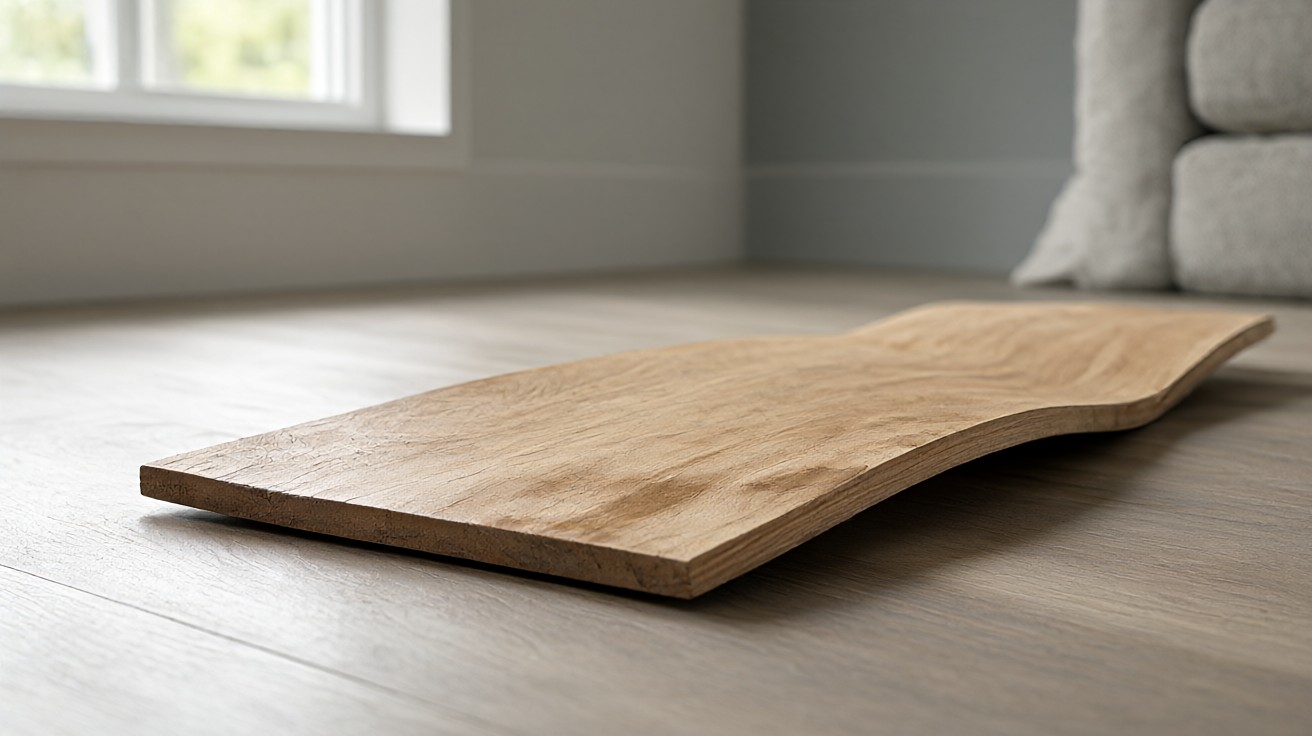
Two failure modes explain why this is necessary. First, adhesive breakdown: most flooring adhesives have an upper relative humidity limit, and sustained exposure above it dissolves the bond. Second, dimensional change: wood and engineered wood absorb vapor from below and expand, producing cupping, crowning, and gapping. A mitigation system addresses both by reducing the vapor flux at the interface.
When Mitigation Is Needed
Mitigation is needed when testing shows the slab exceeds the limit written in the flooring or adhesive manufacturer’s specification. The two standard tests are ASTM F2170 in-situ relative humidity and ASTM F1869 calcium chloride moisture vapor emission rate. A slab can look and feel dry and still fail either test.
Age is not a reliable indicator. A slab poured years ago can re-wet from a failed vapor barrier, a changed drainage pattern, or a new irrigation system. That is why every slab gets tested before installation, regardless of age, and why re-testing after mitigation is part of the specification.
RH and MVER Thresholds
Most standard flooring adhesives are rated for slabs at or below roughly 75 to 80 percent relative humidity. Above that, mitigation or a high-RH-tolerant adhesive is required. The exact number is set by the product data sheet, not by a rule of thumb, so the data sheet is the governing document.
Moisture vapor emission rate limits are expressed in pounds per 1000 square feet per 24 hours. A typical adhesive limit is 3 pounds. Slabs testing above that need mitigation before a standard adhesive can be used.
| In-Slab RH (ASTM F2170) | Recommended Approach | Typical Timeline |
|---|---|---|
| Below 75% | No mitigation for most standard adhesives | Proceed immediately |
| 75 to 80% | Verify against adhesive limit; natural drying may resolve | Re-test in 3 to 4 weeks |
| 80 to 90% | Standard two-coat epoxy or high-RH adhesive | 3 to 7 days after prep and application |
| 90 to 98% | Premium high-RH epoxy rated at least 95% RH | 5 to 10 days after prep and application |
| Above 98% | Premium system rated for unlimited RH; consult manufacturer | 7 to 14 days after prep and application |
| Hydrostatic water present | Drainage plus negative-side waterproofing; epoxy alone is insufficient | Engage a waterproofing specialist |
”>
Types of Moisture Mitigation Systems
The market groups into five chemistries. Each has a different mechanism, a different rated limit, and a different cost. The right choice depends on the measured moisture, the flooring type, and the schedule.
Two-Component Epoxy
Two-component, 100 percent solids epoxy is the most common category for commercial and residential work. It is applied in two coats at roughly 200 to 300 square feet per gallon per coat, and it forms a continuous film that blocks vapor. Standard formulations are rated for slabs up to about 80 to 90 percent relative humidity. Premium high-RH formulations are rated to 95 percent and above, and some are rated for unlimited relative humidity when applied to the manufacturer’s specification.
Epoxy is the default for most flooring types because it is compatible with a wide range of adhesives and creates a hard, durable surface. Its weakness is application sensitivity: it needs a clean, profiled surface and a dry ambient environment during cure.
Polyurethane
Polyurethane mitigation systems are single or two-component coatings that cure to a flexible membrane. They are often specified where the slab is expected to move, where crack bridging is needed, or where a faster cure is required. Ratings overlap the epoxy range, and many polyurethane products are rated for high relative humidity.
Polyurethane tends to be more tolerant of surface moisture during application than epoxy, which makes it useful on slabs that cannot be fully dried. It is also more flexible, which helps over slabs with minor cracking.
Crystalline and Cementitious Systems
Crystalline systems are cementitious coatings that react with moisture and unhydrated cement in the concrete to form insoluble crystals in the pore structure. They are applied as a slurry or powder and become part of the concrete rather than a surface film. Cementitious systems are similar but rely on a dense cement matrix to reduce vapor flux.
These systems are slower to install and cure, and they are generally used on below-grade or heavily saturated slabs where a film coating would be at risk. Their advantage is that they do not rely on surface adhesion in the same way a coating does, so they tolerate damp substrates better.
Silicate Densifiers
Silicate densifiers are not true mitigation systems. They penetrate the concrete and react with calcium hydroxide to form calcium silicate hydrate, densifying the surface. They reduce dusting and improve abrasion resistance, and they modestly reduce vapor emission, but they do not create a barrier and they are not rated for high relative humidity.
A densifier is appropriate as a pretreatment or as a standalone solution only on slabs that already test within the adhesive limit. Using a densifier in place of a rated mitigation system on a wet slab is a common and expensive mistake.
Barrier Versus Reactive Chemistry
The five chemistries split into two functional groups. Barrier systems, which include epoxy and polyurethane, form a film on the surface that blocks vapor. Reactive systems, which include crystalline and cementitious coatings, change the concrete itself by filling pores.
Barrier systems give predictable, tested performance ratings because the film thickness and continuity are measurable. They are the basis for most manufacturer warranties. Reactive systems are harder to verify in the field because the depth of penetration is not visible, and their performance depends on the concrete’s chemistry and moisture content at the time of application.
For most flooring projects on slabs testing between 80 and 95 percent relative humidity, a barrier system is the specified solution. Reactive systems are reserved for slabs that are too wet for a film, for below-grade conditions, or for cases where the substrate is too damp to accept a coating.
Surface Preparation Requirements
Surface preparation is the single biggest determinant of whether a mitigation system performs. The slab must be clean, sound, and profiled to the manufacturer’s requirement, which is usually an ICRI concrete surface profile of 3. That means light shot blasting or grinding to remove laitance, curing compounds, old adhesive, paint, and sealers.
Preparation also includes crack repair and patching. Cracks wider than about one sixteenth of an inch should be routed and filled with a compatible epoxy or polyurethane filler before the mitigation coat. Holes and spalls are patched with a cementitious repair mortar and allowed to cure.
The slab must be tested for moisture before preparation begins, because the test locations need to be in the original concrete, not in a patch. Testing after preparation but before coating is also recommended as a confirmation.
Application Process and Cure Time
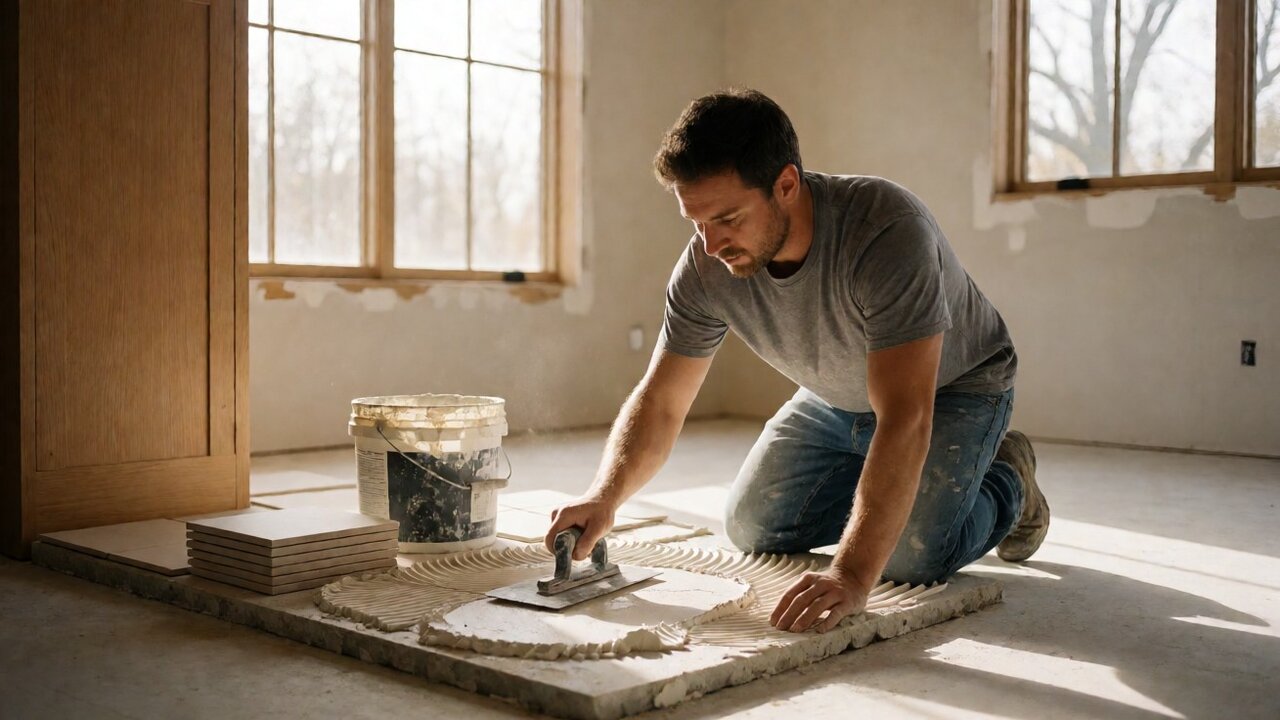
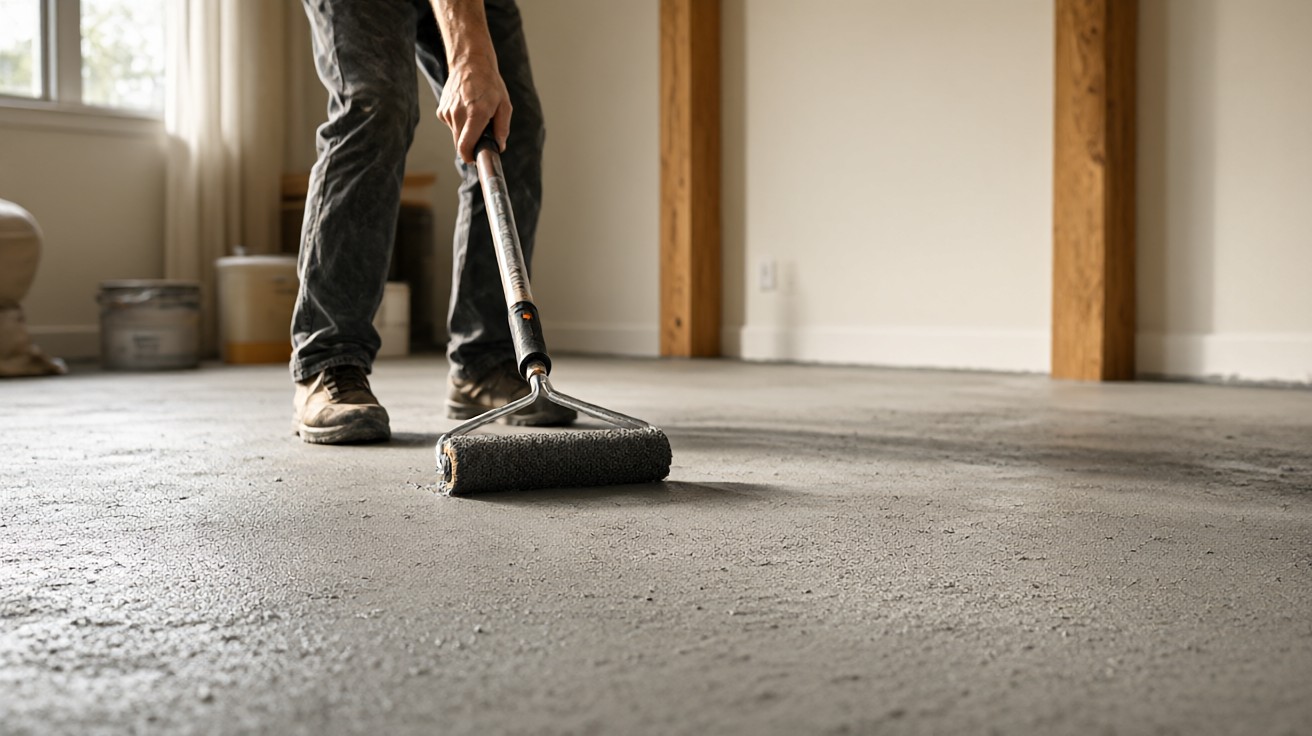
Application follows the manufacturer’s data sheet precisely. A typical two-coat epoxy system is mixed in the specified ratio, applied with a squeegee or roller at the published coverage rate, and allowed to cure before the second coat. The first coat is usually applied in one direction and the second coat perpendicular to it, to ensure full coverage.
Ambient and slab temperatures must be within the published range, usually above 50 degrees Fahrenheit and below 90 degrees. High humidity during application can cause amine blush on epoxy, a waxy film that interferes with adhesion of the second coat and the flooring adhesive. If blush appears it must be removed by washing and sanding before proceeding.
Cure time before flooring installation is typically 12 to 24 hours per coat, plus a final 12 to 24 hours before adhesive application. A two-coat system therefore occupies the slab for roughly 3 to 7 days from preparation to flooring. Premium high-RH systems can take 5 to 14 days. That schedule must be written into the project plan before the flooring is ordered.
Performance Ratings and How to Read Them
Every rated mitigation system publishes a maximum relative humidity and, in many cases, a maximum moisture vapor emission rate. These numbers are the basis for specification and for warranty. A system rated to 90 percent relative humidity is not acceptable on a slab testing 92 percent, even by a small margin.
Ratings come from standardized test methods. ASTM F3010 is the standard specification for two-component resinous moisture mitigation coatings, and it defines the test protocol and performance requirements. ASTM F3099 covers moisture mitigation systems for use under resilient floor coverings. ASTM F710 is the practice for preparing concrete floors to receive resilient flooring, and it is the reference for surface preparation expectations.
When comparing products, compare the rating, the coverage rate, and the cure time together. A product rated to 99 percent relative humidity with a 12 hour cure may be the right choice on a wet slab with a tight schedule, while a product rated to 85 percent with a lower cost is the right choice on a slab testing 82 percent.
Cost Ranges
Mitigation is priced per square foot of slab area, and the price includes material and labor. Industry cost data places moisture mitigation treatments in the range of 2 to 6 dollars per square foot, with epoxy coatings toward the higher end and silicate sealers toward the lower end. Basement waterproofing with epoxy runs 5 to 7 dollars per square foot, and silicate sealers run 4 to 6 dollars per square foot.
| Sealant or Treatment Type | Average Cost per Sq Ft (2026) |
|---|---|
| Moisture mitigation treatment | $2 to $6 |
| Epoxy coating (basement waterproofing) | $5 to $7 |
| Silicate concrete sealer | $4 to $6 |
| Acrylic waterproofing paint | $1 to $8 |
| Surface preparation (removal of old coatings) | $1 to $3 |
”>
For a typical residential basement of 800 square feet, that puts mitigation between roughly 1,600 and 4,800 dollars before flooring. The cost is small relative to the cost of removing and replacing a failed floor, which is why testing and mitigation are treated as insurance rather than expense.
Costs vary by region, slab condition, and the amount of preparation required. Slabs with old adhesive, paint, or an uneven surface cost more to prepare. Multiple small rooms cost more per square foot than one open area because of setup and edge work.
Compatibility With Flooring Types
Not every mitigation system is compatible with every flooring type. The system must be approved by both the mitigation manufacturer and the flooring manufacturer for the specific combination. Compatibility is documented in technical data sheets, and it is the installer’s responsibility to confirm it in writing before ordering materials.
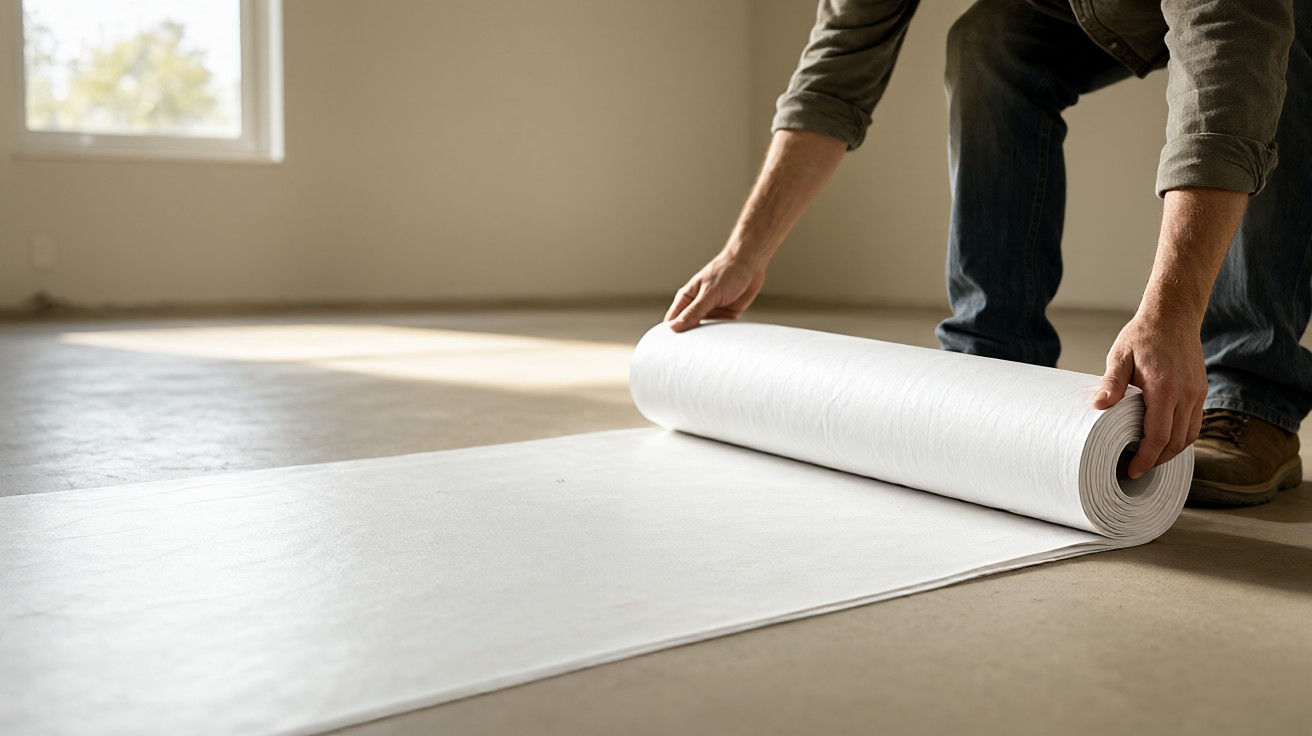
Resilient flooring, including luxury vinyl plank and sheet vinyl, is the most common pairing and the one with the most published compatibility data. Wood and engineered wood require confirmation because some epoxy films are too hard and can interfere with adhesive bond. Carpet and tile each have their own requirements, and tile installations over mitigation often require a specific primer or a decoupling membrane.
Adhesive compatibility is equally important. The mitigation system and the flooring adhesive must be from manufacturers who publish a joint approval, or the adhesive manufacturer must approve the specific mitigation product. Using an unapproved adhesive over a mitigation system voids both warranties.
Common Mistakes
The most common mistake is specifying a system rated below the measured moisture. A slab testing 92 percent relative humidity treated with an 85 percent system will fail, and the failure will not be covered by warranty. The second most common mistake is skipping surface preparation or preparing to the wrong profile, which causes delamination of the mitigation film.
Other frequent errors include applying over a damp or contaminated surface, mixing the two components in the wrong ratio, applying outside the temperature range, and installing flooring before the full cure time has elapsed. Each of these is documented in manufacturer data sheets, and each voids the warranty.
A final error is treating mitigation as a substitute for fixing the water source. A slab with active hydrostatic pressure, a failed foundation drain, or a plumbing leak cannot be fixed with a surface coating. In those cases the water source must be addressed first, and the mitigation system is applied afterward as a backup.
Documentation and Warranty
Documentation is what converts a mitigation job into a warranted job. The record should include the original moisture test results with dates and locations, the preparation method and profile achieved, the product name and batch number, the application date and conditions, the coverage rate, and the final re-test results after cure.
Most manufacturers require a signed installation record and photographs to honor a warranty. The warranty period varies by product and by the relative humidity rating, and it typically requires that the system be installed by a trained applicator following the data sheet. Keeping the documentation protects the homeowner, the installer, and the flooring manufacturer.
For a deeper look at testing before mitigation, see how to test concrete moisture before flooring and relative humidity testing for concrete slabs. For slab fundamentals, see concrete slab subfloors and vapor barriers and flooring underlayment.
Can a mitigation system be applied over an existing floor?
No. Mitigation systems are applied to bare concrete after the existing flooring and adhesive have been removed and the surface has been profiled. Applying over an existing floor leaves the old adhesive and flooring in place, which breaks the bond and traps moisture.
How long does a mitigation system last?
A properly applied system lasts the life of the flooring installation. The membrane does not degrade under normal conditions, and it is not consumed by the moisture it manages. Failure is caused by application errors, not by age.
Does mitigation replace the need for a vapor barrier under the slab?
No. A vapor barrier beneath the slab, installed at the time of construction, is the first line of defense. Mitigation is a surface treatment applied when the slab, with or without a vapor barrier, tests above the flooring limit. The two work together, not as substitutes.