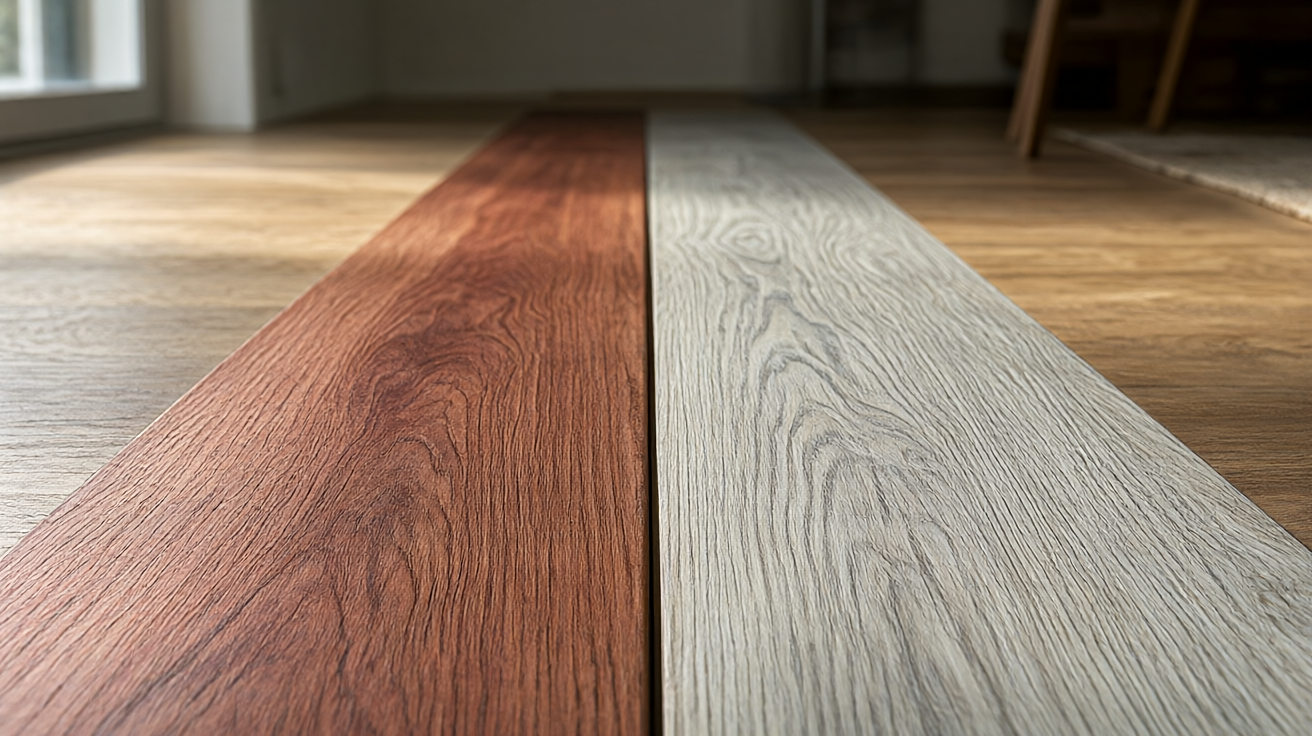

Red oak and white oak are the two species most American floors are made from, and in a stack of samples they look nearly identical until you know what to check.
The answer is white oak when the finish is gray, natural, or whitewashed, when the room sees water, or when the planks run wider than 5 inches. Red oak wins on price, warm color, and matching a floor that is already down. The two sit about 70 pounds apart on the Janka scale, so finish direction and room use decide more than hardness does.
Decision at a Glance
The choice comes down to three things: the color you want, the moisture the room sees, and the width of the board. Hardness runs a distant fourth, because both species clear the same residential bar by a wide margin.
| Criterion | Red oak | White oak |
|---|---|---|
| Janka hardness | 1,290 pounds | 1,360 pounds |
| Pore structure | Open, few tyloses | Closed by tyloses |
| Grain | Bold cathedral, wavy | Tight and straight |
| Raw undertone | Pink to salmon | Tan to gray-olive |
| Dark stain | Rich, high contrast | Even, slightly flatter |
| Water resistance | Moderate | Better |
| Material price | $5 to $11 per sq ft | $5 to $12 per sq ft |
Read the table in the order your project actually forces. Finish color narrows the field first, the room rules out one species in wet zones, and board width decides the rest. If you are still comparing oak against other domestic woods, the oak, maple, and hickory comparison puts the hardness and grain numbers side by side.
A red oak floor can look expensive or cheap depending on the cut and the finish. The same is true of white oak, because species sets the ceiling, not the result.
Grain and Figure
Red oak is ring-porous, with wide earlywood vessels that stay open in the heartwood. Those open pores drink finish and stain at different rates across the board, which is why red oak reads busier even before color enters the picture.
White oak is also ring-porous, but its heartwood vessels are plugged by tyloses, the cell growths that seal the pore. The face looks calmer and the board resists liquid in a way red oak cannot match. That single anatomical difference drives the water behavior, the stain behavior, and much of the price gap.
Plain-sawn red oak produces the cathedral arches most people picture when they hear oak floor: wide, repeating peaks that march across a 3-inch to 5-inch plank. Plain-sawn white oak shows the same arch, only tighter and flatter, with less contrast between earlywood and latewood.
Quarter-sawn white oak is the cut that changes a room. The saw runs through the medullary rays at a right angle, and the rays surface as ray fleck, pale ribbons that flash across the board when light hits them.
Quarter-sawn red oak has rays too, but they are shorter and far less pronounced. If ray fleck is the look you want, white oak is the only reliable route, and it carries a milling premium because the log yields less flooring.
Ray fleck is the tell, and no stain can fake it.
You can confirm species on site with an 8X to 15X hand lens and a clean end-grain cut. Tyloses look like crumpled cellophane packed into the large pores. A board with open, empty pores is red oak or sapwood, and sapwood appears in both species. The fuller treatment of cut, grade, and natural variation sits in the grades and grain pattern guide.
A hand lens settles in two minutes what a showroom sample cannot. Buy the lens before you buy the floor if the species is in doubt.
Stain Behavior
Red oak takes a dark stain deep and contrasty. The open pores pull pigment into the grain, the latewood stays darker, and the result has movement. Walnut, espresso, and Jacobean tones look rich on red oak in a way they rarely do on a closed-grain wood.
White oak takes stain more evenly and predictably. The sealed pores absorb at a uniform rate, so a custom gray or taupe lands as one color across the field instead of blotching. That consistency is why white oak dominates modern and transitional work.
The trade-off appears in light colors. Red oak’s pink undertone pushes through a gray stain and reads muddy or faintly mauve, no matter how carefully the floor is prepped. White oak’s neutral base lets cool pigment sit cleanly on top.
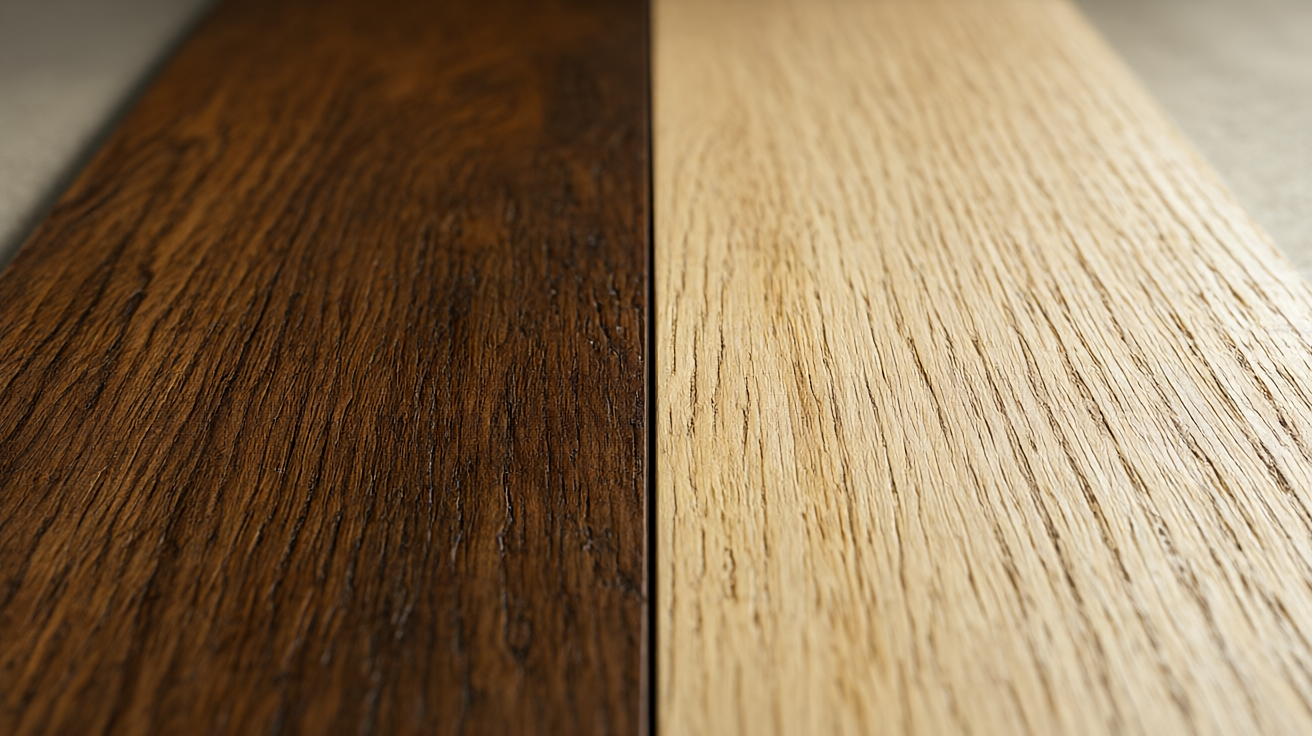
White oak can also be fumed instead of stained. The wood goes into a sealed chamber with 26 percent to 30 percent ammonium hydroxide, and the ammonia reacts with the tannins to darken the board through its thickness.
Fuming leaves the grain visible and cannot blotch, but it is hard to control across batches, and red oak turns greenish rather than brown under the same treatment.
Fuming is a factory process, not a site finish. A contractor with a spray gun and a can of stain cannot reproduce it in your living room.
Can You Stain Red Oak to Look Like White Oak?
Not convincingly. A conditioner, a water-based dye, and a gray toner can pull red oak toward neutral, but the pink base keeps surfacing in raking light. The grain pattern also differs, so even a close color match reads as red oak at the quarter-sawn detail level.
If the goal is a light neutral floor and the wood is not down yet, buy white oak. If the red oak is already installed, work with a warm neutral or a medium brown and let the species be what it is. Test the exact stain on a 2-foot by 2-foot sample of the actual floor before committing to a whole room.
Undertone
Raw red oak runs warm: pink, salmon, and light reddish brown. Raw white oak runs cooler and slightly darker, a tan or light brown with gray and olive in the shadow. Put the two unfinished boards side by side and the difference is obvious within a second.
Finish changes the reading. An oil-based polyurethane adds amber and pushes both species toward orange over 5 to 10 years. A water-based finish stays clear and keeps white oak closer to its sanded color, which is why light and Scandinavian looks specify water-based systems.
White oak is not always the lighter board. In unfinished form it is often a shade darker than red oak, and the same stain can look darker on white oak because the starting color is deeper.
Stain charts are usually printed on red oak, so a white oak sample can surprise a buyer who chose from a chip. Lighting decides the rest. North-facing rooms flatten the pink in red oak and make white oak look gray, while warm afternoon light amplifies red oak’s warmth.
Judge the sample in the room, at the hour you use it most. A board that looks perfect at noon can turn peach under a 2700K bulb at night.
Hardness: 1,290 vs 1,360 in Practice
The Janka test drives an 11.28 mm steel ball halfway into the face and records the force required. Under ASTM D1037, red oak measures 1,290 pounds and white oak measures 1,360 pounds. The gap is 70 pounds, or about 5.4 percent.
Five percent is real in a lab and almost invisible in a hallway. Both species sit well above the 1,000-pound line that separates a floor-grade hardwood from a soft one, and both will dent under a dropped cast-iron pan or a piano leg without a pad. A factory finish with aluminum oxide and a proper subfloor matter more than the species delta.
Where white oak’s extra density helps is in high-traffic commercial space and in very wide planks, where a softer face shows every impact. In a normal house, the difference shows up as slightly fewer shallow dents after a decade, not as a different floor.
Which Oak Hides Scratches Better?
Red oak hides them better. The busy cathedral grain breaks up the line of a scratch, so fine surface marks disappear into the pattern. White oak’s tighter, straighter face gives a scratch nowhere to hide, though its harder surface takes slightly less damage in the first place.
Households with large dogs and gravel at the door usually prefer the busier red oak for exactly this reason. Households that want a calm, uniform field accept the visibility and rely on a matte finish to soften it.
Moisture and Water Resistance
White oak’s tyloses slow liquid penetration, which is why the species has wrapped whiskey barrels and boat hulls for centuries. Red oak’s open vessels let water move in faster, so a spill that sits on the surface reaches the wood sooner.
Neither species is waterproof, and neither tolerates standing water. The finish is the first barrier, the seams are the second, and once water reaches bare wood through a worn spot, both oaks stain and cup the same way.
Moisture content matters as much as species. NWFA/NOFMA flooring is milled at 6 percent to 9 percent moisture content, with a 5 percent allowance for pieces up to 12 percent, and the oven-dry test in ASTM D4442 is the reference method for checking it.
A floor installed at 12 percent in a house that settles at 7 percent will gap at every seam, whatever the species.
Does White Oak Really Resist Water Better?
Yes, but only by slowing absorption. A puddle left overnight can still leave a dark ring and a raised edge on white oak. The advantage is measured in minutes of forgiveness, not in immunity, and a kitchen spill wiped promptly will not hurt either species.
Keep indoor relative humidity between 30 percent and 50 percent at about 70 degrees Fahrenheit, and the floor stays near its manufactured moisture content through the heating season. Below 30 percent, both species shrink and gap. Above 50 percent, both swell and can cup at the edges.
Price Difference
Material for red oak generally runs $5 to $11 per square foot, while white oak runs $5 to $12, with the top of the white oak range driven by wide planks and clean grades. Installed, the gap widens to roughly $9 to $20 for red oak and $10 to $24 for white oak.
| Line item | Red oak | White oak |
|---|---|---|
| Material, solid | $5 to $11 per sq ft | $5 to $12 per sq ft |
| Material, rift and quarter-sawn | About $5 less per sq ft | Full premium |
| Installation labor | $3 to $8 per sq ft | $3 to $8 per sq ft |
| Installed total | $9 to $20 per sq ft | $10 to $24 per sq ft |
The premium is not uniform across cuts. In select rift and quarter-sawn stock, red oak can run about $5 per square foot less than white oak, because the sawmill gets far fewer quarter-sawn feet from a white oak log and the barrel trade bids up the best logs.
In character grade, the spread narrows to roughly 30 percent. That is the grade most remodelers buy, and it is why two quotes for the same room can differ by a few hundred dollars rather than a few thousand.
Here is the arithmetic on a 500 square foot room. Red oak installed at $10 per square foot costs $5,000. White oak at $15 per square foot costs $7,500.
The difference is $2,500, or 50 percent more for the white oak floor, which is roughly the price of refinishing two average rooms. The hardwood flooring cost breakdown separates material, labor, and prep if you need a full budget.
Is White Oak Worth the Price Premium?
It is worth it when the design calls for gray, whitewash, or wide planks, because red oak cannot deliver those looks cleanly at any price. It is not worth it when the goal is a warm traditional floor or a match to existing red oak, where the premium buys nothing the eye can see.
Grade matters as much as species. A clean No. 1 Common white oak can deliver a better cost per year than a Select red oak in the same room, because the visible defects in the lower grade are the ones a rug and furniture hide.
Matching an Existing Oak Floor
Most American strip floors installed between 1950 and 2000 are red oak, often 2 1/4 inches wide. If the existing floor has the pink cast and busy grain, red oak is almost certainly the match, and adding white oak beside it will read as a patch even under a dark stain.
Check the end grain before you order. A flooring contractor can pull a vent register or cut a hidden edge and look for tyloses in two minutes. The same check tells you whether the existing floor is solid or engineered, which changes how a new section should be fastened.
Plank width and sheen cause more mismatches than species. A new 5-inch white oak plank next to a 2 1/4-inch red oak strip will look wrong before anyone notices the color. Match width, grade, and sheen first, then tune the stain on site.
If the addition spans a slab or a crawlspace, the construction choice matters as much as the species. The solid versus engineered hardwood comparison covers where each one belongs, and the IRC sets L/360 as the floor deflection limit that any new framing has to meet.
Which Room Fits Which Oak
Room use decides more than style. Wet zones favor white oak, dry rooms accept either, and a basement favors neither without a moisture barrier and a tested slab.
The room, not the sample board, picks the species.
| Room | Better pick | Reason |
|---|---|---|
| Kitchen | White oak | Spills and damp mopping |
| Entry and mudroom | White oak | Wet shoes and slush |
| Living room | Either | Dry, even traffic |
| Bedroom | Either | Low moisture and wear |
| Dining room | Red oak | Warm color under traditional decor |
| Sunroom | White oak | Humidity swings |
| Basement | Neither | Slab moisture risk |
A bathroom is a poor home for either species, no matter what the sample board suggests. A toilet overflow or a tub splash reaches the seams faster than any finish can shed it, and the repair means replacing boards rather than touching up a coat.
If the room is a kitchen with a dishwasher and an ice maker, white oak buys real forgiveness. If it is a formal dining room that sees dry traffic and warm light, red oak’s color is the better fit and the savings are real.
Which One Should You Pick
Choose white oak if the finish is gray, natural, whitewash, or matte, if the room sees water, or if the planks are wider than 5 inches. Choose red oak if the finish is warm brown or honey, if the house already has red oak, or if the budget is the binding constraint.
If both species still fit the design, walk the samples into the room and look at them at 7 a.m. and 7 p.m. The undertone shows up in low sun in a way it never does under showroom light.
If you’re installing over a slab, test the slab for moisture before either species arrives. No finish survives a wet slab, and the species argument becomes irrelevant once the floor cups.
Whatever you pick, buy the actual flooring before you approve the stain, keep the indoor humidity between 30 percent and 50 percent, and test the finish on a scrap from the same lot. Species sets the direction, but those three steps decide whether the floor looks right in five years.
For the wider selection logic, from subfloor to trim, the hardwood flooring guide is the place to start.